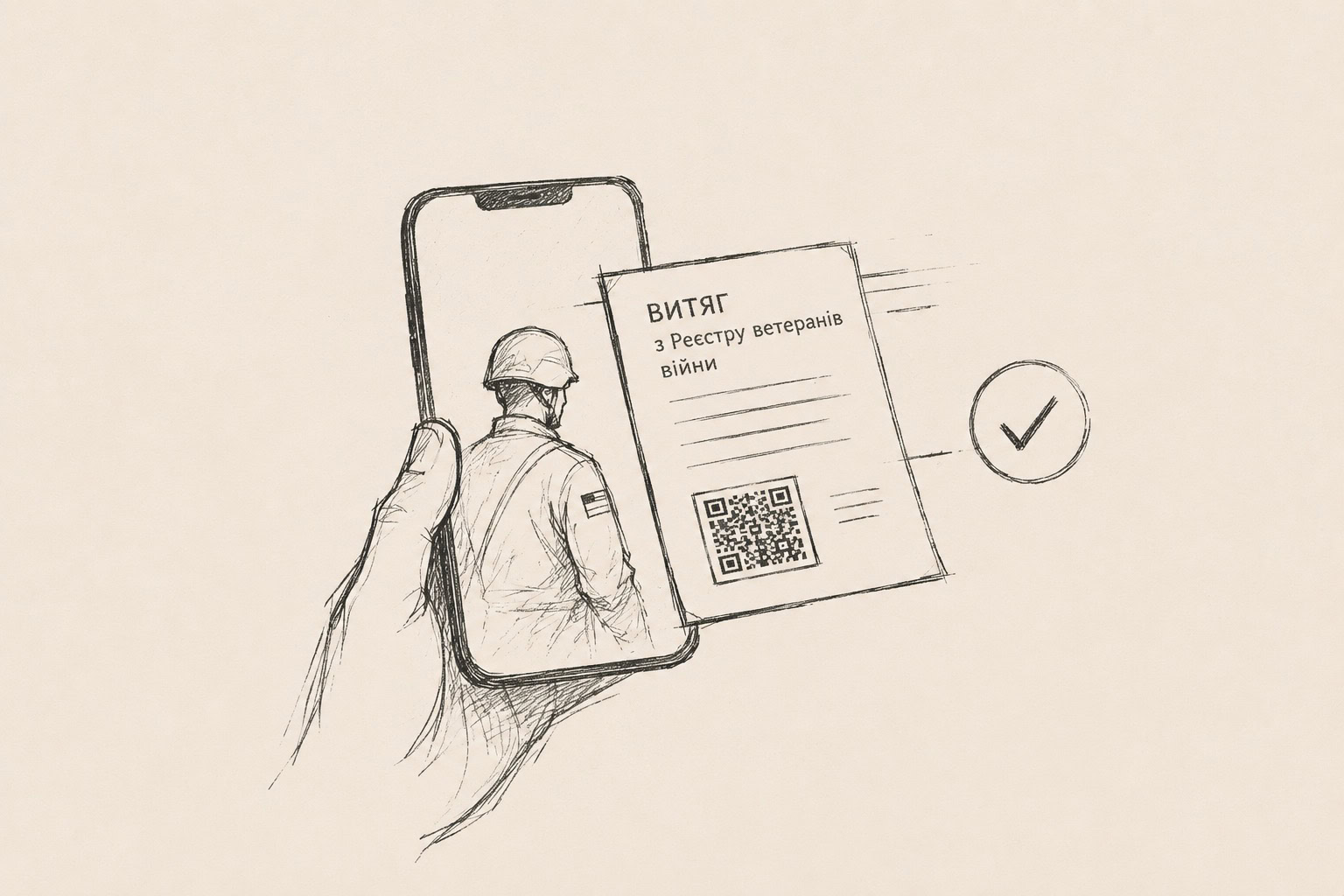
The electronic veteran’s extract: Who will be able to get the document without a TsNAP
An extract from the Veterans Registry will be available without a trip to an Administrative Services Center (or TsNAP). The Cabinet of Ministers has allowed veterans to generate the electronic document themselves through through Diia, Ukraine's state portal and app for digital IDs and government services. The system will verify data across several state registries, and the completed extract can be downloaded or printed. Frontliner reviewed the new rules and looked into who can use the digital service, why a veteran's e-ID is needed, and what to do if the information in the registries doesn't match. (zakon.rada.gov.ua)
The Cabinet of Ministers amended the Regulation on the Unified State Register of War Veterans (EDRVV) through Resolution No. 1050 of Aug. 21, 2026. It took effect the following day. The registry itself has operated since 2019 and contains information on veterans’ statuses, documents, benefits, social guarantees and other data. Following the August amendments, it will also record the acquisition, termination, revocation and reinstatement of veteran-entrepreneur status.
An extract from the registry already existed before this change. It is used to confirm status within Ukraine. The amendments primarily affect how the extract is obtained: for some veterans, an administrator at a TsNAP is no longer needed between the request and the finished document.
The registries will generate the extract themselves
A request without a electronic signature
To obtain an extract through the Diia portal, a veteran must complete electronic identification and authentication, select the service, and confirm the request. A separate qualified or advanced electronic signature is not required.
The registry then checks the veteran’s data against several other government databases. A person’s name and passport data are verified through the Unified State Demographic Register, their taxpayer number through the State Register of Individual Taxpayers, and their veteran status through the EDRVV. If all the required information is confirmed, the request is automatically forwarded to the registry.
The completed extract is returned to the person’s account on the portal and sent by email. In the mobile app, the document will appear directly in Diia. It can be downloaded and printed.
The smartphone route has an additional requirement
Different requirements apply to the portal and to the mobile app. To submit a request through the app specifically, a veteran must already have an electronic veteran’s ID there. The resolution explicitly sets this condition.
The e-ID appears once information about a person’s status has been transmitted to the EDRVV. The Ministry of Veterans Affairs has previously explained that if the document doesn’t appear in Diia, the cause may be missing or incorrect information in the registry. In some cases, correcting it requires contacting the body or commission that originally established the status.
So the digital extract effectively doesn’t start with a smartphone. State databases must first recognize the person and confirm their status.
What the document will contain
From status to the decision that granted it
The extract will include more than just a notation of veteran status. It will also list the person’s date of birth, taxpayer number, passport details, the date the status was granted, and its duration), if one has been set. It will name the body or commission that granted the status or entered the information into the registry, along with the details of the relevant decision. If a person’s status was revoked, the document will state the date and grounds for that decision.
Each extract receives a registration number and the exact date and time it was generated. The Ministry of Veterans Affairs applies a qualified electronic seal to it.
The document will include a QR code. Where technically possible, it can be scanned to access the corresponding confirming record in the registry. This will allow an institution to which a person presents the extract to verify it directly against the source.
Relatives and representatives get their extract at a TsNAP
The right to information from the EDRVV extends to a broader group of people than the right to request it independently through Diia. An extract can be obtained by the person themselves, or by their legal or other authorized representative. The regulation also covers children who need the document to receive state support during their education, as well as specified family members of people held in Russian captivity or missing due to the war or occupation.
For these cases, the TsNAP procedure remains in place. An administrator identifies the applicant, checks the documents, and submits the electronic request. A representative must provide a document confirming their authority. A family member of a prisoner or missing person must provide the corresponding information from the relevant state systems.
Once the registry responds, the extract is sent to the administrator’s account. The TsNAP must notify the applicant no later than the next business day. If the person requests it, the document will be printed on plain paper. A special form, the administrator’s signature and an official seal are not required.
When the data doesn’t match
The new system has two distinct verification stages. When a request is created through Diia, the process stops if the system fails to obtain all the required information or cannot confirm veteran status. In that case, no request is even forwarded to the EDRVV.
Once a request has reached the registry, different rules apply. If the data linked to a person’s identifiers doesn’t match, the system still generates an extract, but flags it with a note that the information needs to be clarified. If no data on the person is found at all, that too will be indicated in the document.
This is where the limits of the new service lie. Diia shortens the path to information the state already holds about a veteran and automates its verification. The app cannot correct an erroneous record or add a missing status.
Resolution No. 1050 therefore changes access to the registry above all. A veteran with accurate data gains the ability to generate a confirmation of status on their own, without a separate visit to an institution. TsNAPs remain in place for more complex cases, representatives and families, while the digital service now identifies errors in state databases more quickly.