Tanks hide, pickups fight: Where have armored vehicles gone from the line of contact?
As soon as armored vehicles appear near the gray zone, the “safari” begins. Shaped-charge munitions are dropped on them, penetrating the metal and incinerating the crew inside. Any potential survivors are finished off by FPV drones. According to the soldiers from the maintenance battalion of the 33rd Mechanized Brigade, it is a horrific way to die. Anti-drone cages soldiers nicknamed “grills,” welded on top of armored personnel carriers, offer no protection either. As a result, light armored vehicles and tanks are unable to perform their primary roles, sitting idle in holding areas for more than a year. Frontliner looked into whether there is any future for combat vehicles that Ukraine rarely deploys to the front line due to the lethal risks.
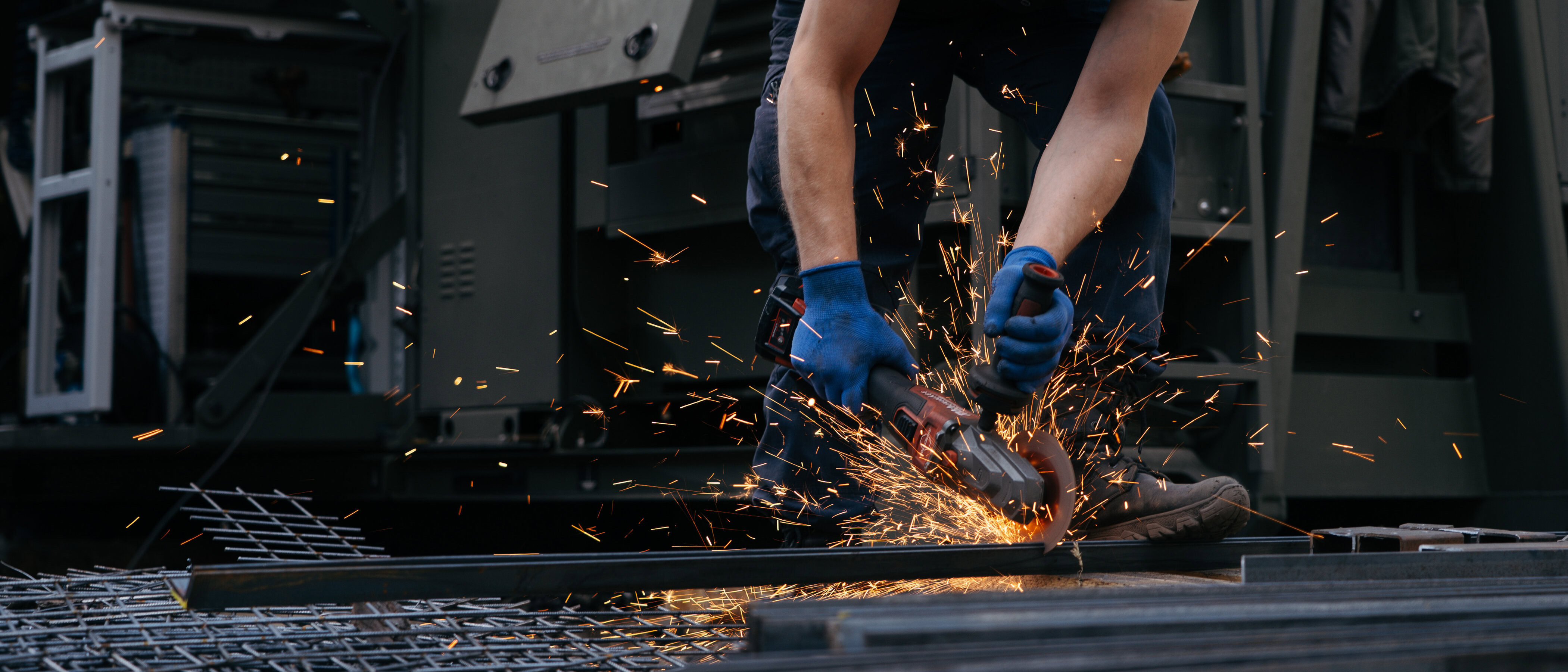
Before noon, the face of a mechanic with the call sign “Diadia” is already covered in soot and grease. He circles an M113 armored personnel carrier (APC) with an angle grinder, smoothing down freshly welded rebar as sparks fly two meters in all directions. Sweat runs down his face, and “Diadia” wipes it away with grease-stained hands. There is no time to wash up since the vehicle must be equipped with an anti-drone cage by the end of the week. He and his comrades have to finish the steel frame, wrap it in reinforced cage, and splay the wires on top. Only then will the metal “dandelion” be ready.

It takes three people and about a week of continuous work to build a ‘hedgehog.’
That’s an extra ton and a half of metal that must be welded
properly so it doesn’t complicate the crew’s evacuation. But even now,
it’s far from perfect; you constantly have to change something,
Armored personnel carriers and tanks have not been deployed in the 33rd Mechanized Brigade’s area of responsibility since 2025. That was the last time the brigade’s Leopard carried out a planned firing mission toward enemy lines, recalls the commander of the maintenance battalion, call sign “Pasichnyk.” Whenever the Russians expose their armored vehicles, Ukrainian drone operators destroy them.
The 33rd Brigade’s tanks are currently on standby and will deploy to firing positions only in the event of a critical enemy breakthrough, the battalion commander says.
From there, UGVs and heavy-lift drones deliver
everything to the positions,

“The primary purpose of M113 or YPR-765 armored personnel carriers is to protect the crew from machine guns, heavy-caliber rounds, and shrapnel from mines or shells. But this armor cannot withstand a direct hit. As an assault vehicle, the M113 is also largely ineffective: the machine gun or grenade launcher shakes so hard that hitting a target is impossible, while the risk to the vehicle and crew is far too high. That’s why our M113 only transports soldiers and supply packages to the second line now. From there, UGVs and heavy-lift drones deliver everything to the positions,” “Pasichnyk” says.

Dismantling half an APC for a minor repair
On the Dobropillia and subsequently Kupiansk fronts, where the 33rd Mechanized Brigade held the line throughout 2024-2026, combat vehicles became a major headache for mechanics. Anti-drone cages are single-use protection, says a soldier with the call sign “Mekhanik.” The armor might withstand a kamikaze drone strike, but if the vehicle throws a track, the carrier turns into a tomb for the crew. Even if the vehicle can be evacuated, mechanics have to dismantle almost everything just to inspect the engine or change the oil and filters.
Fixing a vehicle like this requires a dedicated workshop,
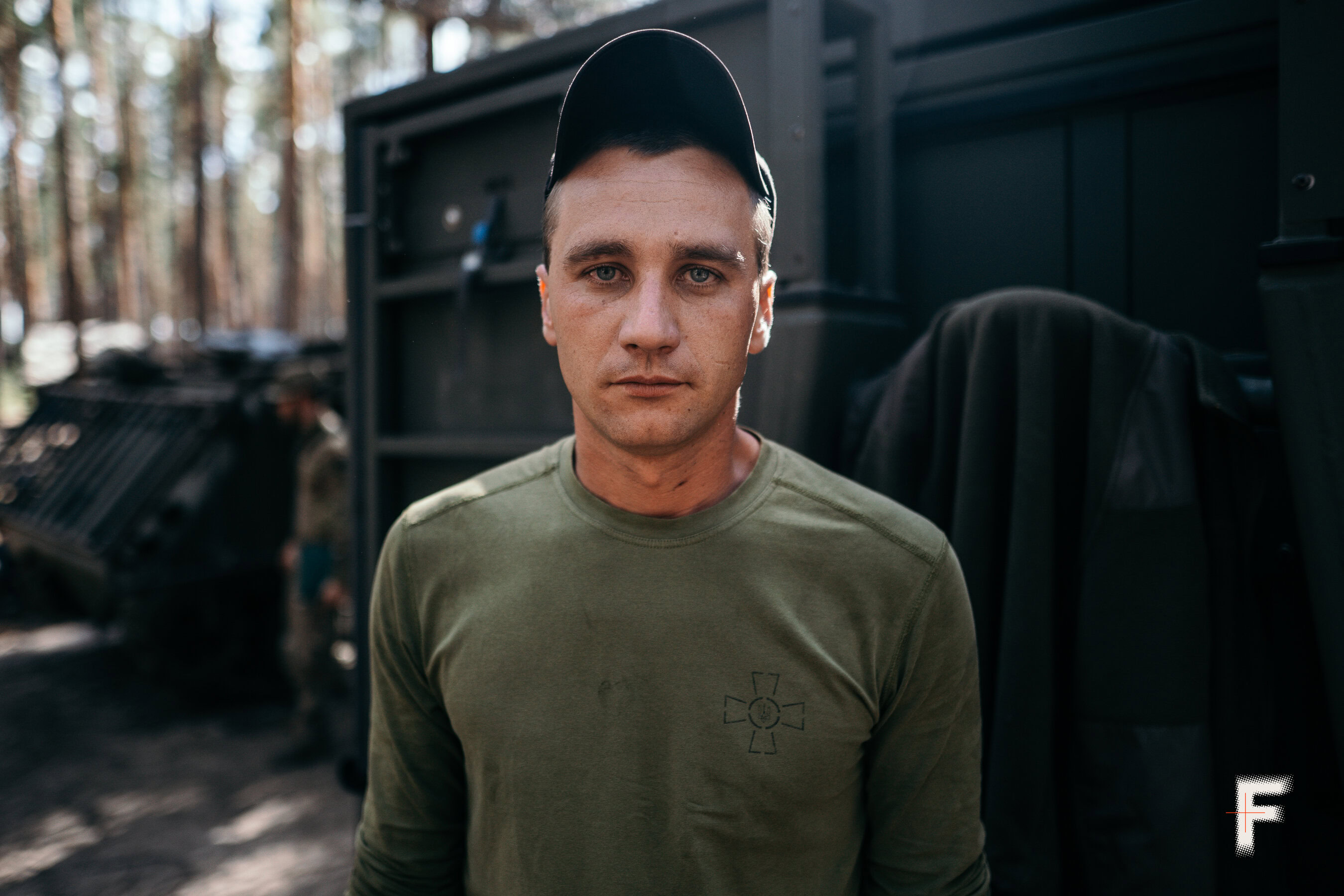
“The most difficult repairs after strikes take two to three weeks. We have to call in a team of turret specialists to fix the turret and wait for a replacement track. Because of the vehicle’s structural density, reaching many components is impossible without taking apart half the armor. Replacing a starter or changing the oil is just as problematic as repairing the engine — you have to crane out everything, including the gearbox. Fixing a vehicle like this requires a dedicated workshop,” “Mekhanik” says.
The 33rd Mechanized Brigade’s maintenance battalion does have such a workshop. It is a mobile unit designed specifically for repairing Leopard tanks, equipped with a loader crane, a generator, and semi-automatic welding capabilities. Mechanics handle from 50% to 60% of repair jobs in this workshop.

However, some carriers sit idle in holding areas like scrap metal. Fixing a Husky armored vehicle after a strike is impossible due to the finicky nature of its mechanisms. The vehicle has to be evacuated to western Ukraine, where it will be completely dismantled.

On the Kupiansk front,
vehicles just get bogged down.
Spare parts for armored vehicles are in limited supply. The unit builds up its own “repair reserve,” — a resource drawn from vehicles that can no longer be restored, turning them into donors. Because of this, armored personnel carriers are rarely deployed even for logistics. Their tracks are not designed for asphalt, while frontline terrain is difficult to traverse.
“Near Robotyne, the mud was viscous, like grease, serving as a sort of lubricant for the tracks. But on the Kurakhove front, stones from the mines constantly make the tracks snap. And on the Kupiansk front, vehicles just get bogged down,” the soldier says.
Welding an anti-drone cage onto light armored vehicles is much easier than onto a pickup truck. Their rectangular shape means you can just “weld on strips of metal,” says “Diadia.” But the M113 has an aluminum hull, so you cannot just weld metal to it. You have to drill holes, tap threads, and mount special adapters, whereas on regular pickups, the metal is simply welded on in the same amount of time.

It’s cheaper for us to buy an old pickup truck for 300,000 hryvnias.
But light armor definitely has a future,
as it protects infantry from shrapnel and drones,
In the Zaporizhzhia region, tanks deploy on combat missions
The situation with armored personnel carriers on the front line is difficult: they lack speed and maneuverability needed to carry out their intended combat missions. With tanks, however, the situation is different. In particular, on the Huliaipole front, T-80 and T-72 tanks of the 1st Assault Regiment continue to deploy on missions. Some of the combat vehicles are dug in and operate from fixed positions, says a tank company commander with the call sign “Lutsyk.” If a tank is spotted, the crew have to relocate, dig it in, and camouflage it all over again. Sometimes several times a day.
“Tanks deploy when we need to destroy targets that drones can’t reach. A tank moves in, does the job, and leaves nothing behind. The distances we fire at vary: anywhere from three and four kilometers up to 12 kilometers. Sometimes we fire from as close as 500 meters,” the officer says.
On the Zaporizhzhia front, welded anti-drone cages help protect the armor even after FPV drone strikes. There have been cases when UAVs recorded drone strikes on a tank, yet the vehicle returned relatively undamaged. During deployments, however, mined roads pose a far greater threat: a tank can hit a mine and throw a track. If an anti-tank mine capable of burning through the vehicle’s floor is hidden in the grass, the crew is at risk of catching fire. In T-80 and T-72 tanks, in particular, there is also a risk of the ammunition detonating, as the shells are stored directly on the bottom of the hull.
After sustaining such damage, retreating under its own power is impossible. Another tank has to be deployed to recover the damaged vehicle. This doubles the risk, as armored vehicles are an even higher-priority target for the Russians than drone operators. Yet the company commander is convinced that tanks remain irreplaceable on the battlefield, at least in terms of firepower. That is why it is necessary to find ways to protect them from drones, as Russian attacks are constantly changing: the Russians are looking for and finding weak spots in armored vehicles.
It used to be scary going out on missions,
but now it’s even more terrifying.
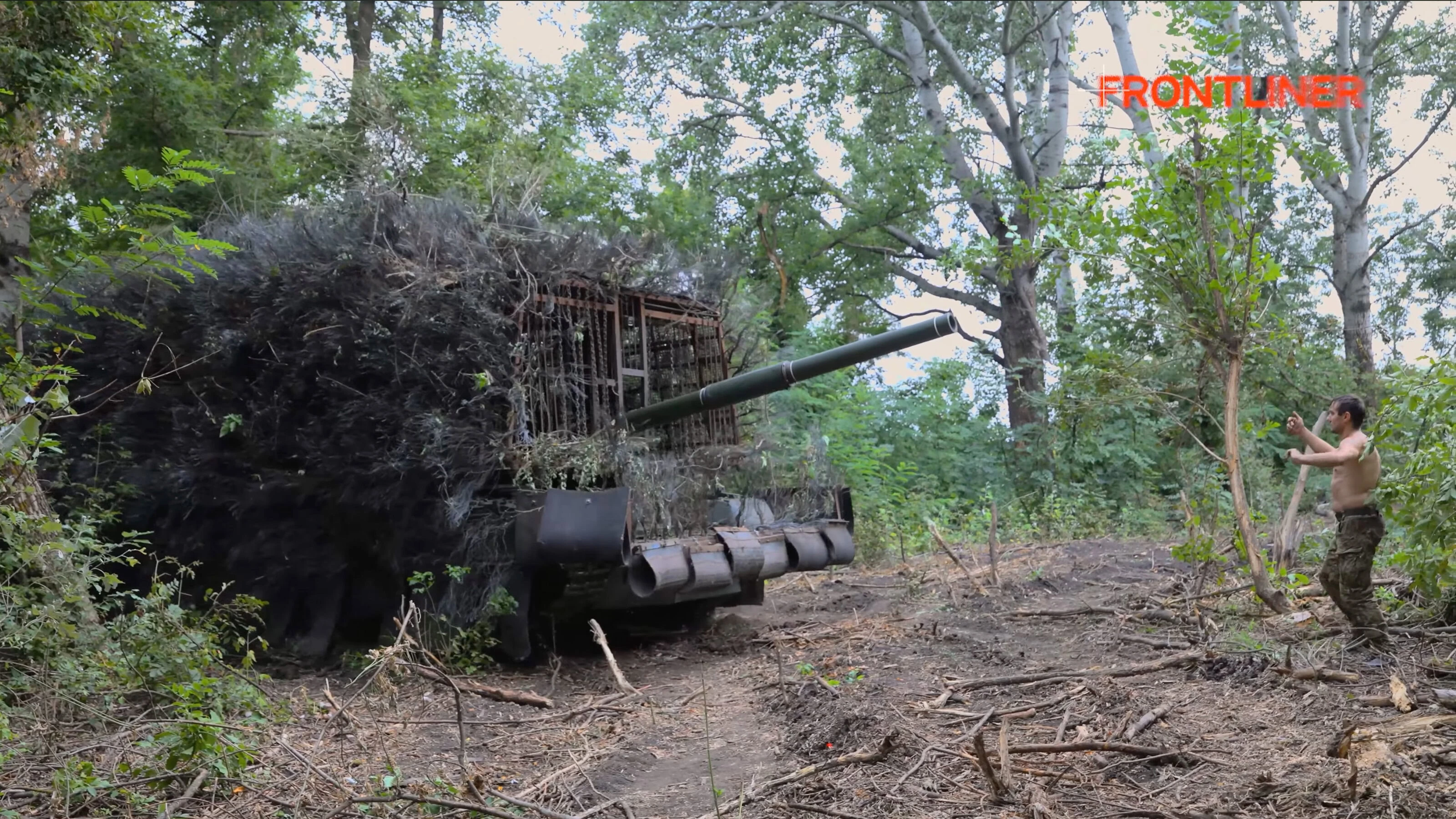
“Just yesterday, we went out and took out Russian tanks. It used to be scary going out on missions, but now it’s even more terrifying. You have to be more careful choosing your spot [Ed. note: firing position], because we’ve had a Lancet hit our tank before, and a large fixed-wing drone can punch a hole in the armor, after which the small drones will finish the job. And they know exactly where to strike. Still, tanks have a future because of their sheer firepower. If we aren’t deploying on missions, we use them as artillery,” says a tank commander of the 1st Assault Regiment with the call sign “Borshch.”
Pickup trucks replaced APCs, but armor isn’t done fighting yet
The majority of tanks in service with the Defense Forces of Ukraine are over 30 to 40 years old. They reflect the realities of World War II, but have little in common with the demands of modern warfare. There has been no generational shift in tanks and armored personnel carriers: the vast majority of the armored vehicles defending Ukraine were manufactured in the 1980s and 1990s, with modernizations carried out between 2000 and 2020. That was long before drones, which are dozens of times smaller than the armor itself, became the primary threat.
The role of tanks on the battlefield may be due for a rethink. Currently, they are often used like self-propelled guns for indirect fire from concealed positions. However, there is a possibility that a portion of mobile armored vehicles will transition to autonomous control. India has already embraced this technological solution, planning to convert roughly 2,000 of its T-72 tanks into unmanned ground vehicles.
For Ukraine, this solution is both temporary and costly. Converting armored vehicles designed to be manually operated into automated systems is far more difficult than building a remotely operated platform from scratch. However, Ukrainian defense manufacturers have not ruled out this option, says Mykola Salamakha, an armored-vehicle specialist.
“Even back in the 1930s, the Soviet Union was developing remote-controlled teletanks, including the TT-26 and TT-BT-7. There was also the Goliath, which was controlled via cable. Armor manufacturers want to create a modern equivalent, but remote operation is only possible via radio links that also transmit video. It’s technically challenging, and it is difficult to guarantee fully secure communications,” Salamakha says.
The technology for remote control already exists, but its use is limited by the cost of the systems and the increasing use of drones on the battlefield. For defensive operations, UGVs equipped with machine guns remain the priority. But if the Defense Forces launch an offensive, those weapons would have to be replaced with at least 30mm autocannons. To ensure accurate fire, the platform would need to weigh between two and three tons. This means Ukraine will have to bring tanks and armored personnel carriers back to the battlefield, Salamakha says.
“It is impossible to jam all enemy drones. That’s why armored vehicles must have countermeasures against UAVs controlled via both radio and fiber-optic links. Air defense systems need to be autonomous, allowing them to eliminate aerial threats while the vehicle engages its primary target,” Salamakha says.
Yet as of today, there are officially no developments capable of restoring the battlefield relevance of tanks and other armored vehicles.
***
The last time I heard of a successful armored vehicle deployment in the Donetsk region was in 2024. Back then, the cannon of a T-64 tank on the Lyman front fended off the occupiers to recover one of our tanks they were trying to capture. But when the drone era began that same year, light armored vehicles became a top-priority target for the Russians. The occupiers attack these vehicles until they tear them to shreds. Crews often perish, unable to escape their tanks under precision strikes. Today, most combat vehicles are fitted with anti-drone cages, yet even these do not save crews from a horrific death in a metal trap. As a result, armor increasingly sits idle for months, completely unused.
Every story starts with your support. Join the Frontliner community so we can keep up documenting Russia’s war against Ukraine from the front line and the rear.
***