The wounded steppe: How scientists document the scars of war
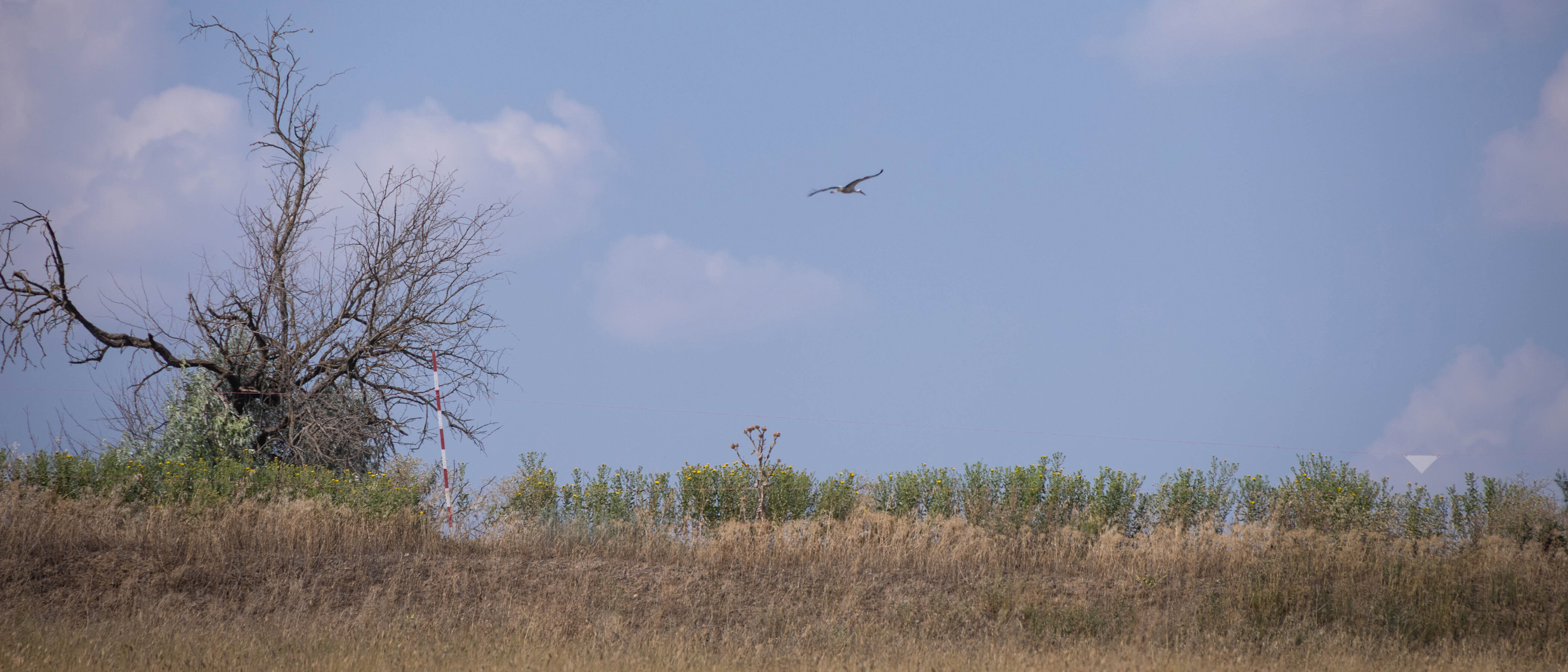
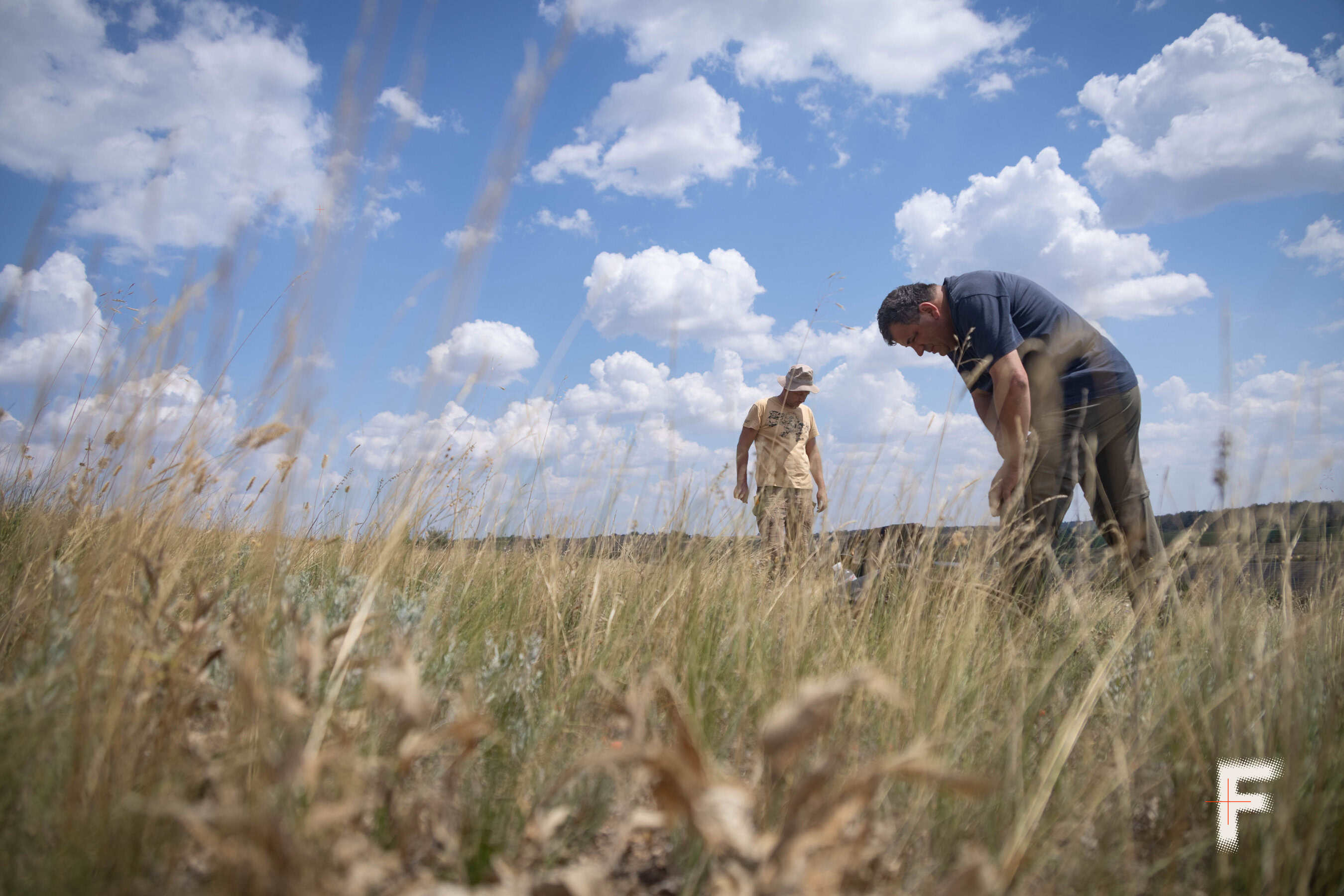
The steppe hums with crickets and smells of sun-baked herbs. Beyond it lies a field where the harvest is currently underway. A few years ago, the liberation of the Ukrainian south began right here. Now, a group of scientists steps over the tape marked “Mines” to see how nature heals the wounds of war. The researchers slowly make their way between the craters. Shell fragments lie in the grass, and near the impact sites are recognizable remnants of multiple launch rocket systems. Here, you have to watch your step at all times. There is nowhere to hide from the southern sun on these scorched slopes. Frontliner visited the Vysun-Inhulets Regional Landscape Park on the border between Mykolaiv and Kherson regions to learn how Ukrainian scientists document the environmental damage caused by the war.
In 2022, the frontline ran across these steppes and kurgans in Mykolaiv and Kherson regions, and later it was from here that the liberation of the right-bank Kherson began.
The area is still marked as mined. The scientists joke that they send the oldest person ahead first, and if he makes it through, the rest follow. Tymur Bedernichek, a researcher with combat experience, explores the unfamiliar terrain first. The rest of the group follows only after him.
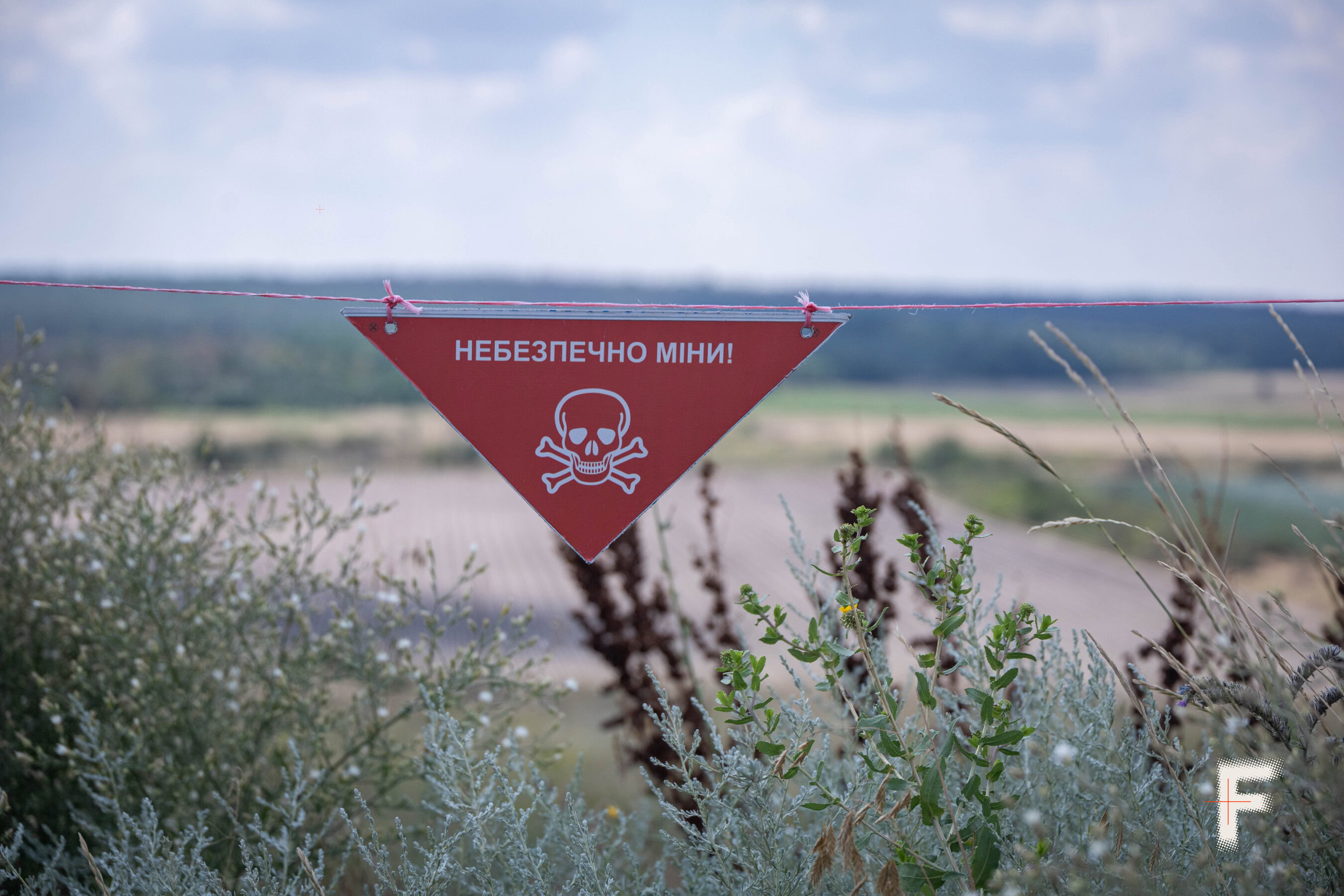
Last year, the scientists went out into the steppe wearing body armor and helmets, carrying tourniquets with them.
“Standard scientific equipment for researchers working close to the line of contact,” Khodosovtsev says.
Biologist Oleksandr Khodosovtsev, a senior researcher at the M. G. Kholodny Institute of Botany, National Academy of Sciences of Ukraine, points to the craters left behind by the battles:
“There was fierce fighting here, and a vast number of craters remain in the steppe. Today, we are studying the impact of this very factor on virgin steppe vegetation. We are trying to understand how to correctly assess this impact, describe the plants across different morphological zones of a crater, set up monitoring plots, and investigate how vegetation recovers step by step.”

Every crater is measured down to the smallest detail. Plants are documented separately inside the craters, across the blast-affected area, and on an intact patch of the steppe for comparison. All gathered data is filled into specialized forms.
Two researchers stand over the crater: one calls out plant species while the other writes them down. Latin words sound over the dry grass like an incantation. On plots where the expedition worked previously, the bodies of Russian soldiers were found. The scientists joke that the form should include a separate column for such finds.

Describing a single crater takes about two hours. Depending on its size, researchers conduct seven to nine geobotanical descriptions. A pair of scientists can document up to four such sites a day. Foxes have already inhabited some of them, digging dens inside. For the scientists, this represents yet another form of damage to the study plot.
The expedition aims to determine how vegetation changes after explosions, trench digging, and the movement of heavy equipment. The collected data will help decide the fate of these damaged sites: whether to leave the craters as scars of war or to fill them in and restore the steppe.
This is what real steppe actually is — no sunflowers,
no wheat, just massive biodiversity,

A hundred species in ten meters
To the untrained eye, it is just land overgrown with grass. Botanists, on the other hand, see a whole world where up to a hundred plant species can grow in just ten square meters. Khodosovtsev explains such ecosystems are protected at the international level:
“All the steppes here are protected at the European level. To the average person, any open field looks like a steppe. But this is what real steppe actually is — no sunflowers, no wheat, just massive biodiversity, with up to 100 different plant species packed into a single ten-square-meter plot! To prove its true value, we have to conduct comprehensive surveys: compile a full inventory of vascular plants, bryophytes, lichens, fungi, insects, and other wildlife, assess the data, and show that this area holds a high concentration of endemic, rare, and protected species. That is precisely why this land needs formal protection at either the local or national level.”
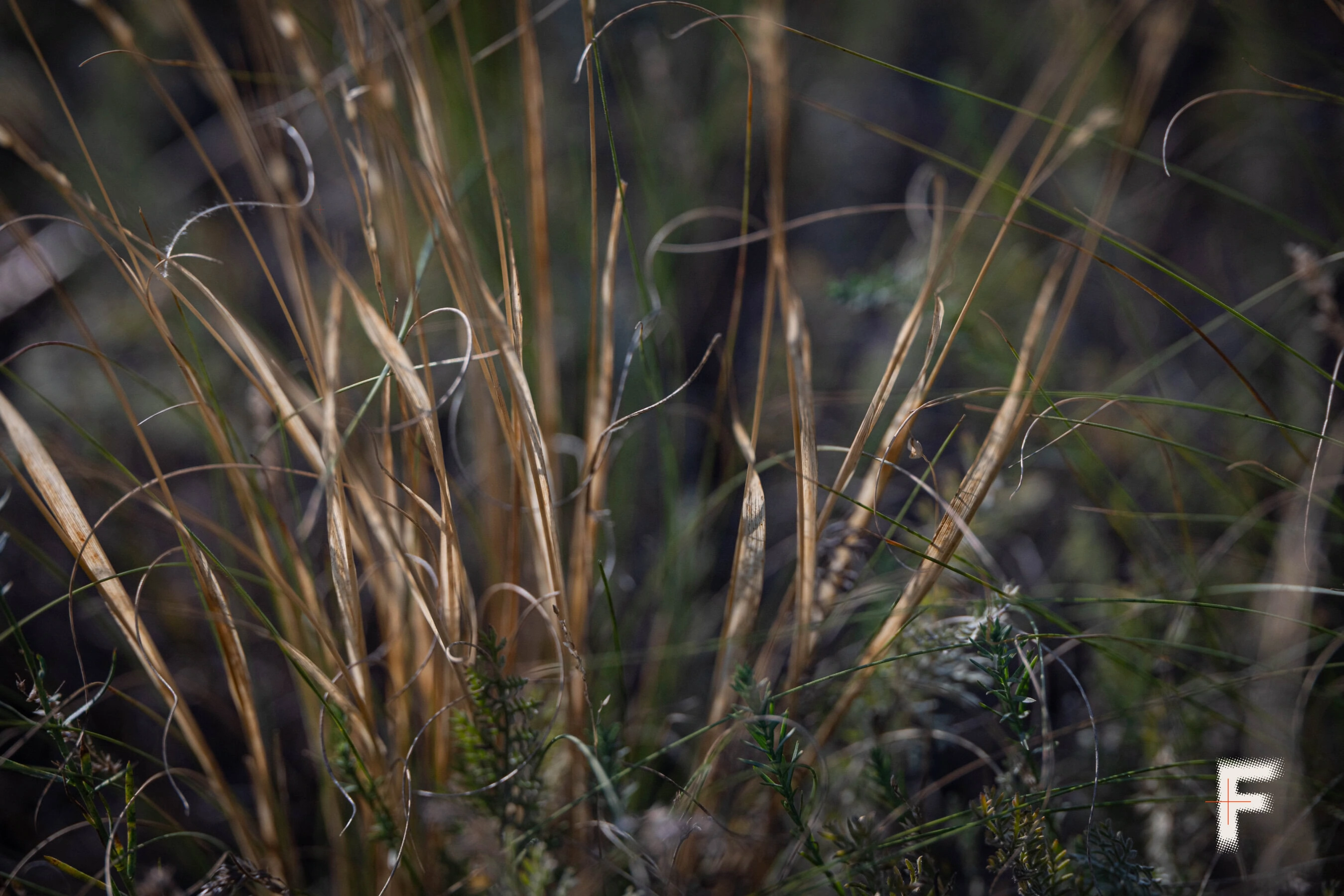
Steppes and grasslands aren’t just grass.
Every biotope is a world in itself
Anna Kuzemko, a biologist at the M. G. Kholodny Institute of Botany, says that in the public perception, the steppe is still seen as “just grass.” People are far more likely to consider forests as real nature, while grasslands are often viewed as areas to be plowed up, planted with sunflowers or trees:
“The general public understands nature as a forest. They believe forests need protection, while in the public consciousness, steppes are just grass to be plowed up, planted with sunflowers, or covered in trees. One of our main missions is to show that steppes and grasslands aren’t just grass; they are home to countless species of plants and animals. Every biotope is a world in itself, rich with diverse components. And they don’t need to be improved or destroyed — they simply need to be preserved as they are. We used to study various factors affecting steppes, but now the impact of war has been added to that list. Ukraine’s core steppe zones lie in the south and east, where most of our best remaining steppes have ended up directly in the active combat zone.”
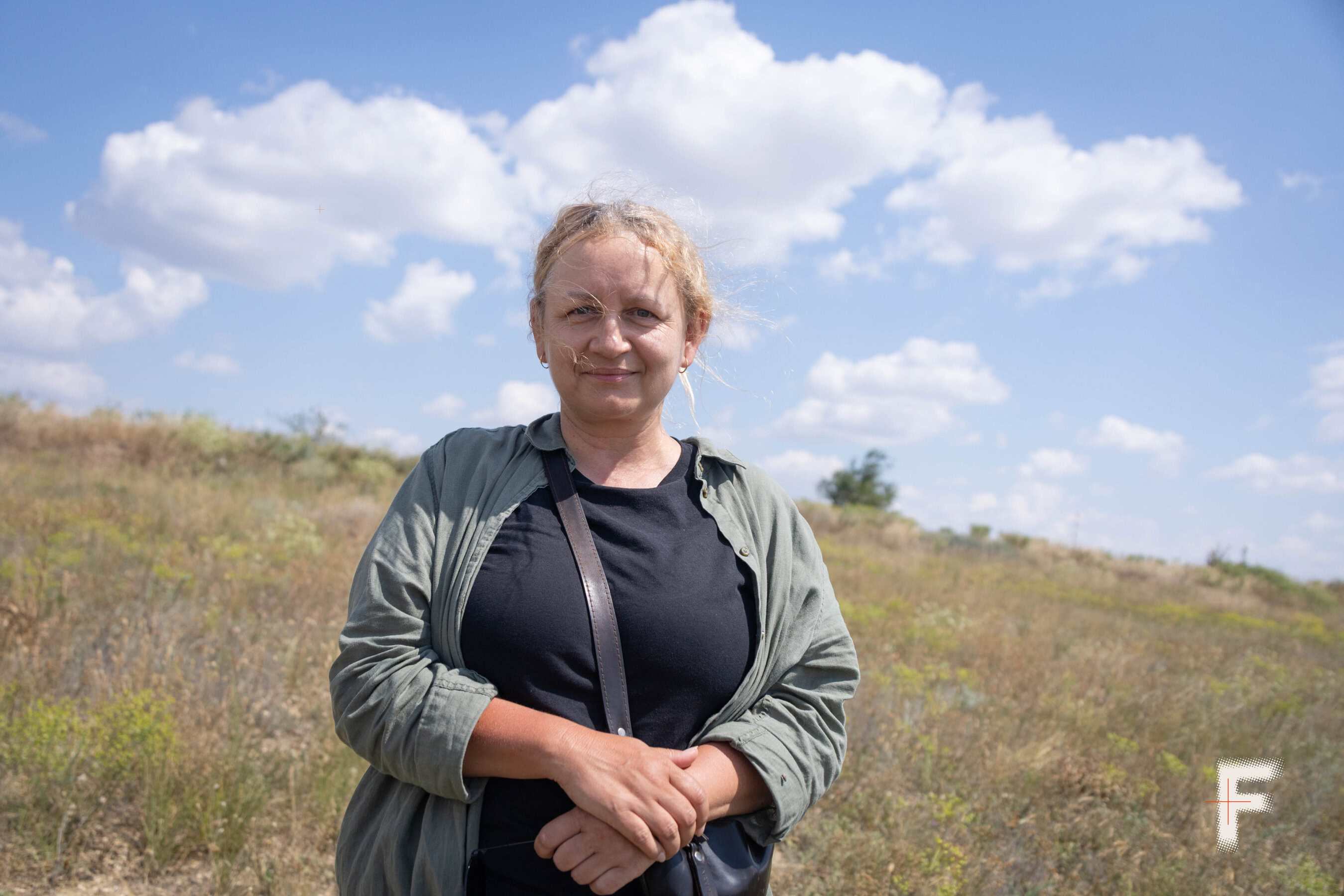
Kuzemko points to Tanacetum millefolium, a type of tansy. This fragrant plant is used in teas and seasonings, traditional medicine, perfumery, and essential oil production. Thyme grows nearby, and just a few days ago, the researchers found wild tulips.
What excites scientists the most is finding Red List species that might not have survived the fighting. Among them is Centaurea paczoskii, an endangered knapweed species.

Zonal steppes begin in Ukraine — they don’t exist
anywhere else in Europe.
Sometimes, scientists do not even know whether a species they have discovered has survived. In 2021, a previously unknown lichen was found in the Oleshky Sands. Molecular genetic analysis confirmed it was new to science. The paper describing it was published only in 2024, by which time its habitat had already endured occupation, the movement of heavy equipment, and likely flooding following the destruction of the Kakhovka Dam, also known as the Hydroelectric Power Plant. Anna says that it remains unknown how badly this site was damaged:
“There’s a military training ground in the Oleshky Sands, and heavy equipment ran right through this lichen’s habitat. Yet the paper describing the species was published only in 2024. There is a high chance this species went extinct before it was even formally described in scientific literature.”
Kuzemko chuckles at photos taken in sunflower fields captioned “Ukrainian steppe.” While a sunflower field has become an iconic symbol of the country, it actually has nothing to do with the real steppe:
“In Ukraine, 40% of the territory is steppe zone, but according to various estimates, only 3 to 4% of actual steppes remain. Furthermore, zonal steppes begin in Ukraine — they don’t exist anywhere else in Europe. So, essentially, our country bears the responsibility for preserving these steppes for all of Europe. There needs to be a clear understanding at the national level that a steppe is not just grass.”

Ragweed comes first
An explosion leaves behind more than just a crater. It strips away the vegetation cover, mixes soil layers, and alters the chemical composition of the soil, allowing toxic substances to enter it.
The damaged area quickly becomes overgrown. The first to arrive are weeds — adapted to soil that is constantly plowed, dug up, and damaged. Native steppe plants cannot always survive alongside such neighbors.

An explosion effectively causes an ecosystem disturbance:
the soil and vegetation cover are destroyed,
Invasive species arrive from the outside, seize exposed soil, and displace native flora — their very own form of occupation in the plant world.
This process is clearly visible on the steppe kurgans. On one of them, biologist Ivan Moisienko documents tracks left by heavy equipment. During the fighting, the mound was evidently used as high ground to position weaponry.
The scientists are excited about steppe plants as if they were family, and mark weeds separately. Moisienko points to ragweed that is already invading the damaged soil.
“Because they are adapted to surviving in heavily disturbed habitats, like agricultural fields, for instance. An explosion effectively causes an ecosystem disturbance: the soil and vegetation cover are destroyed, and parent rock is often exposed at the surface. You can see ragweed here — it’s the first to appear.”

Even an ordinary shovel disrupts the natural soil layer. That is why weeds — rather than feather grass or wormwood — grow among cultivated plants in vegetable gardens. A similar process is triggered by explosions, trenches, dugouts, and the tracks of heavy equipment.
A steppe island in a sea of fields
Foxes have dug into the top of the kurgan. Vehicle tracks from four years ago are still visible. Archaeologists have never excavated the mound, so it remains unknown who is buried inside.

People built this kurgan, but over millennia it became part of the steppe. Once, these mounds were surrounded on all sides by wild grasses that quickly covered them after construction. Later, the surrounding land was plowed up. Plows bypassed the tall kurgans, and today, rising above the mown stubble, they remain islands of the ancient steppe. Moisienko climbs to the summit:
“They are like little islands of steppe in a sea of fields. Of course, these kurgans are small, but nevertheless, on this one we can see how beautiful the steppe is. Two species of feather grass listed in the Red Book of Ukraine grow here, along with many other steppe plants. But as for the top, where all the heavy equipment drove, it’s covered in weeds — the two are obviously connected,” he says.

This is the 13th kurgan the expedition managed to survey. It suffered less damage than the others: on previous mounds, the scientists found dugouts, trenches, and craters. On one, a large caponier had been dug. Along with vegetation, it likely destroyed archaeological layers that can now never be studied.
Nature left out of the counts
Nearly half of Ukraine’s most valuable natural areas were already engulfed by war in 2022, according to data from the Ukrainian Nature Conservation Group. Today, the picture is undoubtedly worse, although complete information is still lacking. Some protected lands are occupied, Ukrainian military forces are present in others, and scientists are still not allowed into the rest due to mines and Russian drones.
As recently as 2025, researchers were still making field trips to the steppe zone of the Kamianska Sich National Nature Park. The park’s territory also includes the Kakhovka Reservoir, destroyed by the Russians. This year, the steppe area of Sich has turned into a “kill zone.” The park’s director and staff have learned to use drone detectors and anti-drone rifles, and are now assisting colleagues who arrived from Kyiv.
Khodosovtsev took part in calculating the damage caused by Russian aggression to Ukraine’s nature reserve fund. According to him, as of September 1, 2025, the damage in the Kamianska Sich National Nature Park alone was estimated at 190 billion hryvnias. This total includes the impact of fires that destroyed thousands of hectares along with rare plants and animals, as well as the destruction of the Kakhovka Reservoir ecosystem. Following the terrorist attack on the hydroelectric power plant, nearly 500 kilograms of fish died, and Ukraine lost a unique water area that was part of the European Emerald Network conservation framework. To restore the damaged steppe areas, the park prepared a land restoration plan, but the security situation currently prevents its launch.
“That’s the damage for the Kamianska Sich National Nature Park alone. And it’s not even everything that has been calculated,” Khodosovtsev says.

In national and international discussions on the environmental impact of the war, the loss of arable land is mentioned far more often. The world is used to seeing Ukraine as the world’s breadbasket. The wild steppe, of which only a few percent remained even before the full-scale invasion, does not always fit into this picture. Anna Kuzemko is convinced that a great deal of work lies ahead:
“So far, there is no understanding at the state level regarding wild nature. Even when it comes to the impact of war on the environment, people usually focus on Ukraine losing arable land. We had several events with American partners, and everyone keeps saying that Ukraine is the world’s breadbasket. But when we explain that beyond cropland, we have wild nature that is also suffering, even at the international level there isn’t always an understanding of these issues.”
The craters are gradually becoming overgrown, with foxes settling inside them, while ragweed is the first to rise from the exposed soil. The steppe heals its wounds, though it does not always return to its pre-explosion state.
The scientists move on to the next crater. Once again, they measure its slopes, identify plants in Latin, and fill out their forms. Step by step, they record what nature can still restore on its own — and what the war has changed permanently.
The Frontliner editorial team would like to thank the following individuals for their assistance in preparing this report: Serhii Skoryk, director of the Kamianska Sich National Nature Park; Ivan Moisienko, chief researcher at the Askania-Nova Biosphere Reserve, board member of the Ukrainian Nature Conservation Group, doctor of biological sciences and professor at the Department of Botany, Kherson State University; as well as Andrii Seletskyi, head of the Novovorontsovka Settlement Military Administration of Beryslav district, Kherson region.