“I don’t want my children to see me cry”: Stories of displaced people from the Kherson and Donetsk regions
Modular housing settlements in the Kyiv region remain one of the few free housing options for people who have fled the frontline and temporarily occupied territories. Everyday life in these shelters is often confined to a single room shared by several people, communal kitchens, and the daily struggle to secure an income and medication. At the same time, humanitarian aid is dwindling, making it increasingly difficult for evacuees to cover their basic needs. Read their stories in this Frontliner report.
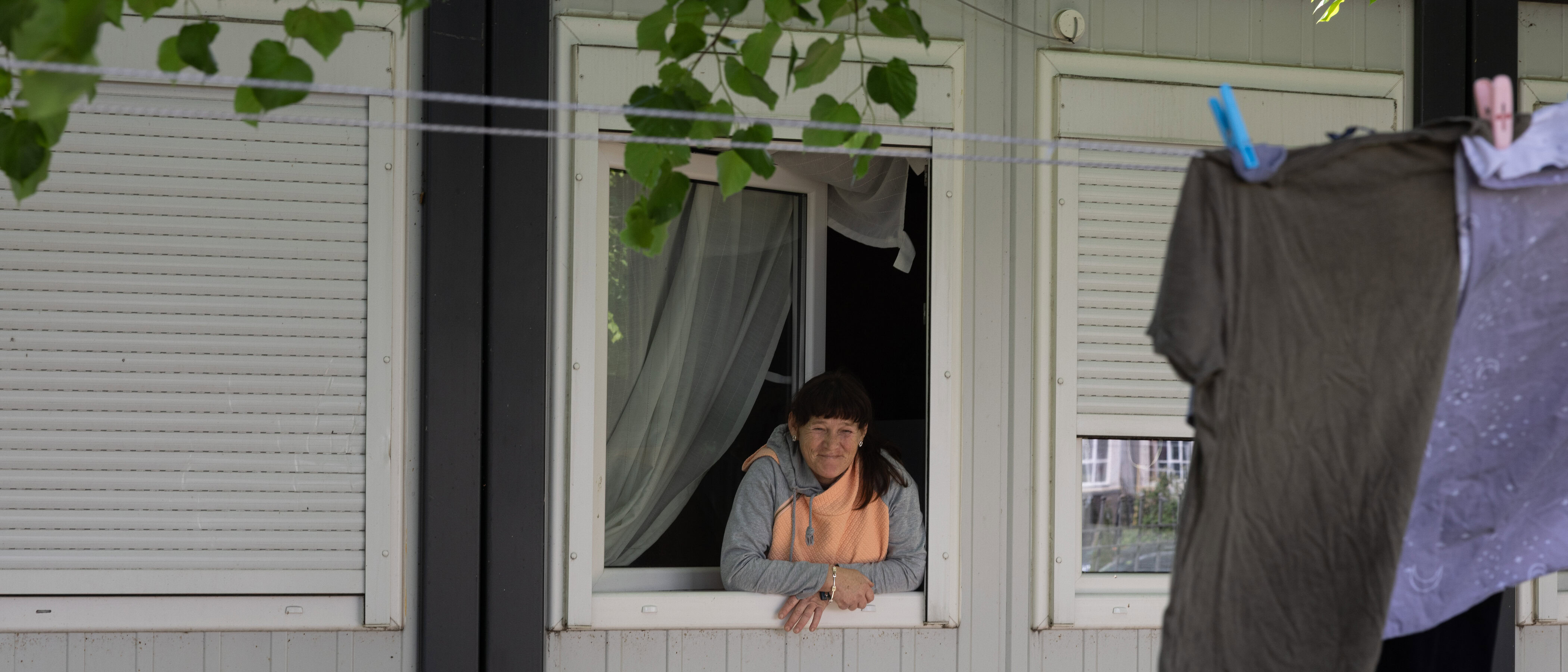
Polina Larionova fled the village of Chereshenky in the Kherson region with her sons four years ago, right after it was de-occupied. She measures the time spent under enemy control not in months, but down to the hour: nine months, six days, and three hours. She says it quickly, without pausing, as if the answer was memorized a long time ago.
Life, she recalls, was turned upside down the moment Russian troops arrived. The village was completely cut off. People were afraid to go outside, and any attempt to pass through the checkpoints could result in being beaten or vanishing altogether.
Larionova says their greatest fear back then was for the children and women. Those who had their own cars or enough money managed to leave at the very beginning of the occupation. The rest stayed behind. She also tried to evacuate with her children several times through humanitarian corridors, but Russian troops constantly detained the convoys or turned people back.
They started firing at our convoy.
We survived only because we crawled through the tree line,
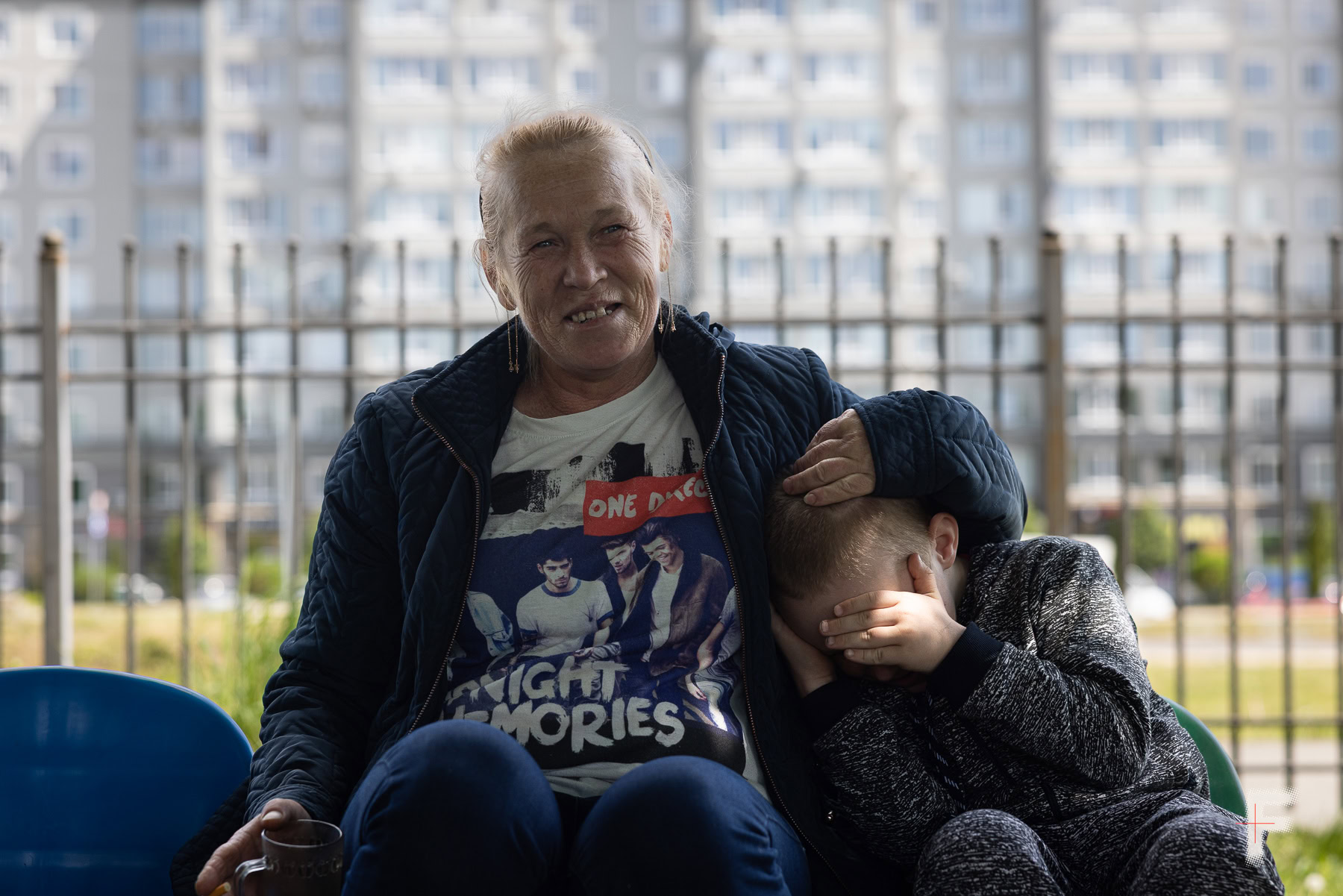
“There were children in the car,” she recalls. “And they started firing at our convoy. We survived only because we crawled through the tree line. The field right next to us was mined. One man had his leg blown off. We applied a tourniquet to him right there. After that, I realized we might not have survived at all.”
After that, the family returned to the village and continued living under occupation. Polina says that people were constantly looking for food, medicine, and cell service. Every day, she rode her bicycle for tens of kilometers to Bilozerka to buy groceries and call her relatives.
Our Ukrainian bank cards didn’t work.
The Russians smashed ATMs and looted stores.
“To make a phone call, we had to use Russian SIM cards. If they spotted a Ukrainian SIM or phone at a checkpoint, they would either confiscate it or smash it,” she recalls.
In the village, Polina says, people tried to resist the occupiers as much as they could. In response, the Russians staged public acts of terror.
“We threw Molotov cocktails at them at night,” she recalls. “And in the morning, the Russians gathered the whole village together, everyone, even the children. They told us: ‘One more joke like this, and we will shoot everyone.’ They actually could have done it.”
Certain memories still haunt Polina: the Russian military forcing a local tractor driver to bury the bodies of their own soldiers, a man being shot right in front of the locals, and Russian soldiers distributing humanitarian aid packages with Russian flags in exchange for interviews about how good life was under occupation.
After the liberation of the Kherson region, Polina stayed home for a while. She says she really did not want to leave. But she realized that her children needed to go to school and kindergarten, and there was no normal life in the village. There were no jobs left, either.
Now she lives in a shelter in the Kyiv region with her two younger sons: 14-year-old Oleksandr and 6-year-old Dmytro.

Polina is in no rush to praise her living conditions. She notes that conflicts frequently break out among the residents, and there is less and less aid. Previously, humanitarian organizations would bring food kits, bedding, and kitchenware. Now, most new residents receive only a place to stay.
“Two bunk beds, two wardrobes, two tables. That’s all. There’s barely enough room to turn around,” she says.
To make ends meet, Polina takes on odd jobs, like cleaning the local market and taking out the garbage. She says finding a permanent job is difficult because of the children. During air raid alerts, she has to pick up her younger son from kindergarten, and she has no one else to leave him with.
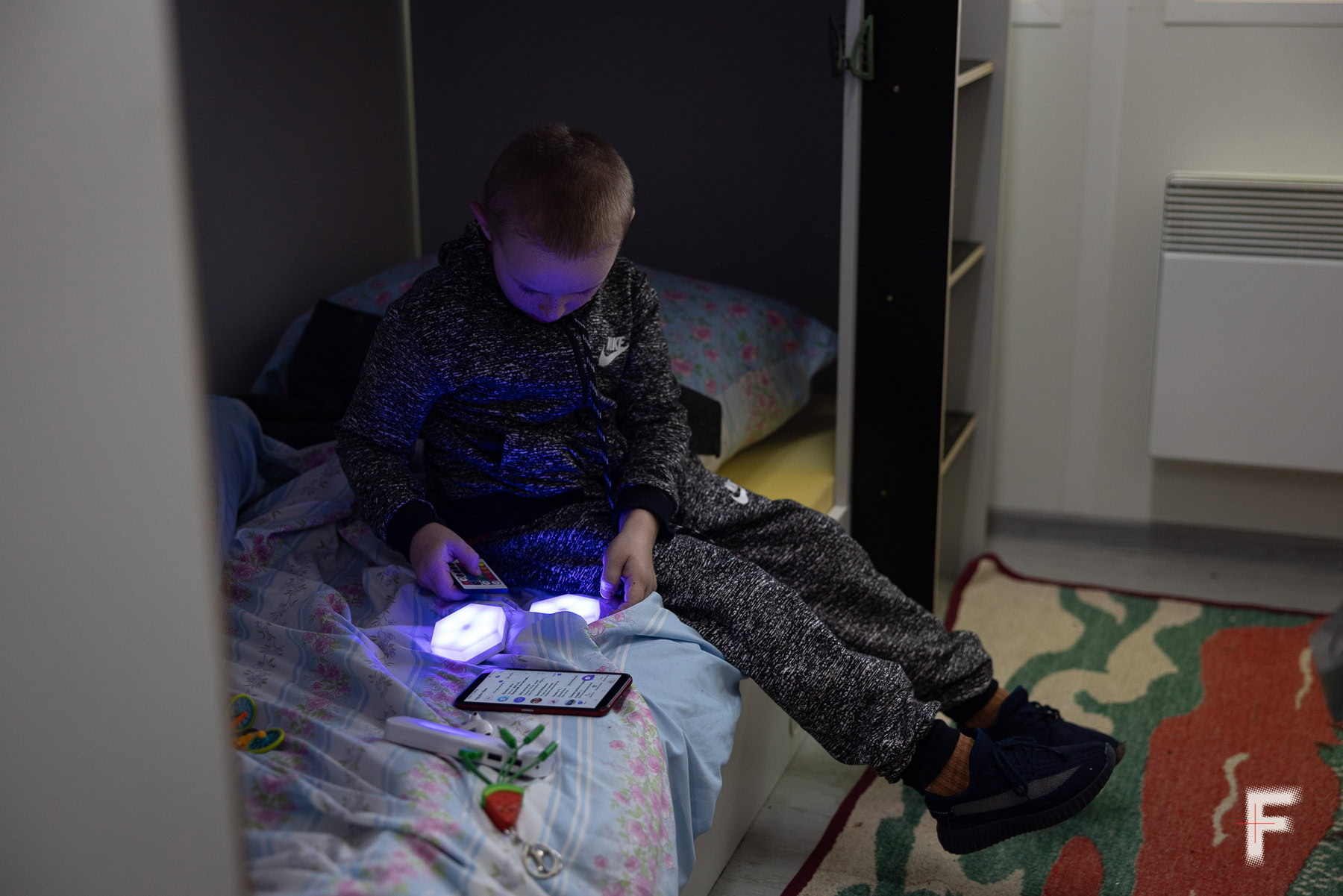
“I go to the market in the evenings and work for three or four hours. They pay me 500 hryvnias,” Polina says. “I pick up extra work on the weekends. There’s no other way to survive. I can’t afford to buy my kid a phone or a tablet. We barely have enough for food and medicine.”
Her middle son still hasn’t gotten used to Kyiv. He has only one friend at school. In his view, some locals treat displaced people as outsiders.
“People here often treat displaced people like intruders who just flooded in,” she adds. “A child feels that. He says, ‘I have nothing in common with them.’ He wants to go home.”
Polina herself wants to go home, too. In Chereshenky, she left behind a house without a roof, constant drone raids, and shelling. Yet even that feels like the normal life she once knew, the life the war has put on hold.
It’s warm back home. There are fields. It used to be so peaceful.
Everyone knew everyone. I never got used to this place.
This is not my life.
I’m only holding on for the sake of the children. I don’t want them to see me cry.
“I waited for my son until the very end”
In April 2026, Polina’s sister, Maryna Larionova, arrived at the shelter. Before that, she lived in Bilozerka, which is under constant Russian shelling. She says she refused to leave until the very last moment, holding out at home, waiting for her son to return from the front lines, and trying to cling to a familiar life.

“It’s my third week here,” Maryna says. “The military evacuated me. There is hardly anyone left back there. First, they evacuated the children, people with disabilities, and the elderly. But I kept waiting for my son.”
Her son, Eduard Larionov, joined the Territorial Defense Forces at the very beginning of the full-scale invasion. He is 23 years old now. Maryna says that during the occupation of Kherson, her son helped guide Ukrainian soldiers and civilians out of encirclement.
“He led the guys across the river. Through the reeds,” she recalls. “They stood in chest-deep water. We didn’t hear from him for 24 hours. We thought that was it. But then he made it out with the wounded boys.”
During his service, Eduard was wounded in the arm. According to his mother, his right arm still doesn’t function properly, yet he was sent back to active duty following a military medical commission.
“He says that when he puts on his body armor, it’s very difficult for him,” Maryna says. “But they kept transferring him from brigade to brigade anyway. The only thing I want is for him to be allowed to undergo proper medical treatment.”
Under the occupation, Maryna practically lived in a basement. She says that the Russian military constantly checked people, forced them to obtain Russian documents, raided homes, and hunted down anyone who had relatives in the Ukrainian Armed Forces.
They were looking for me.
They beat me and knocked my teeth out.
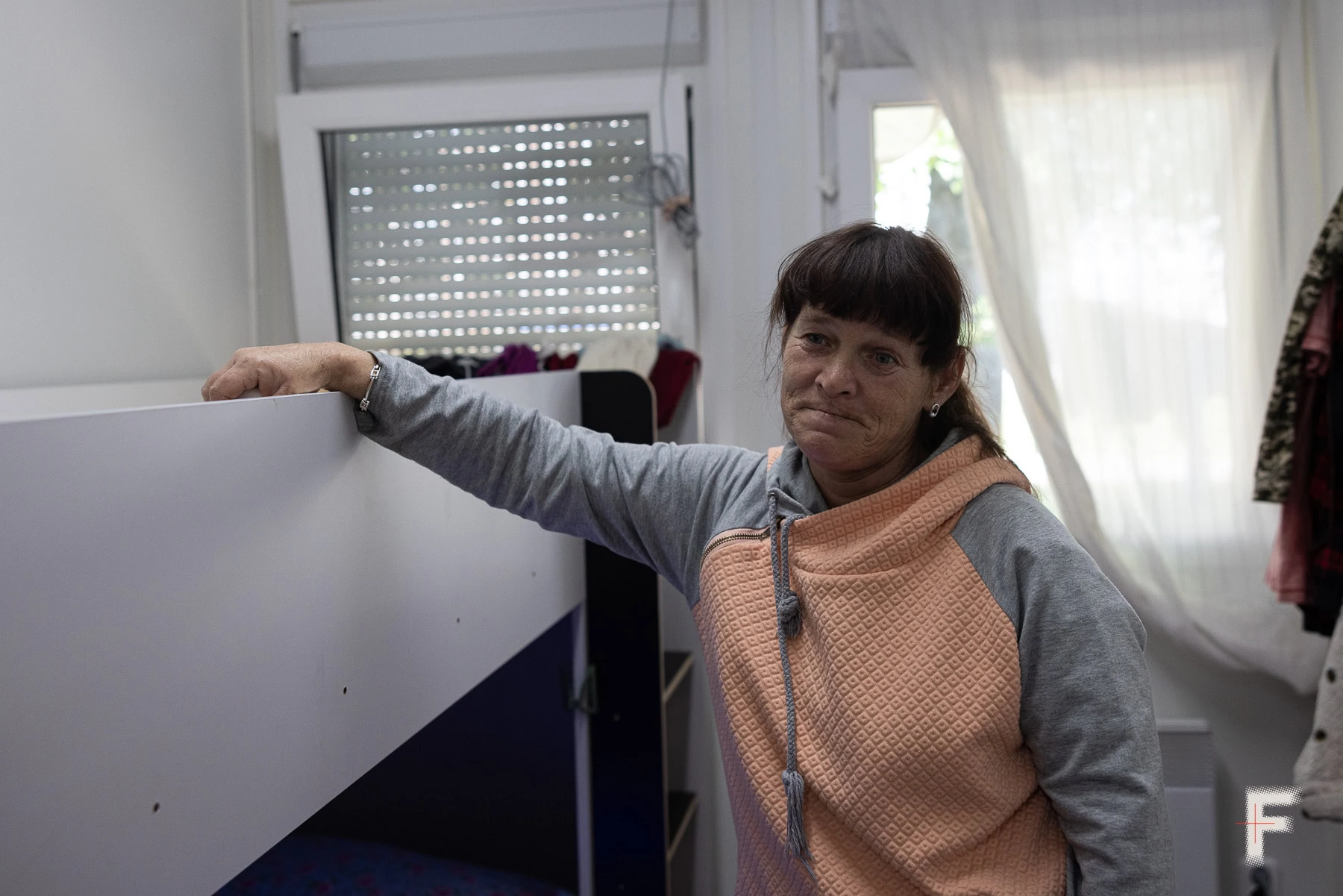
“My son was in the Territorial Defense. Because of that, I was in their ‘red folder.’ They were looking for me. After holding me for two days at the Bilozerka police station, they beat me and knocked my teeth out. I was interrogated while my entire house was turned upside down as they searched for evidence,” Maryna says.
The only thing that saved her, she explains, was a woman she knew at the village council who helped her get a document claiming her son was a humanitarian volunteer, rather than military personnel. Had it not been for that, Maryna is certain, they might not have let her go, or they would have arrested her.
However, even after de-occupation, life in the Kherson region grew increasingly dangerous: Russian drones flew right over the houses.
After the New Year, the drones started flying much more frequently.
You’d step out onto the porch, and one would already be hovering right above you.
We would hide under the trees as long as they still had leaves.
Then we were hiding in the basement.
There were constant power outages,
Even so, she held out until the absolute last moment. Eventually, the military forcibly evacuated her. First, she was taken to Mykolaiv, and from there, her sister helped her move to the Kyiv region.

To scrape together some money, Maryna immediately found a job. Today, she works as a packer. She sends almost her entire paycheck back to her family in the Kherson region, where her son, nephew, and daughter-in-law remain. Maryna points out that getting aid in the frontline villages is getting harder by the day.
“They used to bring humanitarian aid all the time, delivered bread,” she explains. “But now, it’s dwindling. The small villages are practically forgotten. People are just surviving however they can.”
Despite everything Maryna has been through, her mind is always on home. She says she cannot get used to life in Kyiv. Her only wish is for her son to survive and to finally be able to go back home.
“All I want is for my child to be taken off those combat missions and given proper medical treatment. And for us to simply go home,” Maryna says.
Life after losing a home in Bakhmut
Among the residents are also those who lost their homes to the hostilities in the Donetsk region. One of them is Oleksandr Bondarenko, an internally displaced person from a village near Bakhmut.
Prior to the full-scale invasion, he led a quiet rural life: he worked alongside his father at an agricultural enterprise, ran his own homestead, and tended to an apiary. However, since 2022, his life has turned into an endless series of relocations and evacuations.

“We evacuated right at the start of the war,” Oleksandr recalls. “I had my little boy with me, and we found ourselves in Kramatorsk. I still remember the missile strike on the train station. For two days afterward, I could barely see anything, just silhouettes. It took a massive toll on me.”
Their house was eventually destroyed. He says the family tried to start over. They rented an apartment near Mykolaivka, bought essentials, and hoped the hostilities wouldn’t reach their new home. But eventually, the shelling intensified there, too.
The Russians started wiping out the neighborhoods in Mykolaivka,
where we had been living recently, with guided aerial bombs.
Apartment buildings were crumbling right in front of us,
so we had no choice but to evacuate again,
Oleksandr arrived in Kyiv in March 2026. Now, he lives in the shelter alone, spending almost all of his time in his room: listening to the news, watching YouTube, and occasionally taking the commuter train to see his brother. His children live on their own: his elder son works in Poland, while his younger son is studying and working part-time.
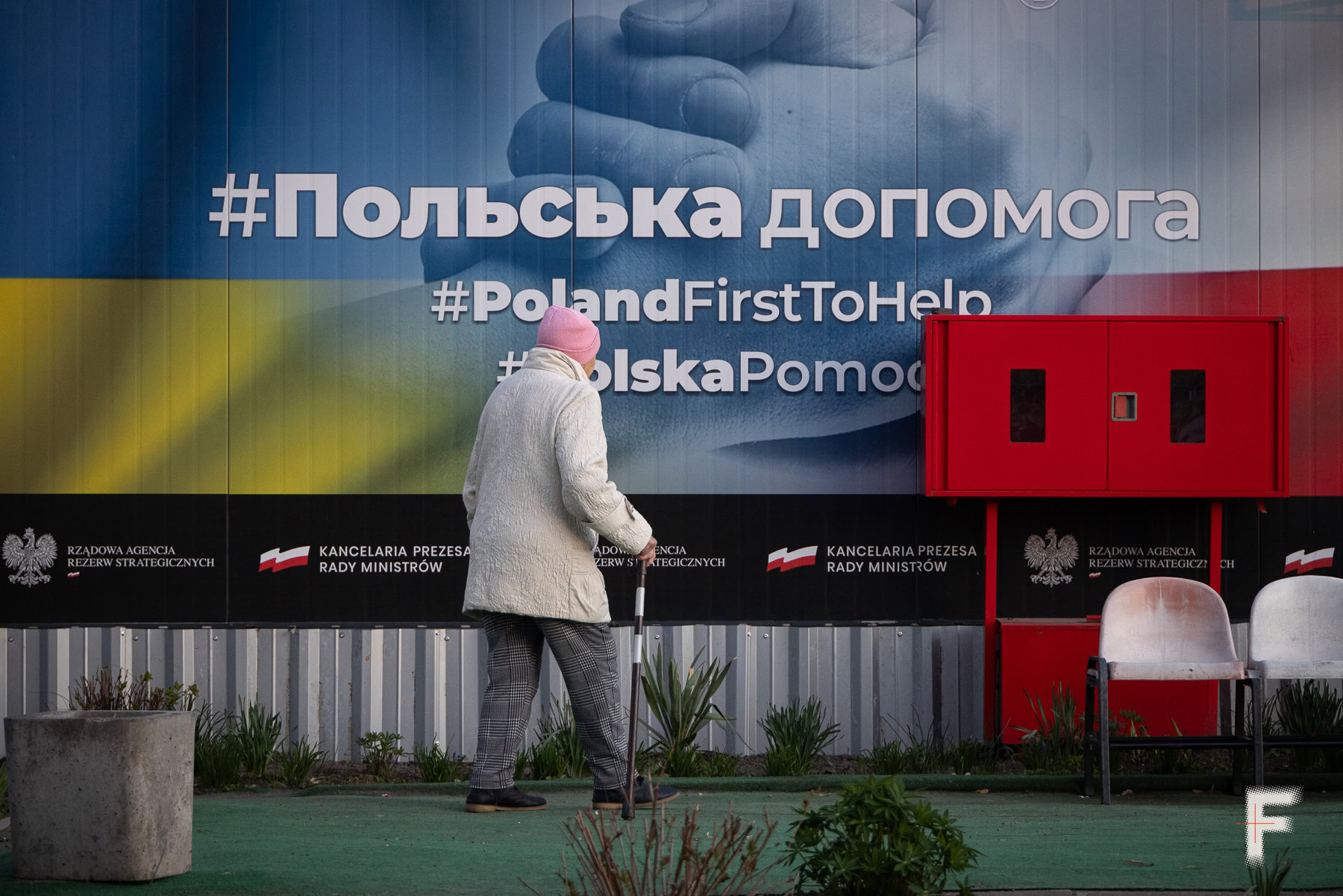
Oleksandr is classified as having a severe disability, as he is practically blind. Because of this, he cannot find a job. He lives on his pension and state displacement payments, but admits that the money is barely enough even for food.
I went hungry for three days. Yesterday, I got my displacement payment,
so I had some bread and tea.
What are 5,000 [hryvnias] worth these days?
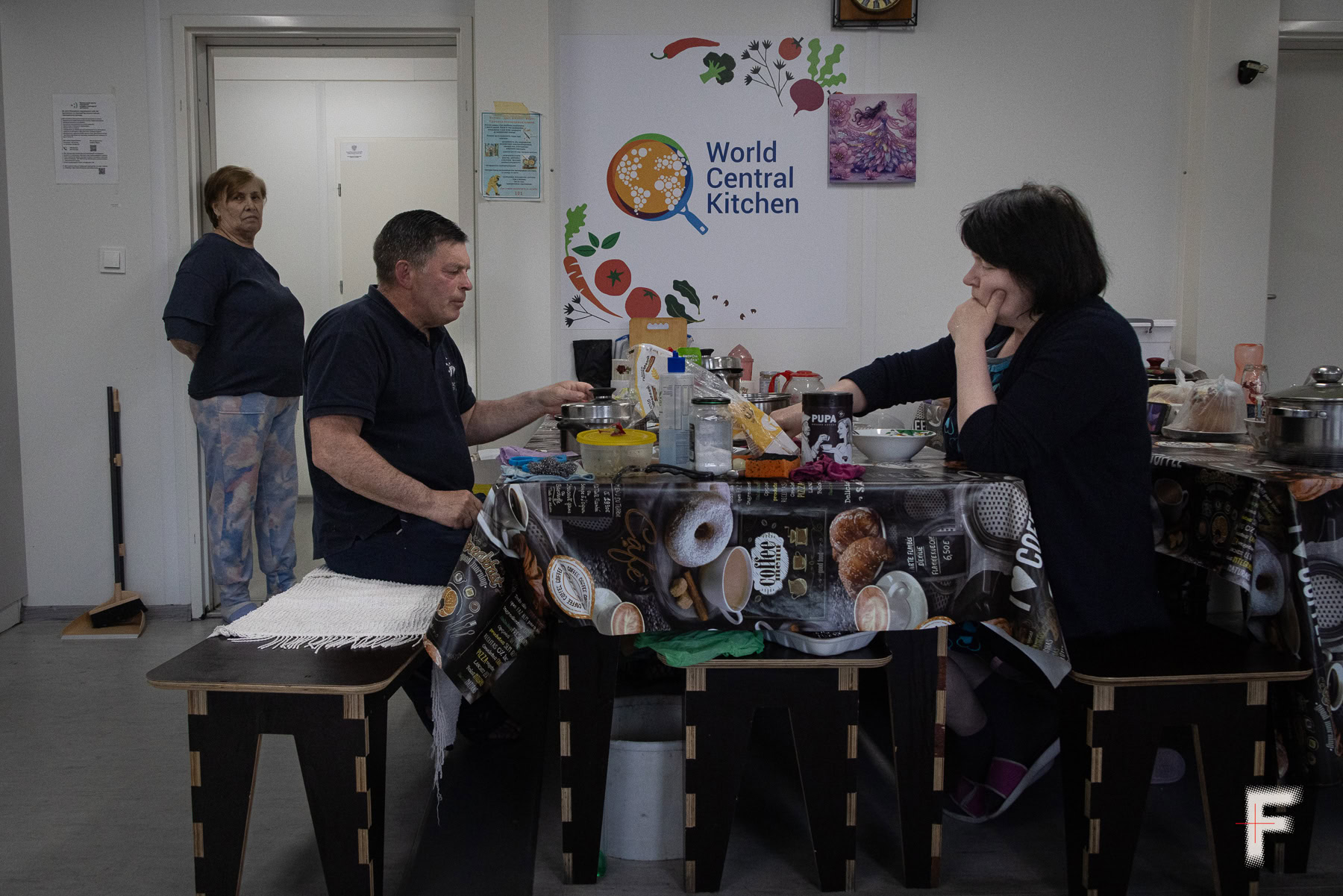
At the shelter, he has only the bare essentials: a few bags of belongings he managed to grab during the evacuation. He says that everything they had built up in the years since they first fled their home was once again left behind under the shelling.
Despite the difficulties, Oleksandr refuses to lose hope. He is waiting for compensation for his destroyed home. If he receives the funds, he wants to buy a small house in a village in the Kyiv region and return to a quiet life, closer to the land and a homestead.
There are almost no personal belongings in the shelter rooms: just a few bags of clothes, children’s school notebooks, medication, and the phones people use to call home every single day. Calling back to the places where Russian drones now fly, and houses lie in ruins.
Most of the residents here refuse to call the Kyiv region their new home. They still speak of the Kherson and Donetsk regions in the present tense, holding onto the hope of one day returning home.

***
The modular housing settlement has become a temporary home for people who were forced to leave their homes because of the war. Despite their strong desire to stay at home, many families moved to relatively safe areas to escape the hostilities and the constant threat to their lives.
The experiences of the settlement residents reveal that evacuation is only the start of another difficult chapter. After relocating, people are forced to rebuild their lives, find jobs and housing, adjust to unfamiliar conditions, and cope with constant concern for family members who have stayed close to the front. For many internally displaced people, the journey is accompanied by uncertainty, the loss of their familiar environment, and the challenge of rebuilding their lives from scratch.
It is important to draw attention to the needs of internally displaced persons, as many of them still require humanitarian, financial, and psychological support.
Every story starts with your support. Join the Frontliner community so we can keep up documenting Russia’s war against Ukraine from the front line and the rear.
***