From mechanical feet to bionic arms: How to get a prosthesis free in Ukraine
More than 44,000 people have received prostheses under the state program since the full-scale war began. Ukraine now fits mechanical and bionic devices, and since September 2026 the state also pays for osseointegration, a procedure that anchors an implant directly in the bone. Frontliner examined which prostheses are available in Ukraine, how to obtain one free of charge and when care abroad may still be needed.
Prosthetics begins before the first fitting. After a wound heals, a person needs pre-prosthetic rehabilitation, in which specialists work on swelling, scarring, joint mobility, muscle strength and the shaping of the residual limb. Treatment includes physical exercises, compression therapy and scar massage, and patients are taught how to care for the residual limb.
A person should already start looking for a prosthetist and a prosthetics facility at this stage. The device is chosen based on the level of amputation, the condition of the residual limb, physical activity and daily needs. Two people with the same amputation may receive different prostheses: One may need to get around the city and work in an office, while another may need to cross rough terrain or do physical labor.
From mechanics to bionics
Ukraine fits prostheses for upper and lower limbs at various levels of amputation. For legs, prostheses are made after amputation of the foot, lower leg or thigh; for arms, after amputation of the hand, forearm or upper arm. Both mechanical systems and externally powered devices are used. The state system covers initial and high-function prosthetics, as well as subsequent repair and replacement of devices.
A high-tech prosthesis can have electronic control. For a lower limb, that might be a microprocessor-controlled knee that responds to the person’s movement. For an upper limb, it might be a powered hand or other components that allow different types of grip. Bionic prostheses are also available through the state system.
When a socket doesn’t fit
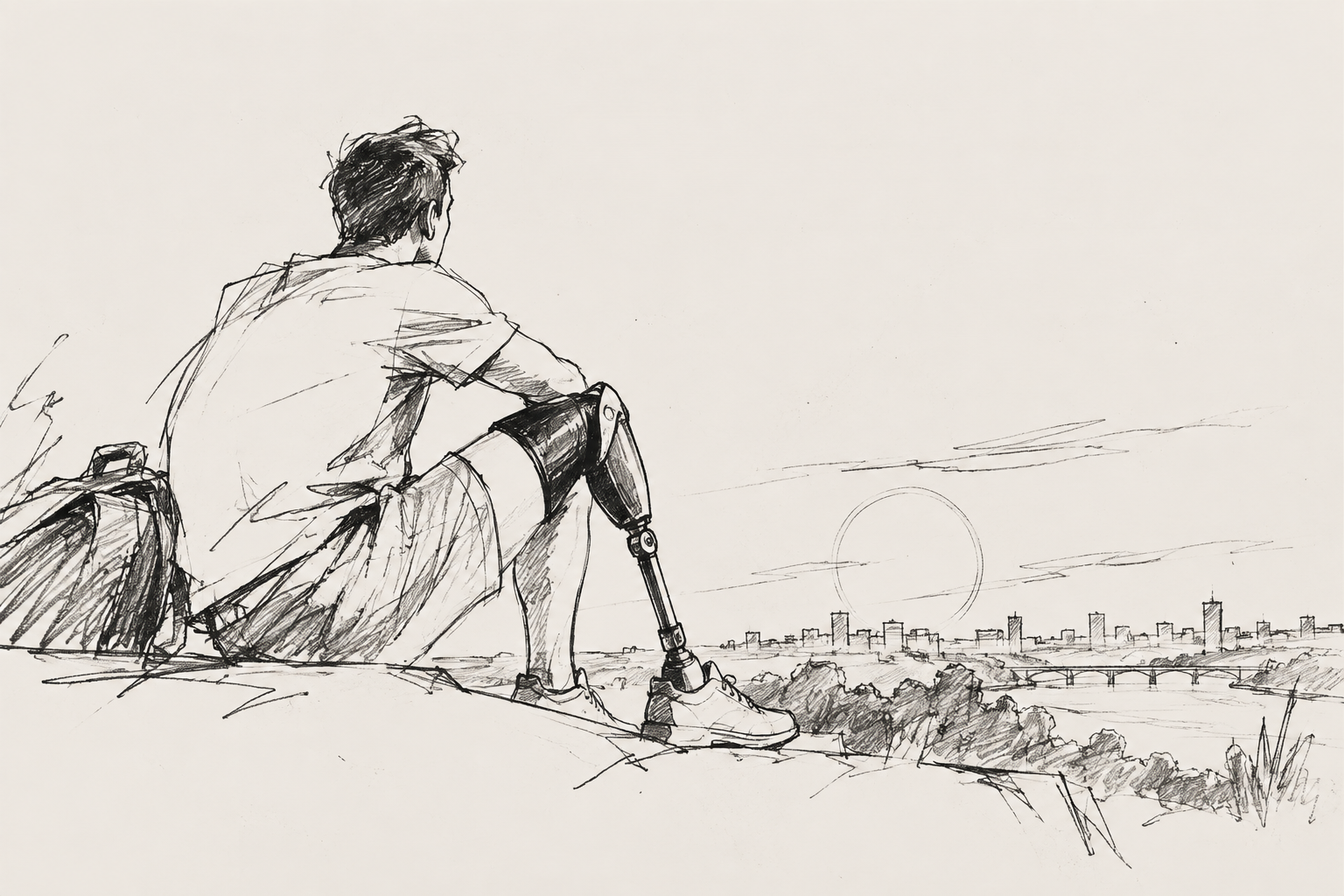
Osseointegrated prosthetics is a separate approach. A special implant is placed in the bone, and the external part of the prosthesis is later attached to it. The first such operations in Ukraine were performed in 2023, and as of April 2026, Ukrainian doctors had performed 101 osseointegrations.
In September 2026, the government launched a two-year pilot program in which the state pays for this method. It is intended primarily for people with short or deformed residual limbs after thigh or upper-arm amputations who struggle to use a conventional socket because of pain, scarring, dermatitis, ulcers and other problems. The National Health Service of Ukraine (NHSU) pays a supplement of 1.2 million hryvnias for a direct skeletal attachment system.
Osseointegration is not suitable for everyone. Before surgery, a person must undergo medical screening and obtain opinions from two prosthetics facilities on whether conventional noninvasive prosthetics could be used.
Which prostheses aren’t available in Ukraine
There is no universal list of amputations for which a person must go abroad for a prosthesis. Ukrainian facilities work with upper- and lower-limb prostheses, high-function devices and bionic systems. Some components are manufactured abroad, but the prosthesis is assembled, fitted and maintained in Ukraine.
The need for treatment or prosthetics abroad may arise in some complex cases, when the necessary technology or the capacity to provide appropriate care is not available in Ukraine. The complexity of a prosthesis alone, therefore, does not mean a person needs to go to another country.
This matters for long-term use as well. A prosthesis needs adjustment and repair, and because the volume of the residual limb changes, the socket sometimes has to be modified or replaced. That is why the Fund for the Social Protection of Persons with Disabilities advises patients to consider a facility’s location when choosing one, along with how easily they can see specialists there regularly.
How to get a prosthesis free of charge
Initial prosthetics under the state program involves several steps:
- Confirm the medical need. Depending on the situation, the need can be confirmed by a military medical commission, a medical advisory commission, a multidisciplinary rehabilitation team or an expert team for assessing daily functioning.
- Submit an application. This can be done through an administrative services center (known as TsNAP), a social protection office, a regional office of the Fund for the Social Protection of Persons with Disabilities or online.
- Choose a prosthetics facility. The choice is the patient’s own.
- Get measured. The prosthetist determines the required configuration and agrees on the order with the patient.
- Attend fittings. The prosthesis is adjusted and fine-tuned.
- Learn to use it. Prosthetic rehabilitation is part of the initial prosthetics process.
- Receive the prosthesis, then seek maintenance and repairs as needed.
A person can also switch facilities for repairs. If a prosthesis needs repair or a new socket, the person has the right to use another facility that performs such work under the state program.
Out-of-pocket costs
Prosthetics under the state program is free for patients. The state pays to make the prosthesis within a defined configuration, as well as for its maintenance and repair. Combat veterans have separate options for obtaining high-function and sports devices.
A prosthesis has a set service life: three years for a functional or cosmetic prosthesis for one limb and five to six years for a high-function one. If two or more limbs are fitted, the periods are shorter. When the service life ends, patients can receive a replacement.
It makes sense, therefore, to check what the state program covers before raising money for an expensive prosthesis. Bionic systems, electronic components, sports prostheses and, since September 2026, even osseointegration can already be state-funded.