One date on all the graves: Life in Hroza after a Russian missile strike
In Hroza, the streets stand empty and the yards are overgrown, and in the cemetery dozens of graves share a single date of death. On October 5, 2023, a Russian missile killed 59 villagers who had gathered for a memorial dinner. Before the tragedy, 330 people lived in Hroza; now, locals say, only about 70 remain. Frontliner went to the village in Kharkiv region to speak with those who survived the strike and lost the people closest to them.
The road to Hroza has to be driven fast, with one eye always on the Chuika, a drone detector. The village sits close to the front, and Russian first-person-view (FPV) drones threaten the locals and anyone on the roads around it. Now and then, through the static on the Chuika’s screen, fields and roads surface. One of them leads to Hroza.
The bus stop comes into view before you even reach the turn into the village. A poster covers its entire inner wall: “Killers have a name.” It shows a portrait of Volodymyr Mamon, and beneath it, a line saying he killed 59 of his own neighbors for money from Russia.

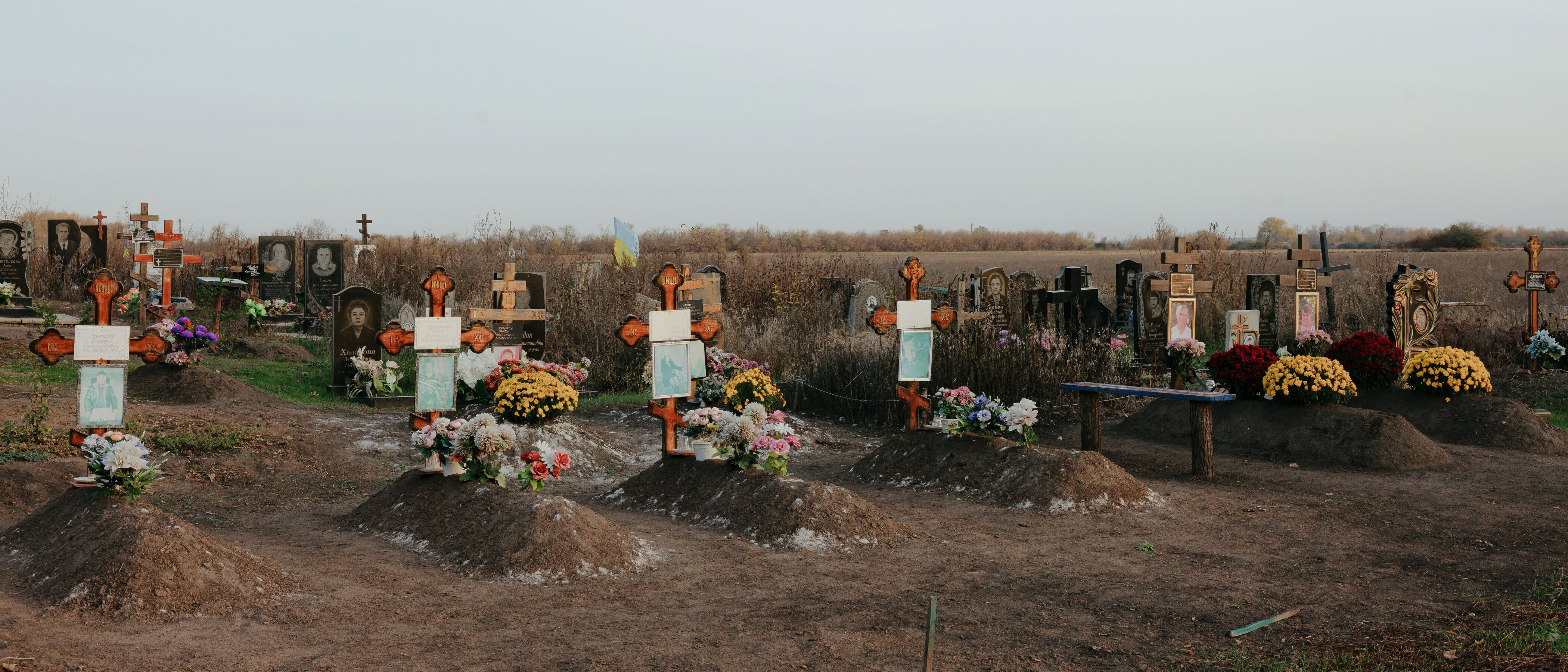
The cemetery sits just past the turn. It’s small, but many new graves have been dug since October 5, 2023. The same surnames repeat across the headstones — whole families, several generations of them, buried side by side, people of every age who died on one day. “Your eternal rest is our eternal pain,” reads one stone. Grass has grown thick between the graves.

The road carries on into the village, where the wind moves through empty streets. By one of the houses, a woman pushes a man in a wheelchair; they’re on their way to the small village shop, where Hanna Kudriashova is behind the counter. A big black-and-white dog named Adam lies beside her.
‘Before the full-scale war, we were one’
Before the full-scale war, people in Hroza were always dropping in on one another, marking birthdays together, cleaning up the village each spring. After work they would set out a shared table. They played volleyball, tended their homesteads, and were always ready to lend a neighbor a hand.
“Before the full-scale war, we were one,” Hanna says. “See the overgrowth? We never had anything like that before.”
On October 5, 2023, people gathered at the Suputnik cafe for a memorial dinner honoring Andrii Kozyr, a Ukrainian soldier who had been reburied in his home village of Hroza. A Russian missile struck the building while they were inside. Fifty-nine of them were killed.
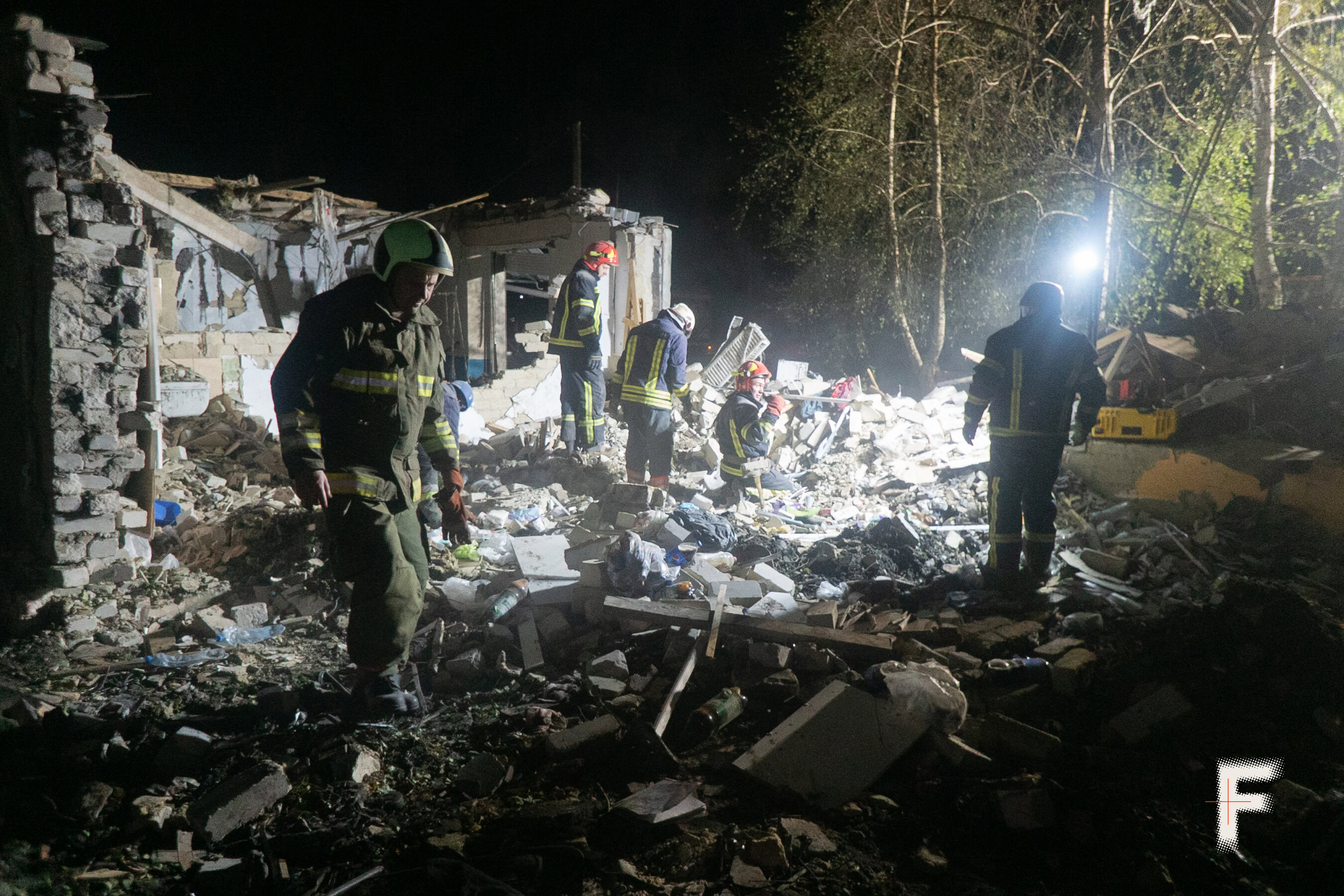
According to law enforcement, it was two brothers who passed the time and place of the memorial gathering to the Russians: Volodymyr and Dmytro Mamon, former residents of Hroza. Under the occupation they had sided with the occupiers, and when Kharkiv region was liberated, they fled to Russia.
Among the dead was Hanna’s brother, Ivan Yaremenko, who had been defending Ukraine since 2014. In 2023 he was wounded by a mine, losing an eye and suffering a broken leg. He’d had surgery the day before the memorial dinner and was getting ready to return to his unit.
Can you imagine,
he went through so much war — and then died at a funeral,

The man in the wheelchair had stayed in the shop the whole time. He tried to join in, but speaking came hard, and the woman with him helped him to express himself. Once they left, Hanna told his story.
His name is Valentyn. The Russian strike took his wife and other family members. Before the tragedy, Hanna says, he was lively and hardworking. After losing them he fell silent, kept away from people, and wouldn’t talk about what he’d lived through. If someone put on music and a song his wife had loved came on, he would ask them to turn it off.
Later came a stroke. Now Valentyn can’t walk and barely speaks.
Hanna had known the Mamon family since she was a child. They lived next door to the Kozyrs, and their sons were close with Andrii Kozyr.
Talk turns to the Mamons. Hanna had known the family since she was a child; they lived next door to the Kozyrs, and their sons were close with Andrii Kozyr
She remembers the brothers’ parents as hardworking people who never turned down a request for help. Their father, Serhii, worked the collective farm as a tractor driver.
“They were a good family. I can’t say a bad word about them,” Hanna says.
The Mamon brothers left Hroza in early September 2022, as Ukrainian forces liberated it. Later, law enforcement says, they handed the Russians the details of the memorial dinner. Among the 59 dead were their old neighbors and friends — people they had lived alongside almost all their lives.

Hanna still can’t make sense of how people she grew up with, people she’d lived beside all her life, could do such a thing.
“I’m not one for talking myself. It’s only because you’ve asked. Aunt Toma lives on down the way. One of the survivors. She can talk to you too. Right, Adamushko?” Hanna turns to look at the dog, who ducks behind the counter and heads off somewhere, sure of where he’s going.
‘That boy never leaves my mind’
Tamara Korkh’s husband opens the gate and greets us with a smile. He calls for his wife and waves us in. A moment later Tamara steps out of the house.
“What, journalists again? Enough already! Old man, put the kettle on! Come in, come in,” she says with a broad smile.

At Andrii Kozyr’s memorial dinner, Tamara sat at the table next to her neighbors. They were talking when one of the women asked her for something to drink, and she poured it. It’s one of the last things she remembers before the strike.
She remembers eight-year-old Vania too. He was at the table as well, eating borshch.
That boy… he never leaves my mind.
Sitting there, eating that borshch
like it was the best thing in the world,
Vania was killed. His mother survived but was severely wounded.
Tamara doesn’t remember the strike itself. One moment she was at the table, she says, and the next she was lying in a heap of rubble as people were digging her out. She suffered a wound to her arm, fractures to her shoulder blade and her leg, and burns across her back. Shrapnel is still lodged in her head; doctors left one piece where it was, since taking it out would have meant a craniotomy.

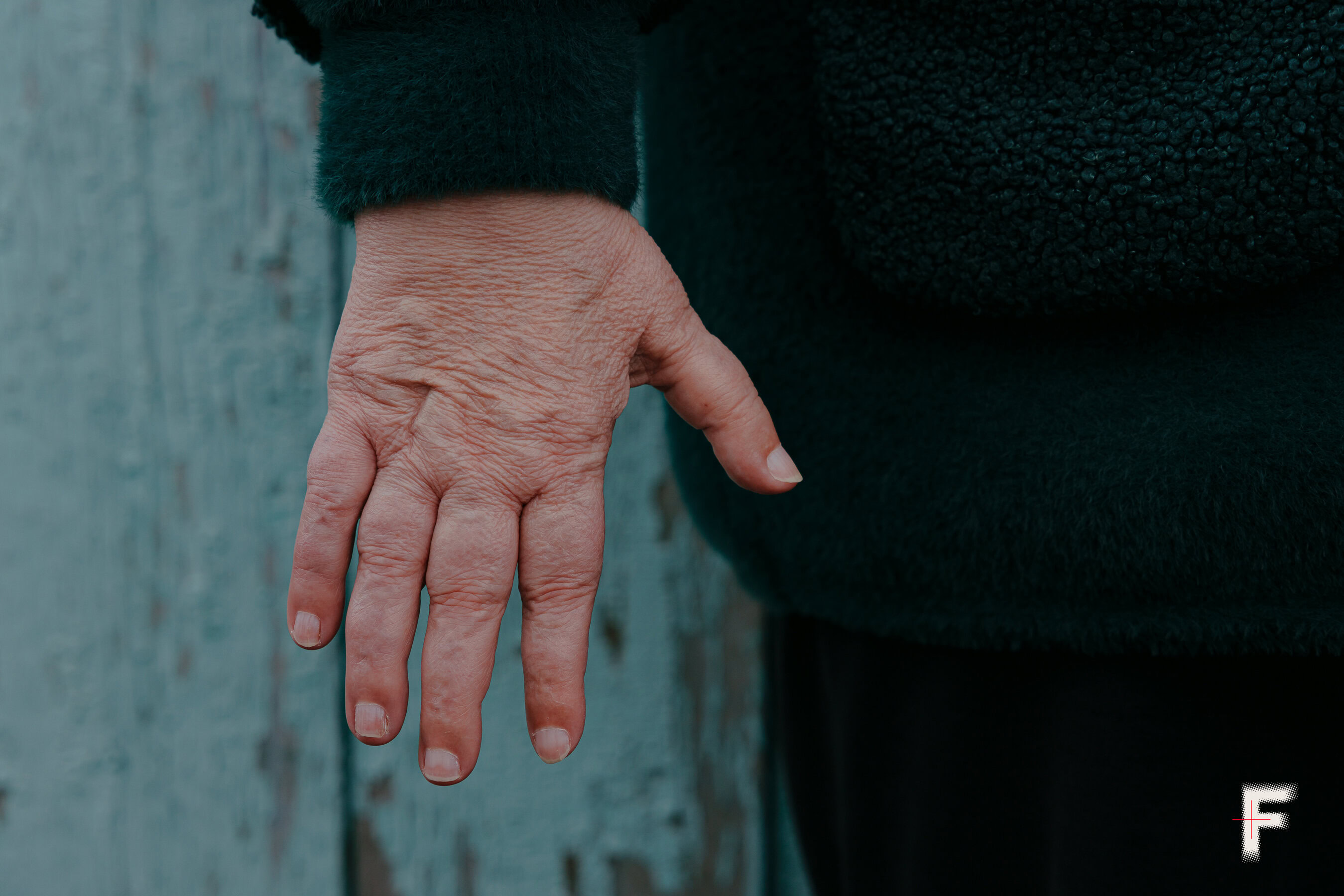
After the strike, Tamara spent a long time in treatment and rehabilitation. Her arm still doesn’t bend well, and many everyday movements don’t come easily. Little by little she learned again to do up a zipper, peel potatoes, chop vegetables, and even pinch varenyky.
“I do everything. You see? I make varenyky, I peel potatoes. I do it all, all of it,” Tamara says.
Tamara isn’t just back to running the house; she’s back on her bicycle, steering with her wounded arm.
While Tamara talks, her husband Oleksandr fusses at the table, brewing tea, cutting the pastries, fetching candy, handing her whatever she asks for.
Oleksandr wasn’t there when the missile hit the cafe. He came searching for his wife but couldn’t find her in the ruins; for a while he didn’t even know whether she was alive. It was only later that their children called to say she was being taken to the hospital. Tamara was treated in Kharkiv, and Oleksandr made his way to her there.
Not long ago, an explosion sounded nearby again. Tamara started screaming and crying. Oleksandr asked what was wrong, but she couldn’t explain it even to herself.
“It’s lodged somewhere deep. I don’t know when it will go away,” she says.
Across the road from Tamara lives Volodymyr Mukhovatyi. On October 5 he stayed home while the rest of his family went to the cafe — his wife, his son, his daughter-in-law. None of them came back.
Two years short of their golden anniversary
He hears the voice of his wife, Tetiana: “Volodia, Volodia!” He wakes, thinking she has really walked into the house.
“I shot straight up: ‘Tania, is that you?’” he says. These past six months, his wife often comes to him in his dreams. Volodymyr hardly goes to the cemetery anymore. Those around him talk him out of it, afraid he won’t bear the grief and will drive himself to his death.

Volodymyr is 72. He sits on a bench by the road, a little lost in thought, a ginger cat winding around his feet. He and Tetiana had nearly half a century together. The way he remembers it, she looked after everything: she made sure he was fed and neatly dressed, and that all was well at home.
They kept a big homestead and worked the vegetable garden. In the evenings they’d come out to sit outside, on the same bench where Volodymyr now sits alone.

They were already making plans for their golden anniversary. Fifty years together was just two years away.
“I had a good life with her. We were getting ready for the fifty years, you know, the golden wedding. Two years we had left,” Volodymyr says.
His son and daughter-in-law had been living in Kupiansk, and shelling was destroying their home. The son came to him to talk through what to do next. Volodymyr knew it was dangerous to stay there, but he had no idea where else they could go. In the end, the couple moved to Hroza.
On October 5, 2023, Volodymyr stayed in to watch television. Tetiana meant only to look in briefly on the memorial gathering at the Suputnik cafe.
She comes into the room, he remembers. “Volodia, are you going to the funeral?” “No, Tania, I don’t want to, I don’t like these gatherings,” he tells her. “Well, I’ll just run across the road and come back,” she says.
Tetiana never came back. His son and daughter-in-law died that day along with her.
“And so you’re left all alone at seventy-two… How do you go on?” he asks.

Twenty-eight people from Volodymyr’s street died that day — neighbors, friends, people he loved. He once had seven kumy. Not one of them is left.
[Editor’s note: Kumy (singular kum) are a form of spiritual kinship in Ukrainian tradition: a lifelong, reciprocal bond usually formed at a baptism between a child’s parents and godparents, or during other important family events. It is treated as a close family tie.]
When we finish talking, Volodymyr walks out to the middle of the wide road to see us off, the ginger cat still next to him. He smiles, lifts a hand, and says: “Come again.”
It’s about a 10-minute walk from his house to the street where the cafe once stood.
‘It’s scary, but not unbearable’
There’s a shop not far from where the Suputnik cafe used to be. Behind the counter is Olha, who has spent most of her life in Hroza. She won’t give her surname, and her answers come short, without detail.
On the day of the strike, Olha might easily have been inside the cafe. As she worked at the shop next door, she and her coworkers would sometimes help the Suputnik staff when big orders came in. But that day was her day off. She offered to come in anyway; the cafe workers told her they’d manage and waved her off.
“I’ve got a guardian angel,” Olha says with a sigh.
She remembers the burials. Some of the dead weren’t brought home at all and were taken directly to the cemetery. Some days there were two or three funerals.

She talks about an 11-year-old girl who lost her mother, father, grandfather, and grandmother in the strike.
I’ve never seen anything like it before,
and I hope I never do again,
Olha has thought about leaving Hroza. For now the shop is the reason she stays.
“There’s still life here. There’s work, for now,” Olha says.
“It’s scary, but not unbearable,” she says.
Next to the shop, on the spot where the Suputnik cafe once stood, there’s a memorial. The names of all 59 of the dead are cut into the granite. Flowers and toys lie at its base.

Two women stand at the memorial, looking at the stone in silence. Then one of them says they’ve come to honor her mother, killed here on October 5, 2023.
Today would have been their mother’s birthday.
***
Frontliner is independent. Our readers help fund our reporting on the war and the people living through it. Subscribe on Patreon to keep us on the road.
***