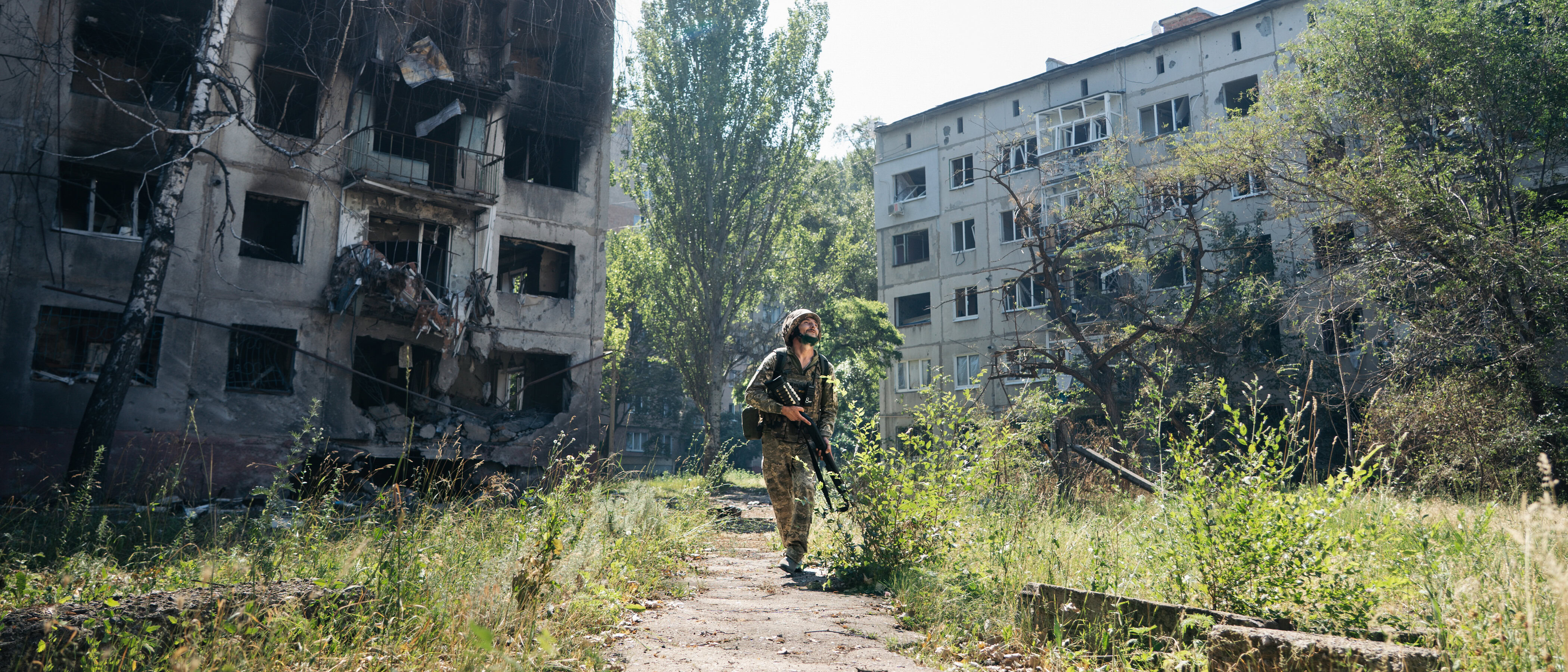
Next after Kostiantynivka: Industrial Druzhkivka is no longer the rear
Druzhkivka has turned into a "kill zone" where Russian forces attack with glide bombs, as well as rocket and tube artillery. In the pauses between bombardments, FPV drones and other types of UAVs fly in swarms. Their targets are civilian and military vehicles. Accompanied by troops from the 44th Mechanized Brigade, Frontliner reporters visited Druzhkivka to capture how the city is changing as the front line approaches.
There is no place where
you can feel safe and rest.

Preparing to leave for Druzhkivka means gearing up with body armor and helmets while still in Kramatorsk. The distance between the cities is only about 15 kilometers, a drive of under 20 minutes. Soldiers joke that if you order hot takeout in Kramatorsk, it won’t even have time to cool down by the time you reach Druzhkivka.
“It takes a psychological toll,” admits a serviceman who goes by the call sign Hai. “Kramatorsk is considered the rear; it’s the largest city in the Donetsk region still under our control. In the morning, you go out for coffee and run daily errands. But when you get ready for a mission, you put on your armor right here. There are anti-drone nets all around here, too. There is no place where you can feel safe and rest.”
On the way out of Kramatorsk, a typical scene of a Ukrainian frontline area unfolds before your eyes: an anti-drone corridor, burned cars along the roadsides, and checkpoints, most of which are destroyed. The only thing that distinguishes the Kramatorsk district from others is the flow of civilian vehicles moving along the highway. There are more of them here than in other directions. This still gives the city a rear-area feel, because despite the worsening security situation, logistics between Kramatorsk and Druzhkivka remain viable.

The city has been looted
The soldiers drive us in an armored vehicle to one of the outermost streets of Druzhkivka in a residential neighborhood. From there, the route continues on foot. At first glance, it seems like a quiet street that has miraculously escaped destruction. But suddenly, a man’s voice rings out from behind:
“You want to see what’s being done to the city? Well, they are looting the homes, stripping them of everything they can carry. Look, film this!” he says loudly.

Without bothering to introduce himself, he takes the lead to show the houses that, according to him, were robbed by locals. The journalists follow him, trying to ask questions.
“What’s your name?”
“Do you really need to know that?”
“Of course.”
“Oleksandr Serhiyovych.”
“Could we get your last name?”
“Oh, no. You’ll go broadcasting it on the news. I don’t want my last name out there.”
As the man talks about the looters, the buzzing of an FPV drone can be heard from the sky. The soldiers ask everyone to take cover under the trees. But their calls do not stop the man. He keeps walking as if there is no threat.
Looking back, he explains that he is the only one left on this street. He says he looks after not only his own house but also the homes of the neighbors who have left. He enters one of the battered houses. The windows are blown out, the walls are damaged, and shards of glass and broken furniture are scattered across the floor.
So many people have evacuated,
which is why looting has surged in recent months.
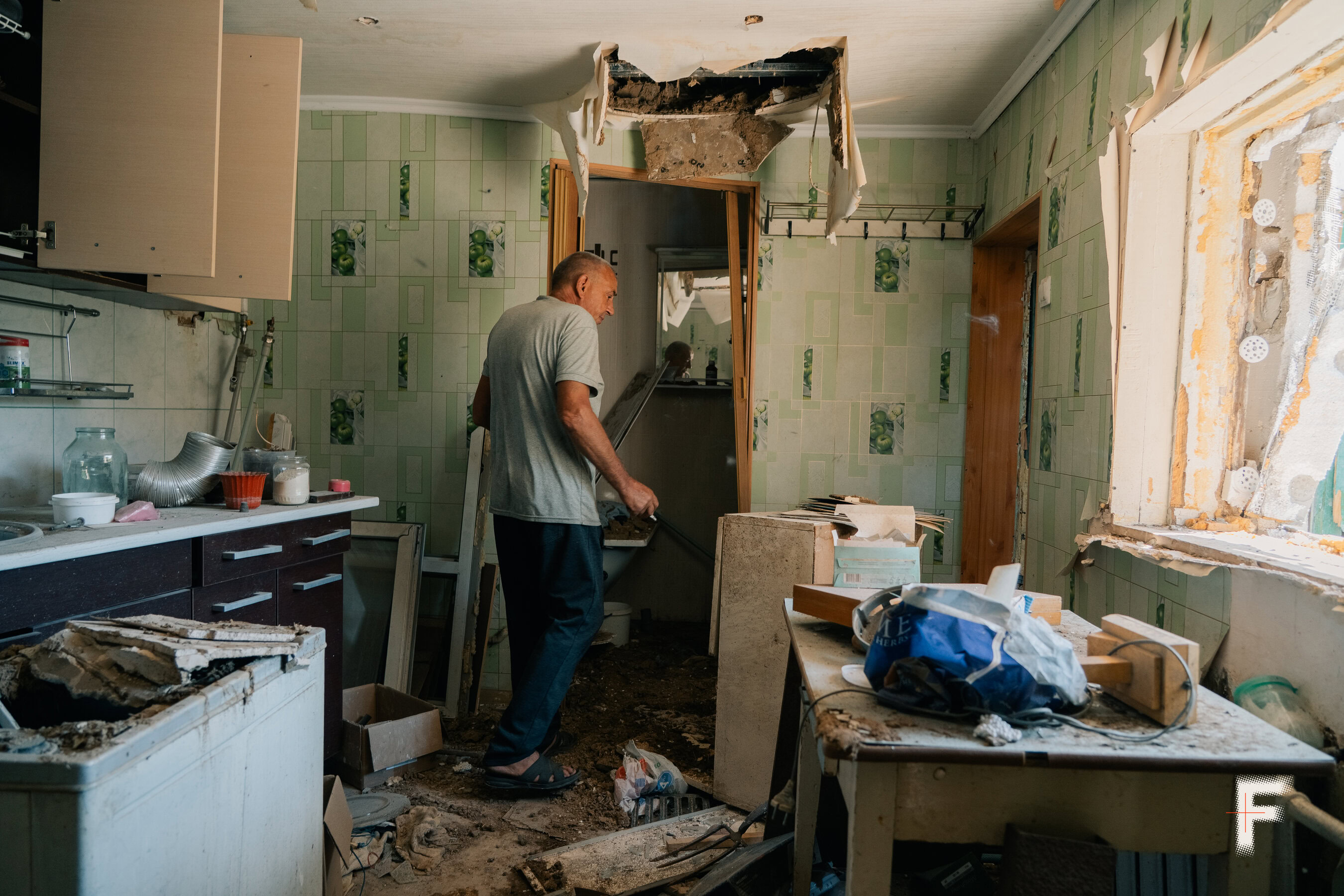
“There’s still a washing machine and a new table in here,” the man points out. “Give it two days, and they will be gone. They [looters – ed.] strip these places of everything. They’ve already picked clean every unlocked house on the street. So many people have evacuated, which is why looting has surged in recent months.”
The path to the central district passes through the city’s industrial area. Along both sides of the road stand buildings that are either partially damaged or destroyed down to their foundations. Across the street, two men walk in silence with their hands full of belongings. One is carrying a large painting, while the other pushes a bicycle loaded with packages. The entire city is covered with anti-drone nets, in which the remains of FPV drones are still hanging. The streets are almost deserted.

“The curfew ends at 11 a.m.,” says a soldier with the call sign Oz. “That is when people come out of their homes. There is a store open in the center, so everyone gathers there. The curfew starts again at 3 p.m. So, right up until three, you can find locals on the streets.”
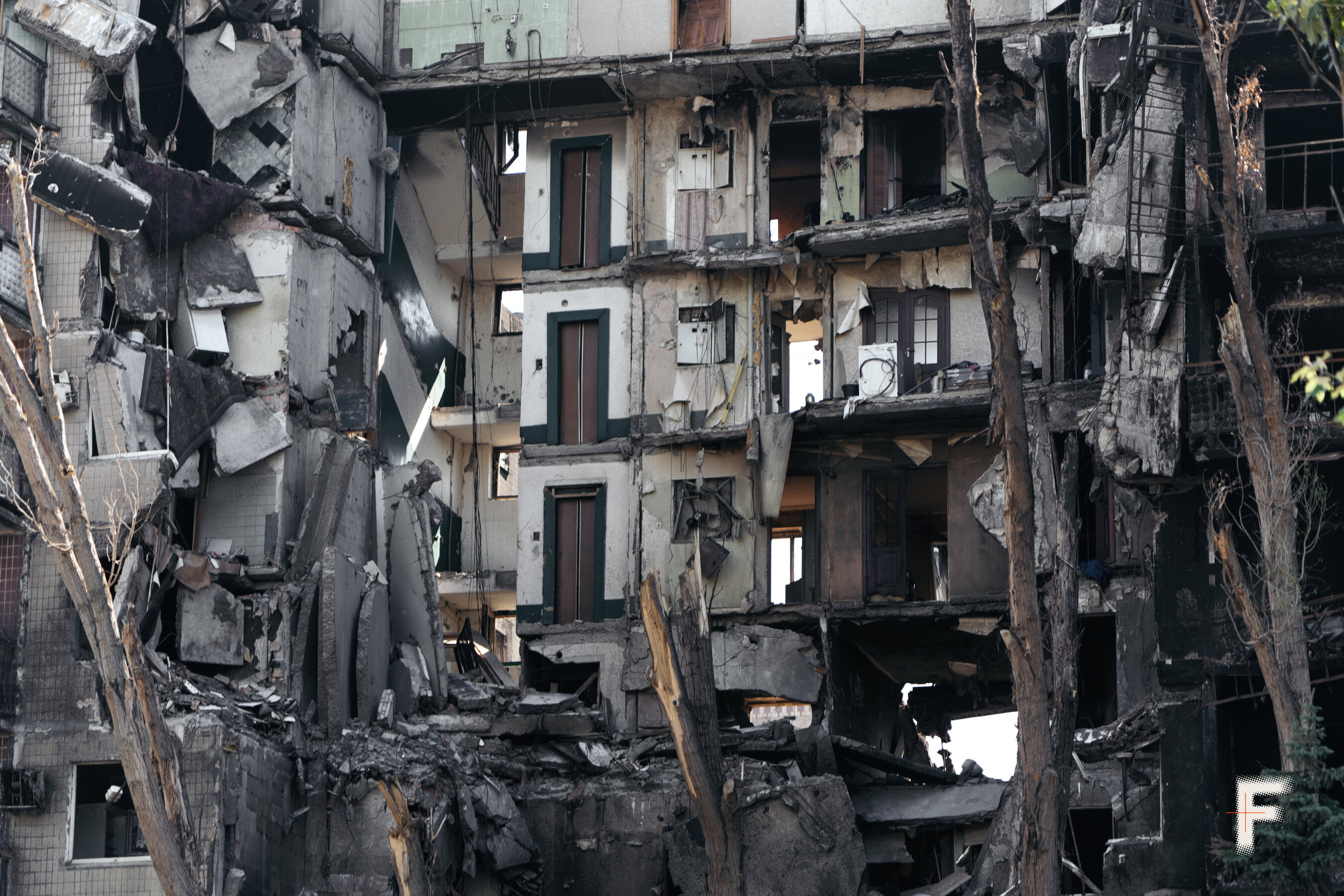
The central neighborhoods take the heaviest pounding from glide bombs, as well as rocket and tube artillery. In the pauses between these attacks come the FPV drones. On one of the streets, a house is on fire.
The city has been abandoned.
The city council is gone. Everyone fled.

Nearby, an elderly man silently watches the flames. The only thing that forces him to look away is a question from the journalists:
“Is this your house?”
“Not mine. But it used to be a home. Now it’s gone. There are no police. No firefighters. Nothing. The city has been abandoned.”
“Who abandoned it?”
“Well, the city council is gone. Everyone fled. Who are you, anyway? Reporters?”
“Yes.”
“Then watch closely, so this never happens in your country. You’re taking photos, so maybe they’ll be useful for history someday.”
“What’s your name?”
“Doesn’t matter. I live nearby, on Molotova Street. Tomorrow, the same thing could happen to me. I see this every single day. These drones are on the hunt every day.”

The man turns around and walks away quickly, holding a bag in his hands. Silence falls for a few seconds, broken only by the crackle of the flames and the thud of distant explosions.
“More than likely, it was an FPV strike,” Oz suggests. “If it had been something heavier, the scale of the fire would be entirely different. FPVs hit houses all the time.”
Why Druzhkivka matters
Druzhkivka was considered one of the most industrial cities in the northern Donetsk region. Before the start of the major war, six large enterprises operated here, the most famous being the machine-building plant, the porcelain factory, and the Greta gas appliance factory. All of them suffered destruction from Russian shelling and were relocated.
Today, the surviving buildings serve as shelters from drones. Some of them still feature ceiling moldings, sweeping staircases, and mosaic floors, all of which serve as reminders of the days when these facilities were symbols of industrial development.

Before the full-scale invasion, the city’s population exceeded 50,000 people. As of July 2026, up to 4,000 civilians remain in Druzhkivka. Currently, evacuation is possible only on foot, as any vehicle becomes a primary target for Russian drones.
Druzhkivka had cemented its status as the deep rear, which the city remained until the beginning of the winter of 2025-2026. Half a year ago, soldiers would stop here on their way from combat positions, take off their gear, and turn off the electronic warfare (EW) systems on their vehicles. Coffee shops were open in the central square, with lines forming for coffee and hot dogs.
Defenders say the hardest thing right now is to comprehend how quickly the front line has approached this very place. The distance to the line of contact is about 12 kilometers.
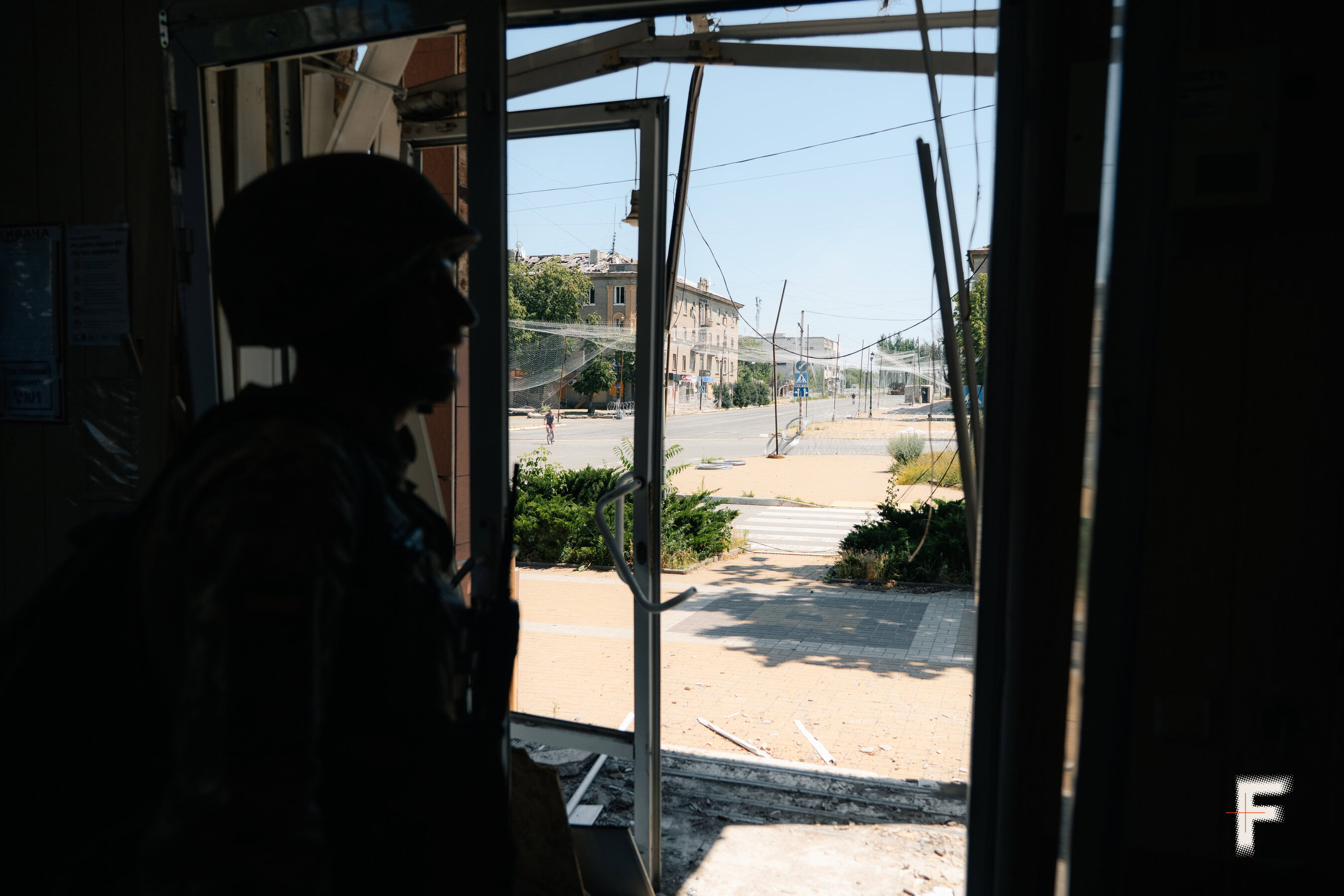
The military started talking about the threat to Druzhkivka when neighboring Kostiantynivka came under constant fire. After capturing the adjacent villages between August and the end of autumn 2025, Russian troops made their first attempts to break through to the outskirts of the city. As of July 2026, heavy positional battles are raging in Kostiantynivka.
The military explains that if it falls, a direct path will open for the Russians to the so-called “fortress belt”: Druzhkivka-Sloviansk-Kramatorsk. These cities are their primary target in the Donetsk region.
The Russians have increased
the flight range of their drones.

“They are hitting Kramatorsk very hard,” says Hai. “This does not necessarily mean that the front has moved closer. The Russians have increased the flight range of their drones, and now they can reach 50 to 100 kilometers from the line of combat contact. But in the case of Kramatorsk, they are primarily trying to take control of logistics. The main H20 highway runs through Kramatorsk, Druzhkivka, and Kostiantynivka. The enemy is trying to deprive us of the ability to travel along it.”
“Why were the Russians allowed to get this close?”
The center of Druzhkivka is deserted and battered. On March 2, 2026, the Russian army struck the civil registry office. A monument to lovers survived nearby. Approaching it is out of the question: the open terrain is a magnet for Russian drones. Their buzzing, along with the gunfire from mobile fire groups, echoes constantly overhead. Metal fences are set up all around. The entire city looks like this.

We are open and
we’ll keep working until the very end,
A few dozen meters from the destroyed registry office, a grocery store is operating. The only sign of life is the hum of a generator. Inside, the shelves are stocked with bread, meat, dairy products, vegetables, and grains. Even a cashless payment terminal is working. The city has long been living without centralized electricity and running water, and cell service is spotty at best.
“You’ll start filming us now, and then we’ll get hit,” the saleswoman says irritably.
A few minutes later, she finally agrees to talk, but refuses to give her name.
“We are open and we’ll keep working until the very end,“ she says. “I walk to work. Deliveries come in daily from Kramatorsk. The store owner lives over there as well.”
People need to eat, so I drive.
The store will not close.
A man approaches the cash register, having earlier brought in several boxes of goods. He hands over documents for a signature. From his conversation with the saleswoman, it becomes clear that he delivers the goods from Kramatorsk.
“I’ll talk to you, but no cameras,” he says in a firm voice.
Once anonymity is agreed upon, the man turns his back to the counter, looks over the shelves of goods, and with a sigh, continues:
“I personally deliver the goods here from Kramatorsk,” he says. “I have a car; the windows are already blown out, it was hit by a drone this week. But it is still drivable. I was slightly injured and got a concussion. Sometimes I make several trips a day. People need to eat, so I drive. I take private orders. Locals often ask me to bring something specific. And the guys [soldiers – ed.] need it, too. When they come off their positions, they stop by and buy energy drinks and food. The store will not close. And if we can no longer drive, it means we will walk.”

He lives in Kramatorsk. His family evacuated to Dnipro. When asked if he plans to evacuate himself, he gives a short reply:
“No.”
The next question, about whether he fears the Russian troops might push even closer, gets cut off before it can be finished:
“And why are you asking if we are afraid?” the saleswoman interrupts. “Better ask why the enemy was allowed to get here in the first place. Why did the war reach this place?”
Silence falls in the store. Several customers silently pack their groceries into bags, pay, and quickly slip outside.
Beyond the door, a drone is buzzing again.

“Logistics are maintained here despite the danger,” says Hai. “Even Nova Poshta [a Ukrainian private postal service – ed.] is working, although all branches have been closed since early June. I’m not sure how often they do it, but a few times I’ve seen orders delivered to a single drop-off point. People gathered there, received water, household supplies, and everything they needed and ordered. They have to survive.”
“Who is waiting for us and where?”
The route from the store leads to the residential neighborhoods closer to Oleksievo-Druzhkivka. They are considered some of the most dangerous in the city due to their proximity to the front line.

“This is exactly where their drones fly in from, maneuvering toward the city,” notes Oz. “They hunt for moving vehicles. They also perch on rooftops and lie in wait for targets.”
There are almost no people on these streets. Only occasionally, near the apartment buildings, can you see residents stepping out of their ruined apartments for a short time. Near one of the five-story buildings, a small group of people is arguing loudly about something. Miraculously, the entranceway remains intact, even though nearly all of its windows have been blown out. In the courtyard, the shards of glass have been meticulously swept into neat piles. Suspended above the building, tangled in the power lines, hangs a Russian drone.

“Good afternoon! And what exactly are you hoping to see?” says a man with a bandaged arm. “How we are living here in misery? If you’re recording, then record my message: damn everyone who started this war. On all sides! We’ve lost everything we ever had.”
A reporter asks in response:
“Were you wounded?”
“Yes. A drone hit. Fortunately, there were some leftover medicines, so the arm was treated.”
“What kind of drone hit you?”
“A Russian one. Because ours do not have ones that big.”
“Do drones fly here often?”
“Constantly. We see and hear them every single day.”

Like most of the people we spoke with in Druzhkivka, the man refuses to give his name. He speaks emotionally and does not hide his despair. He says he is caring for his son, who has limited mobility. Their supplies of food and medicine are left over from humanitarian aid, which, according to him, stopped being delivered in May 2026. For more than half a year, Druzhkivka has been without water and electricity. He isn’t even considering evacuation. There is simply nowhere to go.
“Who is waiting for us and where?” he says. “I have worked here my whole life. My home is destroyed. I have no relatives anywhere else. Who would need me?”
We are not going to evacuate.
I am afraid that my husband might be mobilized.
Everyone who has stayed in Druzhkivka has their own reasons for not leaving. Iryna Hniezdilova gives only her maiden name. Her daughter lives in Germany, but she herself has no intention of leaving the city.
“We are not going to evacuate,“ she says. “I am afraid that my husband might be mobilized. That is why we are staying home. And then, whatever God wills. Many people are hiding like this here because they are afraid. This is one of the reasons why they do not tell you their names.”
During the conversation, a drone flies over the neighborhood several times. The people raise their eyes to the sky only for a moment, then return to the conversation.
Drones perch on the roofs
The final stop on the route is Kozatska Street. This is Druzhkivka’s outermost neighborhood, opening the way to Kindrativka and Oleksievo-Druzhkivka.

“There are a lot of sleeper drones here,” notes Hai. “They perch on rooftops and on damaged cars. They wait for a vehicle to drive by or for infantry to go on rotation. There are mobile fire groups that shoot them down. When we hear that a drone has landed on a building, we move under the trees. If there is an opportunity, we take it out.”

On the way back, we did not encounter any people. At 3:00 p.m., the curfew began. Serviceman Oz had warned us to be out of the city by 6:00 p.m., because at this time the Russians begin massive bombardments, using glide bombs and artillery.

***
Druzhkivka feels like a punch in the gut. It brings tears and leaves an emptiness inside. There is a heavy and painful silence in the city center. And you understand what it means. The city is preparing to hold back the advancing enemy forces.
The article draws a parallel. Only six months ago, coming back from the front lines through Druzhkivka meant finding yourself in relative safety. You relaxed physically and took off your gear. Then followed the standard procedure: you step into a cafe on Cathedral Square, grab a cup of coffee, and breathe out.
Now, six months have passed. You no longer take off your armor when driving into Druzhkivka. You put it on.
It is no longer a safe rear area. It is the front line.
I am always fiercely protective when I speak about the Donetsk region. It is my home, my roots, and my childhood. The small percentage of cities that remain under the control of the Defense Forces are the very places where I grew up.
Fifteen years ago, I passed through Druzhkivka on my return trip to Donetsk from a children’s camp in Sviatohirsk. The very center of the city where our bus stopped remains burned into my memory. Back then, I could never have imagined that 15 years later, my home would become not just a combat zone, but a place where the fates of human lives are decided.
Every story starts with your support. Join the Frontliner community so we can keep up documenting Russia’s war against Ukraine from the front line and the rear.
***