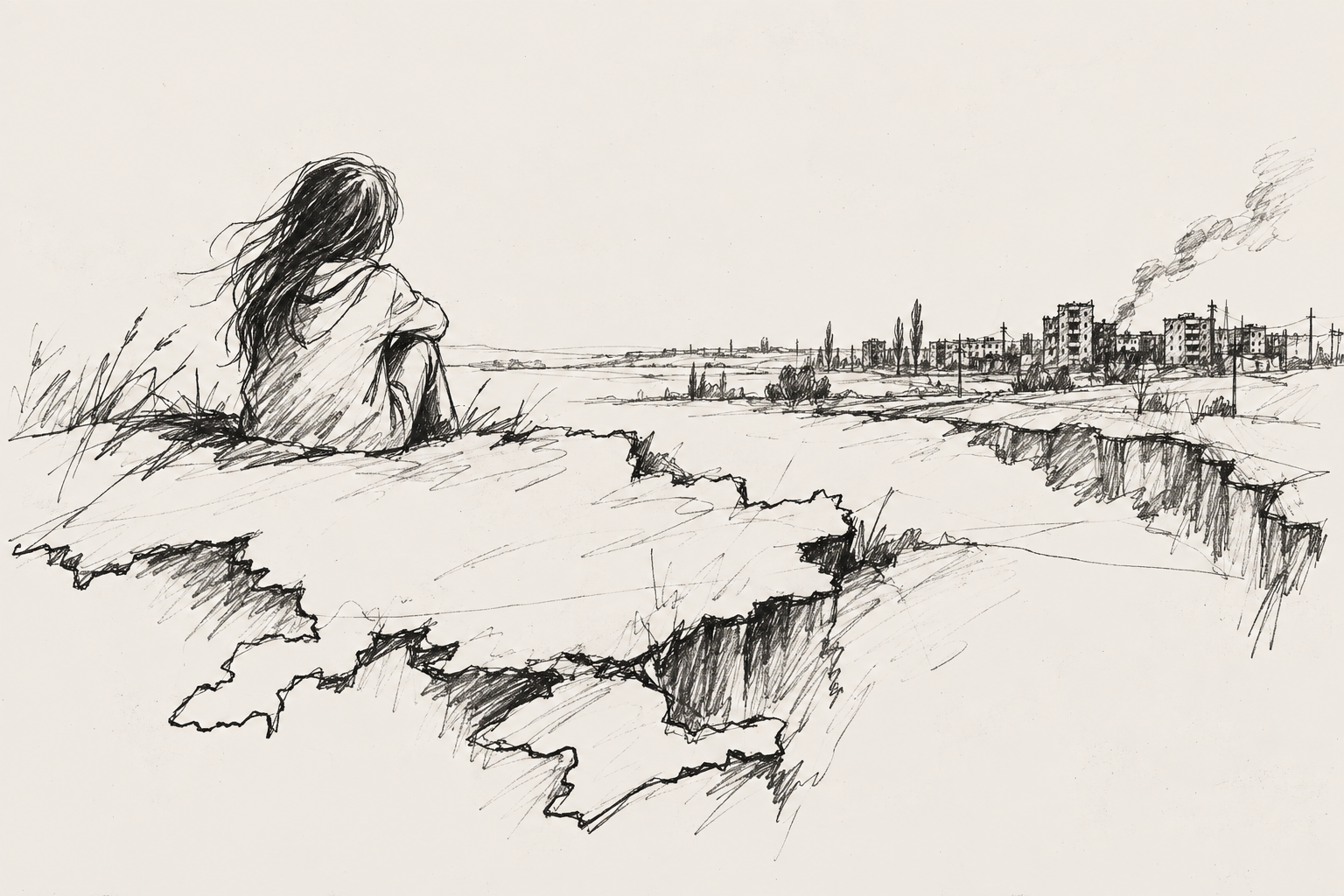
Nearly a fifth of the country: Life under Russian occupation
About 116,500 square kilometers of Ukraine, more than 19% of its territory, remains under Russian occupation. Ukrainian authorities estimate roughly 3.5 million Ukrainians still live there, under the laws, documents, schools and administrative systems Moscow has imposed. Frontliner breaks down, in figures, how occupied Ukraine has changed and what life looks like for those who remain.
Before the full-scale invasion, Russia already held Crimea and parts of Donetsk and Luhansk regions, about 7% of Ukraine’s territory combined. By the end of 2025, the open-source monitoring group DeepState put the occupied area at 116,165 square kilometers, or 19.25% of the country, an increase of 4,336 square kilometers over the year.
The front line has kept shifting in 2026. As of September, DeepState’s mapping shows Russia holding roughly 73,000 square kilometers more Ukrainian land than it did before Feb. 24, 2022. Both sides gained and lost ground in September; Ukrainian forces, for instance, liberated Shandryholove, Derylove and Serednie in Donetsk region.
3.5 million people behind the line
Counting the population of occupied Ukraine with any precision is, for now, impossible. Ukraine cannot conduct a census there, residents keep leaving, Russia has relocated parts of the population, and Russian citizens have been moving in. Russian statistics, for their part, cannot be treated as an independent source.
The most recent figure comes from the Council of Europe, which said in September 2026, citing Ukrainian authorities, that about 3.5 million Ukrainians remain in the occupied territories. The council also flagged the continued spread of Russian law and institutions there. Human Rights Watch, separately, estimates about 1.6 million children remain in occupied areas, roughly 600,000 of them school-age.
Schools become tools of occupation
A Russian curriculum is now standard in occupied schools. In a 2026 report, Human Rights Watch documented the absence of Ukrainian-language instruction, pressure on children still enrolled remotely in Ukraine’s school system, and militarized content woven into lessons. Students must obtain Russian documents to receive a diploma.
As children grow older, that control shifts from classrooms to military rolls. HRW found boys being funneled into Russia’s conscription system, a practice that violates international humanitarian law, which bars an occupying power from forcing residents to serve in its armed forces.
A Russian passport becomes essential
Issuing Russian passports has become about far more than paperwork. The United Nations describes the push for Russian citizenship as one of the chief tools Moscow is using to integrate the occupied territories. Holding Russian documents increasingly determines access to administrative services, education, social benefits and the ability to register property, according to the U.N.’s latest report on the territories, published in June 2026.
Bit by bit, this system is tying ordinary life to Russian law. school enrollment, identification, property registration and social services each become a step along the way. In September, the Council of Europe named the imposition of Russian citizenship one of the most pressing problems in the occupied territories.
An apartment with no owner
Another tool is the re-registration of real estate under Russian rules. Occupation authorities can declare homes “ownerless” if the owners haven’t registered their property under Russian-imposed procedures, a particular risk for Ukrainians who fled and have no way to comply from outside the territory.
Over 2025 and 2026, “the Office of the Ukrainian Parliament Commissioner for Human Rights received 151 complaints over the unlawful seizure of property in temporarily occupied areas. According to the office, Russian documents are required before property can be re-registered; homes belonging to those who don’t complete the process can then be declared ownerless.
The price of dissent
The consequences of Russian rule are starkest in Crimea, where the occupation has lasted longest. As of Sept. 21, 2026, the Mission of the President of Ukraine in the Autonomous Republic of Crimea counted 316 people facing politically motivated prosecution there, 169 of them Crimean Tatars.
The same office recorded 1,774 cases filed under Russia’s administrative statute on “discrediting” its armed forces; 1,651 have already ended in a fine or been folded into another resolved case. Those numbers, however, cover Crimea alone and don’t capture the full scope of repression across all temporarily occupied territories.
Behind the 19% figure lie territories with vastly different histories, from Crimea, seized in 2014, to towns Russian troops captured only after the full-scale invasion began. But they all face the same changes imposed by the occupiers: Russian documents, laws, schools, property rules and bureaucracy are steadily displacing Ukraine’s own institutions.