‘Donetsk Switzerland’ without power or water: Life in Sviatohirsk near the front line
The heights near the Artem monument offer a sweeping view of both banks of Sviatohirsk city. The Siverskyi Donets River cuts through the city, winding between chalk slopes and dense forests, some of which have been scorched by fighting. Smoke rises beyond the horizon. Once known as the "Donetsk Switzerland," Sviatohirsk is now home to just a few hundred residents. The city has no power or running water, only two grocery stores are still open, and Russian troops are once again threatening it. Frontliner visited Sviatohirsk to document the lives of those who chose to stay.
In the fall of 2025, Russian forces advanced in the Lyman sector. By December, the fighting closed in on Sviatohirsk, leaving the city about 10 kilometers from the front line. In September 2026, Russian dictator Vladimir Putin falsely claimed the city had been captured. However, the claim proved false: Sviatohirsk remains under Ukrainian control. Ukrainian defense forces pushed back the Russian units, and according to its residents, Sviatohirsk has grown quieter.

Serhii, a resident of Sviatohirsk, pulls up on a bicycle to one of two grocery stores. He is eager to talk about his life, starting almost every story with a joke.
“Fiber-optic drones were flying here so intensely that I once literally got tangled in the wire,” says Serhii. “One time, a wire wrapped around my neck and nearly strangled me. But now it’s finally gotten quieter because our forces pushed the Russians further back.”
“How long have you been living in Sviatohirsk?”
“I’m ancient, I don’t even remember. I have a fiancée here, she is 96.”
“A fiancée?”
“Well, I’m just kidding. She’s my neighbor, and she lives with me in a damaged house nearby. When my wife died, it was just the two of us left. We live on her pension. If she passes away, I don’t even know how I’ll scrape by.”
“What about your own pension?”
“I’m only 56.”
“And what is your name?”
“My name is Serhii, but I won’t tell you my last name. Someone might see me on the internet, and I don’t want any more trouble.”
Groceries run: Tens of kilometers under drone threat
Kateryna Fesenko pushes her bicycle, loaded with bags and a box of groceries. She came from Lyman, a city located 20 kilometers from Sviatohirsk, to get some food. According to the DeepState OSINT project, the front line runs just two kilometers from Lyman.

“It is incredibly hard to survive there,” Kateryna Fesenko says emotionally. “We are constantly under fire, and people get wounded and killed. There are no intact houses, no gas, no water at all. If only there were some military targets there, but the Russian strikes hit civilians. Take the woman who kept cows and provided people with milk: her house, her belongings, her entire farm were completely destroyed! How are we supposed to live now? We walk to get groceries under drones, taking four hours each way.”
Kateryna’s bags are packed with cigarettes, meat, grains and sugar. Despite the constant Russian shelling and the dangerous trip for food, she stays in Lyman, saying she has nowhere else to go.

Before the full-scale invasion, Sviatohirsk was home to about 5,000 people, with 9,500 living in the broader community. As of 2026, according to the Sviatohirsk City Military Administration, only 278 residents remain in the city, and 1,025 in the broader community. Most of them are senior citizens.
Without power, water or cell service: Refuge at the lavra
Silence hangs over the streets on Sviatohirsk’s left bank. The roads are lined with ruined shops, hotels and restaurants. On the opposite bank of the Siverskyi Donets River stands a men’s monastery, while a 28-meter monument by Ukrainian sculptor Ivan Kavaleridze towers atop Lysa Hora hill. Built in 1927 in honor of the Bolshevik Artem, the statue remains one of Sviatohirsk’s most prominent landmarks.

During decommunization, authorities planned to dismantle the monument but ultimately decided to preserve it as a valuable example of monumental art. In September 2023, it was renamed in honor of its creator, the Ukrainian sculptor Ivan Kavaleridze.
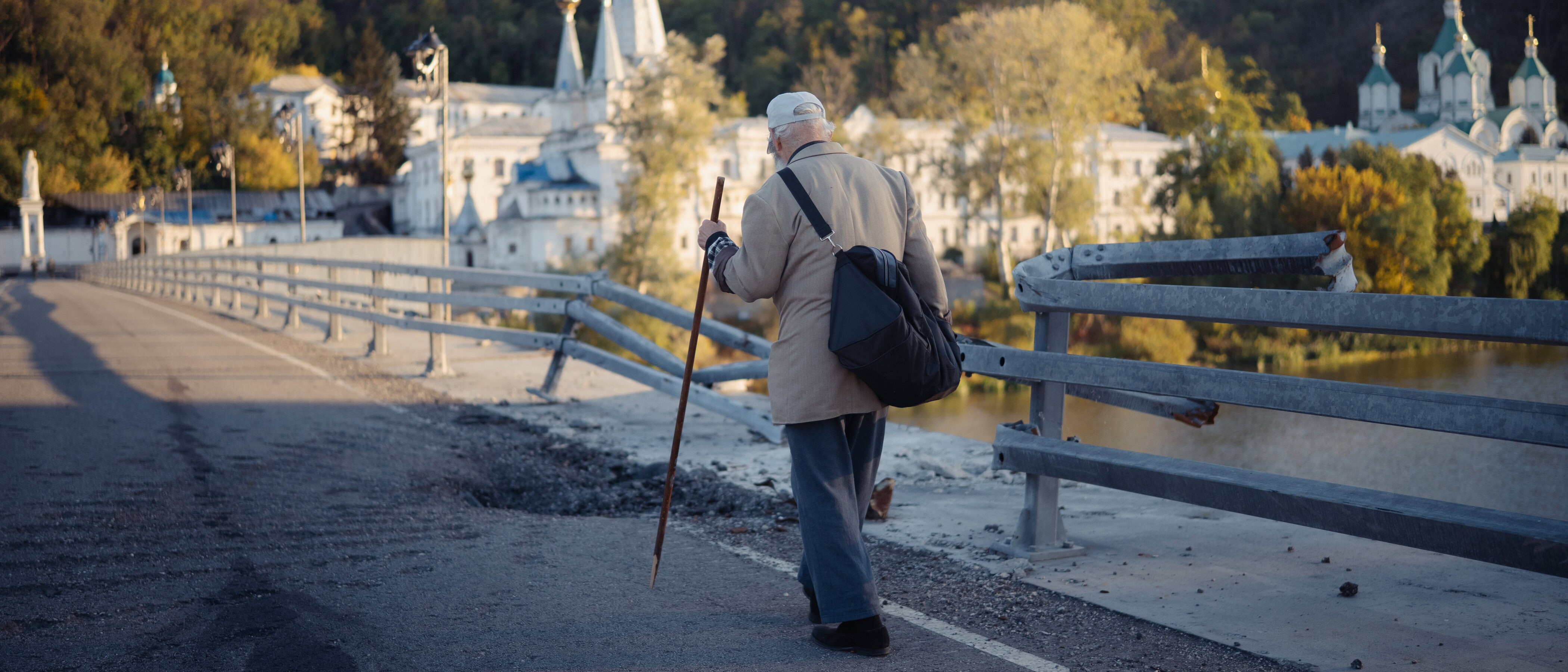
An elderly man makes his way across the bridge over the Siverskyi Donets River, which connects the two parts of Sviatohirsk. This is 74-year-old Ivan Myronenko. He works as a security guard at the Sviatohirsk Lavra and lives on its grounds.
Ivan is originally from the village of Bohorodychne, seven kilometers from Sviatohirsk. Russian troops destroyed his house in 2022, but his children still live in his native village. He found refuge at the Lavra and does not plan to leave Sviatohirsk. The city lacks centralized power, water and gas supplies, and cell service is spotty.

“It’s been like this for four years now. They bomb regularly, we can hear it. And here, look: this crater is relatively fresh, not even six months old. I don’t know exactly what hit,” Myronenko says. “Life is hard on people here. Over five-story apartment blocks are completely unlivable. And to catch a cell signal, you have to climb the hill, closer to the Artem monument.”

Returned under fire once again after occupation
In June 2022, Russian forces occupied the left bank of Sviatohirsk. In September, Ukrainian troops liberated the city. Gradually, shops and other businesses reopened, and residents began to return. Sviatohirsk was also home to displaced people from other towns in the Donetsk region, including those who settled here after the onset of Russian aggression in 2014.
“We came here from Makiivka [occupied since 2014 — ed.]. My daughter and I worked at the Lavra, and later we received housing. We feel a deep connection to Sviatohirsk. The nature here is incredible, and up until a certain point, everything was accessible and reasonably priced,” says city resident Iryna Zhurba.
Walking home, Iryna shows the main street of Sviatohirsk. Lots of shops and businesses once operated here. Now, most of them are closed.

“Until September 2025, about 1,000 people lived here,” Iryna recalls. “Displaced people were housed in local resorts and the hospital. Generators were installed, fuel was available, and a water well was drilled. They even rebuilt the bridge that was blown up in 2022. There were free field kitchens for refugees, mobile market stalls with goods and an ATM. Sloviansk is only 30 kilometers from here, and it was very convenient. But after September 2025, when neighboring Yarova was hit, the situation worsened every day.”

Iryna, her husband Yurii and their daughter Yuliia remained in Sviatohirsk in the summer of 2022, when Russian forces controlled the left bank of the city. Until 2025, the family lived in their own apartment in a five-story building. But as Russian shelling intensified, they left the apartment and began looking for safer housing.
“We rented a summer kitchen where we keep our belongings,” Zhurba says. “We have a vegetable garden in the yard and a well where we draw water. For the winter, we are looking for a small house with a stove so we can heat it and make it through the cold. I don’t know what the future holds, but something will work out. In 2022, it was much worse. We were in complete isolation.”
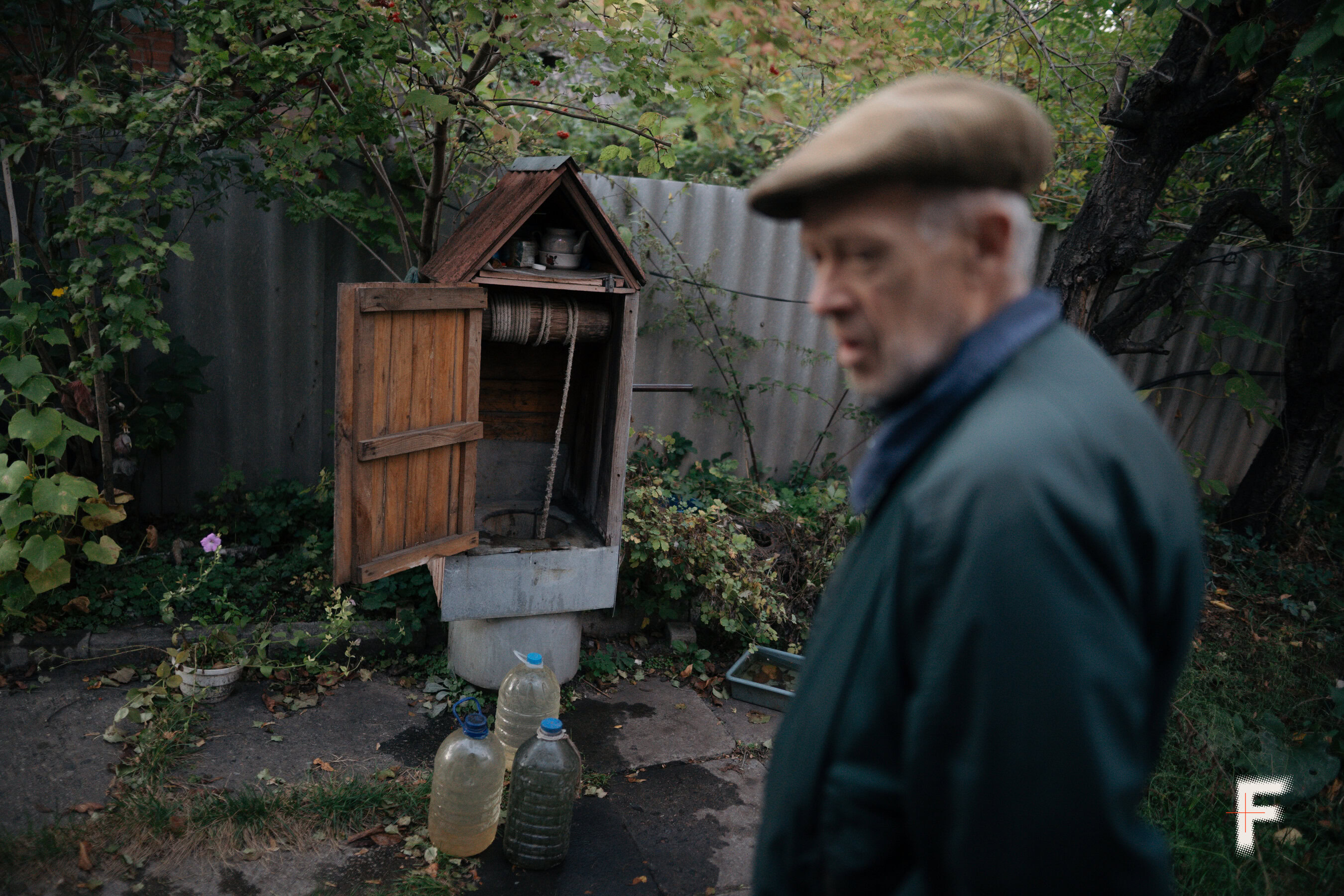
“We currently have five cats and two dogs with us, so we cannot leave,” Iryna says. “We live on my husband’s and my social benefits. We travel to Sloviansk to withdraw cash because there isn’t a single ATM here.”
Scorched forests instead of a ‘green sea’
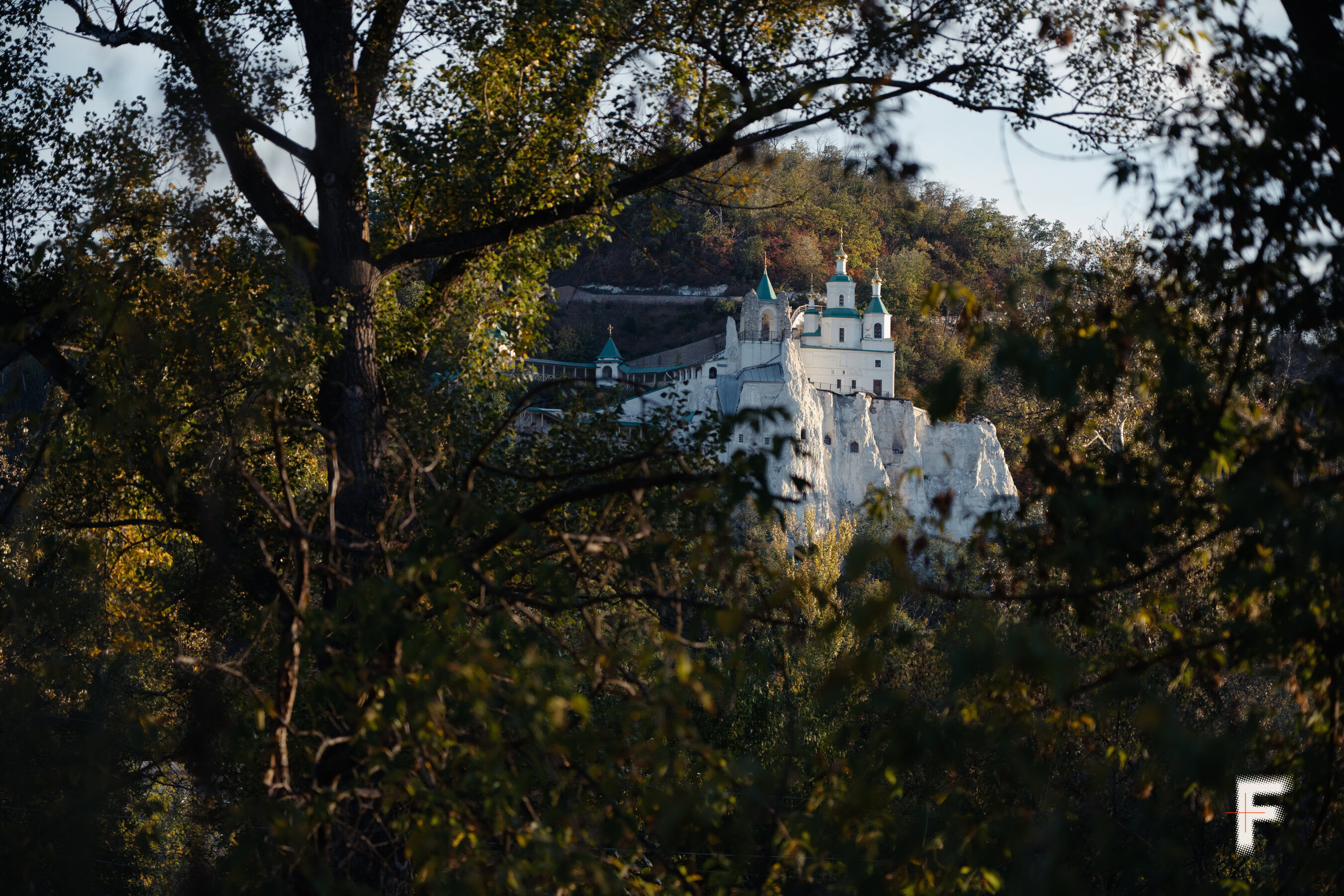
The autumn sun lights up the white walls of the Sviato-Uspenskyi monastery. The oldest parts of the sanctuary are carved into a chalk cliff on the right bank of the Siverskyi Donets River. The top overlooks coniferous forests, now scarred by large patches of scorched trees.
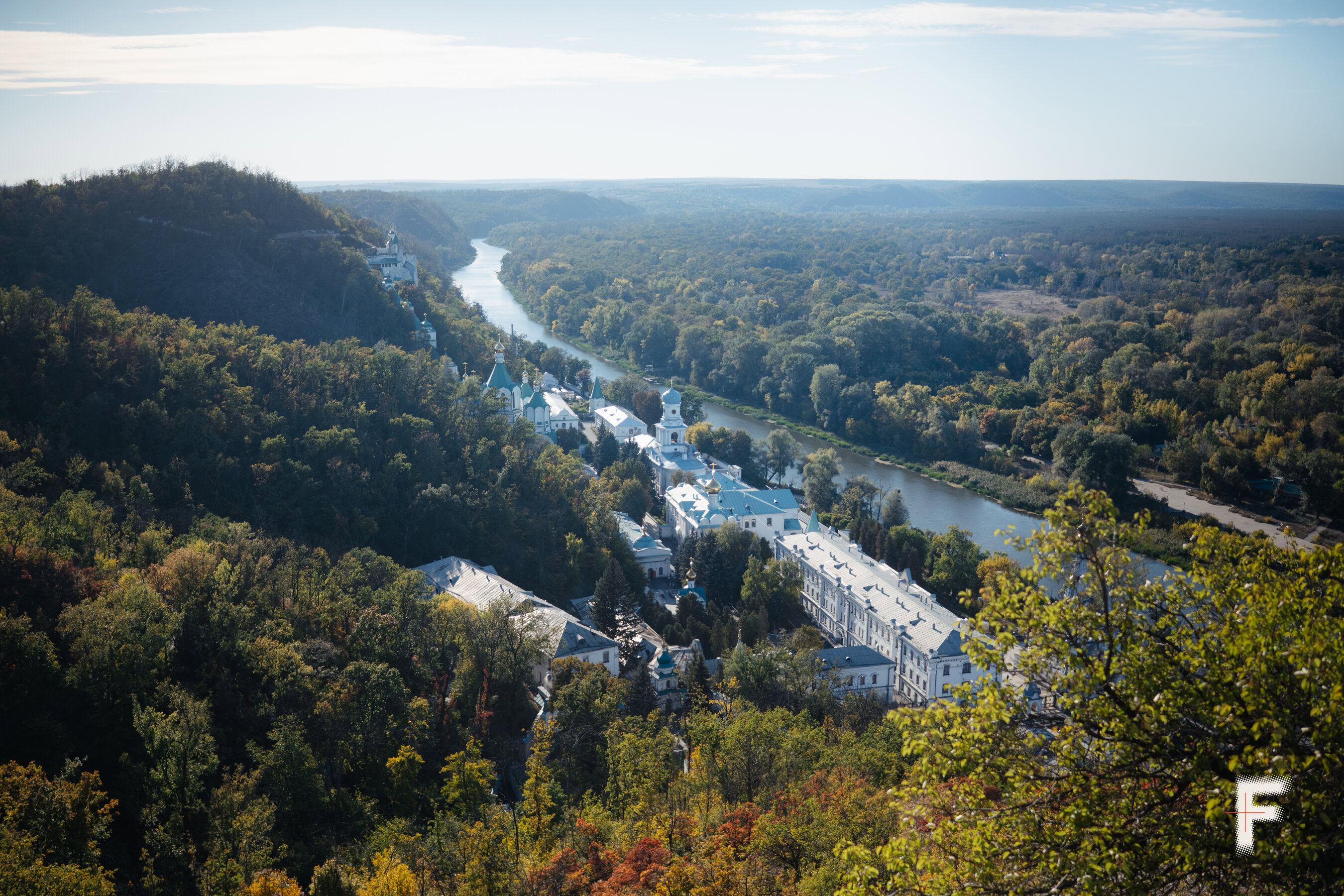
The Sviati Hory National Nature Park, spanning more than 370 square kilometers, was created here in 1997. Its forests had drawn tourists to Sviatohirsk for decades.
“Anyone who has visited Sviatohirsk even once calls it a place of power and always returns,” says Volodymyr Rybalkin, head of the Sviatohirsk City Military Administration. “Everyone finds their own energy here. Some find religion, and others find nature. We have five lakes, a beautiful river and forests. There are few compact communities in Ukraine with such resources.”

Volodymyr carries an anti-drone gun slung across his shoulder. According to him, people in the Donetsk region must constantly account for the threat of Russian drones.
A forced evacuation of families with children has been declared in the Sviatohirsk community, according to Volodymyr. While there are no children left in the city itself, 37 remain in other settlements. Local authorities are urging people to evacuate due to the danger of Russian attacks.
“We are consistently delivering humanitarian aid,” Volodymyr says, “and we hope that once Ukrainian troops push the enemy further back, we will restore both the city and the community.”
Sviatohirsk Lavra between destruction and controversy
On the streets of Sviatohirsk, one can often see people heading to or returning from the monastery. The Sviato-Uspenska Sviatohirsk Lavra remains an active place of worship and a refuge for those who stayed in the city. The earliest written records of the Sviati Hory area date to 1526, and the monastery was established in 1624.

In 1922, the Bolsheviks shut down the monastery, looted the churches and opened a recreation center on its territory. In 1980, the complex was granted the status of a state historical and architectural reserve. Eventually, the complex saw a revival of church services and monastic life.
In 2004, the monastery was granted the status of a lavra. It is affiliated with the Ukrainian Orthodox Church, whose ties to the Moscow Patriarchate remain a subject of public discussion.
[Editor’s note: Ukraine has two main Orthodox churches — the independent Orthodox Church of Ukraine (OCU) and the Ukrainian Orthodox Church (UOC), historically tied to the Moscow Patriarchate, with some clergy accused of collaboration during Russia’s full-scale invasion.]
Ihor Saletskyi, director of the historical and architectural reserve, holds an FPV drone detector in his hands. According to him, the danger of Russian drones has made such a device necessary.

“We are actively working to break free from the influence of the Moscow Patriarchate,” Ihor explains. “Formally, the Sviato-Uspenska Sviatohirsk Lavra is subordinate to the UOC. At the same time, the churches, chalk caves and other buildings are used by the men’s monastery, which received these rights along with its lavra status in 2004.”
A fence surrounds the grounds of the Sviatohirsk Lavra. Entry is open to the public, and the gates are closed only at night. A sculpture of the Mother of God, the Abbess of the Sviati Hory, stands by the entrance.
There are nine churches on the monastery grounds. The white-stone Pokrovska Church, featuring blue roofs and golden domes, stands near the main entrance. Its structures were damaged by strikes, and parts of it have been covered with protective film. The Sviato-Uspenskyi Cathedral has a battered roof, with shrapnel scars still visible on its walls.
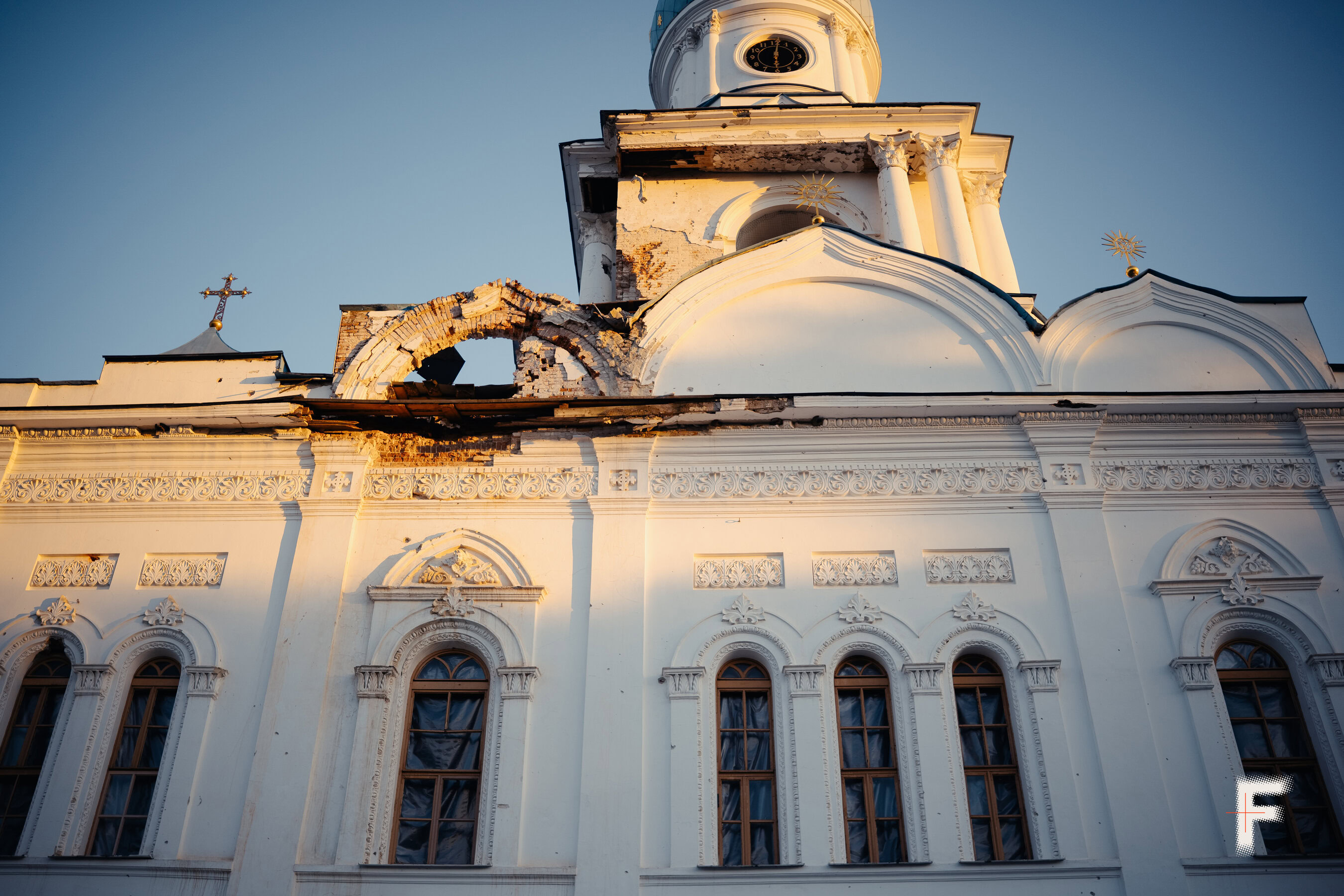
Russian shelling has damaged 26 cultural heritage sites across the Sviatohirsk reserve.
“Around 60 facilities are located at the state reserve, including utility and administrative buildings,” Ihor Saletskyi says. “Some buildings support daily operations, like guest quarters and cells, as well as the sacred sites of the men’s monastery. Many unique cave churches survive here. In 2022, the Russians failed to cross the Siverskyi Donets River and capture the Lavra, but due to constant, heavy Russian shelling, it suffered critical damage.”
According to Saletskyi, 100 monks, 30 nuns and about 100 displaced people live in the monastery blocks and on the lavra grounds, among them elderly people.
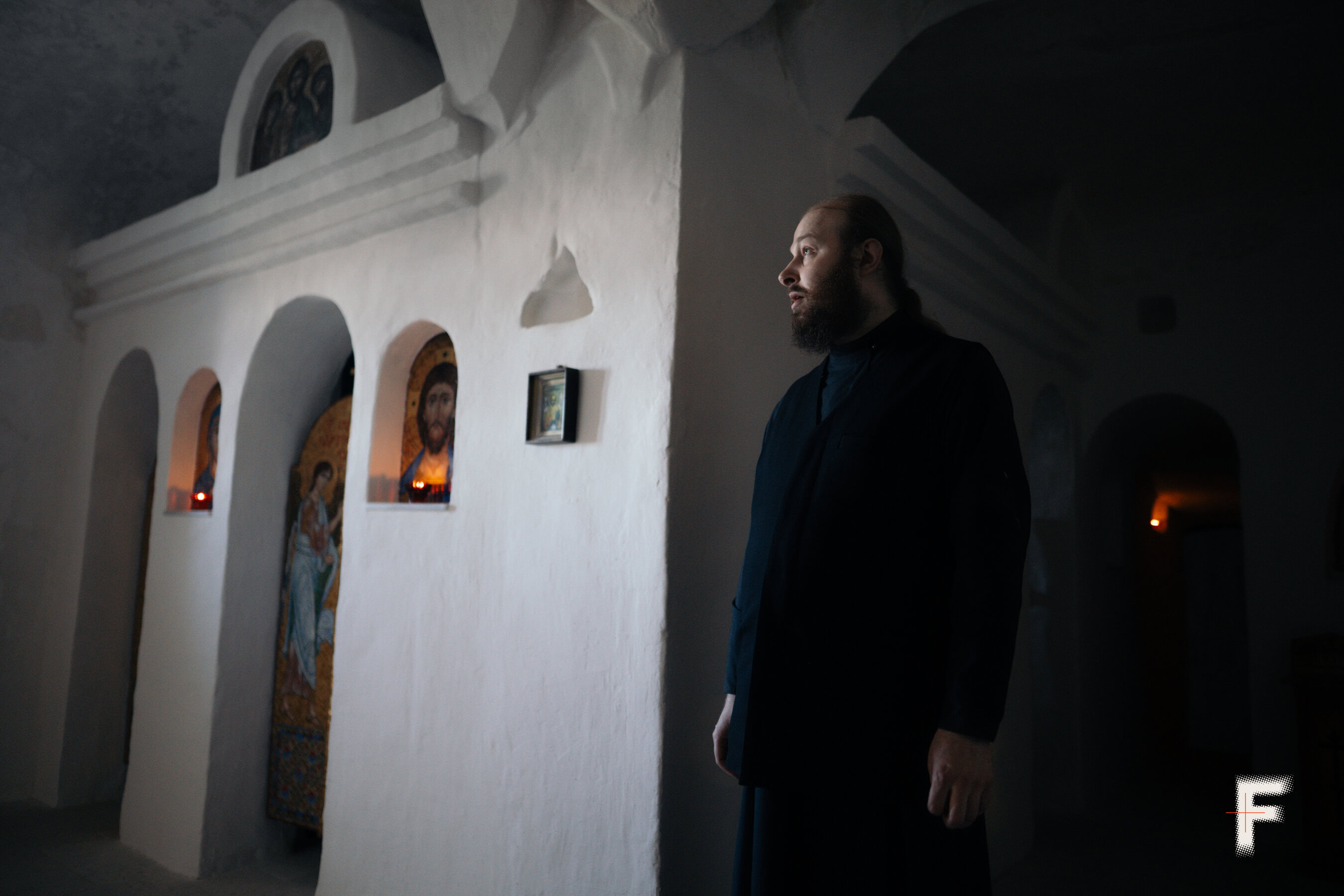
Solar panels were installed on the lavra territory in the summer of 2026. A generator operates twice a day. Ahead of winter, windows are additionally covered to conserve heat.
Before the full-scale invasion, Sviatohirsk attracted tourists and pilgrims from across Ukraine. The Lavra hosted guided tours, and the city thrived largely thanks to its visitors. Currently, visitor numbers are substantially lower due to the threat of Russian shelling.