
Hunting Kherson’s buses and trolleybuses: Russia’s war on public transportation
Kherson is living under conditions that are difficult to compare to any other experience of modern warfare. The frontline city on the banks of the Dnipro river lives under constant artillery fire. Residents are now facing a new threat: Russian drones deliberately targeting public transport. While strikes on minibuses or trolleybuses were previously the result of chaotic shelling, since the beginning of 2026 this has become an enemy’s systematic strategy. Russian forces are openly targeting the passengers and municipal infrastructure. Frontliner reporters explore the story in detail.
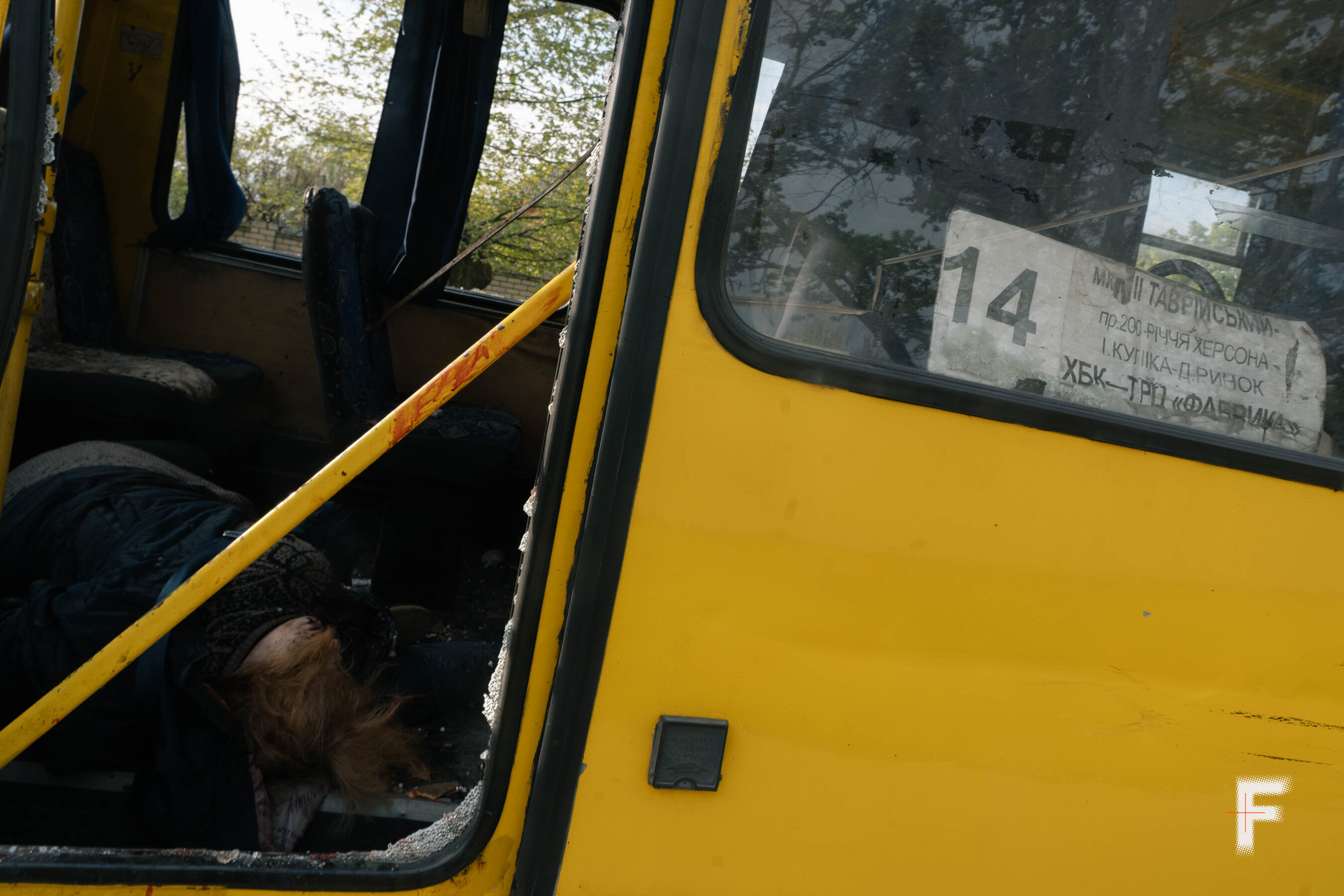
On March 12, 2026, a yellow minibus was struck near the Dniprovskyi market in Kherson. More than 20 passengers were inside: some commuting to work, others going home or heading to the market. Two passengers, Tetiana and Zoia, recall that day: the bus had just left the bus stop when an explosion rang out.
“A girl who was with us noticed a drone following the bus. She shouted to the driver, and he immediately sped up. Thanks to that the drone did not strike the inside or the roof: it went straight underneath the bus,” the women say.
[Editor’s note: Minibuses are privately operated shuttle-type vehicles running fixed routes.]
The minibus was attacked by a Russian Molniya. According to the passengers, the drone was on a fiber-optic cable, so it could not be spotted by the drone detector the driver had on him.

The seats and the floor were torn apart. The driver was injured as well;
his face was covered in shrapnel injuries and he had broken bones.
The doors were closed, so we climbed out through the window.
Some people were pulled out, others got out by themselves,

The drone’s low trajectory left most passengers with severe leg injuries, many of whom are now recovering at a hospital in Kherson. For Zoia and Tetiana, a routine bus ride ended with Ilizarov frames and daily bandaging.
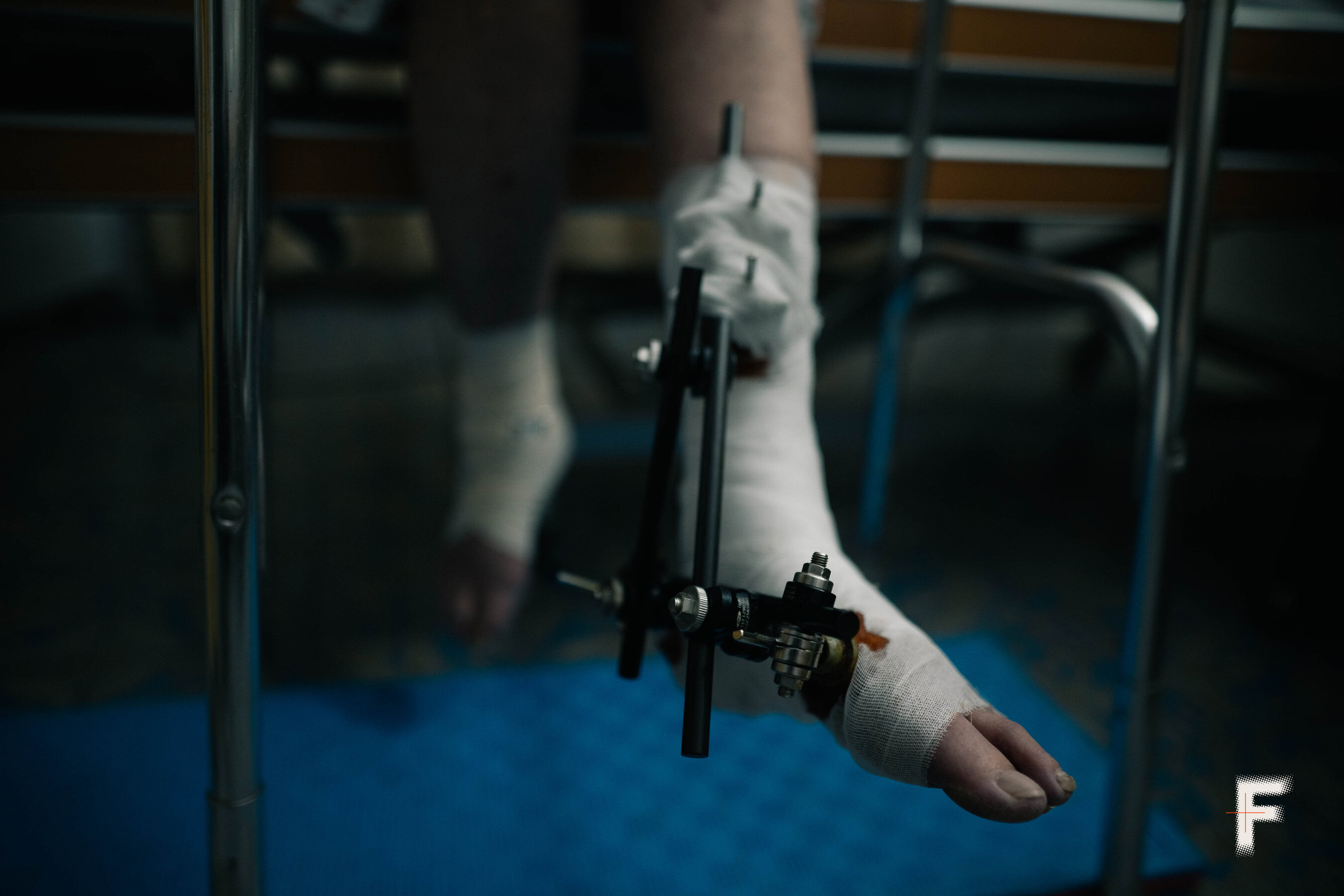
According to Zoia, the operator could see that it was a civilian target, as several reconnaissance drones hovered over the site of the attack for a long time, observing the aftermath.
They are no longer hiding the fact that they are killing civilians.
They are simply hunting people, even children,
How the attacks on Kherson’s public transport began
Russian forces have been systematically targeting Kherson’s public transportation since early 2026. Oleksandr Syrovatko, who works for the Kherson municipal enterprise Kherson Parks, was among the first victims of such attacks.

It was his day off and he was riding the bus to run an errand. A drone attacked near the manufacturing plant, dropping explosives right in front of the bus. The driver did not slow down attempting to get the passengers out of the danger zone faster.
A piece of shrapnel hit a vein, and blood started gushing out.
I pressed my finger against the wound. We made it to the station,
where the driver pulled over and wanted to call an ambulance,
Oleksandr suffered a concussion and a laceration from broken window glass. At the time, he thought it was a random occurrence.
“Dual-purpose transport”
Mykhailo Lynetskyi, Deputy Head of the Kherson Regional State Administration, confirms that the attacks reached a massive scale in 2026. At first, the Russians tried to pass this off as so-called provocations by the Armed Forces of Ukraine, but now they openly state that they consider the buses to be “dual-purpose transport.”
In early May, Russian Telegram channels published a photo of a destroyed minibus on one of Kherson’s streets with the caption:
War has been declared on minibuses in Kherson for the next two weeks.
Or rather, on what’s left of them.
Trolleybuses, by the way, are also becoming priority targets.

“They believe that a regular minibus can be used to transport personnel of the Armed Forces of Ukraine and ammunition. Somehow, they decided that was the case. In reality, the Defense Forces certainly do not use minibuses, they have more effective and reliable means. Essentially, it is just enemy propaganda, a pretext,” says Mykhailo.

The drone operator can clearly see where
he is directing this deadly weapon,
Strikes on trolleybuses, the official added, defy any logic. Fixed to overhead wires and running on predictable routes and schedules, they are among the most unmistakably civilian targets imaginable.
“The drone operator can clearly see where he is directing this deadly weapon. This is done deliberately. They know that public transport will be full of people. The enemy’s strategy is to target civilians and create a dead zone here so that the city’s normal life comes to a halt,” explains Lynetskyi.
Repair crews work around the clock
Since Jan. 1, 2026, 21 trolleybuses and 8 buses have been damaged in Kherson. The enemy has attacked public transportation with all types of weapons, including artillery. The attacks have also taken a human toll: three drivers, a trolleybus maintenance supervisor, and an overhead line technician were killed. Eight more employees sustained injuries of varying severity.

When more than 20 passengers were injured in a single day, city authorities suspended all electric-powered transit. They also cut back bus service hours. Buses have since resumed fuller schedules, but trolleybuses have not returned to the streets: local authorities are seeking effective solutions to protect them. Vadym Melnyk, director of the municipal enterprise Kherson Transport Service, says that some routes simply had to be shortened:
Some areas we just don’t serve anymore, wherever drones are most active.
We can’t risk the drivers or the passengers.
Vadym adds that drivers are equipped with personal protective gear and drone detectors.
However, fiber-optic drones, which Russia is deploying in growing numbers, evade these detectors entirely — leaving no way to fully protect the routes.
Despite the constant danger, there is currently no critical shortage of drivers in the city, the director says. The real problem, however, is a shortage of vehicles: the city needs at least 40 buses, but only 12 remain in service. Replenishing the bus fleet with the help of international partners is impossible and illogical, since new vehicles in a frontline city quickly become targets for Russian attacks.

Our workers operate around the clock, quite literally reviving twisted metal
so that a repaired bus can be back on the road the next day,
Despite the risk of coming under targeted fire, Kherson residents continue to use public transportation. This remains the only affordable means of transportation for the majority of the population, since not everyone has a car or can afford a taxi.
While the city searches for ways to protect public transportation from drones and installs anti-drone nets, buses and minibuses continue to operate. Drivers swerve to evade Russian drones while repair crews work around the clock to keep the damaged fleet running.

A complete shutdown, officials say, would hand Russia exactly what it wants — a city cut off and paralyzed. So the buses keep running.
***
Hi, we are Ruslana and Marharyta, the authors of this article. Thank you for reading to the end.
This report documents how life is changing in a frontline city under constant threat of drone attacks and artillery shelling. For local residents, the war means not only the close proximity to the combat zone but also danger during everyday activities, particularly when using public transportation. It is important to document Russia’s war crimes, as enemy attacks are increasingly targeting the civilian population and urban infrastructure.
Every story starts with your support. Join the Frontliner community so we can keep up documenting Russia’s war against Ukraine from the front line and the rear.
***