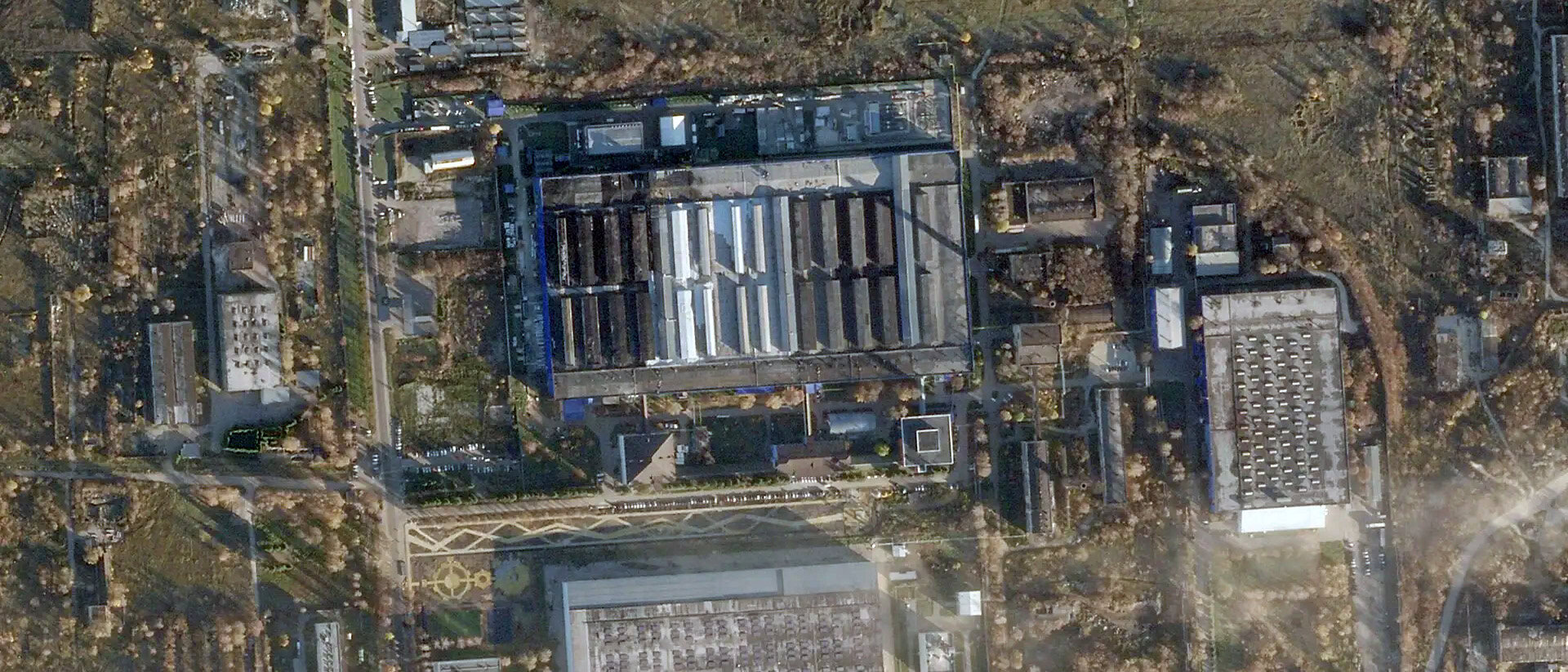
Forced digital detox for Russia’s ‘sovereign internet’: Where Ukraine’s drones struck
Since the beginning of October, the Defense Forces of Ukraine have struck three of Yandex’s five data centers. This was enough to disrupt Russia’s ‘sovereign internet,’ with the Russian government itself having set the conditions for the attacks on its data centers. Such strikes could be a black swan for Russia. Frontliner explains the consequences of the attacks and shares other vulnerable targets on enemy territory.
At around 2am Moscow time, the roof of a Sasta machine tool factory building caught fire. It broke out in Sasovo, a small town in the southeast corner of Ryazan Oblast.
In 2011, Yandex built a data center here with a capacity of approximately 12 megawatts. In an 11-year span, the company invested more than six billion rubles in the facility. For comparison, they could have built three schools at that cost. In 2026, the data center was integrated into the Sasta machine tool factory, which produces high-precision machine tools for Russia’s military-industrial complex, making it an entirely legitimate military target.
On the morning of October 8, 2026, Downdetector received 1,500 complaints. Shares of Yandex on the Moscow Exchange fell by 3.18%. The company’s press service published an announcement without the words “drone,” “fire,” or “war.” But they did mention an “incident that affected part of [their] infrastructure.”
The next morning, a data center in Kaluga was burning. The day after that, another in Vladimir. In the space of four days, the Defense Forces of Ukraine struck three data centers of Russia’s largest IT company, leaving more than 80 services and cloud components out of commission. There were outages in banking, taxi, and delivery applications and problems with access to government registries. The websites of dozens of third-party companies, from small businesses to the Magnit retail chain, stopped working.

Why data centers are an easy target for Ukrainian drones
The main reason for the Russian internet’s vulnerability is government policy. In 2019, the Russian government enacted a federal law requiring that all data infrastructure be located exclusively on Russian territory. The law forbids the storage of Russian citizens’ data outside of the Russian Federation. As a result, all critical digital infrastructure is concentrated within the borders of a single country – two-thirds of it in Moscow Oblast alone. Altogether, Russia has more than 255 data centers.
Why Yandex?
Yandex has over 117 million monthly users and creates infrastructure for banks, retail, media, and government services. According to data for 2026, Yandex Cloud works with 64,000 companies; more than 185,000 organizations use its services. For Russia, Yandex is like the Sberbank of IT. All this data is concentrated in five (or six, according to other sources) data centers. Now, three of them have had their normal operations disrupted.
| Date | Location | Capacity | Results |
| October 8, 2026 | Sasovo, Ryazan Oblast. Data center in the Sasta Machine Tool Manufacturing Complex | Approx. 12 MW |
Fire and complete work stoppage. Two Yandex supercomputers were housed here. |
| October 9, 2026 | Kaluga. Grabtsevo Industrial Park, opened in 2023 and the largest in Russia. |
63 MW, 3800+ server racks |
Several modules completely out of service. Partial shutdown. |
| October 11, 2026 | Vladimir, Energetik microdistrict. First facility opened in 2017; the newest came online in March 2026. |
Approx. 40 MW, up to 2800 server racks |
Complete work stoppage. This facility housed Yandex’s Galushkin supercomputer. |
Aftermath of strikes on Russian data centers
The resulting damage affected average Russians from Siberia to Moscow. Taxi drivers for Yandex Pro were advised to use competing services Google Maps or Waze. Yandex’s own maps and navigation were unable to handle the traffic. Yandex Disk introduced limits on file downloads to keep its other services up and running. Instead, panicked users began downloading their data en masse, further overloading the system.
In response, Russia’s Ministry of Digital Development, Communications, and Mass Media pledged to introduce new types of support for data center construction in the regions. Owners were promised concessional loans and expanded financing for infrastructure projects. Yandex made an optimistic announcement that it would return to normal work within six months. But the loans won’t help, and the company’s claim is a complete fabrication. The primary constraint in repairing data centers is the lack of equipment, for which the waiting list is full until 2028. The Micron factory that produces memory modules has already contracted 75% of its capacity for 2027. All new orders are for 2028. This demand is a result of the rapid development of AI technologies that require precisely these components.
For Yandex, this means that they will have to buy parts at the highest prices in years and in the “peak season.” The most difficult task will be rebuilding their supercomputers. The strikes resulted in varying degrees of damage to three of Russia’s five: Chervonenkis, Lyapunov, and Galushkin. All three require Nvidia A100 accelerators, which are currently sanctioned.
Why Yandex won’t recover
Yandex has three data centers remaining: in Moscow and Podmoskovye and in Vladimir Oblast. Each is covered by multilayered air defenses; damaging or destroying them will require far stronger and more complex strike packages. This explains why the Defense Forces chose Sberbank as their next target. On the night of October 13-14, 2026, they struck a data center in Balakova, Saratov Oblast. While the bank made an official statement that all services are operating normally, users are complaining that their applications are not working. Russian bloggers are panicking and comparing the situation to savings lost from bank accounts in the 1990s. As a show of support for Russian bloggers and the civilian population, Frontliners editors have compiled a set of no less interesting and important targets in Russia within a 1000-kilometer radius (map):

- Data centers of Sberbank, Russia’s largest retail bank. Infrastructure system failure could paralyze the entire country for some time. Mass panic and inability to access money could lead to collapse and break the social contract between the government and the civilian population of Russia’s big cities. Leningrad Oblast, Kudrovo, 4 Leningradskaya Street (59.90000, 30.51000).
- Data centers of Russian Railways. This is the main pillar of Russia’s military logistics. The slightest disruption to the railways would collapse the supply of weapons and other materiel for the Russian army. Saint Petersburg, 57 Borovaya Street (59.91110, 30.33820).
- Data centers of the Federal Customs Service of Russia. Any disruption to its work would cause problems for Russia’s foreign trade. Moscow Oblast, Dubna (56.753382604987635, 37.16409080416744) and Nizhny Novgorod Oblast, Gorodets, 98a Republikanskaya Street (56.646500, 43.472500).
The importance of the data center strikes, and what do the oil refineries have to do with it?
Ukrainian strikes on Russian oil refineries have become a subject of political discussions, manipulation, and direct pressure on Ukraine from the U.S. Taking a wider view, Ukraine could take President Donald Trump’s demands to stop hitting oil refineries as an opportunity rather than as extortion.
Say Ukraine were to stop hitting Russia’s oil refineries and focus on less politicized targets. Strikes on data centers belonging to Yandex, Sberbank, Russian Railways, Customs, and tax services don’t affect the price of oil, which people are feeling at the pumps in Kansas, Iowa, Ohio, or other states. Instead, they impact Russia’s internal politics, accelerate its destabilization, and strengthen the pressure on civilians.
Not being able to order a burger through Yandex delivery brings the war closer to the average Russian than thousands of dead compatriots somewhere down there in the ‘new territories’ ever could. By refraining from striking oil refineries for two weeks, Ukraine could earn more political points; there would be no formal reason to pause aid, Ukraine would continue to receive intelligence from its allies, and there would be no discernible decrease in the price of gas in the U.S. as a result of this ‘agreement.’ The world sees that Ukraine’s strikes are not the reason for the high price of oil. In three weeks, Russia would empty its winter fuel reserves and partially restore operations at its oil refineries and put part of Lukoil’s stock up for sale to stabilize its influence abroad. All while Ukraine continues to hit data centers, destabilizing Russia from the inside. On October 15, Ukrainian President Volodymyr Zelenskyy, rejected the proposed conditions, and so he will be blamed for gas prices in the US and labeled a warmonger. The data centers could have been another card in our hands, but that will no longer be the case. Perhaps the DFU has its own plan; we hope to be pleasantly surprised.