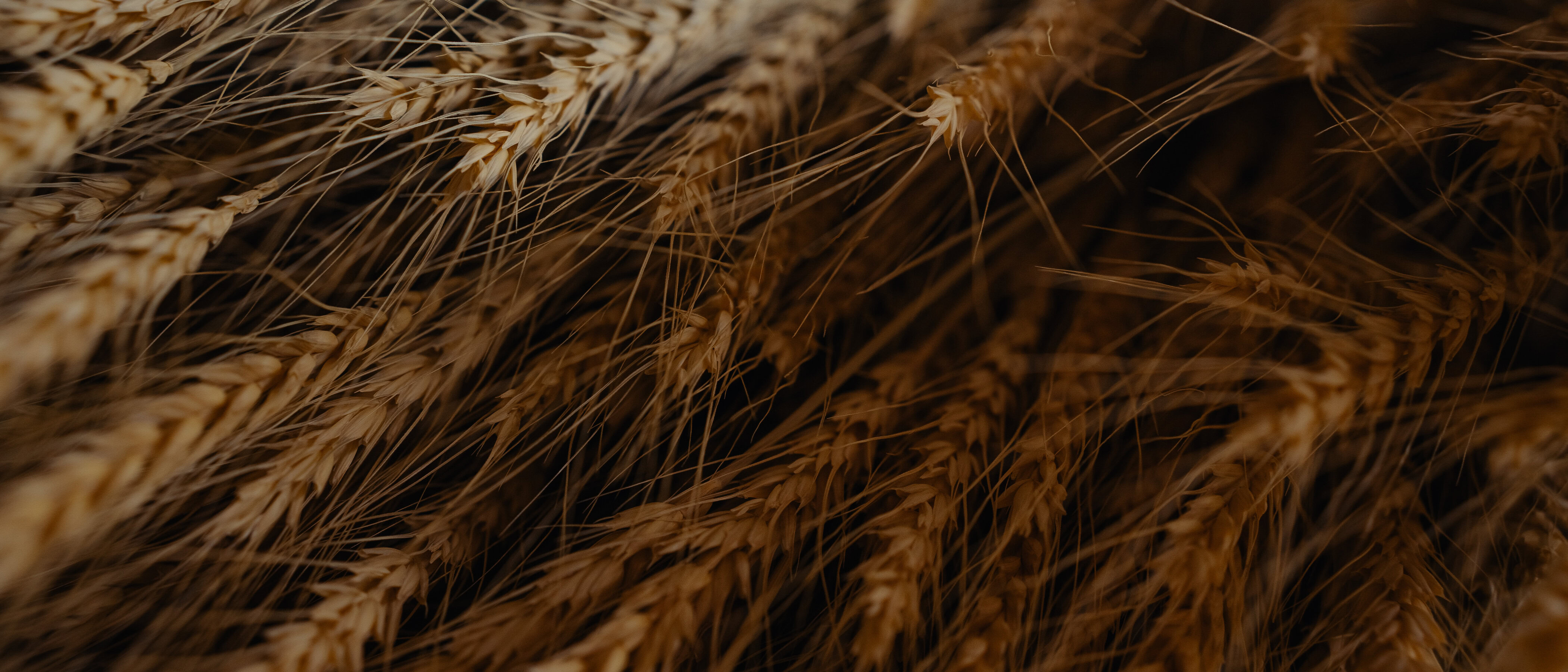
From rye fields to woven angels: Artisans craft didukhs from nurtured straw
The artisan’s hand firmly grasps a bundle of stalks, slicing them as close to the ground as possible with a swift stroke of a sharp sickle. The entire quarter-acre plot is sown with rye. It must be harvested before the rain washes over it. Otherwise, the ears will rot, turn black, or begin to reek. You cannot craft a traditional amulet from ruined grain. This is why the entire Lytovchenko family is hunched over in the field. Their hands burn from the rough stems, the intense heat makes it hard to breathe, and their backs throb with exhaustion. But stopping is out of the question, as rain clouds are already looming on the horizon. Frontliner saw how artisans in the Dnipropetrovsk region transform a green field into traditional amulets.
Inside the gazebo in the middle of the courtyard, the air is thick with the scent of hay. Didukhs, angels, and wreaths flutter in the wind while Liubov Lytovchenko sorts the rye stalks. With the tip of her fingernail, she slices open a dry stem. It yields smoothly, splitting into ribbons, miraculously leaving no cuts on the artisan’s fingers. Years passed before the straw finally yielded to her, but today, she does not even get splinters in her fingers.
[Ed. note: Didukh – a traditional Ukrainian Christmas sheaf woven from grain stalks, believed to protect the home.]
The craft that Liubov Lytovchenko is passing down to her daughter Anna originated three thousand years ago. Ukrainian women would harvest the first or last sheaf from the field and keep it in the house as a protective amulet against evil. They arranged the ears of grain according to strict rules, not at random. The bundle was divided into four tiers and decorated with dried flowers. Specifically, they used cornflowers for harmony, poppy flowers so that children would run around the house, and flax alongside wormwood to keep the household healthy.
In the past, it was believed that a house without
a didukh was bare and vulnerable,
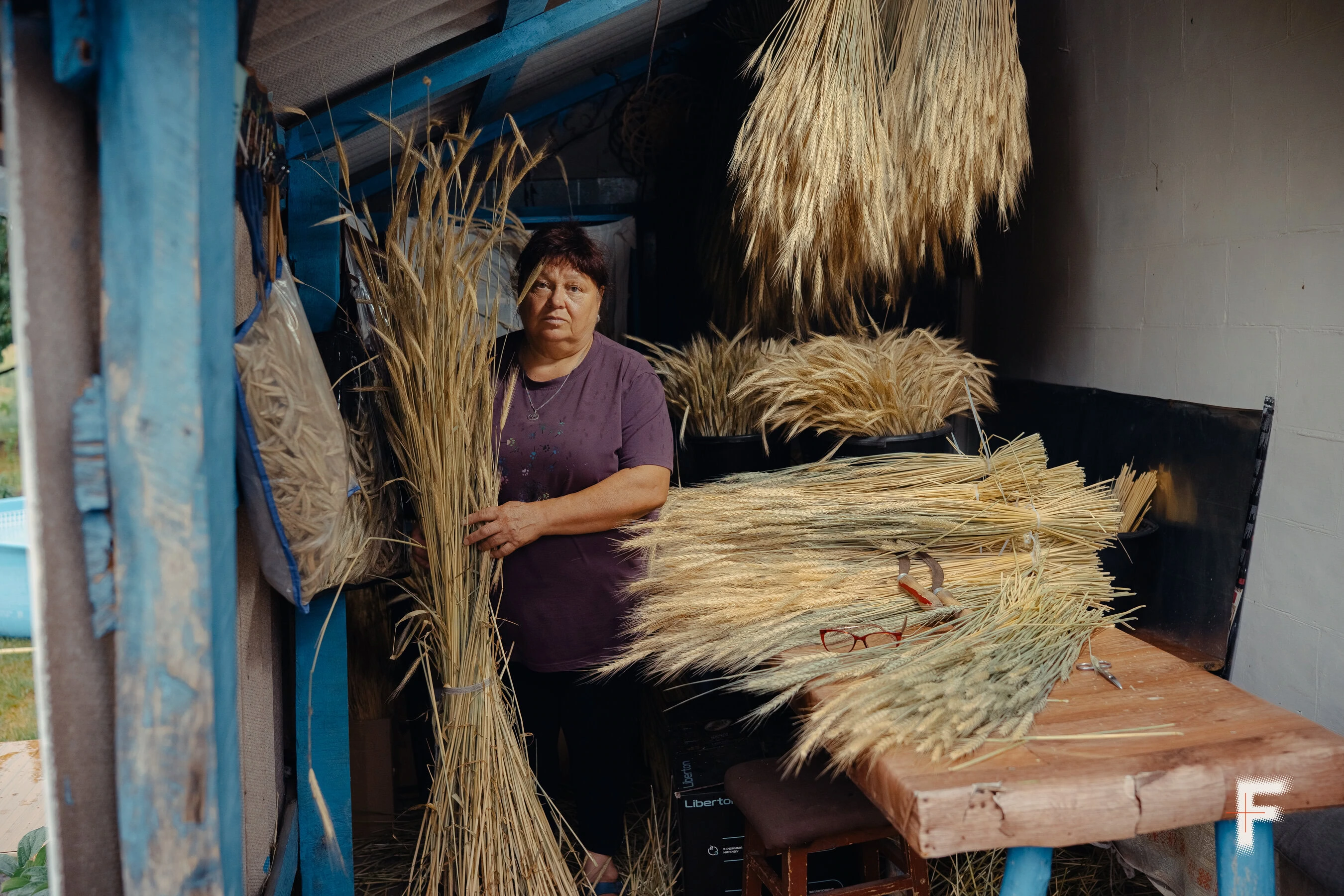
“In the past, it was believed that a house without a didukh was bare and vulnerable,” the artisan says. “That is why the sheaves were placed in the corner beneath the [religious] icons, ensuring the strongest possible protection. Our angels protect the people who believe in this. However, customers from abroad order our didukhs because to them, they smell like Ukraine. For some, they bring the scent of the Kherson steppes. For residents of Kharkiv, they smell like the frontier fields. The straw carries a different fragrance for everyone. To some it smells like home, and to others, like childhood.”
For the amulets to hold their maximum power, you must cherish the grain while it is still green, Liubov Lytovchenko says. You must not curse while harvesting it, nor sit down to work on a sheaf with negative thoughts or a heavy heart. Because of this, she spends anywhere from a few days to a month creating each didukh, simply letting her soul guide the work.
The first didukhs were woven from rye sneaked from the collective farm
Liubov Lytovchenko trained as a nurse. Following the collapse of the Soviet Union, she worked in a hospital where she watched patients go without necessary care and medicine due to severe funding shortages. The emotional toll of this reality was difficult to bear. Therefore, when her daughter Anna was born, she decided not to return to the medical field.
Liubov decided to dedicate her life to weaving protective amulets after seeing didukhs at the Sorochyntsi Fair. A few months later, she and her daughter traveled to the Volyn region to learn the craft directly from an experienced artisan. They returned a month later with a handful of completed pieces. She stayed up until two in the morning, determined not to forget how to weave. Under the dim light of a desk lamp, she crafted roses, braids, and leaves, practicing everything she had been taught. Her husband, Volodymyr Lytovchenko, saw her passion and supported her in every way. He even helped her sneak rye from the local collective farm field just so she would have material to practice on.

“I had learned how to weave, but I needed to practice constantly so I would not forget,” the craftswoman says. “At that time, our garden was completely planted with vegetables. So, my husband and I would ride our motorcycle out to the collective farm fields quite late at night. We would quietly harvest a sheaf or two. We often found small and blackened straws, the kind I throw away today. But back then, we saved absolutely everything. A few years later, we started sowing rye instead of potatoes. It grew incredibly tall, reaching up to two meters. You could easily get lost in it. Today, it simply does not grow that tall anymore.”
To this day, the Lytovchenko family cuts the rye by hand with sickles in the heat. The entire family gathers for this task, including the artisan’s sister, her daughter, and her husband. They must reap quickly and cut low to the ground. If the wind bends the ears, the stalk is ruined and becomes unsuitable for weaving. If heavy rains begin, the crop might rot. This year, relentless downpours destroyed a portion of their harvest. Out of an expected one hundred sheaves, they managed to gather only thirty.

You have to reap so low, practically right at the ground.
It is as if you are bowing to the rye, and afterward, your lower back aches.
We used to sow less rye, so we would gather even the fallen ears.
Mud would get into them, and my mother had to clean the grain
with a brush and powder. If the rain soaks it, everything can rot
in a matter of days. On top of that, drying damp rye is much harder.
The harvested sheaves are tied up in the attic. A week later, they begin cleaning the driest ones. They separate the leaves, cut off the tops with the ears, and sort the nodes by thickness and length. Every part of the straw plays its own role in the didukh. They do not throw away even the damaged parts of the stalk. Anna, the artisan’s daughter, lines the bottom of her shipping boxes with them.

“Only the thinnest top node is suitable for the angel’s arms,” Anna Mamonova says with a smile. “To make the halo, we need the second one. It is medium in thickness. The clothing is made from the third nodes. We grind the damaged pieces into shavings and sprinkle them in the center of the flowers. When I pack the angels, I place them on a hay cushion made from leaves. We do not use those in the weaving. While the parcel is in transit, the leaves steep in the sealed space. The fragrance becomes highly concentrated. The moment the customer opens the box, the entire house fills with the scent of hay.”
A handmade workshop for angels
To make a didukh, many decorative elements must be woven in advance in large quantities. When the straws are woven together, they bite painfully into the fingers, cutting them and leaving splinters lodged deep in the skin. A few years ago, the artisans’ hands were constantly scratched. Therefore, Volodymyr decided to help his girls. He used everyday materials to build small machines and tools that would make their work easier.

“The first “contraption’ is a small machine that twists two straws together,” Volodymyr says. “Twisting them by hand is painful and takes a long time, as you have to wind them over a hundred times. I borrowed the idea from machines that weave cables. I took the most important part, the small motor, out of a tiny fan. I added two small claw clips to hold the straws and adjusted the speed so it would not tear them. The girls have been using it for years now. Sometimes, I simply set the machine on the table, turn on the television, and spin the straw late into the night.”
Volodymyr had to manually straighten the straws after they were cut into several ribbons. He would soak them and smooth them out with an iron until his daughter suggested doing the exact same thing with a hair straightener.
Volodymyr Lytovchenko plays a crucial role while the artisans work. He cooks for the entire family so that the girls do not get distracted from their craft. If Anna is weaving amulets, he does not even call her unnecessarily. He just handles everything himself.
I am proud to live with such a remarkable person as my wife,
and I am proud that we breathe the same air,

“I help with whatever I’m able to,” he says. “I weave some pieces on the machines, cook the food, and transport the straw. We built a gazebo in the courtyard so the girls would have a place to work and enjoy good lighting. I have never once regretted encouraging my wife to master this craft back then. I am proud to live with such a remarkable person as my wife, and I am proud that we breathe the same air.”
Didukhs want to live in Ukrainian homes
Liubov Lytovchenko can sit working on a didukh until late at night. She assembles the body of an angel straw by straw rather than in a bundle. She carefully selects them so all the straws have the exact same diameter and length, ensuring the didukh is completely solid. Sometimes she sifts through dozens of pieces just to find the perfect stem. When she finally goes to bed completely exhausted, she might spend another hour imagining the next didukh she will create.
“This process is draining,” the artisan admits. “Therefore, at the beginning of the invasion, I had to stop working myself to exhaustion and finally learn how to rest.”
I have a world map,
and I place a pin in every country where my angels travel,

“My daughter and I worked ourselves to the bone,” she says. “We were afraid we would not finish the didukh by the deadline, and I was extremely nervous. But Anna decided that this kind of routine was absolute torture. Now we do not promise people that we will send the amulet on a specific date. Instead, we put them on a waiting list. This way, we can take a break if the work simply is not flowing. After all, there are days when the news makes everything fall right out of your hands.”
Even though hundreds of didukhs have passed through Liubov Lytovchenko’s hands, she follows the fate of every single amulet. She remembers who ordered it, where it was shipped, and whether it was kept or meant as a gift.
“I have a world map, and I place a pin in every country where my angels travel,” the artisan says with a smile. “I have pins in almost every country by now.. Even in Hong Kong, our “Spirit of Christmas” was the centerpiece at a craft exhibition. We work using traditional techniques, but we constantly reimagine them. We want the tradition to live outside of a museum setting. We want it to be adapted to modern homes and truly find its proper place.”

Liubov Lytovchenko sees fellow didukh weavers as colleagues. She is not afraid of competition. On the contrary, she wants the craft to spread and reach as many Ukrainian homes as possible. Meanwhile, her daughter Anna wants to promote artisans who do not know how to present themselves, even though they also weave masterpieces out of straw.
“This is not about competition. There are many creators
who do not know how to showcase their pieces. I dream of finding
fellow artisans so I can help them present their work and reveal their talent.
There are quite a few straw weavers out there. Yet, these people
remain hidden in their villages, crafting wonderful items,
and no one knows about them. I dream of helping them and promoting their art,
just like our family managed to do.
***
A multimedia documentary project “As long as hands remember”
Created in partnership between Ukrainian media outlet Frontliner
and Ukrainian design brand GUNIA.
***