‘Captain America’ becomes an Armed Forces of Ukraine captain: How the front and being wounded changed actor Dmytro Linartovych
Giving a voice to Captain America in Ukrainian dubbing, playing a military pilot in "Firecrosser" and a gendarme in "Stolen Happiness," and serving as a reconnaissance captain in real life: that's Dmytro Linartovych. For decades he played soldiers on screen, then in 2022 went to the front himself, first defending Kyiv, then fighting on the Kherson and Bakhmut fronts. In January 2023 he was wounded near Soledar. After rehabilitation, he returned to theater, film and music. He tells Frontliner how the front changed not just him, but his work as well.
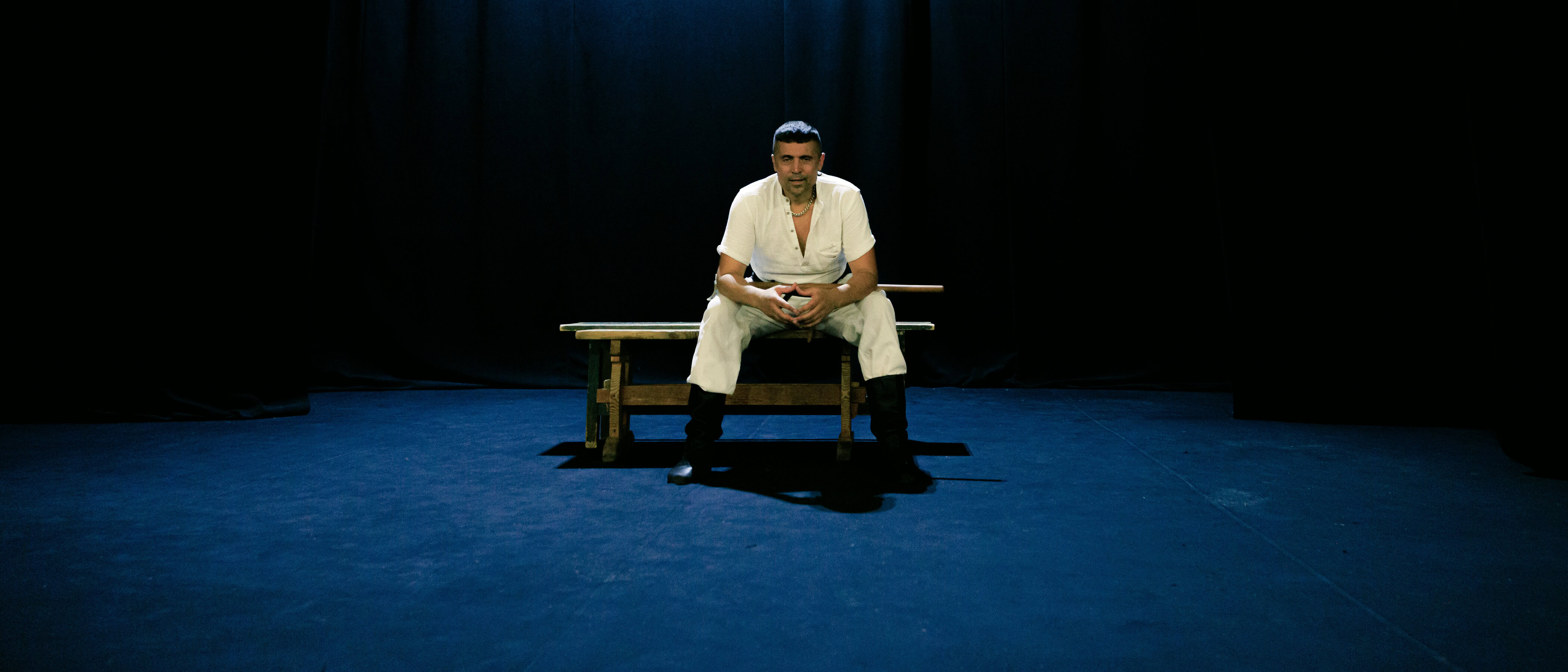
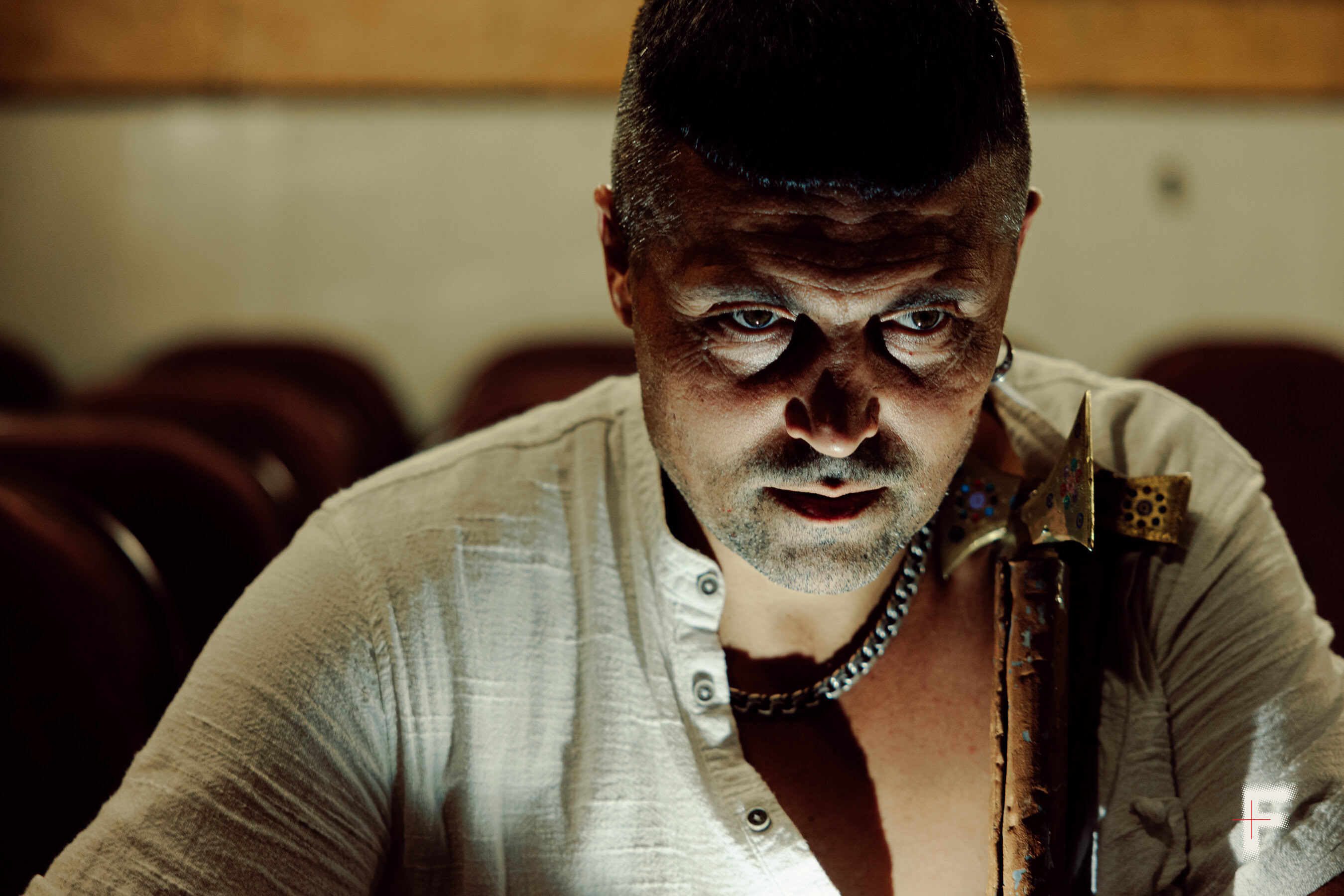
A few hours before the curtain rises on “Shadows of Forgotten Ancestors” at Kyiv’s Berehynia Theater, the customary hush before a performance hasn’t fallen yet. Actors laugh in the hallways. Some already sit before the mirror applying makeup, others pass by still not fully dressed. Off to the side of the stage, musicians tune their instruments. In the audience hall, actor and veteran Dmytro Linartovych runs through his lines.
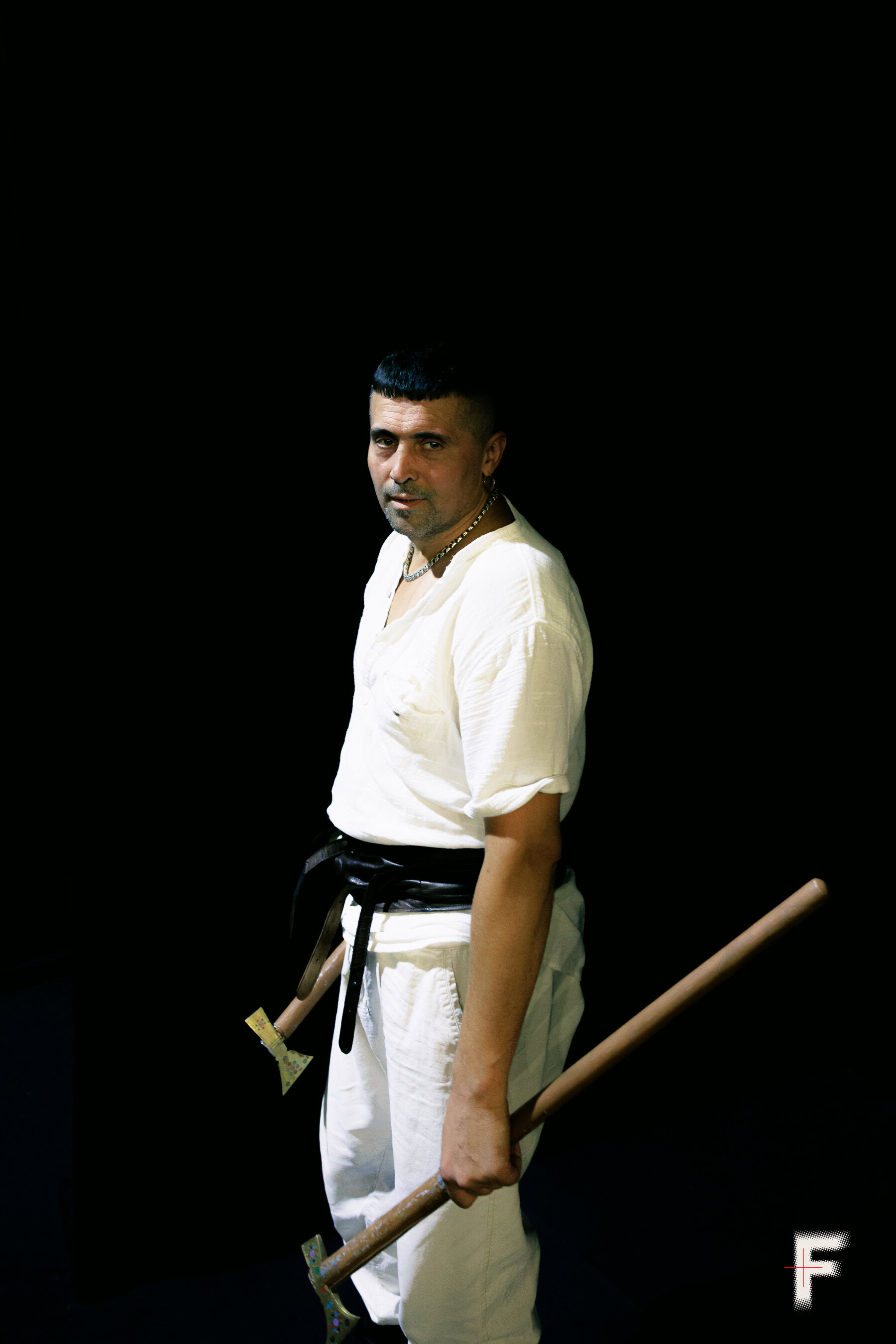
Costume assistants come up to him mid-rehearsal to adjust his shirt. They smooth the stiff fabric, then step back a few paces to check the fit. Linartovych settles into the role of a molfar. In a few hours he’ll walk out to the audience and live someone else’s life on stage once again.
[Ed. note: Molfar — a mystic or sorcerer figure from Ukrainian folklore of the Carpathian Mountains, believed to have supernatural powers over nature, weather, and fate.]
I play an otherworldly person. But I love roles where there’s
some kind of internal conflict within the character, where he’s restless:
he arrives in the stage space or on screen in one state,
then undergoes some transformation,
He chose characters like that even before the full-scale invasion, working mostly with military roles. He played people for whom war was part of their biography, held weapons per the script, and voiced heroes who defended their country.

I’m one of those actors who pull that from their own
life experience and share it with people.
Linartovych points to Ivan Dodoka in the film “Firecrosser,” a pilot who survived captivity and Soviet labor camps. That role became one of the most important of his career and brought him wide acclaim.
But Dodoka was far from his only role in uniform. In Volodymyr Kharchenko-Kulykovskyi’s “The Exchange,” he played a reconnaissance captain with the call sign “Mozart.” In “Stolen Happiness,” he played Mykhailo Hurman, a relentless and determined gendarme.
The characters differ in nature and circumstance, but each undergoes an internal transformation. Linartovych doesn’t separate these roles from his own life experience. He constantly carries something from real life onto the stage or film set.
“I went through sports clubs, boarding school, the street, and military training camps that never let up on toughening me up. So I’m one of those actors who pull that from their own life experience and share it with people,” Linartovych says.
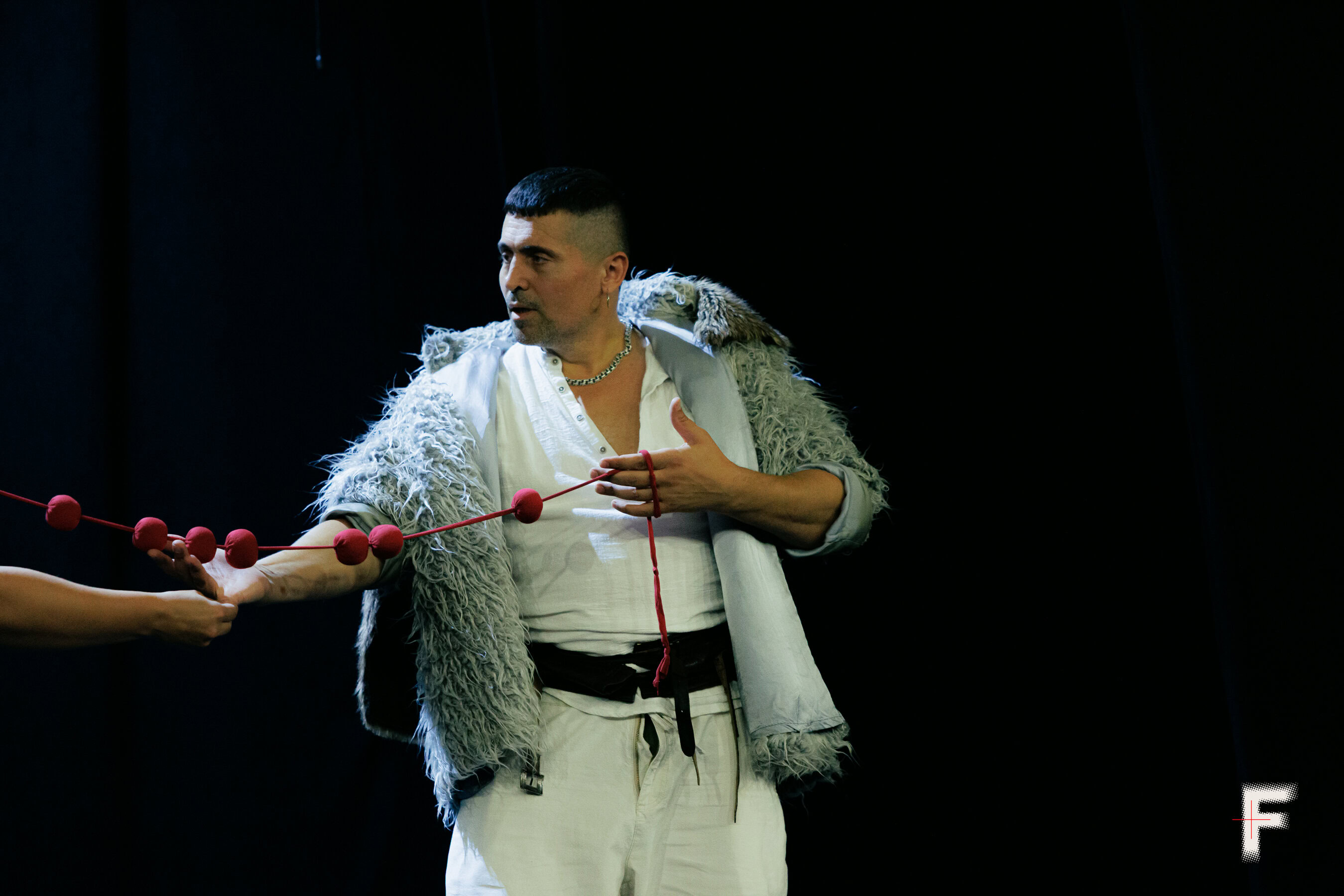
Linartovych joined Ukrainian dubbing back in the early 2000s. One of his first projects was the animated film “Cars.” He went on to voice characters in “Pirates of the Caribbean,” “I Am Legend,” “Transformers,” and other films. In just four years of dubbing work, he racked up more than two hundred titles.
Ukrainians also heard Captain America speak in his voice. At first, what appealed to Linartovych was simply that behind the superhero image stood a person with his own sense of right and wrong, ready to act on it.
Captain America loves his land, he’s ready to risk his health
for his land. And I feel that too. I’m for defending our land,
our citizens, the women, the elderly. Because this is ours.
If we give it up, we will disappear,
Still, fond as he is of the character, Linartovych doesn’t put him in the same league as Ukrainian soldiers. He says our fighters are far tougher than Hollywood’s idols: in comics, technology and weapons decide the outcome, while in the trenches, soldiers rely above all on their own training, endurance, and inner strength.
From playing soldiers to becoming one
Onstage in front of the empty hall, technical work is underway: stagehands check the rigging and set the props. In the theater, everything must be safe and precisely calibrated: the actor only needs to check his makeup, adjust his fastenings, and wait for his cue. Before the full-scale war, stage combat was just as controlled and predictable for him.
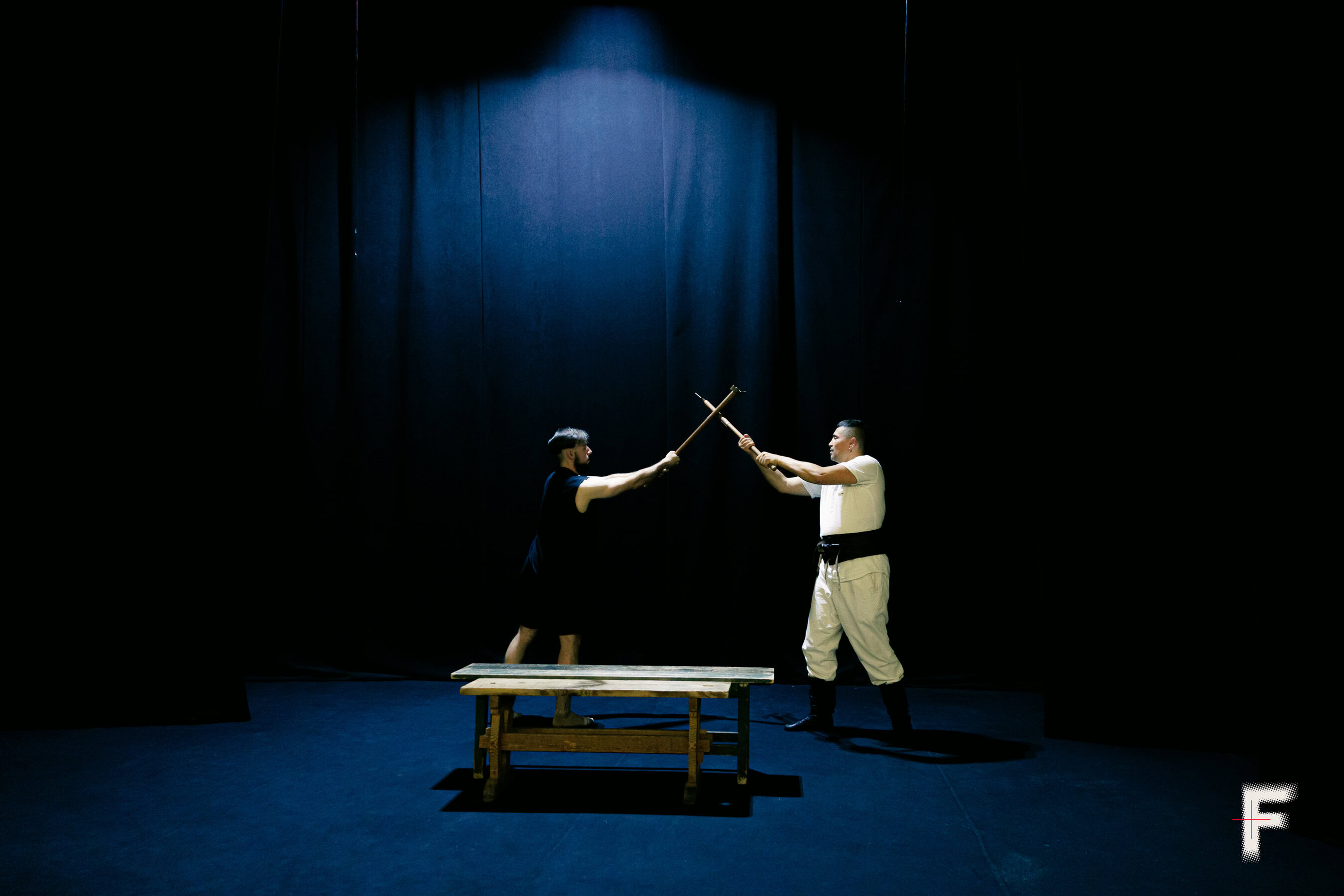
Back then, war was just something Linartovych put on, like a costume. In a matter of hours, he could fall in love, suffer loss, die, then take off the costume, put down the script, and go home. But eventually, war stopped being something he only played.
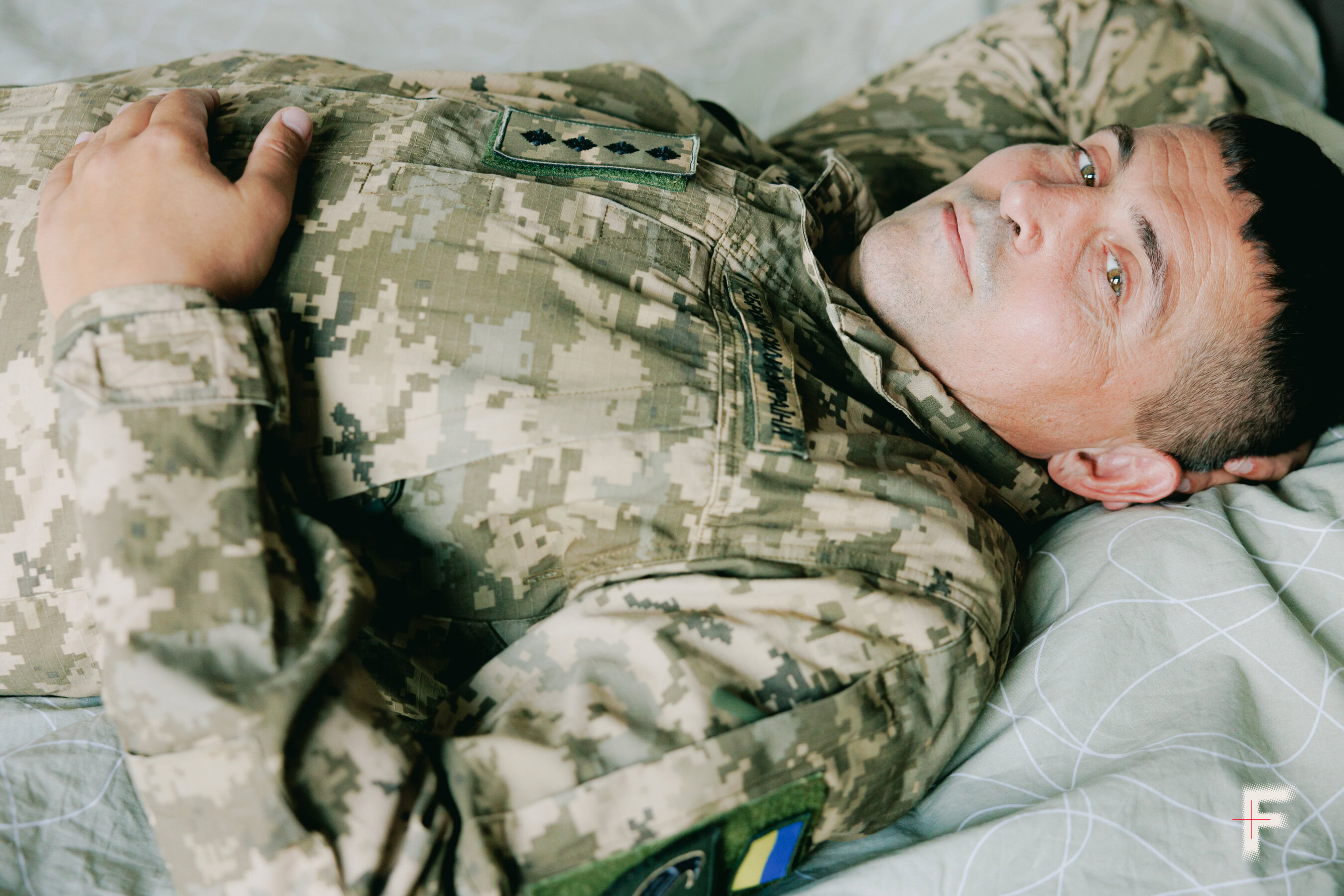
In 2022, Linartovych voluntarily went to the front. He first defended Kyiv as part of the territorial defense, then joined the Air Assault Forces. He served on the Kherson front, later on the Bakhmut front, near Soledar.
“I played Captain America, for example, and I became a captain at the front,” he says.

Linartovych seemed to be rehearsing his own future. The role of reconnaissance captain “Mozart” turned out to be strikingly close to what awaited him next. Once at the front, he ended up in a reconnaissance platoon himself and was given an officer’s rank. When asked if he sees a pattern in this, he says it’s more a set of strange coincidences that only make sense in hindsight.
In January 2023, near Soledar, Linartovych’s unit was surrounded. Enemy snipers were already working the positions, but the soldiers still tried to break out of the sector under fire. During the breakout, the armored vehicle hit a mine and exploded. Linartovych suffered shrapnel wounds and a concussion. What happened after that, he remembers only in fragments.
I’m lying in the triage point in Bakhmut, next to the ones
who are already dead. And I hear a doctor walking past above us, saying,
‘This one will make it, this one won’t,’

Barely conscious, he thought he’d already been counted among the dead. But he still heard the medic’s voice and managed to make a sound so the man would know: he was alive. Afterward came treatment and rehabilitation. The wounds gradually healed, but the PTSD didn’t go away.
Linartovych lived with a constant inner tension, his thoughts constantly returning to the front. Things that once wouldn’t have bothered him now set him off. What tormented him most was the question of why he’d survived when his brothers-in-arms hadn’t.
My PTSD was severe. I was very quick to ignite inside.
What I punished myself for most was that almost all
my brothers-in-arms were killed, and I was alive,

Gradually this state began affecting his work and his relationships with the people around him. Where he might once have laid out his position calmly, he’d now snap straight into a raised voice. And when he saw injustice, he couldn’t look away, he stepped in.
I was like a closed-off animal, I didn’t talk to anyone.
I didn’t want to be pitied. Pity is the enemy,
it keeps a person stuck in their trauma,
Later he began to recognize the moments when rage was taking over, and how to control it. He says he now tries to give himself a few seconds before reacting. For him, that became one way of regaining control over his own emotions.
‘The mission has to be carried out’
The actor pauses his story, an assistant director appears in the doorway and reminds him there’s little time left before the show. Linartovych gets up and lets his gaze linger for a moment on the guitar in its case nearby. He recalls how, after his hospital bed, he started thinking about where to direct his experience of war. He needed an outlet, something to keep him from bottling it all up.
That’s it, the lottery ticket came up, I lived. So now what?
And I say: the mission has to be carried out,
In the end, he returned to what he’d known and loved long before the front, creative work. Linartovych picked up a musical instrument again, and began writing and performing his own “slovospivy,” a blend of poetry and music.
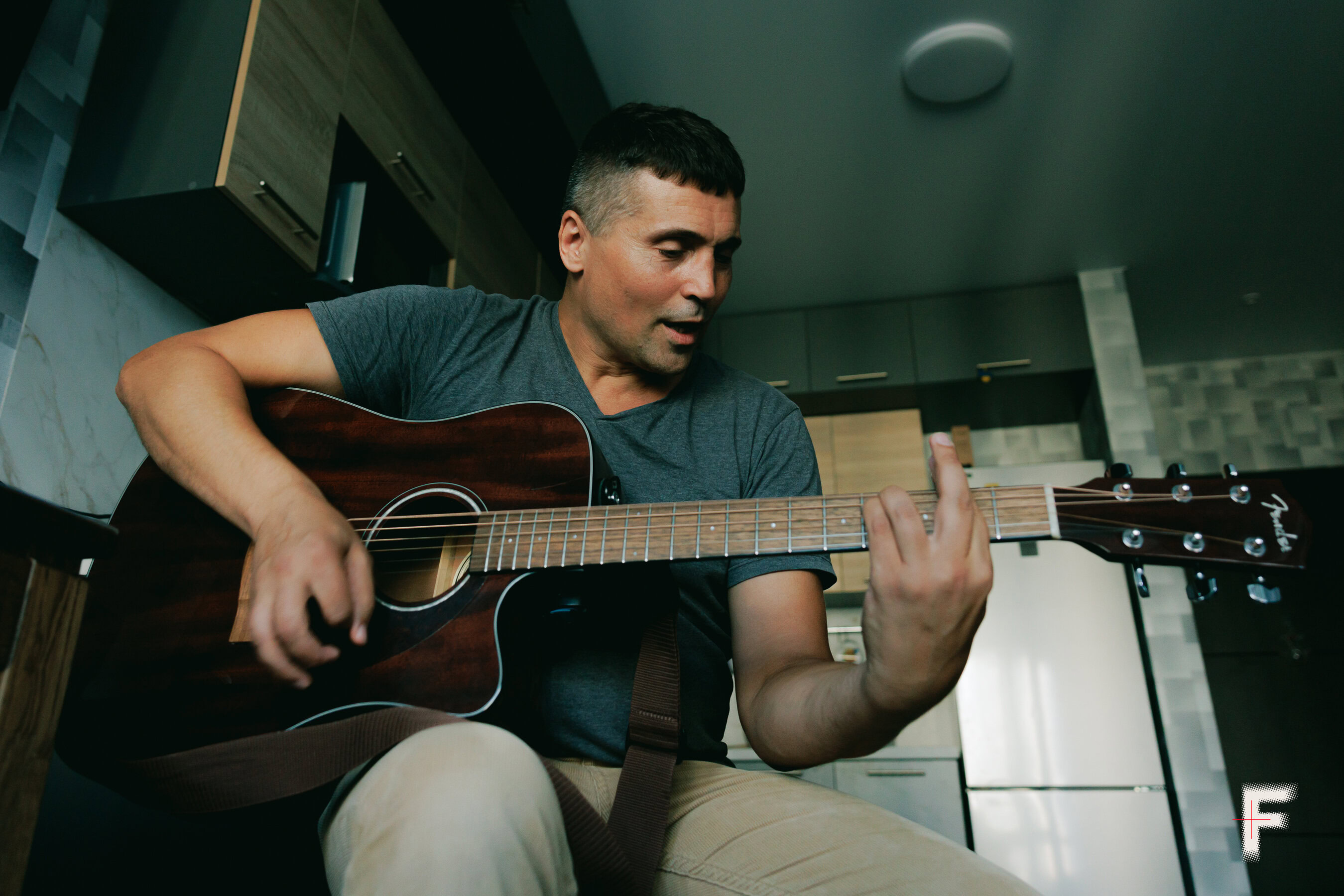
“If you don’t have anywhere to put your feelings, you either fall into depression, or start drinking, or end up in a psychiatric hospital. It’s all the consequences of emotions you haven’t worked through. And I don’t need a lot of psychologists right now, because creativity heals,” Linartovych says.
At first he performed in hospitals, rehabilitation centers, and for cadets. Now the veteran serves in Ukraine’s Rehabilitation Forces and continues sharing his creative work, holding concerts for wounded soldiers.
“I had an acute need to talk it out. It’s best to do that among soldiers, veterans, cadets. I understand them, they understand me,” Linartovych says.
Back to acting
Linartovych has grown bolder in his work, since he now sees his own profession differently. After what he’s been through, a forgotten line or an unhappy audience just doesn’t rattle him anymore.
That’s noticeable at the rehearsal at Berehynia Theatre too. Linartovych doesn’t wait for prompts: he stops in the middle of the stage, checks in with the director on the fly, rethinks the emphasis in a monologue. He does it without fear of losing his place or straying from the script, he simply acts and watches what comes of it.
“I have nothing to lose right now. There’s a new lightness in my work, I’m not afraid to try things in rehearsals,” he says.

Linartovych’s preferences in characters have changed too. By his own account, he now more often chooses freedom-loving, life-loving heroes. He also sees their actions differently, he’s in no rush to divide characters into “good” and “bad,” and instead tries to understand what drives them.
He works the same way in front of the camera. He no longer tries to play a role by some set template. He says what he’s lived through changes the performer himself, his reactions, his facial expressions, the way he speaks to the audience. That’s exactly why he believes actors with combat experience can bring something to film that professional technique alone can’t reproduce.
If an actor has seen combat, absorbed that harsh experience,
and still found the strength to keep living, he absolutely has
to be put in front of the camera. It’ll catch the depth in his eyes.
There won’t be emptiness there, there’ll be thought. Art doesn’t tolerate falseness,
Noise from outside the auditorium interrupts the conversation. The rehearsal is over now, the instruments are tuned, stagehands have secured the set and left the stage. The hallways are filling with people, only a few minutes remain before curtain. Linartovych glances at his watch.
“That’s it, the audience is coming in,” he says, and disappears backstage.
The lights in the hall gradually dim. In a few minutes he’ll walk out onto the stage, in a new costume, in another story, in someone else’s life.
***
This story pulled me in because of the strange coincidences in Dmytro Linartovych’s life, where fiction crossed into reality. For years he played soldiers on screen, then went to the front himself and became a reconnaissance captain. After being wounded, he returned to the stage, this time carrying his own experience of war. I wanted to understand how that changed him, and the actor in him.
Every story starts with your support. Join the Frontliner community so we can keep up documenting Russia’s war against Ukraine from the front line and the rear.
***