Born a patriot: How a prosthetist from Lviv couldn’t outrun his fate
Vladyslav grew up knowing exactly who the enemy was. When the full-scale invasion started, his father left for the front, instructing him to look after the household. But the young man was determined to find another way to contribute. He first considered transporting fallen defenders before ultimately choosing to help the living. Frontliner shares the story of how he searched for his place in the war, and how the war became a part of him.
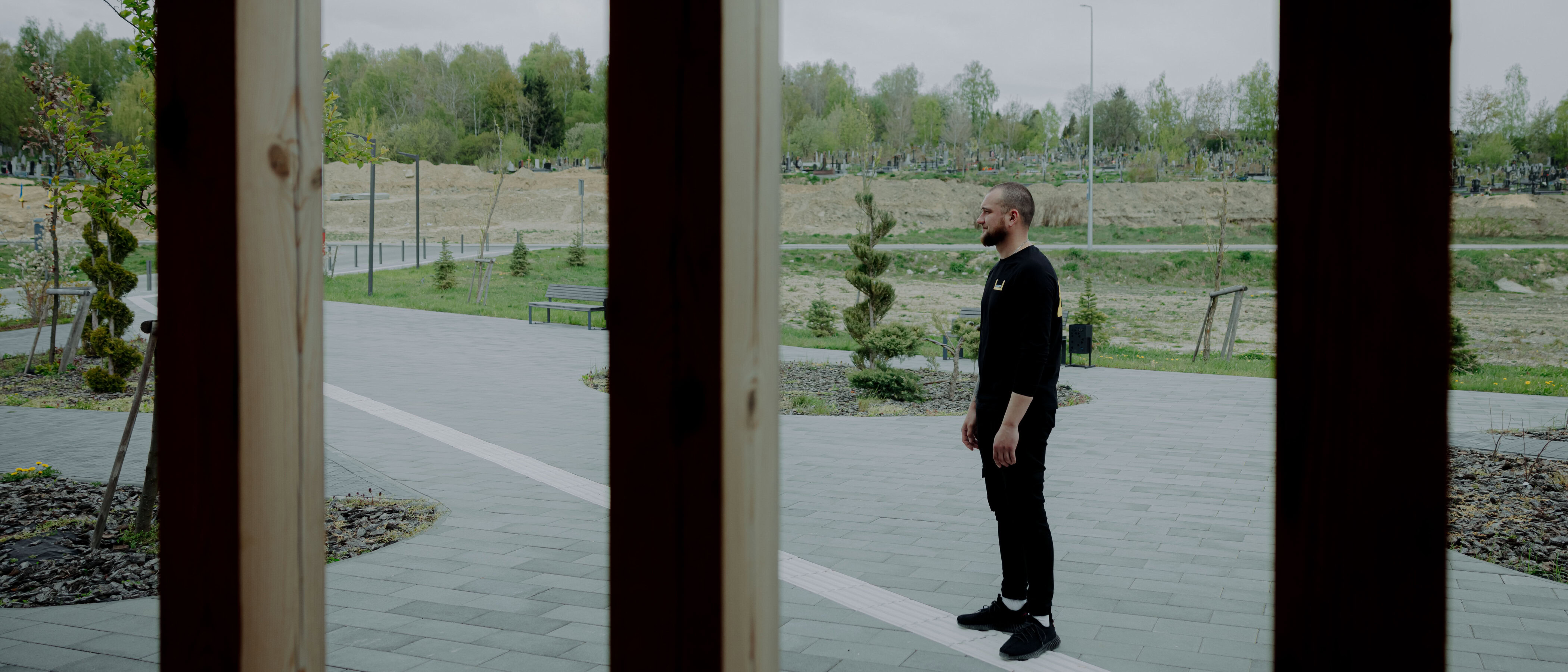
Vladyslav Sikhovskyi angled his phone around, searching for the perfect shot. His father, Andrii, who currently serves in the Armed Forces of Ukraine, had asked to be photographed next to a memorial plaque in the village of Korchivka: “Glory to the heroes of the ‘Viktoriia’ company, who died for the freedom of Ukraine on January 14, 1945, in an uneven battle with the NKVD.” Just below the inscription, the names of those who took part in those events were engraved.
[Editor’s note: The NKVD (People’s Commissariat for Internal Affairs) were Soviet secret police that suppressed Ukrainian resistance through mass arrests, executions, torture, and deportations to Siberian labor camps.]
“Can you see Sikhovskyi?” his father asked again. “Make sure it is a good shot so I can show it to my brothers-in-arms later.”
Reaching the village of Korchivka in the Stryi district is difficult, as there is virtually no one left to visit. However, whenever Vladyslav and his father find themselves nearby, they always stop by to pay their respects to great-grandfather Ivan.
The young man knows little about him, only what his grandfather managed to retell: Ivan served in the Ukrainian Insurgent Army (UPA), and was ambushed along with his brothers-in-arms, after which the NKVD tortured and crucified them in the neighboring village of Zhuravno. His body hung there for two to three days before being thrown into the gentle, quiet Dnister River.
Son, the worst kind of people
are the Moskals,
Vladyslav could hardly understand those words at the time; he simply listened to the stories as they took root deep in his subconscious. The young man became interested in the history of the next generation of his family, his father, Andrii.
He often asked his father about the peacekeeping mission in the former Yugoslavia in 1992. However, it was not the military details that fascinated the young man, as his father had only guarded the border between Croatia and Serbia and never participated in active hostilities.
More than anything, the young man was eager to understand what it was like to sign a contract at the age of 19 and go abroad. Even though his family lived just 60 kilometers from Poland and Belarus, in a village near Kovel, distant countries remained completely out of reach for Vladyslav.
Can one be born a patriot?
Vladyslav was raised among Ukrainian patriots.. He always tagged along with his father, who was a member of the Kovel district branch of the Svoboda party.
In 2011, the party was celebrating its 20th anniversary. Andrii was heading to Kyiv with his fellow party members for the celebrations when a thought crossed his mind: “Why not take the boy? He’ll see the capital.” Vladyslav agreed, because during such trips, his father would buy him potato chips, which his mother strictly forbade.
Around three in the morning, the police stopped their large bus in Lutsk, forcing the party members to switch to separate cars. “Yanukovych was president back then, so they were putting a bit of pressure on members of nationalist movements.,” Vladyslav now realizes. But back then, he understood none of it, half-asleep and thinking only of chips.
As a teenager, the young man joined the patriotic organization “Sokil”. Vladyslav and his father frequently visited the village of Vovchak, which once housed one of the very first bases of the Ukrainian Insurgent Army (UPA) and now serves as a center for patriotic education and training.
Vladyslav first heard the slogan “Glory to Ukraine” outside his home when the Revolution of Dignity began.
“It felt like something so close to me. I thought it was cool that all these people were like-minded,” Sikhovskyi recalls.
This time, Andrii did not take his son to Kyiv. “No, we are going there to work,” he replied dryly, slamming the door behind him. A few days later, he sent his family a photo showing him pulling part of a Lenin monument with a rope. Later, Andrii joined the protests on Bankova Street, where the Berkut riot police broke several of his ribs. Vladyslav also wanted to be useful, but there was nothing for him in Kyiv, so he watched the revolution on TV at home.

Every Saturday he went to observe autopsies
After finishing the 11th grade, he chose to study medicine. His motivation was based on the philosophy of stoicism, or perhaps just pure indifference: “I did a lot of things in life based on the principle that they would either work out, or wouldn’t.” In reality, Vladyslav had a knack for biology and earned a state-funded scholarship at Dnipro State Medical University.
The young man was nervous about facing “Russification” in Dnipro, but he needn’t have worried. Every morning at 9 a.m. in the dormitory, his roommate Pavlo, who had the wonderful surname of Luhanskyi, would turn on the Ukrainian national anthem — that was how they bonded. Vladyslav would tell Luhanskyi about Volyn, while Pavlo shared stories of his hometown of Dobropillia in the Donetsk region.
[Editor’s note: The surname Luhanskyi may be loosely translated as “of Luhansk”. Luhansk was one of the first regions of Ukraine targeted by Russia-backed insurgents and Russian operatives in 2014. It is a reminder that despite Russian claims to the region, Luhansk has deep Ukrainian roots and identity.]
New friends, relationships, and dorm parties marked a period of prolonged freshman euphoria. He had the energy to dream, desire, and plan. The young man wanted to become a pathologist, reasoning that it is hard to make things any worse for a dead person. However, pathological anatomy was not taught to first-year students, so he befriended senior students and spent every Saturday observing autopsies.
Vladyslav had not expected floral scents, but he was not prepared for such a pungent odor either. He and the guys came up with a little trick: they would apply some Zirochka balm under their noses before putting on masks and heading into the morgue.
A few months later, Vladyslav realized that pathology was not for him. “It is boring, just the same thing every single time. And when you look at those pathologists, they all seem so gloomy,” he says.

At the end of his first year, the young man applied for a job as a hospital orderly. Vladyslav had gauged ears and tattoos from head to toe.
“How old are you?”
“Eighteen.”
“Nah, bro, go study some more,” Vladyslav recalls the exchange.
His desire to stay in medicine was gradually fading. The hospitals his group visited for practical training were so dreary they made him want to die of horror, and the salaries were far from the thousands he had dreamed of. Some of his friends had already graduated and bought their first cars with Polish plates, while he was still working part-time as a barista.
[Editor’s note: Cars purchased in Poland were significantly cheaper due to lower EU prices, making Polish-plated vehicles a common sight and an informal status symbol in Ukraine.]
Vladyslav failed his comprehensive exam in anatomy and histology, after which he was expelled. “I was just fed up with being so far from home,” he said and returned to Volyn. There, he enrolled at the Lutsk Institute of Human Development in the department of physical therapy. He was certain that he was done with medicine for good. So, he arranged an individual study plan with the rector and went to Poland to earn some money.

From the weekend in Bukovel to the training ground
February 2022 was snowless. The young man returned home for the holidays with his girlfriend, whom he had met in Poland. Yuliia was born in Belarus, but she was quickly embraced as one of their own by the Sikhovskyi family.
Vladyslav organized a weekend in Bukovel, where he taught Yuliia how to ski. But as soon as they returned, the full-scale invasion began. He asked his girlfriend to return to Poland, and she quickly complied with a request that felt more like an order. Vladyslav then took his mother to a school basement and started building roadblocks alongside his father.
In the village where the Sikhovskyi family lives, a volunteer unit was formed, bringing together over 100 people. “We were like terrorists,” the young man jokes. “The local сommunity police officer allowed us to drive around with unregistered weapons, and someone found some gear they had used for airsoft.”
The men set up a training ground just outside the village, where they trained with a tactics instructor, and prepared hidden caches in the forest in case the Russians advanced. They built a bunker for 80 people as well as watchtowers overlooking the highway, and carefully mapped out a retreat plan.
Just a week later, Vladyslav and his father received their first weapons: a PM and an RPK. Their territorial community volunteer unit was officially attached to the 100th Territorial Defense Brigade. The command sent the men to the Belarusian border to dig trenches, where they also underwent training and set up an armory with 70 assault rifles, taking turns guarding it.
On March 10, 2022, his father received a call from the military enlistment office, and just a day later, he was at the training ground in Rivne. The volunteer unit stuck together until the summer: some went to the combat zone, while others stayed in the village. Andrii refused to let his son go to war, telling him to look after the household. But the young man could not just sit around doing nothing — he wanted to contribute to the front.

How to find yourself
Vladyslav remembered nearly every minute of the first funeral in the village since the start of the full-scale invasion. They had not known each other; the young man who died had worked as a long-haul truck driver and was rarely around. Other truckers lined up their massive semi-trucks in the lot, while anxious neighbors gathered along the road.
Vladyslav was one of the pallbearers carrying the casket. For nearly four kilometers, they bore their neighbor on their shoulders on his final journey from his house to the cemetery. Their hands were sweating, and their legs were treacherously giving out. Suddenly, the trucks blared their horns across the lot — desperately and mournfully. “It was insane, it felt like my own brother had died,” Sikhovskyi shares.
Perhaps it was that very moment that sparked his desire to transport fallen soldiers. He spoke with the head of the district administration, but the official turned him down, saying, “You’ll find a better way to prove yourself elsewhere.”
For a while, he ran humanitarian aid to the front. But those trips only happened once every three months, and it was not enough for Vladyslav. His mother knew how deeply her son wanted to contribute to the front. One day, while scrolling through Facebook, she stumbled upon an announcement from the First Medical Association of Lviv.
“Want to give it a shot?” she asked him.
Vladyslav was just finishing his master’s degree at the department of physical therapy in Lutsk. “Cool,” he thought, and filled out the application.

Later on, he was planning a winter hike in the mountains when his phone suddenly rang from an unknown number. “Would you like to come in for an interview?” a voice asked on the other end. Vladyslav thought: Why not? I was going to drive through Lviv anyway.
He showed up for the interview at St. Panteleimon Hospital wearing ski pants and a jacket. Oleh Samchuk, the CEO of Unbroken, walked into the office. Vladyslav thought for a long time, trying to remember where he had seen that face before, until it finally clicked: the man had once been the chief physician in Kovel.
“Tell me, what is physical rehabilitation?” Samchuk asked.
“Honestly, I’m not ready for this interview,” the young man replied, deciding to be frank. “If you give me a chance, I’d be glad to take it. If not, that’s fine too.”
He was asked to wait in the lobby. After three hours of waiting, Maksym, the director of rehabilitation, came over.
“Come on, I’ll show you what we’re building,” he said.
Vladyslav looked around the construction site and relaxed. “It’ll take them at least another year to finish building this,” he thought. But then:
“Alright, you start work tomorrow.”

To find your calling and find peace
His assistant’s salary was barely enough to cover rent. In his free time, the young man worked as a taxi driver to support himself, his pregnant wife, and keep his car running. He caught up on the material he had missed at university, frequently attending seminars and workshops. But he learned the most from his partner, a rehabilitation specialist with 20 years of experience.
One day, he was asked to come to the reception office. Vladyslav had no clue where it was. After wandering around for a bit, he eventually found it.
“How’s it going, kid?” Oleh Samchuk asked. “Would you like to change careers?”
“Let’s do it.”
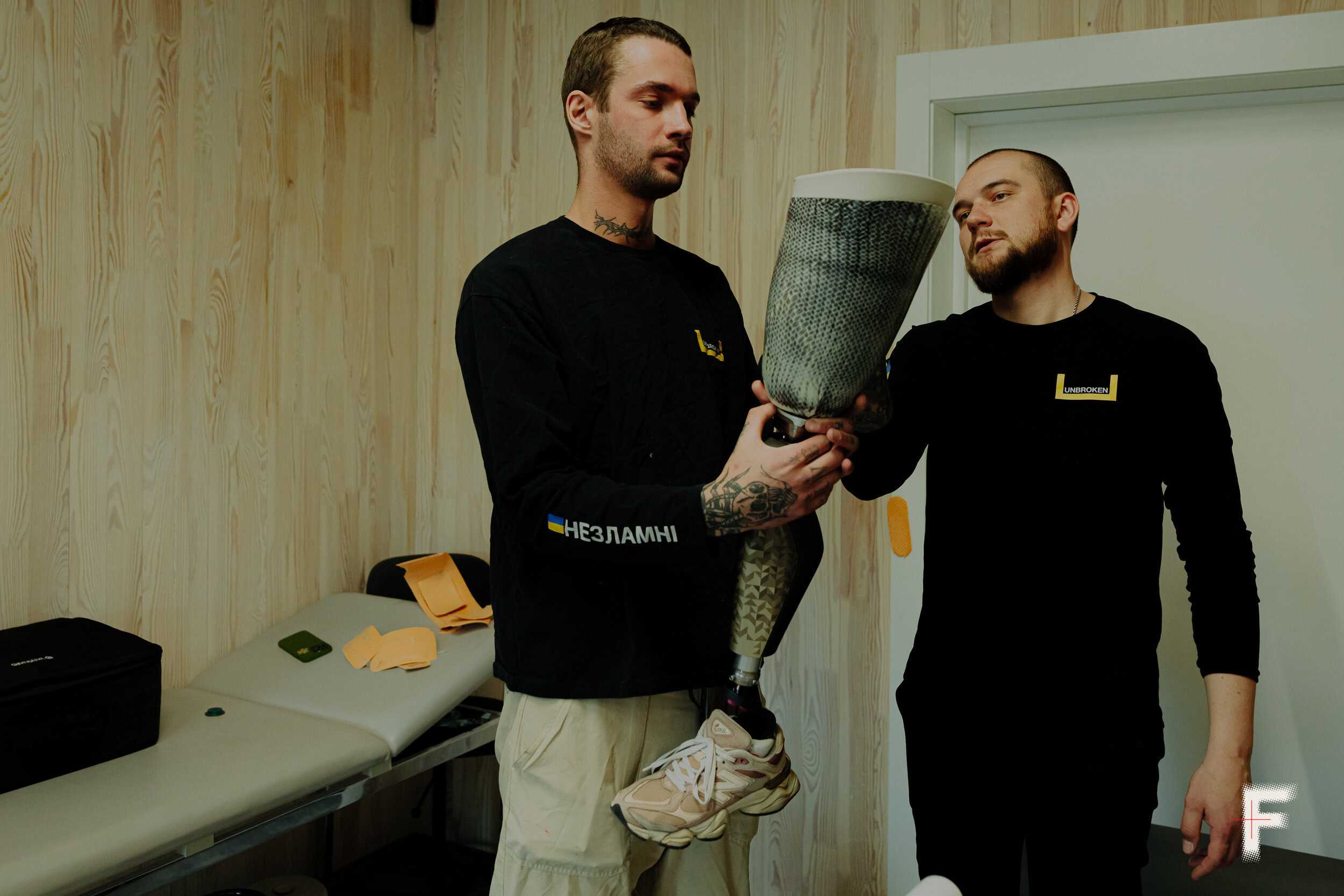
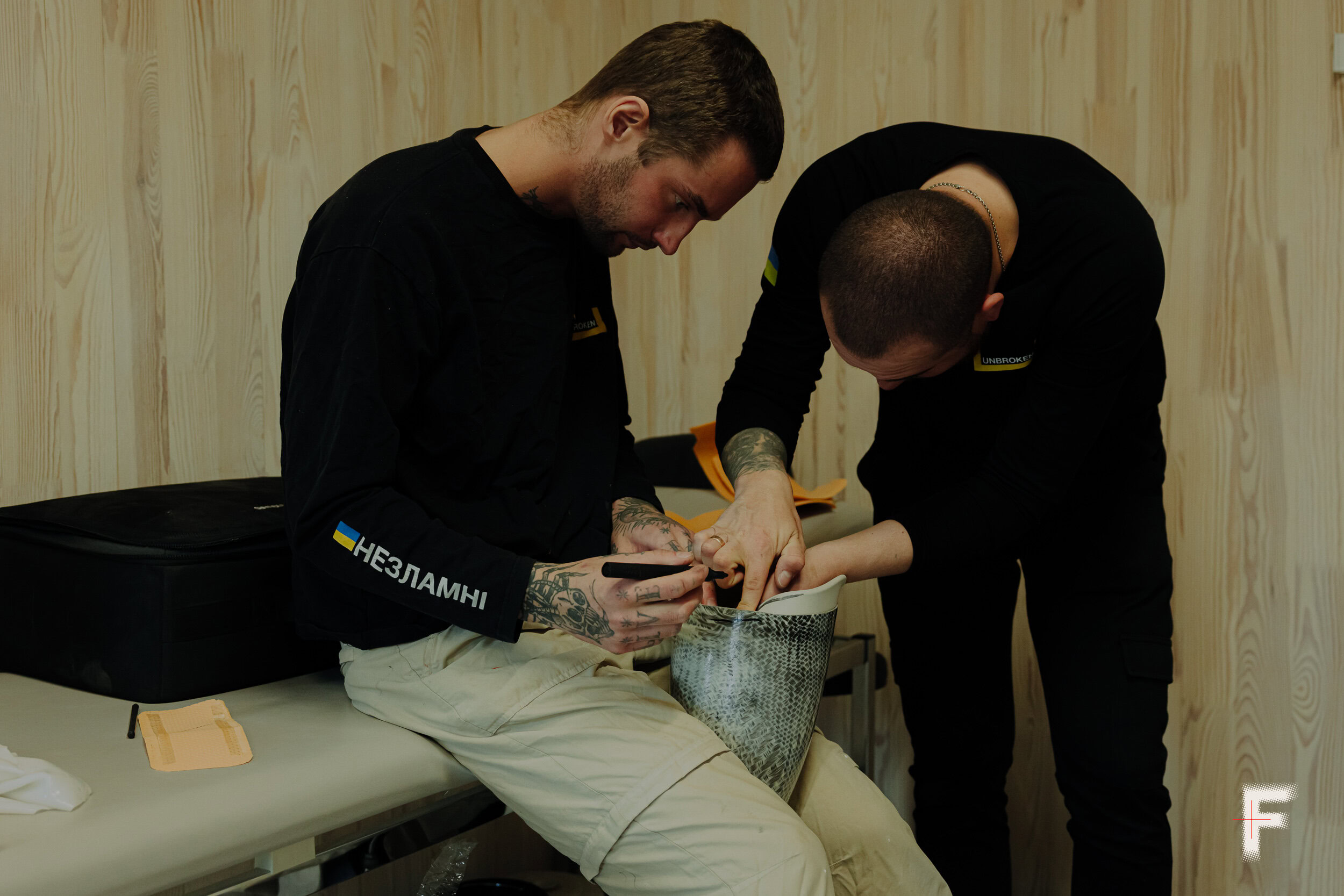
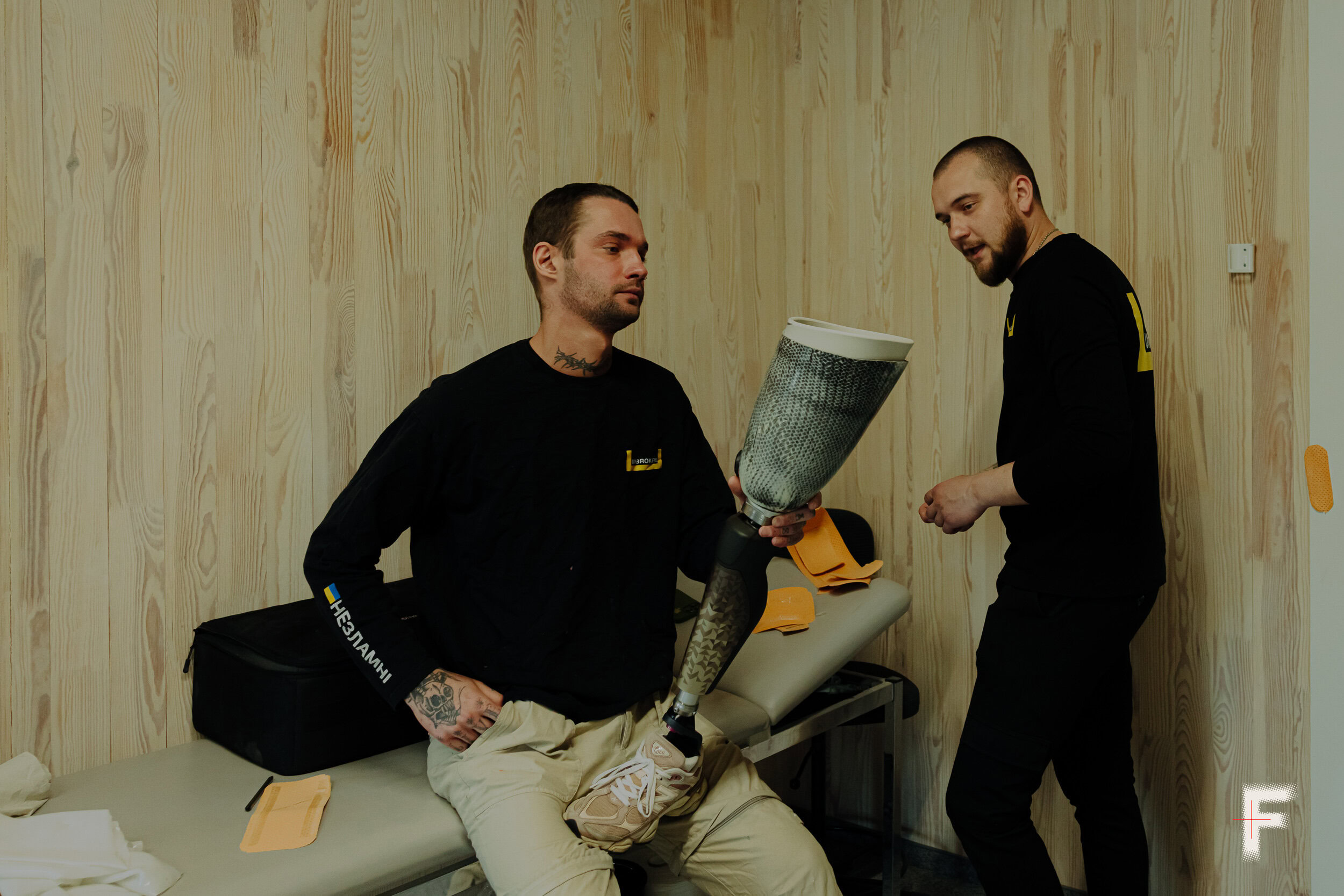
Vladyslav calls himself a “flexible guy.” Besides, he always loved tinkering with things by hand, so the offer to become a prosthetist thrilled him — his eyes instantly lit up. However, his first task had nothing to do with prosthetics, as he was asked to find 10 new people for the team.
“Can you recruit them?” the CEO asked. “Then you’ll have your new team.”
He called all his friends from Kovel and tracked down a few more in Lviv. Within two days, seven shaggy-haired guys showed up at the hospital. The newcomers were sent to train under Nazar Bahniuk, a leading prosthetist already working at Unbroken. The guys picked up the basics and soon began their studies at a German school to get their SPO international certification. Six months later, they earned their official classification and officially became prosthetists.

Vladyslav has been working at Unbroken for three years now, but he still remembers the very first patient he made a prosthesis for. The man walked up to him and said, “Listen, man, for the first time in six months, I peed standing up. Thank you.” Vladyslav felt a warmth spread through his soul. He finally felt grounded, because he was exactly where he was meant to be.