A forest rises from the bottom: Willow reclaims the former Kakhovka Reservoir
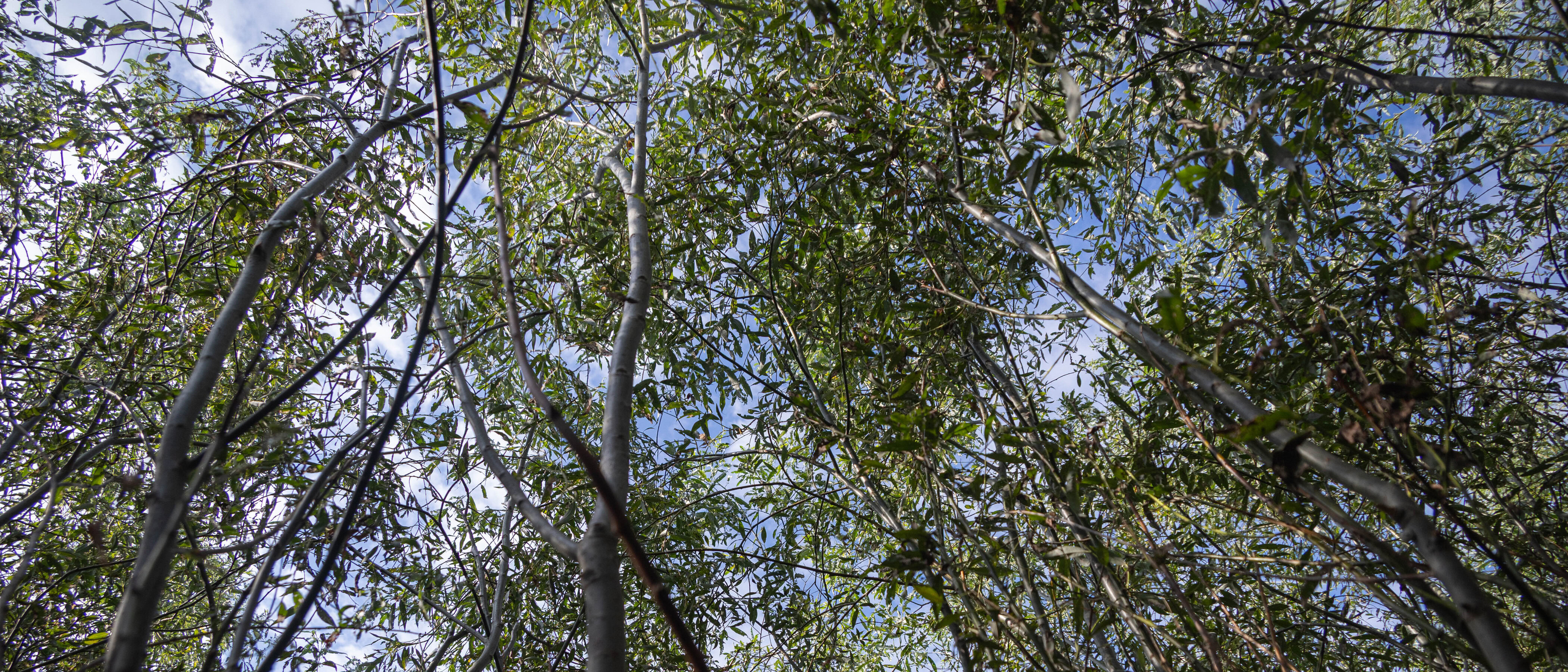
Willows close in above the narrow path, their branches catching on our clothes. Hot, humid air, dense swarms of insects, and lush green thickets transform the former bed of the Kakhovka Reservoir into an almost tropical forest. Thin, flexible trees already tower over five meters high, even though just three years ago, nothing but bare silt lay here. Frontliner joined an expedition with scientists studying the new ecosystem born on the site of the reservoir destroyed by the Russians.
Russian FPV drones, including fiber optic models, as well as Molniya and Orlan aircraft constantly circle above the willow forest and the settlement of Novovorontsovka, where the scientists are based. Sometimes the team has to wait out an attack by hiding in the bushes, listening closely to the deadly buzzing overhead. The scientists spend their nights in a windowless shelter because it is much safer. The Dnipro River is just a stone’s throw away. The occupiers are already stationed on the opposite bank.
Under the constant threat of drones, the scientists observe how a new ecosystem is emerging on the land reclaimed from the water. By 2026, the willow thickets can officially be called a forest, as the average height of the trees has exceeded five meters.
Once, these lands were called Velykyi Luh (Great Meadow). It was the heartland of the Kozaks and a symbol of strength and freedom. “Oh, the Sich is the mother, and the Great Meadow is the father,” folk songs used to proclaim. In the 1950s, the Meadow was flooded. It became the bottom of the Kakhovka Reservoir. Three years ago, Russian occupiers destroyed the reservoir as well.
The miraculous willow
Every year, the flora of the young forest becomes richer. The fallen leaves decompose and change the soil composition. Subsequently, new species emerge. Biologist Ivan Moisiienko points to a poplar tree:
“It is less abundant than the willow, but it is still present. That means the willow arrived first as the pioneer tree, and the poplar is just a bit less common. We just passed an ash tree, and here we see an elm. I think in about five years, we might even see oak trees here. A complete replacement of ecosystems has taken place.”
Many unusual things are happening here,

The researcher expects the variety of tree species to keep growing. The forest already has its own distinct structure: the tree and grass layers have separated, and a moss and lichen layer has emerged.
“All the necessary attributes of a forest have already appeared,” Ivan Moisiienko explains. “The fact that this happened in just three years is a miracle. It is incredible that the reservoir was covered so quickly specifically with willow rather than invasive species. This occurred because the catastrophe happened exactly when the willow seeds were viable for germination. They lose this viability quite quickly, within just a few weeks. The second factor is the growth rate of the willow. In the first year, we recorded that the willow grew an average of almost three centimeters per day, which is a highly unusual speed. In less than two years, the willow bloomed. It was its third season, and an incomplete one at that. Usually, this happens in the fifth to seventh year. In short, many unusual things are happening here.”

The rapid growth of the willow has presented scientists with their next question: what exactly is feeding this forest?
Trees standing guard over the atmosphere
The answer lies right underfoot. The willows receive plenty of sun and water, and the former reservoir bed provides them with nutrients. Organic matter accumulated in the silt beneath the reservoir for decades. After the destruction of the dam, this matter ended up on dry land, and microorganisms actively began to decompose it.
“This organic matter did not decompose in the silt because the thick layer of water blocked it, preventing the bacteria from getting in and doing their work,” Ivan Moisiienko says. “Now it is exposed on dry land. These bacteria have become highly active, releasing an enormous amount of carbon dioxide. Carbon dioxide is the primary gas used to build the body of the trees. Therefore, this abnormally high concentration of carbon dioxide might be the exact reason why this forest is growing so incredibly fast.”

Without vegetation, the carbon dioxide released from the silt would escape straight into the atmosphere. The willow forest intercepts this flow. Ivan Moisiienko emphasizes that the trees are already serving several functions at once in the new ecosystem.
“Not only does this willow grow quickly, but it also protects the reservoir from invasive species,” Ivan Moisiienko says. “Furthermore, it prevents this carbon dioxide from adding another massive dose of greenhouse gas to the atmosphere.”
Traces of past lives
Among the thickets, the remains of water wells, pieces of brick, and fragments of ceramic dishes begin to emerge. The ruins of a flooded cemetery have also survived. These are the traces of life buried at the bottom of the reservoir.
A layer of shells right underfoot serves as a reminder of the dead aquatic ecosystem. They look rather bizarre scattered across the forest trails. According to Ivan Moisiienko, billions of mollusks died when the reservoir was destroyed.

“The fish went down with the water all the way to the Black Sea,” Ivan Moisiienko says. “The Black Sea rapidly desalinated, but it returned to normal within a few months. The water mixed and became salty again, causing all those freshwater fish to die in the Black Sea. There were also sites of massive fish die-offs right here. For instance, there were ponds where the fish got trapped instead of washing away toward the Black Sea. The bottoms of those ponds were completely covered with dead fish.”
The destruction of the dam caused the death of the endangered Danube crested newts. Employees of the Tuzly Estuaries National Nature Park managed to save a few individuals. However, the majority of the animals died.
From leaf to soil: scientists study the new forest
Ivan Moisiienko measures a plot of 10 by 10 meters and documents all the plant species inside. He places willow leaves and other samples into plastic bags for laboratory testing. Both the plants and the soil will undergo chemical analysis. This process will show whether there are pollutants and whether they are entering the plants.
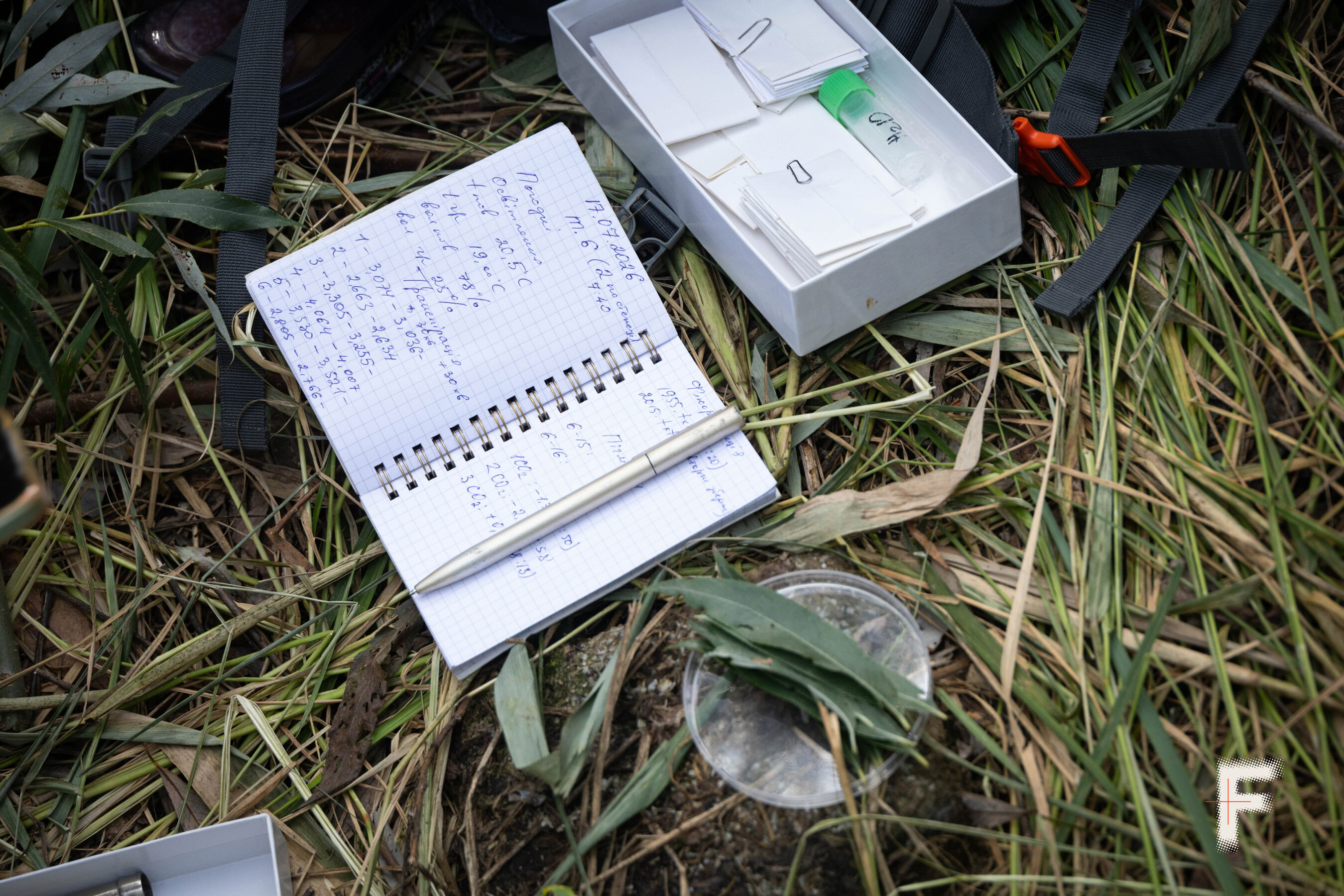
Physiologists Oleksandr Polishchuk and Kateryna Romanenko work separately. Kateryna places several willow leaves on a tiny scale. Then she measures their fluorescence using a special device.
“There was dark adaptation happening inside this box,” Kateryna Romanenko says. “Now the shutter opens, bright light pours in, and the potential of the leaves is measured under that bright light to see exactly what they are capable of.”

The researchers return to take measurements several times a day: at six in the morning, during the day, and at dusk. According to Kateryna Romanenko, this schedule allows them to track the daily and seasonal dynamics.
The vegetation cover and soil composition depend on the distance to the water and the density of the willows. The plants here grow significantly larger than we are accustomed to seeing anywhere else. Plantain leaves, for instance, resemble large burdock. The researchers joke that everything here is growing on steroids. The actual reason for such gigantism is the massive amount of nutrients in the soil.
Real forest soil is already forming in place of the silt. Oleksandr Polishchuk emphasizes the willow’s ability to adapt quickly to difficult conditions.
“When conditions are bad, and there is intense heat during the day, the tree stops its growth and photosynthesis,” Oleksandr Polishchuk says. “But as soon as optimal conditions appear, it instantly starts to use them. When other plants suffer, they experience stress and require a long recovery. They might not recover at all. The willow, however, rapidly reclaims its strength.”

By their third year, pests began to appear on the trees. Still, the willows continue to grow.
The next day, Ivan Moisiienko heads to another section of the former reservoir. Here, near a small body of water, reeds and tamarisk stand like a solid wall. In the willow forest, this shrub was only occasionally seen, but in this area, it already dominates.
Where the tamarisk replaces the willow
“Tamarix ramosissima is a southern shrub that naturally occurs in the Mediterranean and right here in the south of Ukraine,” Ivan Moisiienko explains. “Tamarisk acts as a specific indicator for these forests. We do not yet know the full characteristics of this new ecosystem. However, at first glance, they are unique. For example, they feature branched tamarisk as the dominant species in the shrub layer.”

Birds, alarmed by the appearance of people, circle above the water. One bird repeatedly flies in circles and cries out desperately. Ivan Moisiienko assumes that its nest with chicks is hidden somewhere in the shrubs.
The future fate of this territory remains unknown. Scientists will insist on turning it into a protected nature reserve. Many local residents mourn the lost reservoir and dream of its restoration.
It is impossible to make any decisions with the occupiers stationed across the Dnipro River, turning the villages and roads on the bank controlled by Ukraine into a kill zone.
Meanwhile, the willow forest grows and becomes stronger. It withstands weather changes, shelling, and the appearance of pests. The older residents of the village, who remember the Great Meadow before the creation of the reservoir, point out a fact: the willow grew here before. Before the territory was flooded, the trees were cut down. Now the willow is returning and reclaiming the land.
The Frontliner editorial team thanks the following individuals for their help in preparing this material: Serhii Skoryk, Director of the Kamianska Sich National Nature Park; Ivan Moisiienko, Chief Researcher of the Askania-Nova Biosphere Reserve, Board Member of the Ukrainian Nature Conservation Group, Doctor of Biological Sciences, and Professor of the Botany Department at Kherson State University; and Andrii Seletskyi, Head of the Novovorontsovka Military Administration in the Beryslav district of the Kherson region.