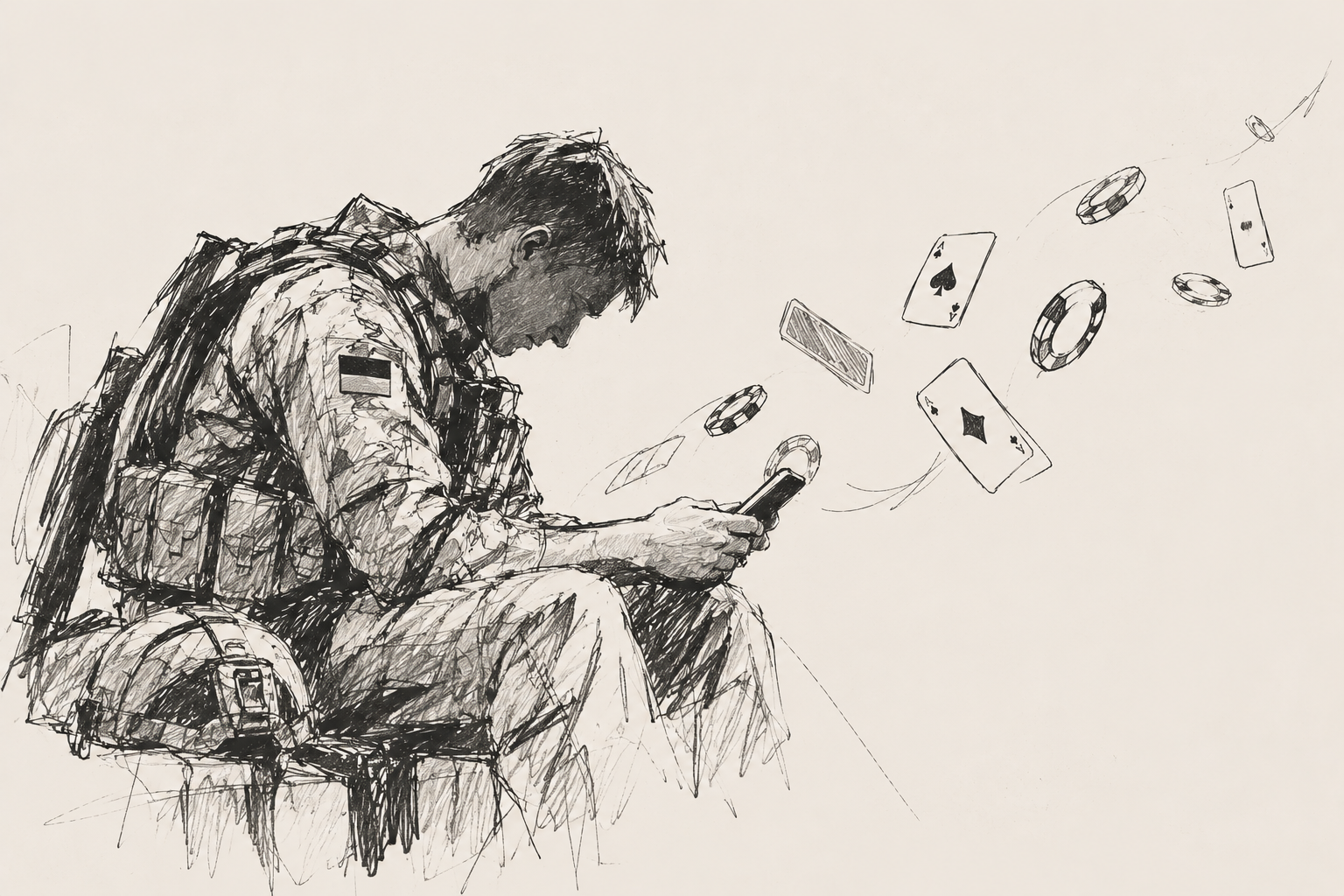
Wartime stakes: What is known about gambling addiction among service members
Signs of a pathological tendency toward gambling were found in 26.67% of service members covered by a 2026 study. The figure applies only to the group studied; the government still has no overall statistics on gambling addiction in the military. Meanwhile, authorities are preparing to automatically block service members’ access to legal gambling. Frontliner looked into how widespread gambling addiction is in the army and whether the restrictions introduced in 2024 have worked.
The scale of the problem came to public attention in spring 2024. Stories of service members losing their salaries and falling into debt spread far beyond conversations within the military. The government responded with a decision by the National Security and Defense Council (NSDC): The president put it into effect April 20, 2024, and military commanders were instructed to bar service members from visiting gambling establishments and playing online for the duration of martial law.
Two years later, the central question remains without a precise figure. The government’s strategy to combat gambling addiction, adopted in August 2026, states outright that Ukraine has no unified system for regularly collecting reliable statistics on gambling participation and the prevalence of addiction. The document separately identifies service members as a vulnerable group. As a result, any claim about a specific share of addicted personnel across the Defense Forces of Ukraine currently lacks sufficient evidentiary support.
26.67%: A warning sign, not army statistics
The most recent concrete data comes from a study by researchers at the Lviv State University of Life Safety. Using a set of psychological assessments, they found signs of a pathological tendency toward gambling in 26.67% of the service members surveyed. The authors link the higher risk to anxiety, emotional instability and a desire to psychologically detach from reality.
The figure shows that the problem exists in the group studied. It does not mean one in four Ukrainian service members is addicted: The authors examined a specific sample and did not conduct military-wide screening. Moreover, a “tendency” identified by a diagnostic test is not the same as a medical diagnosis.
The government’s strategy describes a similar risk mechanism. Prolonged stress can push people toward gambling as a way to escape temporarily. For service members, there is also a security risk on top of the psychological and financial toll: Debt and addiction can make them vulnerable to outside influence.
Two years after the ban, the technical barrier is still being built
The 2024 NSDC decision required the commander in chief of the Armed Forces of Ukraine and the heads of other military formations to immediately ban gambling for service members for the duration of martial law. At the same time, the government was to restrict advertising, introduce time and spending limits for players, develop a self-exclusion system and block illegal gambling websites.
In December 2024, parliament passed a broader law against gambling addiction. It restricted gambling advertising, barred the use of service members and military themes in ads, and required legal operators to set time and spending limits for players. The law took effect April 1, 2025.
A separate technical mechanism for service members, however, appeared only in summer 2026. Government Resolution No. 804 provides for data exchange between the Register of Service Members and the Register of Persons Barred From Gambling. Once the system is launched, a legal operator will be able to automatically identify a person as a service member and deny them access to play. The Ministry of Digital Transformation said in June that technical preparations for the exchange were still underway.
The register is growing, but service members aren’t visible in it
There is, however, one measurable indicator. As of the end of April 2026, more than 16,000 people were listed in the Register of Persons Barred From Gambling. In the first four months of the year alone, more than 3,000 self-exclusion applications were added. By comparison, there were 7,573 such entries in 10 months of 2024.
These figures also do not provide army statistics. PlayCity, the state gambling regulator, does not break out service members among all register entries in its open data. A rise in self-exclusions may reflect wider use of the tool itself, so it would be incorrect to automatically treat it as evidence of an equal rise in gambling addiction.
From bans to prevention
In August 2026, the government approved a strategy to combat gambling addiction through 2035. It devotes a separate track to service members. The plan calls for training commanders and psychological services to spot risky behavior, introducing early detection of addiction, expanding prevention programs in units and providing support to service members with such disorders after they leave the military.
The document also identifies a weak point in the entire system: Ukraine does not yet have a coherent model of care for people with gambling addiction, from early detection through treatment and rehabilitation. Gambling addiction in the military is thus documented, but its true scale remains unknown.