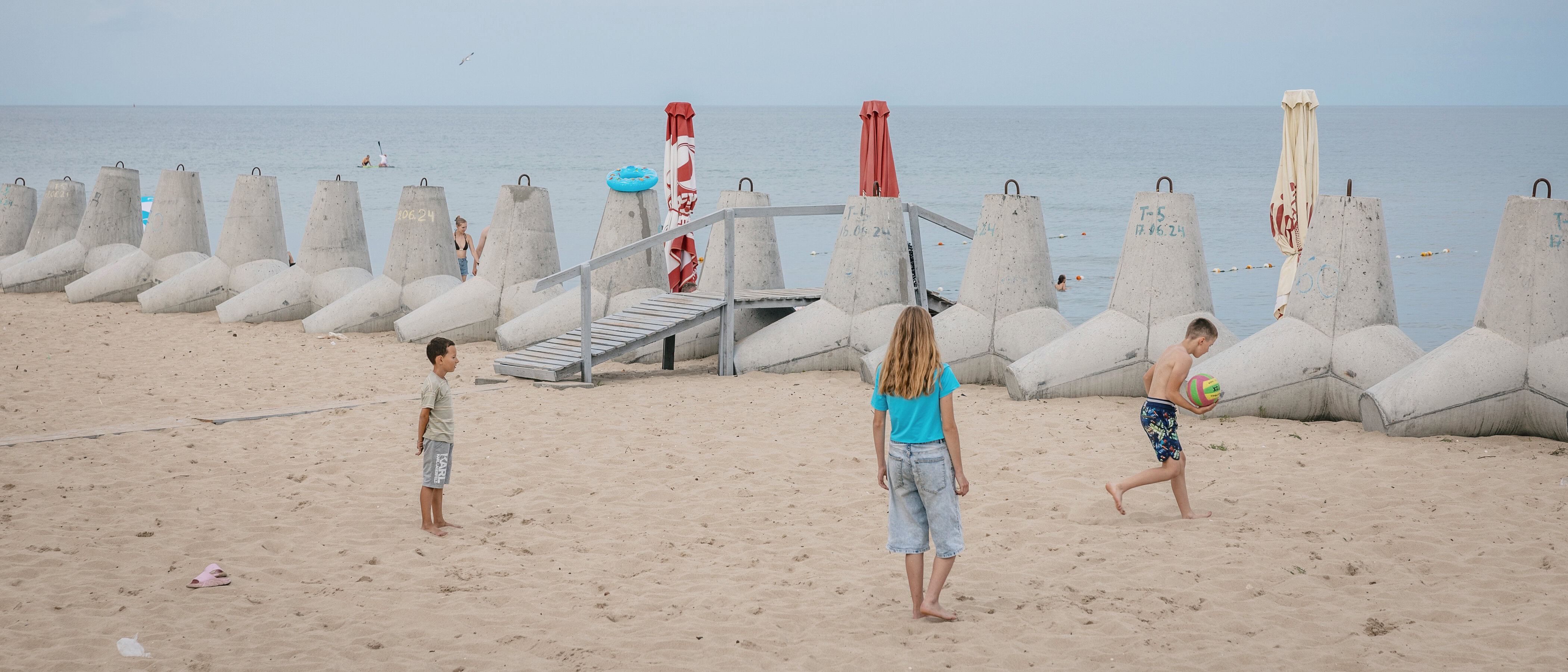
The sea during the war: Is it worth going to the Ukrainian coast
An umbrella is no longer the main thing to look for on a Ukrainian beach. First, one should locate a shelter, verify the official status of the area and make sure the path to the water isn't blocked by mine warnings. Even after the seabed has been surveyed, the sea remains part of a country that the Russian military regularly attacks with missiles and drones. Frontliner has compiled information about how safe it is to travel to the Black Sea coast as of late June 2026.
Officially permitted beach recreation on the Ukrainian-controlled coast has effectively narrowed to a handful of inspected sites in Odesa. In the Mykolaiv region, swimming is banned by decision of the military administration. In the Kherson region, recreational zones were also not opened in 2026 because of combat operations, shelling and mining. Kobleve, Ochakiv and the Ukrainian-controlled portion of the Kherson coastline are not official destinations for a seaside vacation.
An official beach opening means a commission has inspected the site, divers have surveyed the water area, the swimming boundaries have been marked with buoys, and a lifeguard post and medical post have been set up nearby. A shelter must also be accessible. This status reduces risk and creates a response system. It does not guarantee that a Russian drone or its debris will not fall on the shoreline.
Where recreation is permitted
Odesa: 27 inspected sites
As of early August 2026, Odesa had readiness certificates for 27 beach sites. The list included areas at Lanzheron, Delfin, in Arkadia and at the 10th–16th stations of Velykyi Fontan. Among them are Bezmezh, Kaleton, La Cambala, Red Line, Portofino, Zolotyi Bereh and two municipal inclusive beaches.
At open beaches, lifeguards, warning systems and medical points are required to be operating. At some locations, the path to a shelter takes one to two minutes. The problem arises when people don’t know where the shelter is located or stay near the water after an air-raid siren.
A closed beach remains shut
At unofficial sites, the seabed is not regularly inspected, there is no designated swimming zone, no lifeguard post and no guaranteed accessible shelter. The operation of a nearby café, hotel or rental service does not mean the beach is authorized. Zatoka, Karolino-Buhaz, Hrybivka, Lebedivka and Kurortne remain especially dangerous.
The mine threat does not disappear after a single inspection: explosive devices can shift with currents or appear after a storm. That is why permits apply to specific sites, not to an entire municipality’s coastline.
Two threats that have already killed
A strike on the beach
On June 23, 2026, during a Russian attack on Odesa, a 26-year-old woman was killed and a man was wounded at Vidrada Beach. The site was not on the list of approved beaches. After the air-raid alert sounded, most vacationers moved away from the sea; the woman who died and the wounded man remained on the beach.
This case illustrated the limits of any beach inspection. A surveyed seabed protects against some underwater hazards. Protection from an airstrike comes only from leaving the beach in time and remaining in a shelter until the all-clear.
Explosions in the water
On June 7, 2025, two men were killed in Zatoka while swimming when an unidentified object exploded in the water. In August of that same year, explosions at the banned beaches of Karolino-Buhaz and Zatoka killed three more people. Source: State Emergency Service of Ukraine (DSNS), via Suspilne.
Similar tragedies have occurred before. In July 2022, one vacationer died while swimming in Karolino-Buhaz and another suffered a concussion. People were on the shore in violation of the ban.
How to reduce the risk
- Check the current list of approved beaches issued by the regional or city military administration. The name of a resort or a nearby complex does not confirm authorization.
- Locate a shelter before heading onto the sand. Assess the route and the time needed for children, older adults and people with disabilities.
- Leave the beach immediately when an air-raid alert sounds. Return only after the official all-clear.
- Do not go beyond the buoys and do not use stand-up paddleboards, boats or other watercraft if prohibited by site rules.
- Do not touch objects in the water or on the shore. Retreat along the same path and report it to the State Emergency Service at 101 or police at 102.
- Do not enter the sea after a storm. Waves can wash munitions ashore or shift them into shallow water.
- Carry a phone with air-raid alert notifications enabled and charged, along with water, a first-aid kit and identification documents.
- Cancel the trip if it would require breaking the ban to reach the sea.
To go or not to go
Permitted does not mean safe
A vacation at an officially open beach in Odesa is possible. It should be understood as time spent in a region under constant threat of air attack, not as a return to a prewar resort. An inspected seabed, lifeguards and shelters lower the risk. The risk does not reach zero.
A trip to a closed stretch of coastline is no longer a matter of personal courage. A person enters water that has not been inspected and is left without organized assistance during an alert. Known tragedies illustrate the cost of that decision.
Who should choose a different vacation
Families with young children, people with limited mobility, and those not prepared to reach a shelter immediately would do better to choose a safer destination without the sea. In the summer of 2026, the Ukrainian coastline is accessible only at designated sites, and only alongside a level of discipline that fits poorly with the usual idea of a vacation.