The drone sees its target: How the threat to civilians has changed
Short-range drones killed 111 civilians and wounded another 710. The United Nations has not recorded that many casualties in a single month since the start of the full-scale war. Nearly one in four civilians killed or wounded in Ukraine was hurt by this type of weapon. The situation is most acute near the front line, where first-person-view (FPV) drones can reach cars, yards and roads between towns. Frontliner reviewed the July report from the U.N. Human Rights Monitoring Mission in Ukraine (HRMMU) and examined what the new figures mean for front-line communities.
In July 2026, HRMMU recorded 437 civilian deaths and 2,610 injuries. Casualties rose 30% from the previous month and 70% from a year earlier. The mission last documented that many deaths in May 2022. A separate grim record involves children: 17 killed and 166 wounded, the highest monthly total since April 2022.
Across Ukraine as a whole, most civilian casualties came from long-range weapons. Missiles and long-range attack drones killed 183 people and wounded 967, accounting for 38% of all July casualties. These strikes mostly hit cities far from the front line. Airstrikes killed another 105 people and wounded 753; casualties from airstrikes rose 143% over the month, making guided aerial bombs the second-largest cause of civilian casualties.
Drones have intruded into Ukrainians’ daily routine
Over 820 casualties in a month
The U.N. recorded a separate record near the front line. Short-range drones killed at least 111 civilians there and wounded 710, for a total of 821 people, or 27% of all civilian casualties in Ukraine in July. HRMMU has not documented a higher monthly toll from this type of weapon since Feb. 24, 2022.
Geography is what makes these figures especially significant for the front-line zone. A long-range missile can strike a city hundreds of kilometers from the fighting. A short-range drone operates where the distance to Russian positions is measured in tens of kilometers or less. Civilians still live in that same strip of territory, where traffic moves and shops, doctors and utility services keep operating.
The drone sees its target
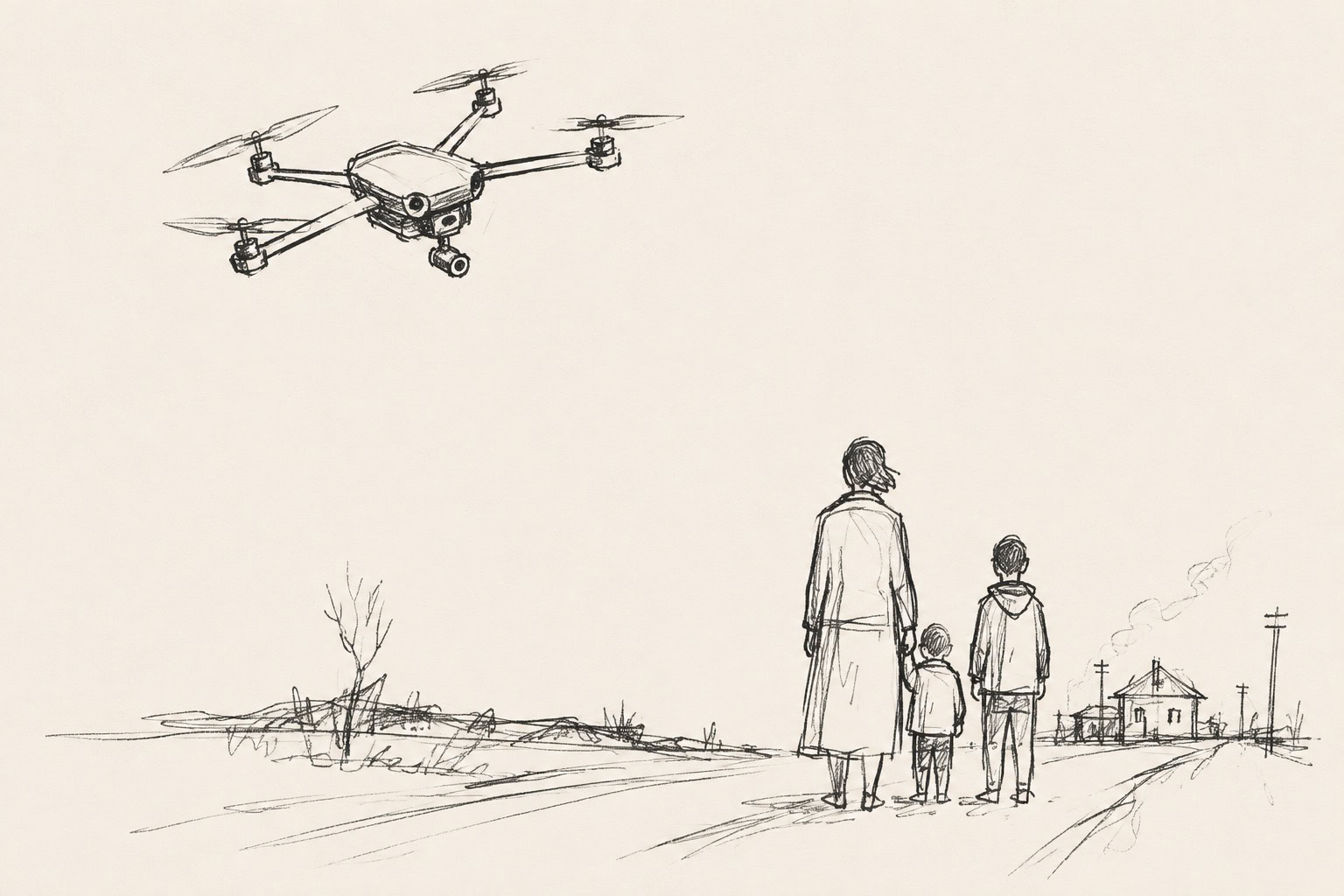
FPV drones are a type of short-range drone, though the U.N. statistics are not limited to them. Such a drone’s camera transmits real-time video to its operator. It can be steered toward a small, moving target, with its course adjusted mid-flight.
For a civilian living near the front, this changes the very nature of the danger. The target can be a single car or a person in an open area. The threat can appear on an ordinary route between a home, a store, a hospital or a neighboring village. A nationwide air-raid alert offers no reliable way to know when that kind of route is safe.
The geography of July’s casualties
HRMMU recorded the highest numbers of civilians killed and wounded in four cities:
- Kyiv — 54 killed and 202 wounded;
- Kherson — 34 killed and 424 wounded;
- Zaporizhzhia — 27 killed and 280 wounded;
- Sumy — 20 killed and 152 wounded.
These figures cover casualties from all types of weapons and cannot be attributed directly to FPV attacks alone. Even so, they illustrate how civilian danger is distributed geographically. Long-range weapons reach large cities in the rear. Short-range drones cause the most casualties in areas near the front line.
In all, the U.N. recorded civilians killed or wounded in 14 regions and in Kyiv. The statistics also include 25 people killed and 50 wounded in Russian-occupied areas of Ukraine.
Leaving home has also become dangerous
The spread of FPV drones along the front-line strip directly affects evacuation. To leave a dangerous village, a person must first travel through territory that itself lies within range of short-range drones. The closer the fighting, the longer that stretch of exposure can be.
The same risk applies to ambulances, humanitarian transport and services that need to reach people in these areas. The drone threat thus affects more than the number of people killed and wounded. It also narrows civilians’ ability to travel, receive assistance and leave front-line communities.
The U.N. simply can’t record all the casualties
Even July’s record total doesn’t capture the full picture. HRMMU explicitly warns of growing difficulty verifying information in occupied territories. Public data from those areas is becoming scarcer, so the mission believes the actual number of civilian casualties could be significantly higher.
The statistics point to another shift. Short-range drones already account for more than a quarter of all confirmed civilian casualties in Ukraine, and their share is even greater near the front. For residents of front-line communities, the danger zone is no longer defined only by artillery range or aerial bombs. It now includes any area an operator can guide an FPV drone to reach.