Hostages of their own parents: Police can’t evacuate children from the kill zone
A trip to get ice cream ended for a six-year-old girl when a swarm of enemy drones flew overhead and one struck a building nearby. People screamed, and her mother pulled her into the stairwell of a random building she'd spotted just in time. The frightened girl isn't crying. She's silent, her breathing is shallow, and she listens carefully for whether she needs to drop to the floor. This is childhood for thousands of children in front-line cities. They live in bombed-out buildings or in basements, as their parents chose not to evacuate from the front line. Frontliner explains why police still can't help these children, even though a law meant to solve this problem has been enacted.
Our basement setup is honestly better than what
they’re offering in shelters right now.

Six-year-old Olia Koval from Kramatorsk hid from Russian drones twice in a single day: in the morning, she ran for tree cover in a park; in the evening, she hid in a nearby shop when an FPV drone dove in her direction. She can tell by sound whether it’s a missile strike, a drone raid, or artillery fire, including when cluster munitions detonate in the city.
In early June, when occupying forces shelled central Kramatorsk, she fell on the pavement and badly scraped her knees. Her mother, Veronika Koval (name changed for safety reasons — ed.), says that her daughter cried for hours, upset that she’d dirtied her new dress and frightened by the explosion nearby.
Olia’s family moved from Pokrovsk in 2024, leaving behind a house, an apartment, and a business. Now, evacuating from Kramatorsk is a very difficult decision for Olia’s parents: they bought their current apartment with money set aside for emergencies. They have nowhere left to go.
“Our child has her own room here, all set up, and there’s a basement that everyone living here chipped in to fix up. We finished the renovation in May: installed ventilation, bought generators and fuel, and there’s a well. We split the space with two other families so everyone has their own area. There are even mattresses in there, almost new. Our basement setup is honestly better than what they’re offering in shelters right now. Why would we go anywhere? Anyone here who thinks they can’t survive has already left. We’ll hold out,” says Veronika Koval.
The line of contact remains 15 kilometers from Kramatorsk, held there by Ukraine’s Defense Forces. Forced evacuation hasn’t been ordered, but dozens of families have already expressed that they won’t be leaving even if such instructions are given. Veronika adds that she might change her mind if the fighting gets as close as it did to Druzhkivka. But for now, they are ruling out evacuation.
They stayed through occupation. Now they are made to evacuate
Viktoriia Melnyk (name changed for safety reasons — ed.) was already living under occupation at 13. Russian forces seized her village, Komyshany in Kherson region, in the first days of the full-scale invasion.
Over six months, Russian troops searched her and her mother four times, checking for hidden soldiers. Armored personnel carriers rolled through the streets, and armed men constantly demanded documents. It was terrifying, but there was no way out of the occupation. When the village was liberated, the family stayed home. They didn’t evacuate until three and a half years later, when Russian drones burned down neighboring houses. But families with children still remain in nearby villages, risking death in the next strike.

“The situation now is that it’s dangerous everywhere. We wouldn’t be safe from a strike anywhere,” counters mother Oksana Melnyk (name changed for safety reasons — ed.).
According to the White Angel special police unit, as of early June 2026, around 50 children remained in the “gray zone” in Kherson region. The families still there are the hardest cases: they refuse to leave their homes despite witnessing Russian forces shell Kherson daily, with roughly 500 enemy drones involved. Evacuation crews themselves come under fire.
Editor’s note: White Angel is a Ukrainian National Police special unit that evacuates civilians, including children, from front-line and combat zones.

In addition, Russian forces remotely mine Kherson, putting families with children in the blast radius, says Serhii Tarasenko, head of civil defense at the Kherson Regional Military Administration. During Viktoriia and her mother’s evacuation, a drone detector picked up a Russian drone circling above their car. The evacuation crew jammed the drone, and they got through safely. But these runs grow riskier by the day, making it harder to rescue people.
In Donetsk region, children were hidden in boxes to get them through checkpoints without authorities spotting them
On March 2, 2026, Ukrainian President Volodymyr Zelenskyy signed a law allowing the forced evacuation of children from combat zones without parental consent. Human rights advocates raised alarms: the law was incomplete. It didn’t specify where evacuated children would live, who would be responsible for them, and how long they could be kept separated from their parents. There was no clarity on whether police could use handcuffs or weapons if adults violently resisted evacuation.
The Verkhovna Rada, Ukraine’s legislative body, was tasked with resolving these issues within three months, by May. But as of June 2026, Law No. 4779-IX still cannot be enforced, since it conflicts with other legislation, including laws that prohibit removing children from their parents or guardians.
Forced evacuation of children in Kherson region progresses without major incidents and relatively on schedule; however, in Donetsk region the situation is quite different. Some Donetsk residents have lived right up against Russian-occupied territory since 2014. Shelling was rare, and living just two kilometers from the line of demarcation was considered safe enough.
In Avdiivka, a grandmother and grandfather kept their granddaughter
in a basement. The girl’s heart couldn’t take the conditions she was living in.
When the front line began shifting rapidly in 2022, many displaced residents moved to nearby cities and remained convinced they could “wait out” the active phase of fighting close to the front line, the way they did in 2014. Many don’t believe occupying forces in the kill zone are actually attacking civilians, including women, and children, says Donetsk police spokesperson Pavlo Diachenko. Some express doubt that the photos of destroyed cities are even real. What actually seems to scare them is forced removal from their homes.
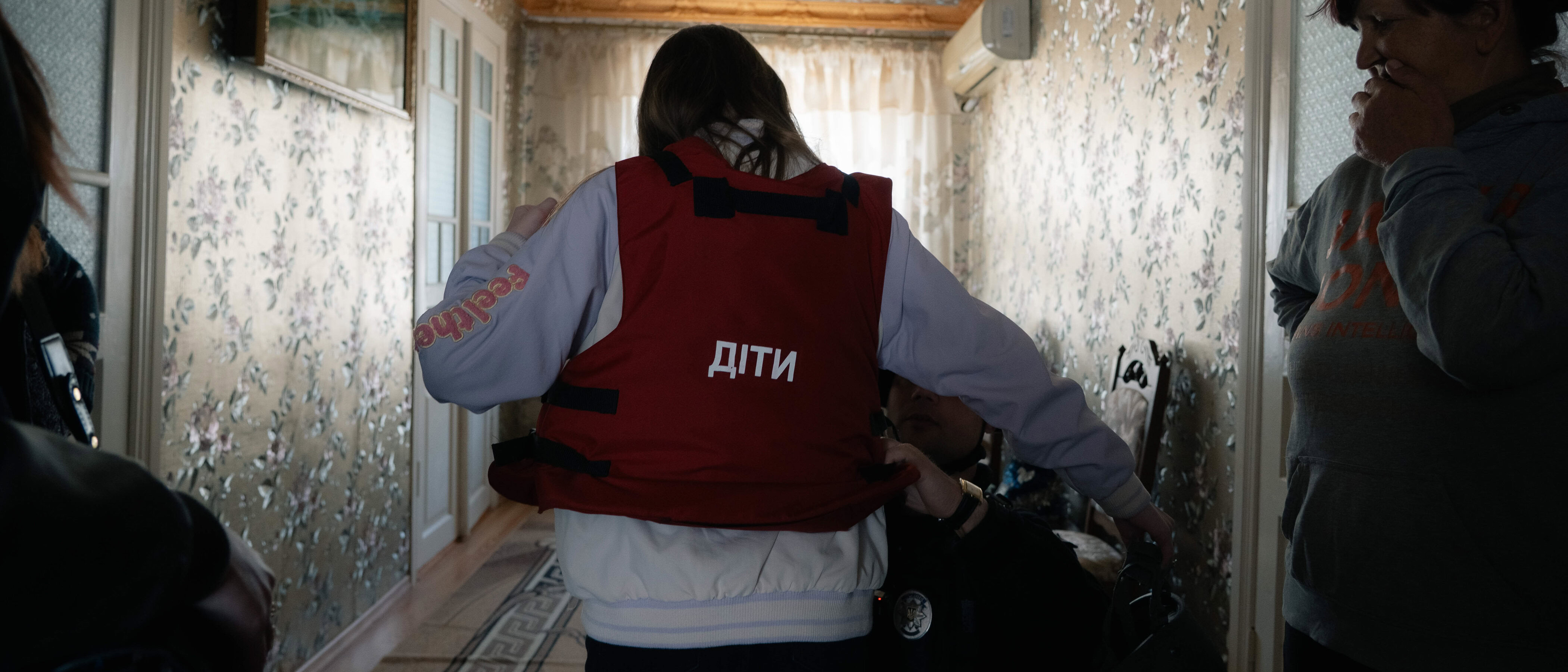
In the kill zone, White Angel officers have to search basements for families with children, as they hide there.
“In Avdiivka, a grandmother and grandfather kept their granddaughter in a basement. The girl’s heart couldn’t take the conditions she was living in. The child died, and the elderly couple stayed behind to wait for the Russians. When the city was occupied, they ended up on video, thanking Russian forces for their ‘liberation’ and not even mentioning the tragedy in their family. They just repeated propaganda talking points,” says Diachenko.
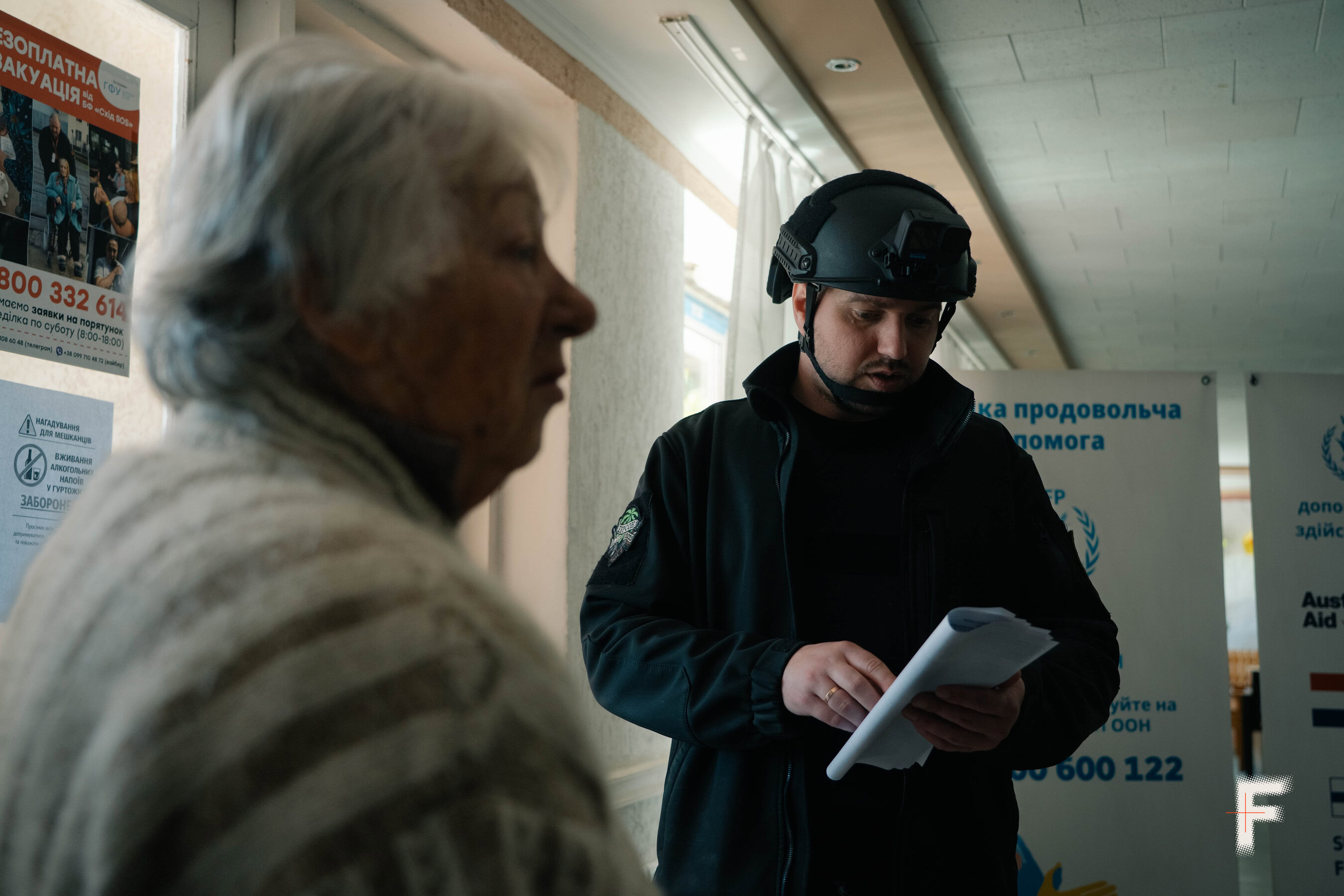
In 2023, the Donetsk Regional Military Administration banned parents from returning to the “gray zone” with children. But until recently, families kept returning to Kostiantynivka. Children were hidden in postal boxes or duffel bags so they wouldn’t be spotted at checkpoints. One family with a young boy tried to return to Pokrovsk through mined tree lines and fields. Some of these families have been evacuated five to seven times.
Diachenko adds that the situation in the Donetsk region is now so dangerous that forced removal rarely has to be enforced: when children are spotted in a mandatory evacuation zone, such as Druzhkivka, parents usually readily agree to evacuate the very same day.

Parents hide in basements instead of turning to human rights advocates
When the need to evacuate children from shelling first emerged in early 2022, the government was slow to respond, admits Dmytro Mykhalov, the Ombudsman’s representative for Donetsk and Luhansk regions. There was no clear policy on how to remove children, whether to remove them at all, or what authority the police had to act.
Responsibility for evacuations fell to a newly formed police unit, White Angel. But until 2026, evacuation required parental or guardian consent, and parents often refused to leave or even chose to wait for Russian forces instead. As a result, hundreds of Ukrainian children ended up under occupation.
To remove children in these cases, law enforcement relied on a different legal tool: Article 170 of Ukraine’s Family Code, which allows minors to be taken from their families, without stripping parents of their rights, if their life is at risk where they live. During the evacuation of Pokrovsk, authorities applied this article 10 times, but each case required drawing up formal reports, going to court, and waiting months for a ruling
“Of the 10 children evacuated under this procedure, parents got seven of them back. For the other three, authorities moved to terminate parental rights and place the children in foster care,” says Mykhalov.
Even so, both then and now, parents could file a countersuit to challenge the legality of police action.
“A child’s life isn’t always treated as the priority. Sometimes a lawsuit comes in, and judges rule in favor of the parents who kept their child under shelling. Judges interpret the law on parental and children’s rights differently,” explains Mykhalov.
For the mechanism to work fully,
we need regulations spelling out the evacuation process.
Because the forced-evacuation law still lacks an implementation mechanism, there’s a risk that judges could rule White Angel’s actions unlawful. Certain provisions need to be finalized to protect police from that risk.
“For the mechanism to work fully, we need regulations spelling out the evacuation process: where a child can be taken from and to, where they’ll stay before being placed under guardianship, who will serve as guardian, and who will oversee them,” adds Mykhalov.
No one should take away a child’s right to life and health.
Not even parents.
Mykhalov says that since 2023, no complaints have been filed against White Angel over forced evacuations in the Donetsk region. The children are evacuated from areas where there’s no electricity, running water, or mobile service. People are afraid to go outside and hide in basements so police won’t find them or occupying forces won’t kill them.
“What matters most is life, especially children’s lives. So if a complaint like that ever came in from a forced-evacuation zone, we’d be on the side of the ‘Angels.’ No one should take away a child’s right to life and health. Not even parents. If they are unable to ensure their child’s safety, the state will protect that child instead,” says Mykhalov, representative of the Verkhovna Rada Commissioner for Human Rights in Donetsk region.
***
Hi, we are Alina and Marharyta, the authors of this article. Thank you for reading to the end.
Living near the front line is deadly, and some parents have condemned their children to a childhood under bombardment as occupying forces try to kill anything that moves and hunt civilians in what’s become known as a “human safari.” The law on evacuating minors was meant to give police a freer hand in moving children out of front-line areas. But the legal system can still treat police-enforced evacuation as illegal.
Every story starts with your support. Join the Frontliner community so we can keep up documenting Russia’s war against Ukraine from the front line and the rear.
***