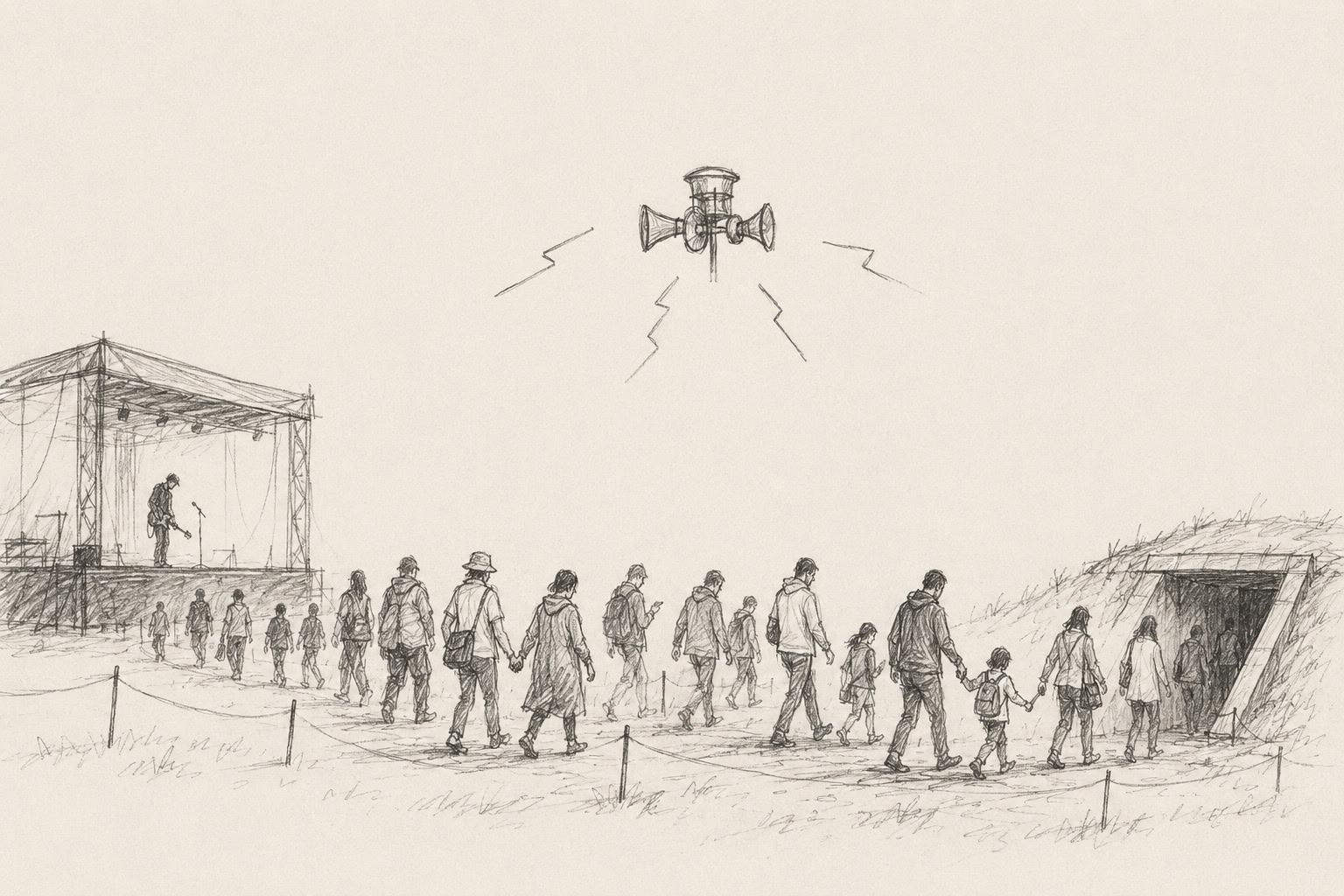
The stage goes dark, when the war alarm speaks: How Ukrainian festivals function under air attack
The bass cuts out mid-song, and instead of applause, a siren sounds. The stage goes dark. Thousands head for shelter. For festivalgoers in 2026, this kind of interruption has become an expected part of the evening. Frontliner examined how air-raid alerts, drones and decisions by military administrations have reshaped safety at mass events.
Organizers are required to have an alert-response plan, evacuation routes, designated staff and shelter space for everyone present. The number of tickets sold depends on the capacity of the protective structure. Such requirements are in effect in the Kyiv region, among other places, and are set out in a procedure adopted in the Lviv region in June 2026.
There is no single nationwide procedure for holding concerts. Conditions are set by regional and city military administrations. In the Lviv region, approval requests must be submitted at least ten business days in advance. In the Kyiv region, an organizer must obtain written approval and limit the audience to the capacity of the nearest shelter. In the Sumy region, the local protocol bans mass events within a 20-kilometer zone from the border with Russia. There is no nationwide restriction using that same distance.
Shelters have become part of festival infrastructure
Thousands of people hiding underground
Kyiv’s Atlas Festival, held July 17-19, 2026, said it had shelter space for 25,000 people. The pop-culture festival FANCON reports an underground space in the first pavilion of the International Exhibition Center with capacity for 10,000 people. During an alert, stages, vendor areas and other locations are required to stop operating. Performers return after the all-clear, and attendees are let back in 20 minutes later.
Faine Misto 2026, held at Arena Lviv, expanded the festival grounds and capped audience growth based on shelter capacity. Organizers designated three protective spaces at and near the arena. After an alert sounds, all stages and festival zones must stop, the festival’s director said.
The alert rewrites the program
During the 14th Book Arsenal festival in Kyiv, several events were canceled or shortened, and some sessions continued in a shelter. The festival drew 27,000 visitors, Suspilne reported. Rules required attendees to move immediately to a shelter set up on site and remain there until the all-clear.
Each venue sets its own rules for resuming the program. Under the published protocol for Lviv’s Jam Factory, a concert would continue after an alert lasting up to one hour. A longer threat meant the performance was canceled without a ticket refund. Ticketing operator Concert.ua says an event may resume after the all-clear and that it sends a separate notification if a show is rescheduled.
A military administration can cancel the show
Decisions change within a day
A purchased ticket does not guarantee an event will take place. After a Russian attack on Kyiv on July 2, 2026, the following day was declared a day of mourning. City authorities banned all entertainment events. Concerts and parties were canceled or postponed.
Starting July 24, the operational headquarters of the Kyiv Region Defense Council canceled mass events in Bucha district until further notice. The decision followed a Russian missile strike.
Drones have made open-air venues more dangerous
An open festival ground leaves people exposed to blast waves and debris from air-defense operations. Where a missile, drone or their fragments will fall cannot be predicted. That is why an event must stop immediately once the alert sounds.
Debris from downed drones can contain unexploded munitions. The State Emergency Service (DSNS) urges people not to approach, touch or move such debris. Any suspicious object should be reported by calling 101 or 102.
Evacuation has become part of the script
The crowd needs to know where to go
The hardest moment comes when thousands of people head for a few exits at the same time. Organizers must mark routes, keep passageways clear and station staff along the flow of people. Attendees should locate a shelter before performances begin.
Panic, stalling in passageways and attempts to go back for belongings slow down evacuation. People with children should agree in advance on a meeting point in case they get separated. Children should not be left unsupervised while people are moving.
Curfew shortens the evening
Organizers are increasingly starting concerts earlier and building in extra time for possible alerts. A long interruption can lead to a shortened program or a postponed performance. The outcome depends on the rules of the specific event.
Attendees need to factor in time to leave the venue, wait in lines and get home. Kyiv city authorities advise planning the trip home with martial-law restrictions in mind.
What to check before a concert
- Find the shelter on the organizer’s map or an official map.
- Check the shelter’s capacity and the route from your section.
- Read the rules for pausing, rescheduling and canceling the event.
- Check for updates from the local military administration.
- Charge your phone, and bring identification documents, water and a power bank.
- Save your ticket and a shelter map offline.
- Avoid carrying items that would make it hard to move through a crowd.
- Follow staff instructions immediately once the siren sounds.
- Avoid using elevators during the air alarm
- Leave the shelter only after the official all-clear.
The audience has become part of the safety system
A person who lingers, argues with staff or stays near the stage creates an added risk for the entire crowd. Metal detectors, bag checks and weapons bans have become standard at entry points. Festival rules may also prohibit large bags, glass containers, pyrotechnics and other items that could complicate an evacuation.
Approvals, security, medical staff and large shelters reduce the risks. No mass event during wartime is completely safe. Each attendee has to weigh the city, the venue, access to a protective structure and their own readiness to spend part of the evening underground.