
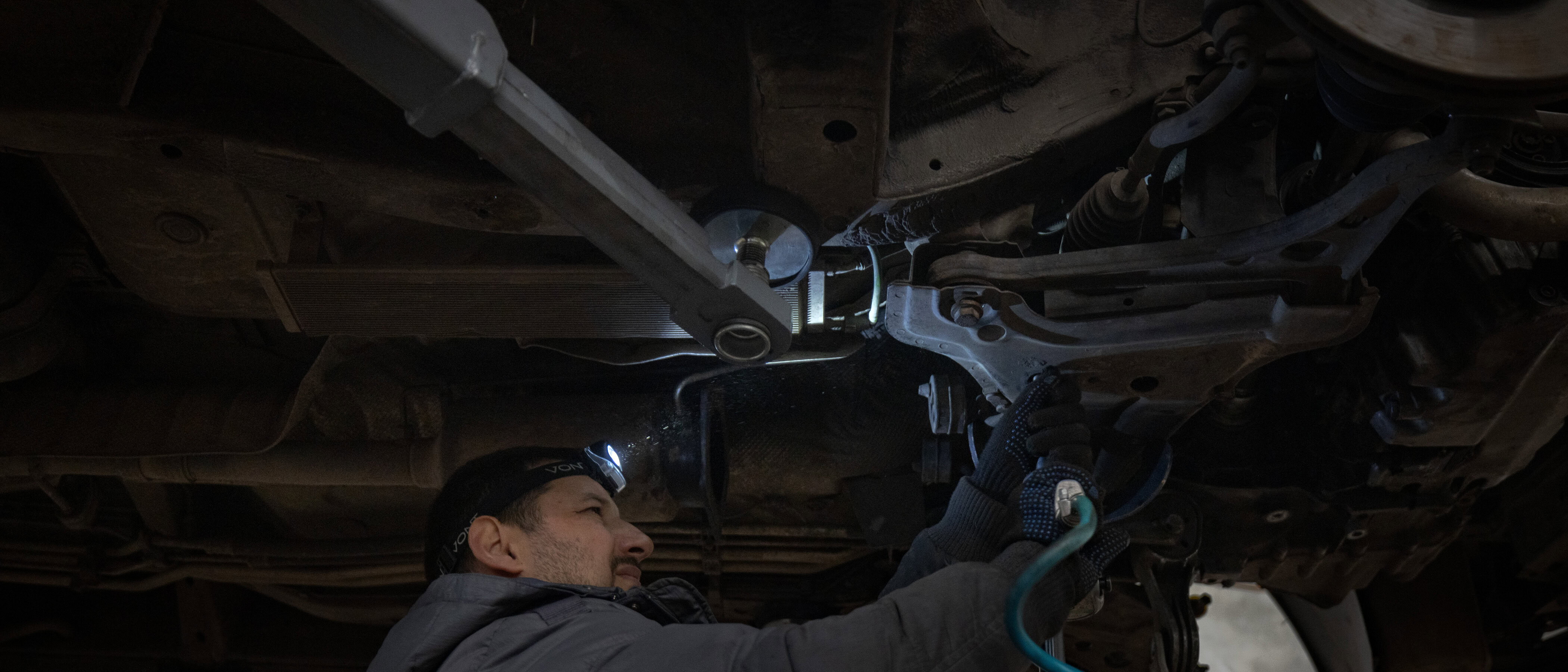
Uninteresting things that hold the front. How does a car service shop for the military function
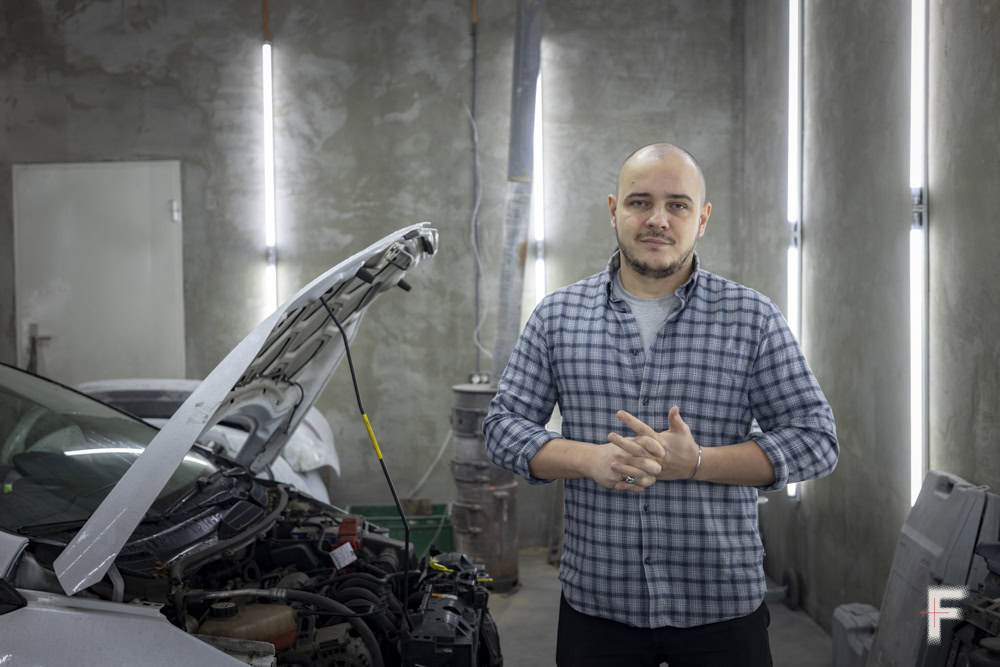
“The biggest problems come from indifference,” says Petro Shuklinov, a servicemember who created a unique auto repair shop. According to him, people are willing to donate to drones or new cars – it’s new and effective. Less popular options are repairing existing cars or re-equipping them for amputees' needs. Frontliner visited a car service shop with the life-affirming name “Nesemos”, which closes the “uninteresting” gaps.
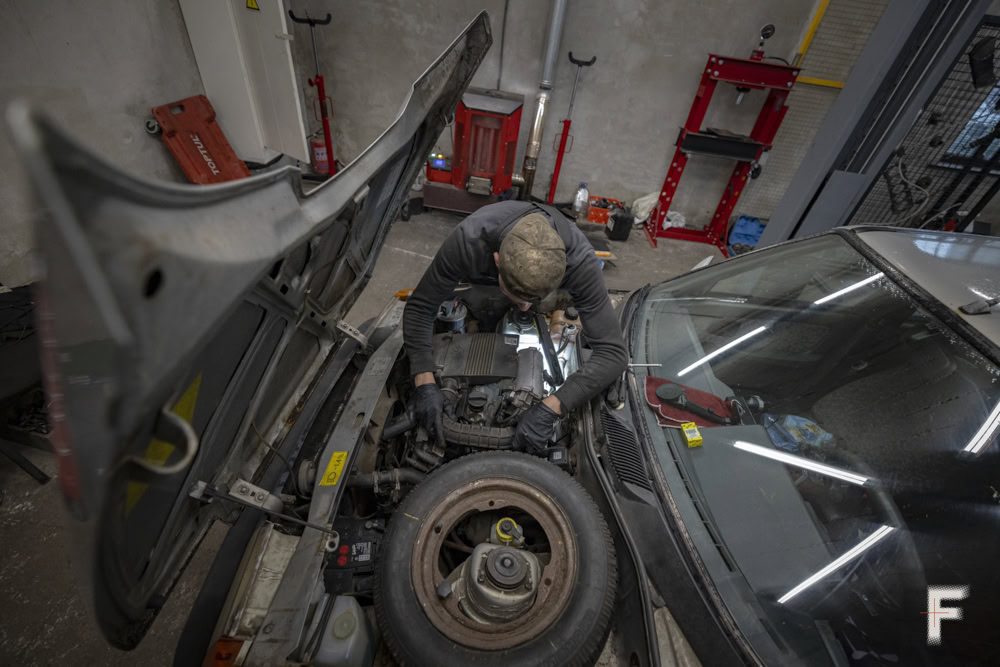
This is a social business, an educational project, and a museum. At the reception, a collection of chevrons stands, and a coffee machine is brewing. The inscription lights up “No one goes astray, no one walks alone.” In the boxes on the lifts, frontline vehicles are “treated.” Next door, their civilian “relatives” are being cared for. According to the plan, the revenue from repairing civilian cars should cover the repairs of military vehicles. If a unit submits a request, it only provides up to 50,000 hryvnias for repairs. Anything above this amount, the service members must cover on their own. Often, the military is unwilling to wait in line, or the car is not on the balance sheet, so they prefer to put the car in a box for civilian vehicles and pay for it. Such cars are repaired with a 20% discount. However, this mechanism currently works only partially, and donations must cover the repair of military vehicles.
A traffic accident that didn’t happen led to new ideas
Shuklinov served in the army for two years. Before that, he was a military and political correspondent. He doesn’t talk about his place of service for security reasons:
“I’m involved in, let’s say, informational things. I’ve been a volunteer since 2014, and in 2022, volunteering became more intense. We started by collecting money and buying cars,” says Petro.
Parrots fly, and dogs run around the office.
Petro worked on cars with a team of like-minded people. Two events led to the idea of moving from purchasing to repairing. When the volunteers had already purchased and distributed 200 cars, a request came from a friend whose father was fighting. They found a vehicle for him and sent it for repair. The girl was supposed to drive the car to Kharkiv and hand it over to her father’s comrades. On the way, it turned out that all the tires at the service shop hadn’t been tightened. The mechanic hadn’t secured the screws at that moment due to a shift change. The girl miraculously avoided a disaster.
Petro recalls that his best friend was almost killed in a similar situation. The second incident that prompted the volunteers to start repairing was the “26 Pickups for Eight Cities” project – purchasing and equipping pickups for air defense groups. Three cars were handed over to each city. In Chernihiv, air defense specialists advised giving new cars to those who need them more and asked to repair the ones they already have. After all, out of a hundred vehicles on the balance sheet, only 30 are running. It turned out that this problem is large-scale – in the State Security, the Main Directorate of Intelligence, the police, and the Armed Forces of Ukraine. On paper, there are many cars, but in fact, they are not always functional.

With pure creativity
We came across this location by chance – we saw a rent ad on the facade. Shuklinov recalls – we immediately hit it off with the owners:
“The first thing they asked us was what our idea was. The platform here is unique – parrots fly, and dogs run around the office. Regardless of the condition of the building, we realized that we were staying here because this is a top team.”
The space was neglected, and trees were growing on the roof, encrusting the walls with their roots. The cost of putting it in order and equipping the repair boxes was astronomical, so the shop’s director, Maria Ksiondzyk, a former journalist, began writing applications and seeking grants. Partial funding was found. According to Petro, some design solutions are embodied in the approach of pure creativity. For example, the windows are the simplest and cheapest; the same ones are installed at the state’s expense after shellings. However, painted and decorated, they look, according to the owner, “very expensive.” The canopy over the entrance is made of old glass doors. The porch is lined with boards with defects. Everything was cut, painted – it looks stylish. Decommissioned tiles were provided free of charge by the “Kovalska” concrete plant. The space is inclusive, with a ramp. The Main Directorate of Intelligence provided generators to keep the shop operational during power outages.
Unfulfilled Russian dreams as an exhibit
The space also serves as a museum. The exhibits are mostly trophies. When the military handed over the first gift, the owners of the service shop decided to start a collection. Petro explains that today its value is millions of dollars. For example, the Supercam with a control panel and a station costs $ 300,000. This exhibit is in working condition:
“Here is a parachute system, you replace it, reprogram it, and it works. The Main Directorate of Intelligence said not to turn it on because the Iskander missile will hit, as the system will immediately signal its location. There is a Lancet strike drone, which is difficult to get. All reconnaissance drones are equipped with a parachute system; all strike aircraft, if they fly, must explode somewhere. “Eleron”, “Orlan”, “Zala”, and “Supercam” are Israeli technologies, purchased before 2013, when they traded with Russia. “Shahed” is classic, Iran transmitted it,” – the military conducts the tour.
-
Military serviceman and co-founder of the “NESEMOS’” auto repair shop, Petro Shuklinov, shows a collection of captured Russian drones, Kyiv, Ukraine, November 18, 2025. Maksym Kishka / Frontliner

-
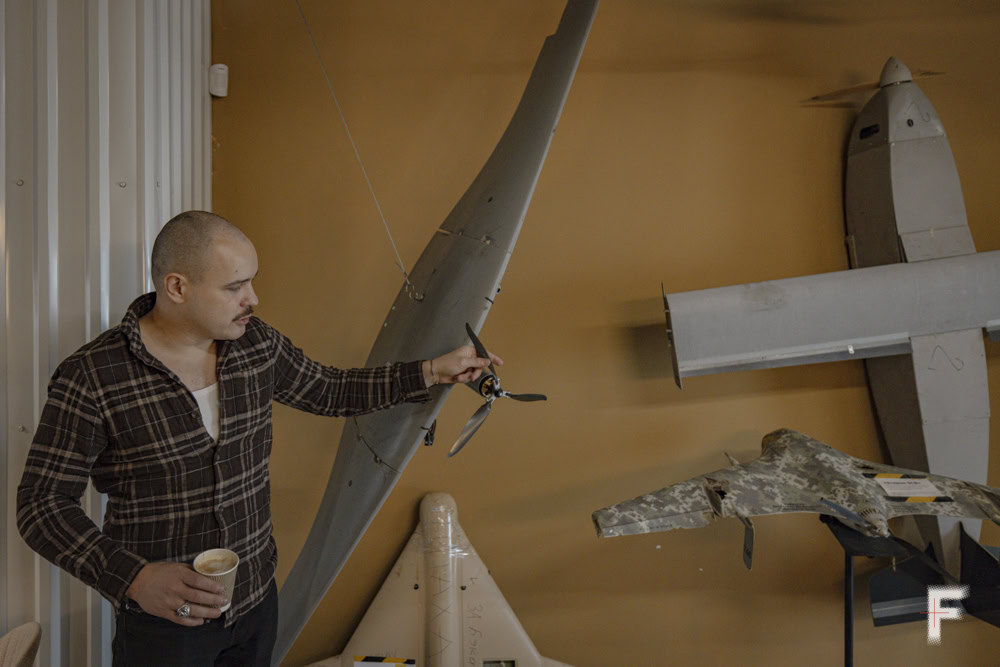
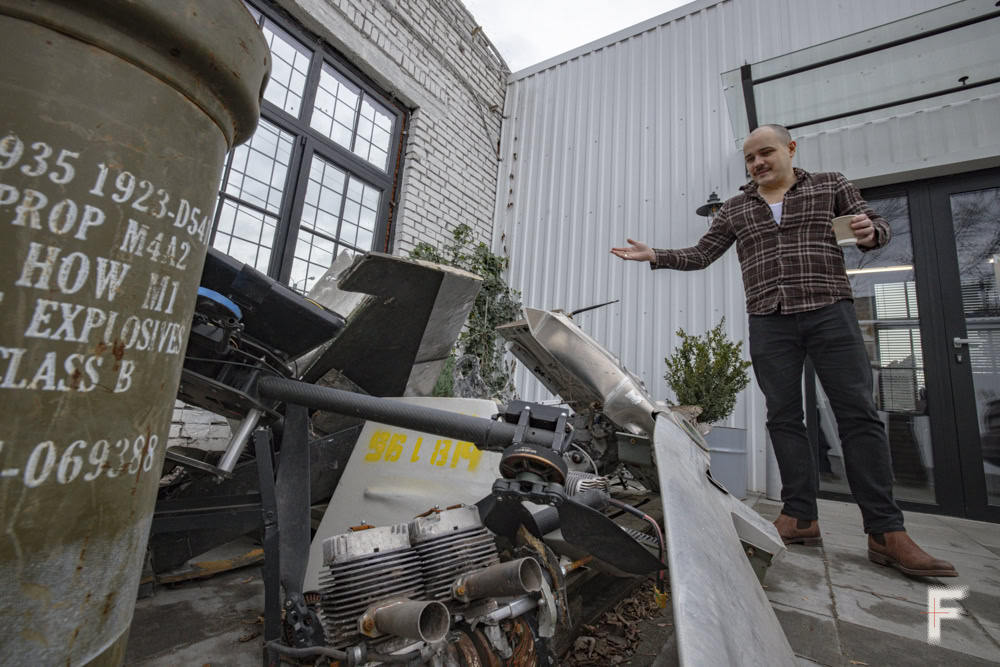
“Gerbera”, a “dummy” made of plywood, looks and behaves on radar like a “Shahed”, and is intended to overload the air defense system. Outside, the wings from the “KAB”. Some details of the exposition are not yet fully descriptive:
“Here is some detail between the fuel system and the engine. When the Kherson region was liberated, we found it in the fields. The soldier sends a photo; the entire fuselage is visible. He asks: “Will you have enough material to make souvenirs?” I say: “We make small things. We don’t need much.” I arrive at the “Nova Post”, and two huge pallets are brought to me. They say: “This is an airplane engine,” – recalls Shuklinov.
A piece of “MI-8”, one of the helicopters that fell into the Kyiv Sea:
“When the Russians stormed Hostomel, this piece was once a part of one of those helicopters. A symbol of “unsuccessful Russian hopes,” says the volunteer.
Spare parts from enemy aircraft – “SU-34”, “SU-35”, “SK-52” – are used to make souvenirs, such as bottle openers and keychains. They are bought for 15,000 hryvnias, mostly by foreigners. This covers about 20% of the monthly fees.
“A place where a service member feels at home”
The work is in full swing in the boxes. The equipment in them was also worth the effort and creativity. The lifts were purchased with a grant. Some things were done independently, such as the exhaust system for exhaust gases. The owner explains that first it’s connected to the pipe, and then the engine is started. In the summer, the same can be achieved by opening the door, but in the winter, in a closed room with the engine running, it is dangerous to health:
“Therefore, this setup is necessary. Building two boxes costs 200000 hryvnias. Of course, we don’t have that kind of money. We installed a pipe, a motor, and bought corrugated board for around 10,000 UAH. We made the carpentry table ourselves,” the volunteer recounts.
A commercial service station cannot afford to repair these kinds of vehicles,

Petro explains the key difference between the work of a regular business and a social business using the example of a lift. At a commercial service station, the lift operates in conveyor mode, cars drive in and out, and the lift generates funds:
“When a car from 2003 is lifted, you twitch one part, and it falls apart. Very often, parts are no longer produced for it; you have to seek out parts from used cars. To make a bolt that no longer exists in nature. This is often artisanal work. Accordingly, the lift is standing, and there is no business. A commercial service station cannot afford to repair these kinds of vehicles,” he explains.
Now, military vehicles are being repaired at the expense of civilian vehicles. After the victory, these will be the veterans’ cars.
We are creating a place where the military will never be told that
their choice to fight for their country wasn’t good enough…

In terms of employment, priority is given to veterans and internally displaced persons. Currently, five defenders work here. The plan is to refine all the nuances and expand the network, first in Kyiv and later nationwide. Petro assures that the team is ideological and motivated:
“We are creating a place where the military will never be told that their choice to fight for their country wasn’t good enough.. Where a soldier feels at home. We need to understand the specifics of people who have returned from the front and see civilian life. They were in the trenches, with injuries, from the horror of war, and here you drink coffee, go to the cinema, and live mostly a normal life. If he approaches everyone and asks, it will turn out that these are the same brothers who are dressed in civilian clothes,” the soldier is convinced.
Special cars for special people
The team, which entered a new market for itself, was convinced that the problem of car conversion had long been closed, but Petro explains that practically no one had dealt with this:
“We thought that the car service sector closed the problem a million years ago; there is already such a level of competition, experience, and it seems like everything has been invented. When we looked at what car services look like on the inside, we realized this is the Stone Age. No rules, no logic, no certification, no sustainable approaches. This area is a wild field,” the military man is indignant. “It started with a veteran with an amputation asking to convert his car. According to him, the only place where he could receive this kind of service was in Odesa. Implied: he would have to deliver the vehicle himself, rent housing there, and go to government agencies to collect certificates to adapt his vehicle to his needs.”
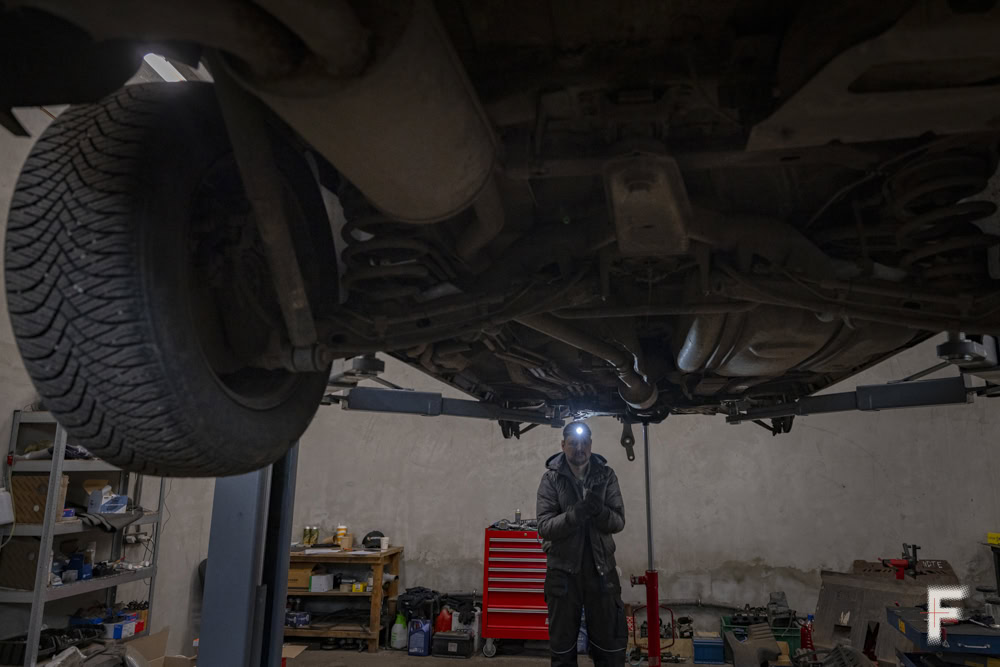
So, a new mission appeared in “Nesemos’” – to show colleagues that re-equipping cars is possible. A training for mechanics was recently held. Petro emphasizes that this humane and straightforward service can and should be added to the price list, and not denied to veterans:
“This is not a question of competition; it can be done at any service shop! If you need advice, we are happy to support. Please do it!” – he says about re-equipping cars.
Here, the service that adapts vehicles to the needs of differently-abled people operates on the principle of equality for all – the re-equipment department is headed by Ruslan Zadorozhnyi, a veteran of the 25th Airborne Brigade who lost his hand while fighting in the Kupyansk direction. Ruslan went to the front in November 2022, and on September 1, 2023, he was wounded. He came across the social service shop by chance: he was searching the Internet for a workshop where he could repair his car qualitatively after an unsuccessful experience with previous repairs:
“I googled it – there must be some service shop for veterans. I came here, and they fixed my car. We talked, and I asked if they needed someone. They said they were hiring. At this stage, I am the manager for the car conversion program for disabled veterans. We recently launched this project. I communicate with clients, equipment suppliers, craftsmen,” says the veteran.
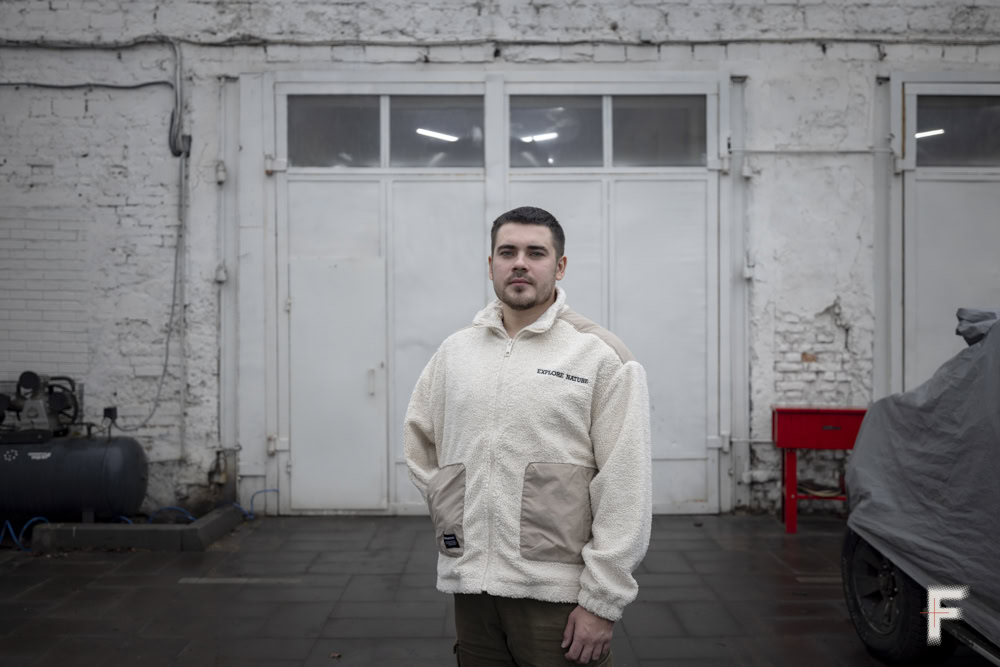
At the moment, two cars have been converted. The service shop is convinced that the demand will be considerable. Conversion depends on the injury. There are complex cases when a person in a wheelchair needs to get into the car and sit in the driver’s seat. Perhaps the person does not have both arms or legs. Ruslan talks about the options:
“When the lower limbs are amputated, a handle is installed, responsible for the gas and brake. You can operate a vehicle with your hands. Or an adapter for the gas pedal, from the right to the left side, when the left leg is amputated. Steering aids that make driving easier are shaped like a trident. In some cases, there are requests to move the turn signal switches to the right side when the left arm is amputated,” he says.
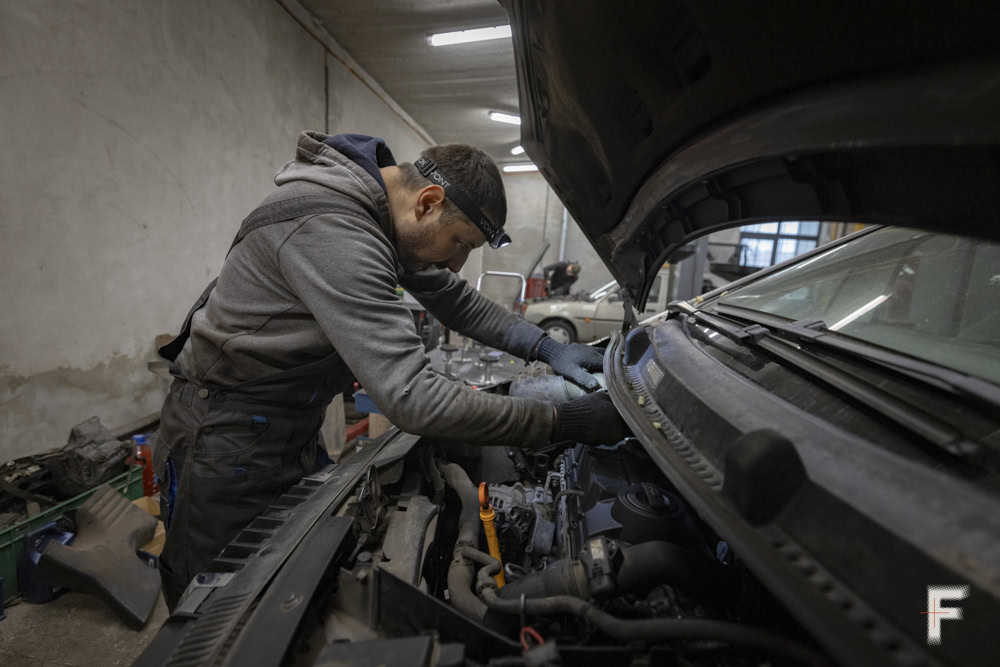
Information is disseminated through rehabilitation centers, ASCs, and veteran communities.
Unfortunately, it is impossible to meet all the military’s needs. Petro Shuklinov suggests that if there were about three such service shops in each regional center, it would be easier because no one goes astray, no one walks alone.
Text: Olena Maksymenko
Photos: Maksym Kishka
Adapted: Olena Sharhorodska
Read more — From discharge to demining: the veterans determined to return to the military service
