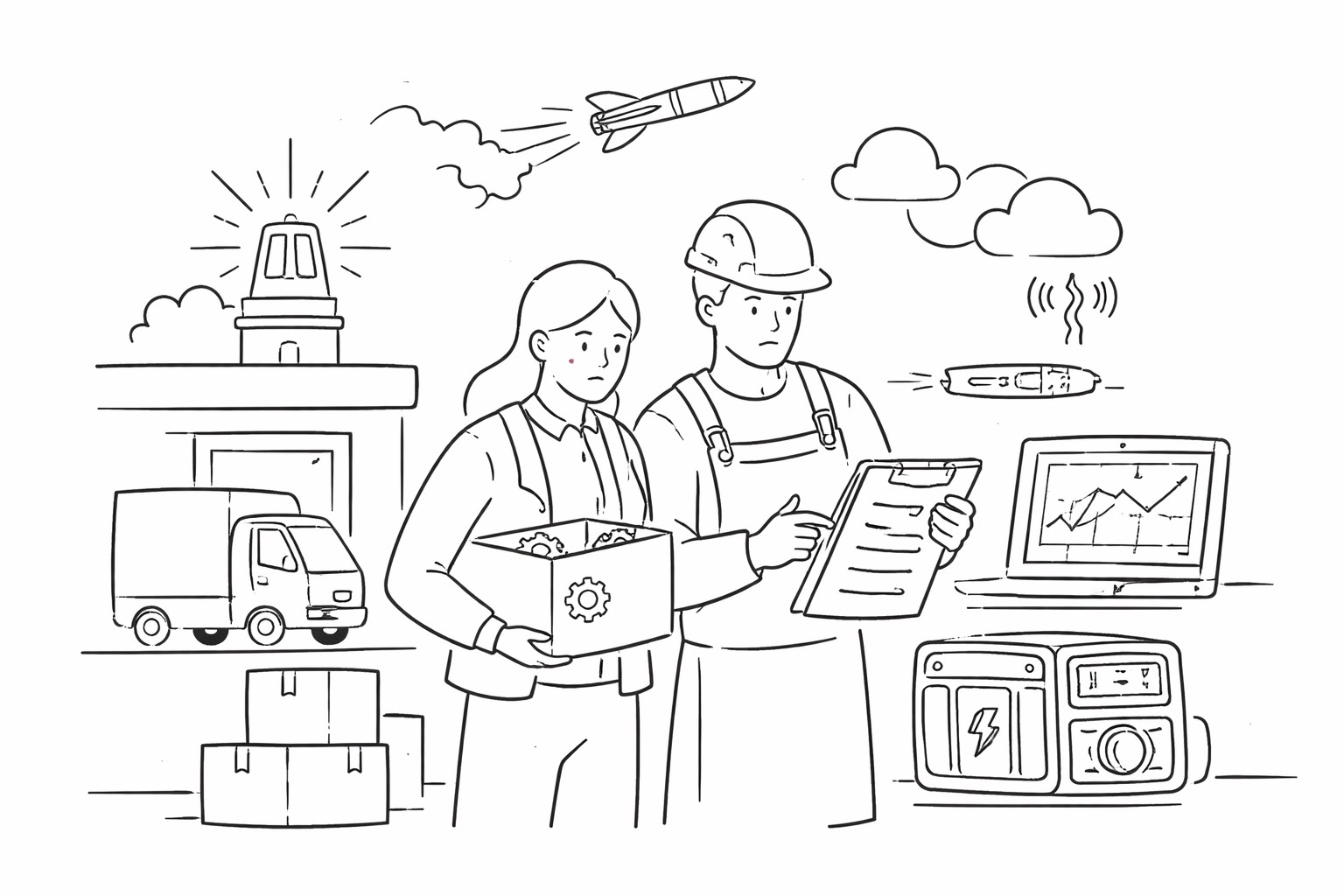
Business under fire: what is actually helping entrepreneurs survive during war
Small and medium-sized enterprises in Ukraine account for 74% of jobs and about 64% of value added, according to the United Nations Development Programme. But these businesses are operating in conditions where a “one-year plan” sounds like a dark joke. Entrepreneurs must simultaneously manage cash flow, think about employees and prepare for power outages, shelling and supply chain disruptions. As a result, business models are becoming simpler, faster and built around backup plans. The Ukrainian media outlet Frontliner examined which survival strategies are working most often for small and medium-sized businesses.
Living in short cycles
The initial shock of the war has long given way to chronic uncertainty for small and medium-sized businesses. Previously, risks were calculated in terms of the dollar exchange rate, rent and seasonality. Now financial models must account for air raid alerts, blackouts, disrupted logistics, employee mobilization and risks to warehouses and retail locations.
The war has changed the logic of risk itself. In addition to financial and market fluctuations, businesses must consider location security, property losses, electricity shortages, workforce reductions and unstable demand. Companies that once relied on steady foot traffic and predictable costs are now forced to operate in short cycles, week to week or month to month, constantly revising projections.
Assessments by the United Nations Development Programme indicate that successful adaptation depends on continuous restructuring of processes.
At the same time, customers have changed. Consumers are spending more cautiously and comparing options more frequently. Basic factors have become decisive: whether a store is open, whether communications are functioning, whether goods will arrive on time and whether customer support responds.
Relocation and decentralization
For some entrepreneurs, relocation became a direct condition for survival. Some moved production facilities or warehouses away from high-risk regions, while others relocated offices and reformatted sales.
According to Ukraine’s Ministry of Economy, the state relocation program has helped move 772 enterprises from dangerous regions and preserve more than 35,000 jobs.
Government and international partners have supported such moves, but the key factor in survival is the business model itself. Companies tied to a single location have proven especially vulnerable.
Decentralization does not necessarily mean relocating an entire company. More often, businesses divide processes:
- Production is transferred to safer areas with infrastructure access.
- Sales move online.
- Services are provided through partners.
- Inventory is distributed across two or three warehouses.
Managing such a system is more complex, but it reduces the risk of a complete shutdown. It also encourages cooperation, including shared warehouses, joint delivery services and local business alliances.
Energy and communications
Following strikes on energy infrastructure, operational continuity has become a separate cost category. Generators, batteries, inverters, backup internet connections and additional payment terminals now affect revenue as directly as advertising or location.
If a business can operate even partially, it retains customers.
Internal preparedness is equally important. Companies are drafting simple contingency plans:
- What to do during outages.
- How to maintain contact with customers.
- How cash registers will function.
- How data will be stored.
Often, these small measures make the difference.
Loans and grants
External financial support has become one of the tools of adaptation: working capital loans, funding for equipment and grants for startups or relaunches. Such resources help businesses navigate costly periods, relocation, equipment upgrades, logistical restructuring and the search for new sales channels.
However, problems arise when borrowed funds are treated as free assets. In a wartime economy, investments must reduce downtime and expenses or open new markets.
When funds are spent on cosmetic improvements or expansion without careful risk assessment, businesses quickly face negative balances.
Advice that increases the chances of survival
- Forecast cash flow 8 to 12 weeks ahead and update projections weekly.
- Develop two or three demand scenarios, each with a procurement and expense plan.
- Maintain backup suppliers and at least one alternative delivery route.
- Separate critical functions: additional warehouses, reserve contractors and duplication of key roles within teams.
- Invest in autonomy: energy sources, communications and offline payment options.
- Shift part of sales to digital channels and focus on retaining regular customers.
- Formalize contracts and prepayments with clear deadlines, terms and liability clauses.
- Back up data and review access controls — cyberattacks and fraud remain risks.
- Document property and losses for compensation, insurance and legal claims.
What will remain after the war
Small and medium-sized businesses have become more digital and oriented toward shorter planning horizons. Instead of relying on a single sales channel, companies now use several. Instead of maintaining large inventories, they prioritize faster turnover. Instead of fixed schedules, they adopt flexible shifts, partnerships and partial employment.
Some of these changes are likely to endure after the war. Entrepreneurs have learned that survival depends not on optimism alone, but on systematic calculation, documentation, automation and contingency planning.
Under these conditions, business resilience rests on discipline and practical daily decisions.
***
Frontliner wishes to acknowledge the financial assistance of the European Union though its Frontline and Investigative Reporting project (FAIR Media Ukraine), implemented by Internews International in partnership with the Media Development Foundation (MDF). Frontliner retains full editorial independence and the information provided here does not necessarily reflect the views of the European Union, Internews International or MDF.