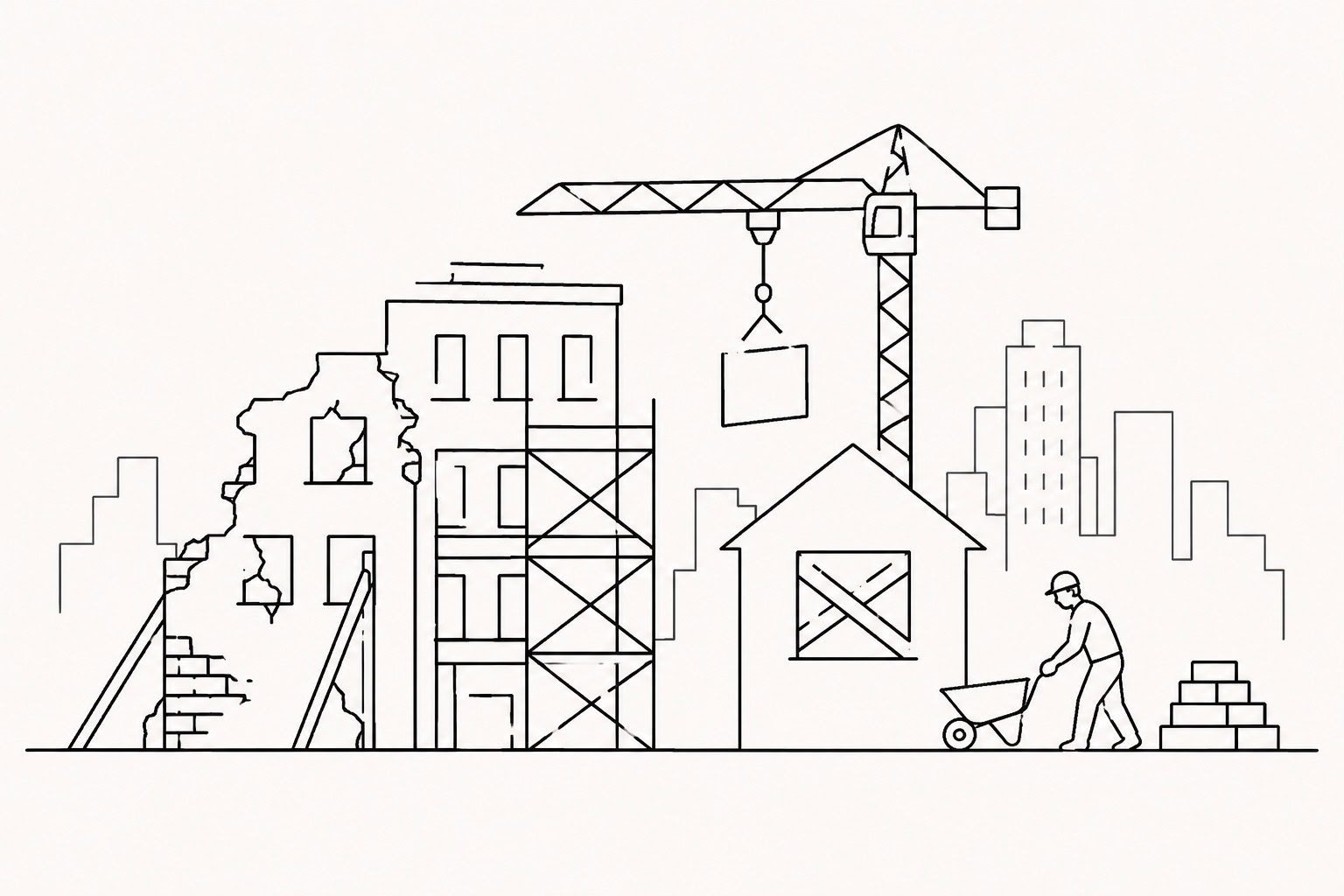
A nation of repairs: how war created an economy of constant recovery
Ukrainian cities increasingly resemble spaces of endless repair. Damaged buildings are boarded up with OSB panels, roads are patched after missile strikes, businesses relocate into temporary premises, and generators and modular structures have become part of the everyday urban landscape. The war has created a new economy in which recovery happens almost simultaneously with destruction. Frontliner looks at how repair became a defining mode of survival for the country in 2026.
Ukraine has spent five years living in a state of continuous recovery. After every large-scale attack, utility crews, construction workers, energy specialists, and local businesses restart the repair process once again. In many cases, the work is not full reconstruction but rapid temporary fixes designed to keep cities functioning.
According to estimates by international organizations, Ukraine’s reconstruction needs have already reached hundreds of billions of dollars. At the same time, much of the work is happening outside major state-led rebuilding projects through constant local patching of infrastructure, housing, and energy systems.
This is reshaping not only cities but also the logic of the economy itself. Demand is driven less by long-term development projects and more by anything that can quickly restore basic functionality, from roof repairs to mobile boiler systems and backup power supplies.
Businesses operating between strikes
The war has generated enormous demand for repair work, construction materials, generators, energy systems, and logistics. Some companies have effectively rebuilt their business models around constant infrastructure damage. For many enterprises, the speed of recovery has become more important than expansion.
The shift is especially visible in the energy sector. After repeated waves of attacks on energy infrastructure, Ukraine has increasingly relied on backup solutions, including diesel generators, battery systems, mobile transformers, and localized power networks. Businesses are adapting to conditions in which disruptions are no longer treated as exceptional.
At the same time, a culture of temporary solutions is emerging. Shops operate out of containers, offices relocate to semi-basement spaces, and damaged apartment buildings stand for years with plywood covering shattered windows. Many of these temporary structures are gradually becoming a permanent feature of Ukraine’s urban environment.
Everyday life in a state of repair
The war has also reshaped daily life for Ukrainians. Water reserves, charging stations, power banks, repair tools, and autonomous lighting are no longer viewed as emergency preparations but as standard household essentials.

People are increasingly renovating homes with future risks in mind. Apartment owners now consider autonomous heating, reinforced windows, backup internet connections, and energy-saving systems as part of routine planning. Even in relatively safer rear cities, the war is changing the architecture of daily life and consumer behavior.
Attitudes toward quality and durability are also shifting. Many decisions are now made according to what works immediately rather than what will last long term. As a result, Ukraine’s economy is becoming increasingly dependent on rapid repairs, maintenance services, and replacement of damaged property.
Symbols of Ukraine’s wartime repair economy:
- generators outside stores, pharmacies, and cafés;
- plywood and OSB boards replacing windows;
- modular towns and temporary housing;
- mobile boiler systems and backup power infrastructure;
- constant repairs of roads and utilities;
- stockpiles of construction materials treated as strategic resources;
- growing demand for repair workers, electricians, and construction crews.
In 2026, Ukraine is living in an economy where destruction and recovery happen simultaneously. The country continues to function, build, and repair even during war, but this model is steadily exhausting financial, infrastructural, and human resources. The longer the war continues, the greater the risk that temporary solutions will become a permanent condition of the state.
***
Frontliner wishes to acknowledge the financial assistance of the European Union though its Frontline and Investigative Reporting project (FAIR Media Ukraine), implemented by Internews International in partnership with the Media Development Foundation (MDF). Frontliner retains full editorial independence and the information provided here does not necessarily reflect the views of the European Union, Internews International or MDF.