A last-resort shot: How Ukrainian innovation takes down enemy drones
How do you stop an FPV drone when it is just seconds away from impact? That is exactly the problem the net launcher was designed to solve. The portable device can take down enemy drones at a range of up to 30 meters. Since it requires no special permits, it is available to civilians as well. Frontliner reporters investigated whether this technology is a truly effective countermeasure and if it has a long-term future.
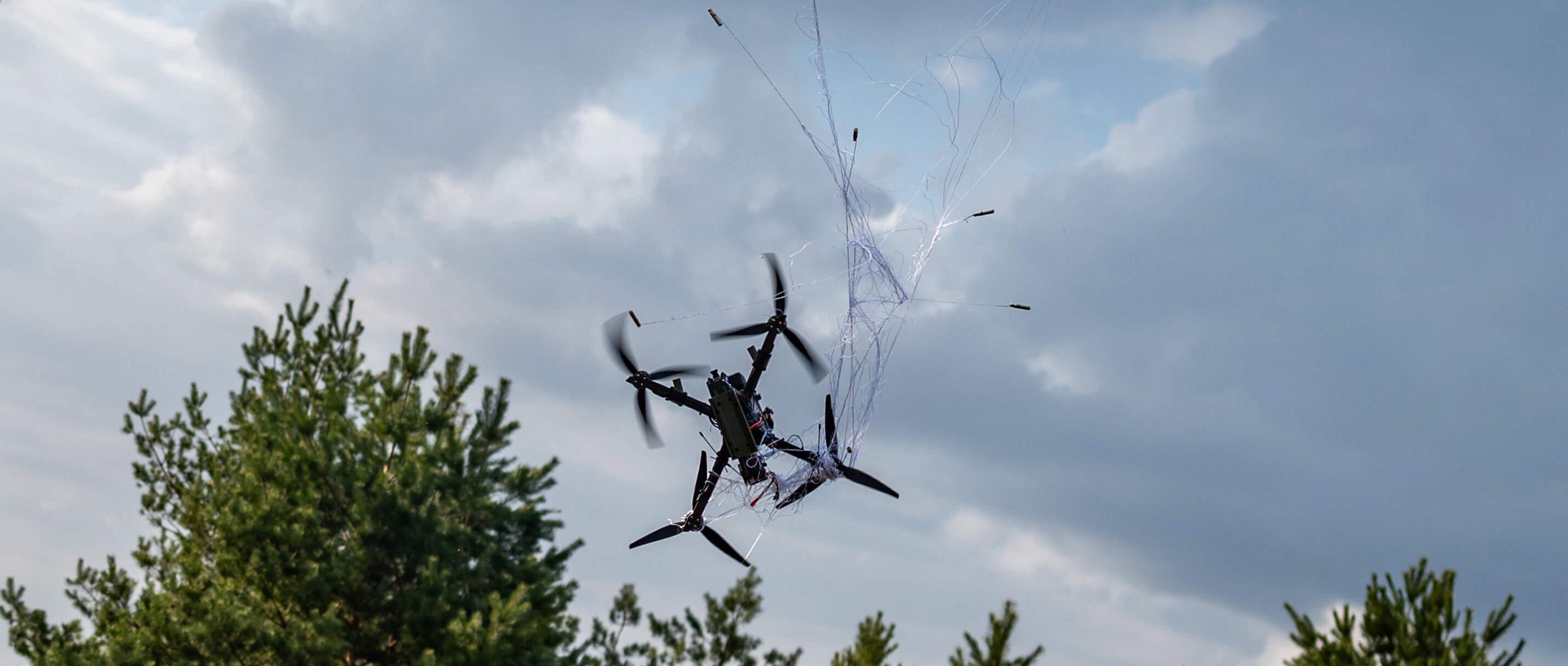
With a 3D-printed body and a net cartridge replacing traditional bullets, it looks like a six-barrel machine gun. This is the Ukrainian net launcher, a portable device built to physically intercept FPV drones. When fired, it deploys a net that instantly expands in the air, entangling the drone’s propellers and halting its movement. The developers note that the net launcher was built to be as intuitive as possible. Therefore, it is quick to learn, even for people who have never handled a weapon or defensive equipment.

After firing, you must drop to the ground
in the opposite direction of the drone,
Net launcher testing results
To test the device in action, Frontliner reporters fired several shots during a simulated FPV drone attack at a training ground. Every attempt was a success, with the net intercepting the target each time. However, the drone sometimes fell very close by; if the drone had been carrying a live munition, the shrapnel likely would have still hit its target. Nevertheless, the odds of survival are still substantially higher even in that situation, according to net launcher developer Vitalii Kyrychok.

“The net is effective up to 30 meters away,” Kyrychok explains. “In any case, after firing, you must drop to the ground in the opposite direction of the drone to minimize potential injuries. According to the military, this device is highly effective not in an open field, but during medical evacuations in pickup trucks. While the drone is falling, the vehicle has time to drive away from the impact zone, keeping people out of the shrapnel’s reach.”
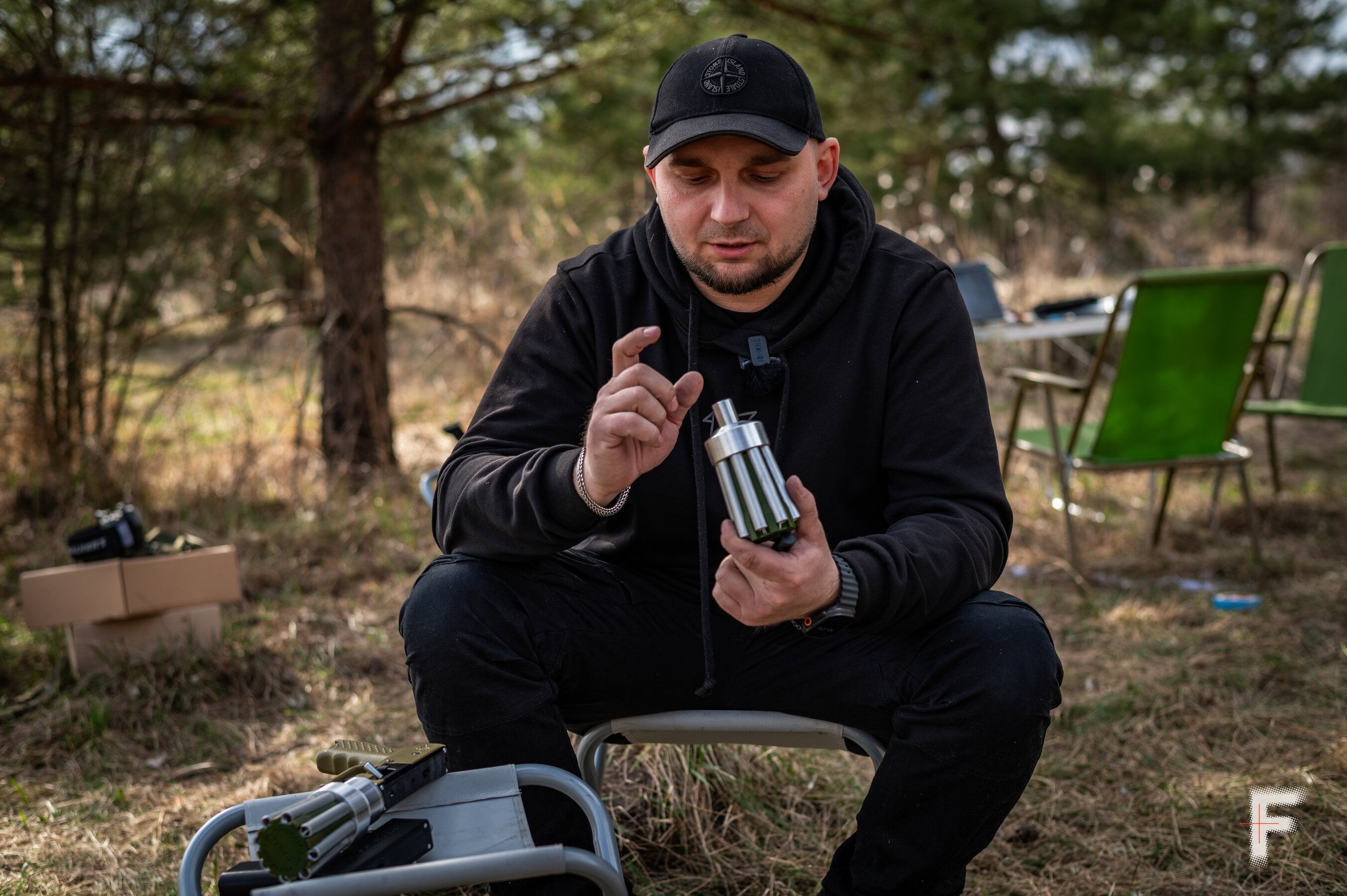
One of the first net launcher developers in Ukraine
Vitalii Kyrychok and his team created the first net launcher prototype in February 2024. They based their Ukrainian design on foreign net guns, which are devices used for animal control. However, the technical capabilities of those examples fell short of the realities of war as firing ranges were limited to just 15 meters. This was insufficient for defending against high-speed drones. As a result, the development team essentially began redesigning the system from scratch. The main goal was to at least double the net’s flight distance.
To achieve this, Kyrychok and his colleagues completely rebuilt the internal gas distribution mechanism and increased the gunpowder charge in the cartridge. Even so, aerodynamics proved to be the biggest challenge: due to the net’s high drag, it would lose speed and shape within the first few meters. It took nearly three months just to perfect the technique for packing the net into the cartridge. This step was crucial to ensure it would expand in the air 99% of the time.
It can be the last shot capable
of saving your life,
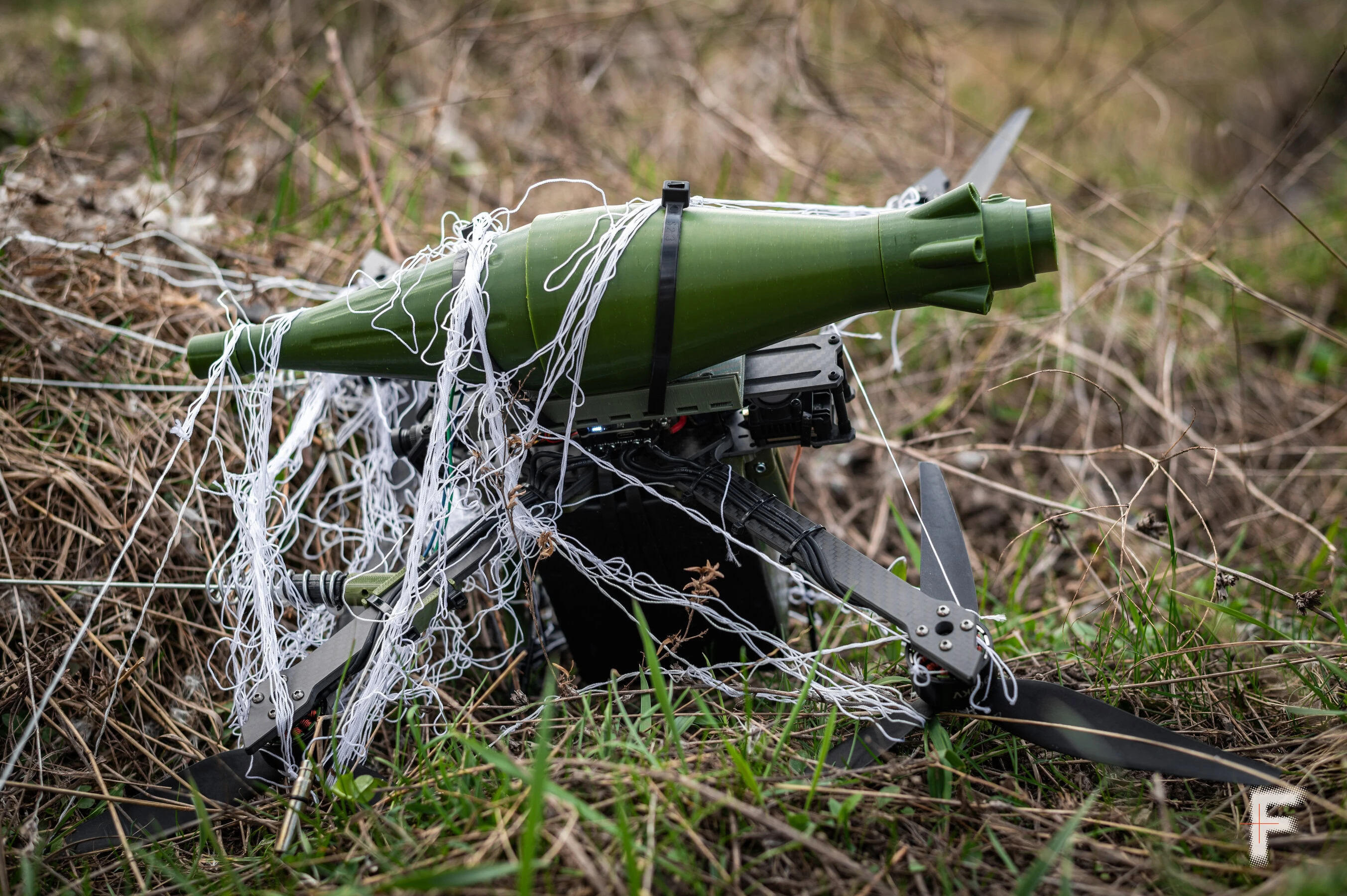
“My colleague Ivan Shyshkin and I put a lot of work into this net launcher,” Kyrychok explains. “We call the device a ‘last-resort shot,’ because when a drone is flying right at you and there is nowhere to hide, it can be the last shot capable of saving your life.”
Cheaper than foreign alternatives
This item could be highly beneficial
for journalists working in war zones,
All of the net launcher’s components, from machined parts to 3D-printed elements, are made in Ukraine. The production cost of the Ukrainian device is 10 to 12 times lower than its foreign equivalents. This makes it accessible not only to the military but to anyone working or residing in a combat zone. Furthermore, anyone can buy the device without any permits or paperwork.
“It is not a weapon, but it is not a toy either,” Kyrychok says. “You absolutely must fire a few test shots before taking it out into the field. Right now, we have many orders from the military and from volunteers. In particular, this item could be highly beneficial for journalists working in war zones. They are not allowed to carry weapons, yet everyone needs at least some defense against drones.”

Pump-action shotguns against drones
At the same time, for many people working near the front lines, a classic pump-action shotgun remains a reliable and time-tested tool to defend against enemy drones. Volunteer Oleksandr Moldovanov, who has been delivering aid to the military since the start of the full-scale invasion, says that the operational area for volunteers has changed significantly in recent years due to the active use of UAVs. While traveling several dozen kilometers from the front line, he and his team have repeatedly come under attack from FPV drones.
“In the past, having drone detection equipment was enough to work in frontline areas,” says Moldovanov, a volunteer with the Invincible Charitable Foundation. “Now, driving even within a 10-kilometer zone of the front line is dangerous without the means to destroy enemy UAVs. There have been cases where a weapon failed or jammed. In those moments, it is better to have a weapon of last resort on hand.”
The net launcher in action
In those final moments when a drone is closing in, the net launcher gives you exactly one shot. The device has to be reloaded after each firing. Even though the creators have added quick-release attachments, using the net launcher as your only layer of protection is still a gamble, the volunteer argues.
“A delay when swapping the attachment can put you in danger,” Moldovanov says. “In combat conditions, there is no time for fumbling. Everything happens in a split second. That is why a group should have at least two, or preferably more, loaded net launchers.”

Even though the net launcher is not legally classified as a weapon, users are still responsible for its safe operation. The device launches a net under pressure and, if handled improperly, can injure both the operator and bystanders.
“There needs to be some control over who gets it and for what purpose,” Moldovanov says. “I have seen situations where guys on the battlefield had a net launcher in their hands but failed to react properly and fire in time. Hearing an FPV drone buzzing overhead and seeing its live warhead isn’t like watching a YouTube video. It brings an incredible amount of stress.”
From prototype to mass production
To scale up production of the net launcher, the developers must pass government codification. For the military to officially procure the device, it must meet several formal requirements. These range from having a safety mechanism to being resistant to dust and dirt. Currently, production capacity allows a single worker to assemble 30 to 50 net launchers per shift, Kyrychok says, but even this pace is sometimes insufficient to keep up with demand.
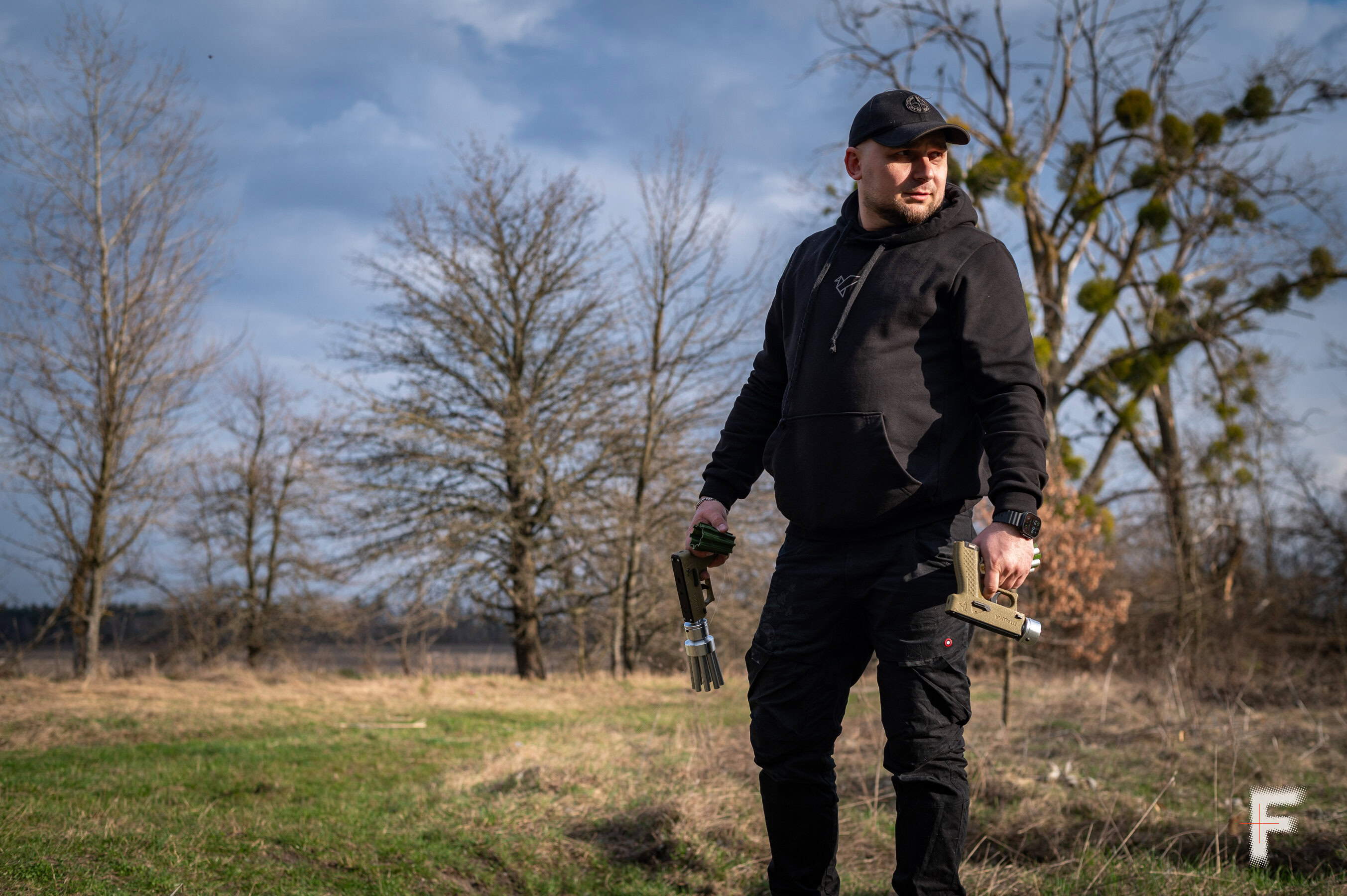
“For some reason, people only start taking an interest in this when the need becomes absolutely critical,” Kyrychok says. “And that need is already here. People’s feedback proves it. To be honest, the greatest thrill I get is receiving a text that says, ‘You saved my life.'”
Today, fiber-optic FPV drones have virtually wiped out the effectiveness of traditional electronic warfare systems. Since the signal travels through a physical cable, radio jamming is now obsolete. In this new reality, the only option left is to physically destroy or knock down the enemy drone. Given these circumstances, net launchers have the potential to become one of the most widespread means of defense against enemy drones in the future.
***
Hi, I am Artem, the author of this article. Thank you for reading to the end.
I decided to cover the net launcher because I knew very little about it. I wanted to see if such a device could be practical, particularly in our line of work. We journalists don’t carry weapons, yet we regularly come under Russian attacks, particularly while traveling in vehicles. So, we set out to figure out whether a net launcher could actually be a lifesaver.
Every story starts with your support. Join the Frontliner community so we can keep up documenting Russia’s war against Ukraine from the front line and the rear.
***