Between plywood and certificates: where Kyiv residents live after their homes were damaged by Russian shelling?
Russian shelling in Kyiv has left dozens of loved ones and neighbors dead under the rubble – losses that cannot be let go – as well as countless destroyed apartments. After the initial shock, the struggle to regain some semblance of daily life begins: repairing windows and navigating the challenges of housing certificates. Residents of areas hit by Russian strikes face these realities after rescuers have cleared the rubble, recovered the dead and survivors, and municipal services have restored the streets. Frontliner spoke with Kyiv residents in the hardest-hit neighborhoods.
Russia is setting new records in both the number and speed of weapon modernizations used against Ukraine during its massive shelling campaigns. In just the first week of November, Ukraine was targeted with roughly 1,000 attack drones, nearly 980 guided aerial bombs, and 36 missiles of various types.
Serhii Movenko, head of Solomianskyi district of Kyiv, told Frontliner that 30% of the district’s homes were damaged by Russian shelling. Kyiv’s Department of Construction and Housing reported that the most damaged residential buildings were in Solomianskyi (304), Shevchenkivskyi (233), Sviatoshynskyi (199), and Holosiivskyi (182) districts.
The uninhabitable apartment
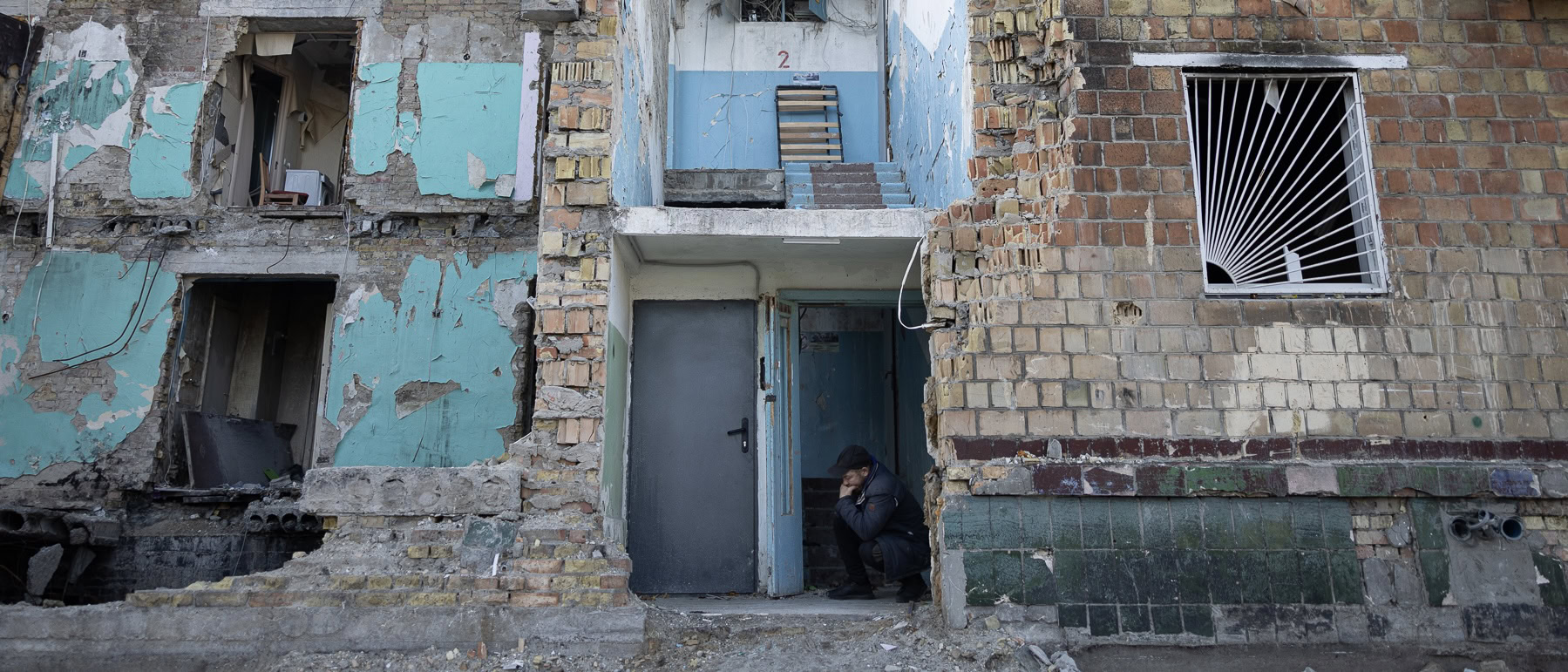
The building in Solomyanskii district, struck by an X-101 cruise missile on June 17, 2025, has lost its entire stairwell number 7. The space that once housed hundreds of lives now lies empty.
The strike was devastating, destroying apartments from the first to the ninth floors. The search and rescue operation lasted more than 39 hours. Emergency Service workers recovered the bodies of 23 victims, rescued two people, and helped free about 50 more from the apartments.
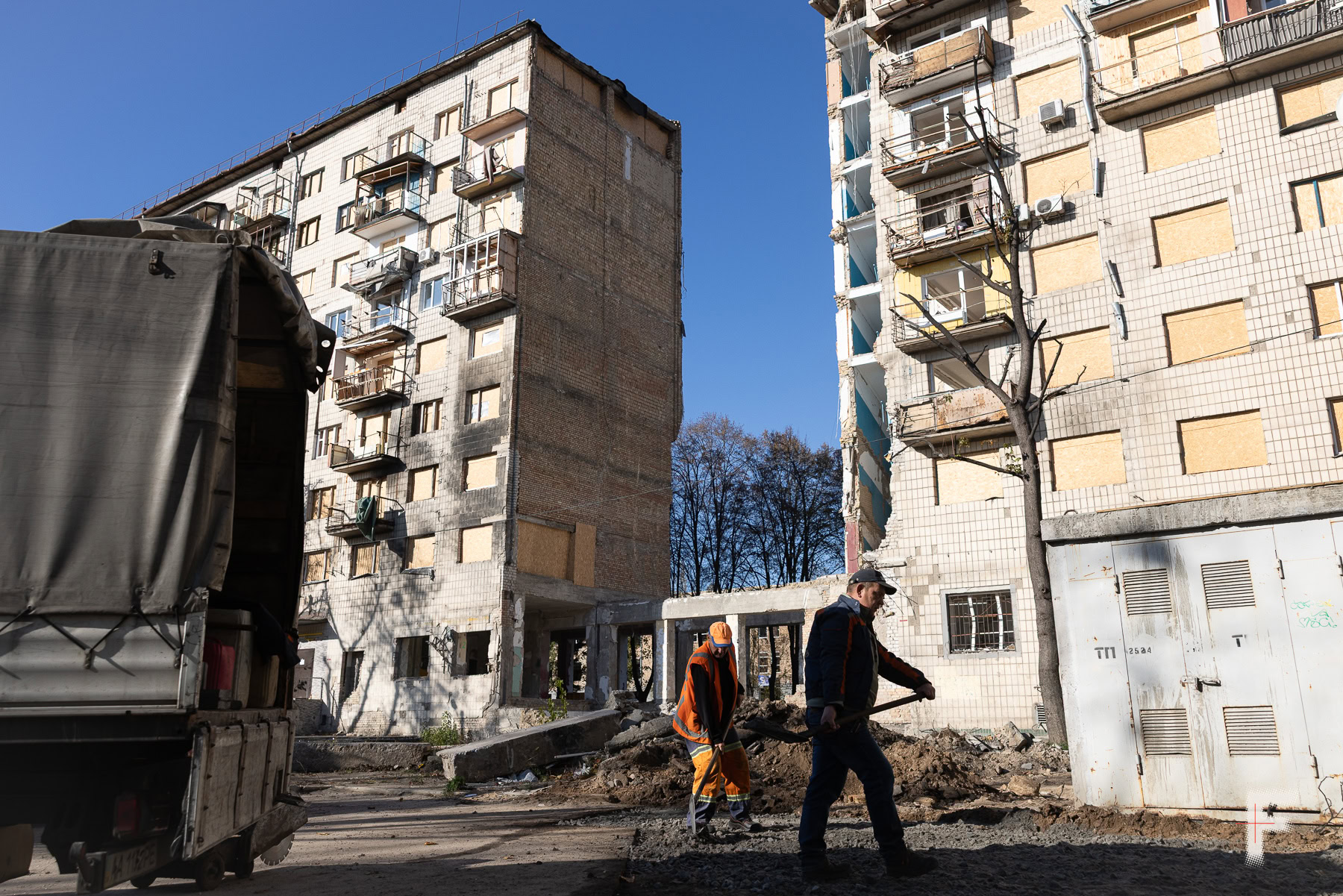
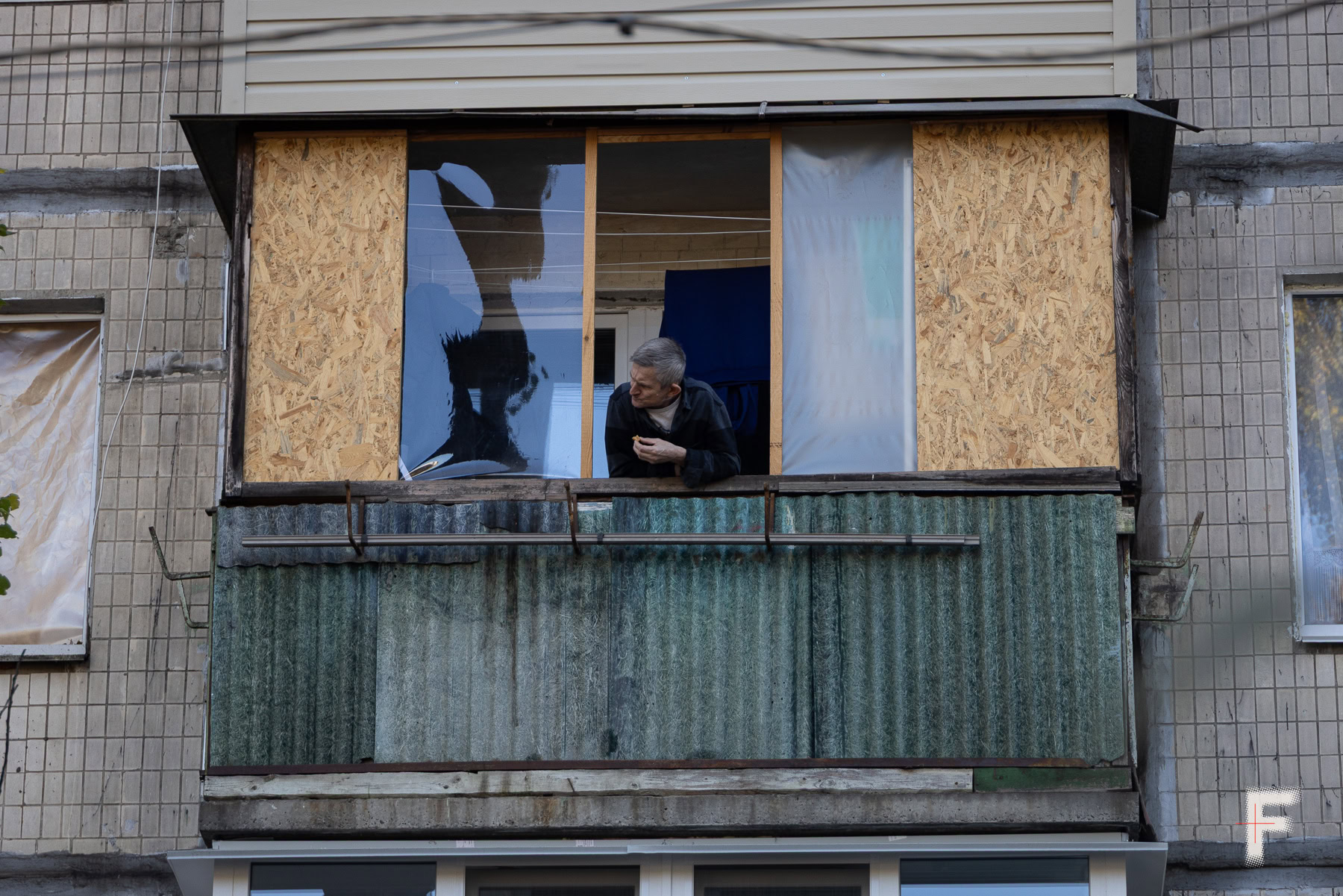
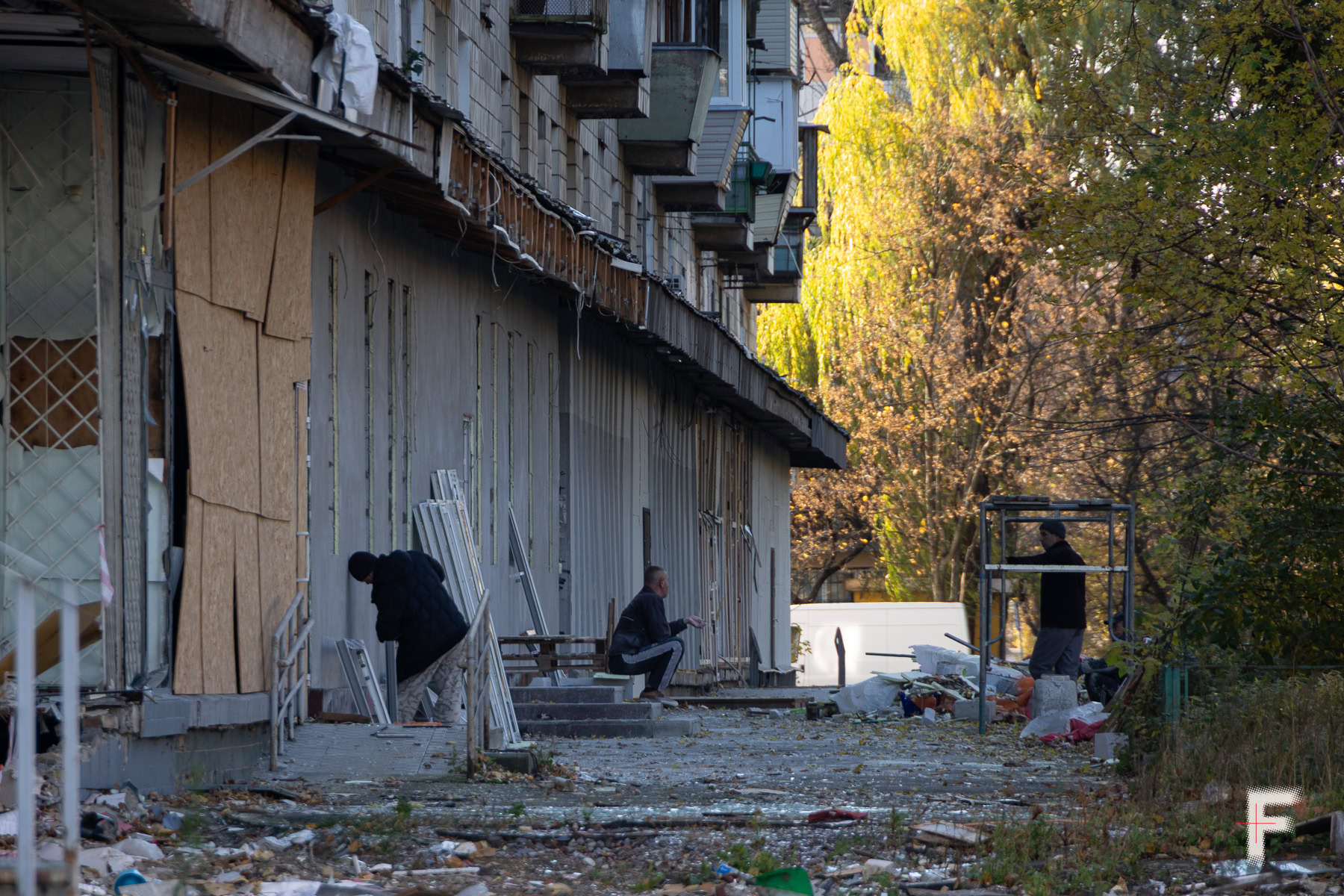
The effects of the shelling are still evident even five months later. Most windows near the epicenter of the missile strike remain boarded up with plywood. The building has no heating, even in the sections that survived, although electricity and water have been restored.
-
Municipal crews work near the site of the June 17 missile strike. Kyiv, Ukraine, November 3, 2025. Danylo Dubchak / Frontliner

-

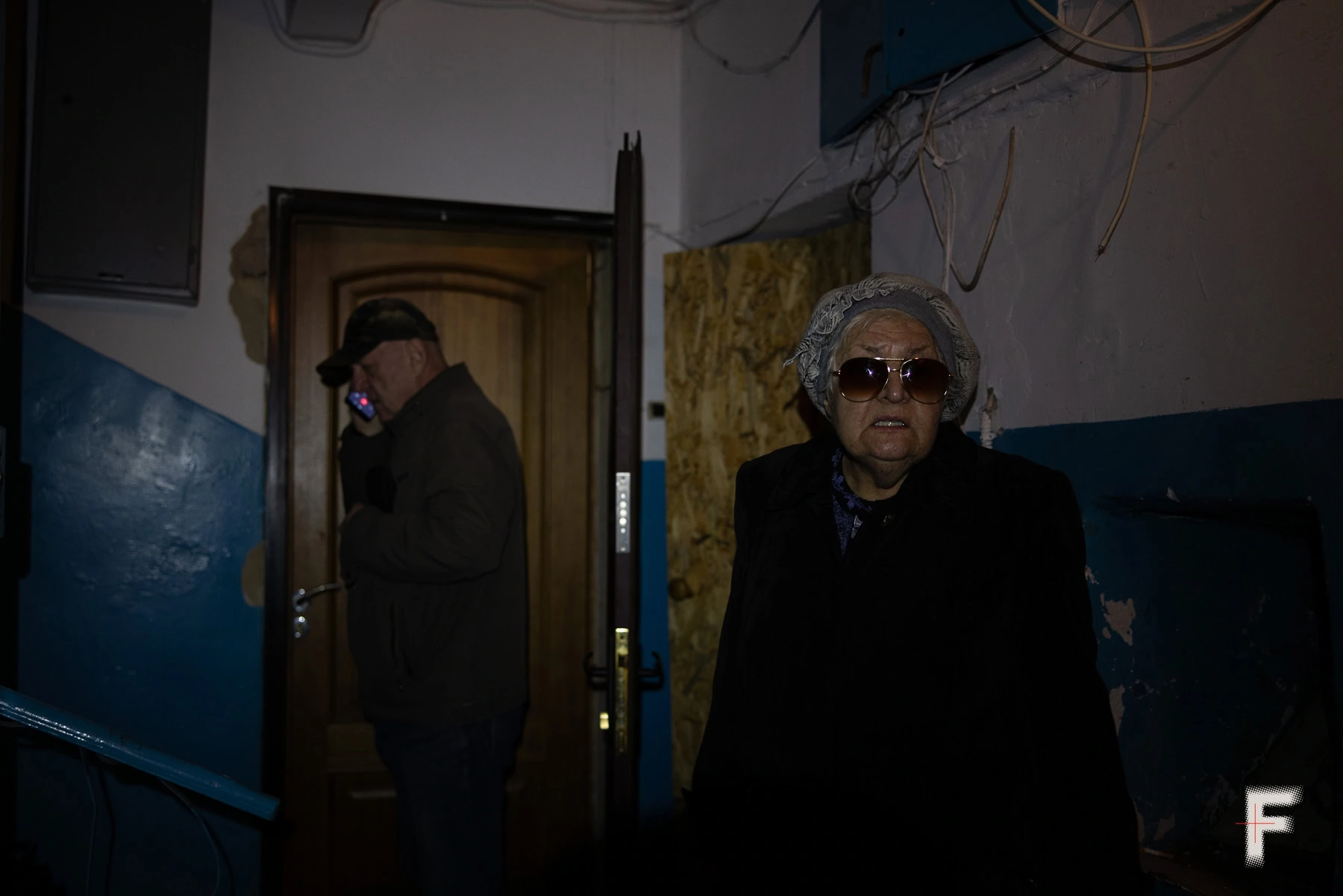
Some residents have already had new windows installed. Among them is Oleksandr Humeniuk, who lives on the fourth floor of section 5. He says that he and his blind mother went without gas for a long time.
Oleksandr and his mother survived, but they lost their property, including their car, and had to spend their limited savings on medical treatment.
“Where is the money supposed to come from? My mother is legally blind a disabled person of the first category. I have to be with her all the time, so I can’t work either,” says Oleksandr. During the explosion, he had been standing on his apartment balcony overlooking the residential courtyard and was injured in the leg.
“I don’t know how I wasn’t cut to pieces. I had surgery below my knee, a lacerated wound. I found my mother trapped under two double-glazed windows. She spent six weeks in the hospital. I know our medical care is supposed to be free, but in reality you have to pay. My mother’s treatment cost almost 30 thousand hryvnias (about $715),” he says, tears in his eyes.
Oleksandr had to spend his accumulated savings. He also took advantage of the state’s assistance of 10,000 hryvnias. According to the Department of Social and Veteran Policy of the Kyiv City Council, such assistance was paid to 12,184 Kyiv residents for a total of almost 122 million hryvnias (about $2,928,000).
“This money really helped,” the man says.
Some of the apartments in section number 6, adjacent to the section where the missile hit, although they survived, are uninhabitable.
For example, the three-room apartment of Svitlana and Volodymyr Povarenki, located on the third floor, has been declared emergency-grade following an official inspection.
The woman says she and her son were asleep when the rocket struck the building. Svitlana was in a room with windows facing the courtyard, on the side where the impact was less severe.
The woman says that she and her son were sleeping when the rocket hit the house. Svitlana was in a room with windows overlooking the courtyard of the house, and on the side from which the impact was less noticeable.
I was burned, injured by glass, my arms were broken,
and they put Ilizarov devices on me,
Her husband was in the countryside at the time, and fortunately, says Svitlana, because the room in which he usually sleeps was the most damaged: its windows face the opposite side, closer to the epicenter of the impact – a wall was blown away here, along with a window and a radiator.
“If he had been there, he would be alive today,” the woman says.
Svitlana says that the military (most likely the rescuers from the State Emergency Service – ed.), who were rescuing people from the rubble, brought her and her son out, saving their lives. Then she spent two months in the hospital.
Today the windows and wall openings in the Povarenkis’ apartment are covered with plywood. The rooms are damp and cold, but they’ve been cleaned so thoroughly that no trace of the explosion remains. The family lost some of their belongings and furniture, though the items stored in the storage space under the sofa survived.

The couple rented an apartment in Borshchahivskyi district with state aid from the Kyiv City State Administration – 20 thousand hryvnias (about $475) per month . The aid is given for a year, and according to the Kyiv Department of Social Policy, 584 Kyiv residents receive it.
The husband and wife come to their apartment from time to time to take things. It is currently unknown what will happen to their place. According to the head of the Solomyanskyi district administration, Serhii Movenko, the restoration of this building is currently at the design stage, and work will begin no earlier than next year.
Former residents of the destroyed building
The five-story brick building in Kyiv’s Darnytskyi district, destroyed on August 28, 2025, remains empty to this day. On one side, an open wound cuts through it – a Russian missile struck here, tearing a hole from the fifth floor down to the first. Now only the wind moves through the shattered apartments, tugging at the curtains and peeling wallpaper. Twenty-two residents were killed by the direct hit, among them four children.

Near the outer wall of the surviving section of the five-story building, faded toys and wilted flowers still lie – placed there as part of an improvised memorial immediately after the Russian strike.
More toys and flowers sit in another spot, at the base of the crater where the building’s entrance once stood. On the foundation slab lie two teddy bears and makeshift pots with flowers. They were placed there by a man who lost his daughter.

Oleksandr Drapak told Frontliner that his daughter Malanka was only eight years old when she died. He and his wife, Tetiana, were helped by the soldiers to bury her. Today, the couple rents an apartment with government assistance, but they visit their destroyed home every day – now missing one room – to keep the memory of their child.

The problem with certificates
In the Sviatoshynskyi district, on the night of July 31, 2025, a Russian Iskander missile struck the outer section of a nine-story building. The section was almost completely destroyed, with only a few apartments on the lower floors partially surviving. Rescue crews worked through the night clearing the rubble, but 28 people were killed.

Aside from the destruction of section number 1, the rest of the building sustained only minor damage, such as broken windows and apartment doors blown off. Overall, living conditions in the building were restored relatively quickly after the shelling, with water and electricity reconnected promptly.
“The first day, there was no electricity, but it was restored later, and water was back by the end of the day. We bought gas cylinders and an electric stove,” says Oleksandr Stetsenko, a taxi driver who has lived in the building’s second entrance since 1969.
The residents of the second entrance say that they submitted applications to the Kyiv Central Administrative Center for compensation for restoration of window damages under the eReconstruction program. They finally got the Kyivgaz technicians to arrive and repair the gas pipes connected to section number 1.
Translator’s note: eReconstruction is the official name of a Ukrainian government program that provides funding and support for the repair and rebuilding of housing damaged by Russian attacks.

The Kyiv City State Administration does everything very slowly,
they know the legislation very poorly,
The residents of section number 1, which no longer exists, have mostly moved into rented apartments. Oleksandr says they return occasionally to retrieve belongings left behind. Some have already received housing certificates, like Tamara Martyniuk, who owned a three-room apartment on the second floor. Although she suffered a concussion, she believes she survived by pure luck – at the moment of the hit, she had stepped into another room farther from the epicenter of the explosion.
Tamara Martyniuk’s daughter, Stella Morozova, is one of the most active residents advocating for the rights of victims of Russian strikes. She says the section was declared uninhabitable by an expert report, but the Kyiv City Administration insisted on rebuilding the housing rather than issuing certificates to those who preferred them.
“We got the Kyiv City State Administration to give us housing certificates. The Kyiv City State Administration does everything very slowly, they know the legislation very poorly. Of course, we could wait for reconstruction, but we have already lost a lot of people, and the children still live in another wing,” says Stella.
Tamara Martyniuk did receive a certificate, but a month later she still hasn’t been able to buy a new apartment, and now they say they can’t buy an apartment.
The amount specified in the certificate does not correspond to the market price, says her daughter Stella.
“We received a little more than two million hryvnias (about $48,000) for our three-room apartment. But we can’t buy such an apartment in our area, only one- or two-room ones, but very few such apartments are sold,” the woman says.
In addition, Stella Morozova points out that many realtors are unfamiliar with the eReconstruction program and often confuse it with the eOselya credit program. She says owners of apartments for sale are wary of accepting payment through a housing certificate, since state funds arrive only on the fifth day. Morozova also notes that not all developers are willing to sell apartments in exchange for a housing certificate.
-
The neighboring entrance of a residential building, where people now live close to the site of the strike. Kyiv, Ukraine, November 3, 2025. Photo by Danylo Dubchak / Frontliner
-
A man looks out the window, watching utility workers repair the gas supply, as his entrance still has no gas. Kyiv, Ukraine, November 3, 2025. Photo by Danylo Dubchak / Frontliner
-
Restoration work at the building that was hit. Kyiv, Ukraine, November 3, 2025. Photo by Danylo Dubchak / Frontliner


In response to Frontliner’s request, the Department of Construction and Housing responded that it is issuing certificates to residents of this building in accordance with the procedure, and that 34 owners of 54 apartments in the first entrance have already been issued certificates. According to their information, a total of 35 more apartment buildings are awaiting restoration in the capital city. The department does not specify when this may happen.
Adapted: Irena Zaburanna