
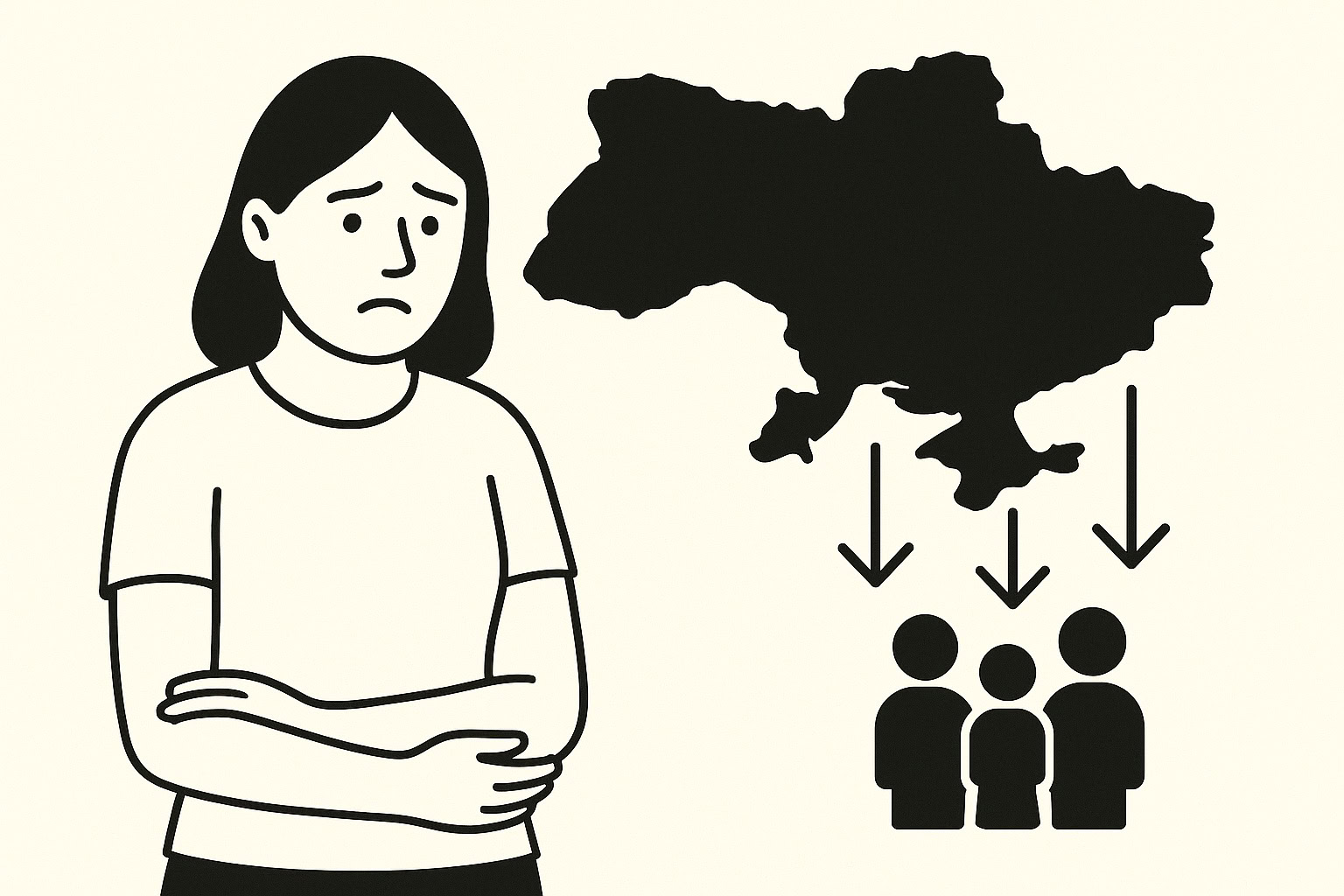
Ukraine is shrinking and aging: will the population reach 34 million by 2030?
After a sharp decline during the full-scale war, the population is expected to stabilize at around 34 million by the end of the decade. That is the baseline scenario of the International Monetary Fund’s forecast. Yet today’s estimates vary widely, from 30 to 36 million, and the state effectively lacks precise population accounting. Despite the discrepancies, all sources point to the same conclusion: Ukraine is rapidly shrinking and aging. Frontliner examines what lies behind the forecast and what Ukraine’s demographic reality in 2030 may look like.
The IMF projection assumes that around 41 million people lived in Ukraine in 2021, and by 2024 that number had fallen to about 33.3 million. The fund models another drop to roughly 32.9 million in 2025, followed by a slow return toward 34 million in 2027–2030.
The key assumption behind this scenario is an end to hostilities in late 2025 and the partial return of people who temporarily left the country. In other words, the IMF is not painting a “rosy scenario” but outlining a conditional range: if the war lasts longer or return rates remain low, the actual population could be even smaller.
Different estimates, one trend
Unlike the IMF, Ukrainian institutions are counting what exists now, and their numbers also diverge. The official government estimate for mid-2024 is around 35.8 million people within the country, of whom roughly 31.1 million live in government-controlled territory.
The Institute for Demography at Ukraine’s National Academy of Sciences reports even deeper losses: according to its calculations, about 31.5 million people were living in Kyiv-controlled areas at the start of 2025, meaning the country has lost at least 10 million people since the full-scale invasion began.
The gap between estimates has a simple explanation: Ukraine has not had a full census for more than two decades, part of its territory is occupied, many people live between countries, and traditional population-counting methods have been disrupted by war.
War, emigration and birthrates: what is driving the demographic collapse
Today’s demographic decline is the result of three processes. The first is direct wartime losses: fallen soldiers and civilians, deaths from injuries, disease, or lack of access to medical care.
The second is mass emigration: millions of Ukrainians live in EU countries and elsewhere under temporary protection, and a portion has already integrated abroad for the long term.
The third factor is a record-low birthrate. Even before the full-scale invasion, fertility was well below replacement level, and after 2022 the number of newborns fell to a historic low.
At the same time, the population structure is aging: the share of older people, veterans and people with disabilities will continue to grow, while the number of working-age residents declines.
What Ukraine could look like in 2030
If the IMF forecast materializes, Ukraine will enter the 2030s with a smaller and structurally different population. Around 34 million people is still a substantial human resource, but one marked by serious imbalances: labor shortages in key sectors, overloaded major cities and regions hosting internally displaced people, and depopulated frontline areas that have lost most of their residents.
Long-term demographic projections are even harsher: under current trends, the population could drop to about 25 million by mid-century. The government has approved a demographic development strategy through 2040, aimed at stopping the decline, but its success will depend not on the document itself but on whether real incentives for return and childbirth are created – from housing to healthcare and security.
Why demographics are becoming a security issue
The IMF’s “34 million” forecast is a warning. It shows that even under a relatively favorable scenario, Ukraine will live with a constant shortage of people, like in the military, the economy and the social sector. Demographic policy is no longer a niche concern for statisticians; it has become a key factor in defense capability, reconstruction potential and the country’s overall future.
In other words, the question is not only “how many of us there will be,” but “what the state will do to make people want to live here.” The answer will determine whether today’s demographic shock becomes an irreversible trend or another challenge Ukraine manages to overcome.
Adapted: Kateryna Saienko
***
Frontliner wishes to acknowledge the financial assistance of the European Union though its Frontline and Investigative Reporting project (FAIR Media Ukraine), implemented by Internews International in partnership with the Media Development Foundation (MDF). Frontliner retains full editorial independence and the information provided here does not necessarily reflect the views of the European Union, Internews International or MDF.

Read more — Facing the future: how an international team of surgeons is saving the faces of soldiers
