
The shelf life of a soldier: why volunteers go AWOL
Half of all cases of AWOL and desertion occurred in the first nine months of 2025. In October alone, one servicemember left their post without permission every two minutes, bringing the total to 21,500 cases, according to the Prosecutor General’s Office. The number of unauthorized absences during this period was the highest recorded since the start of the full-scale war. Those leaving their posts are not only soldiers mobilized after Russia’s full-scale invasion of Ukraine, but also career officers who have been fighting since the time of the Anti-Terrorist Operation and the Joint Forces Operation. Through the stories of individual servicemembers, Frontliner examines what drives battle-hardened, respected soldiers to go AWOL.
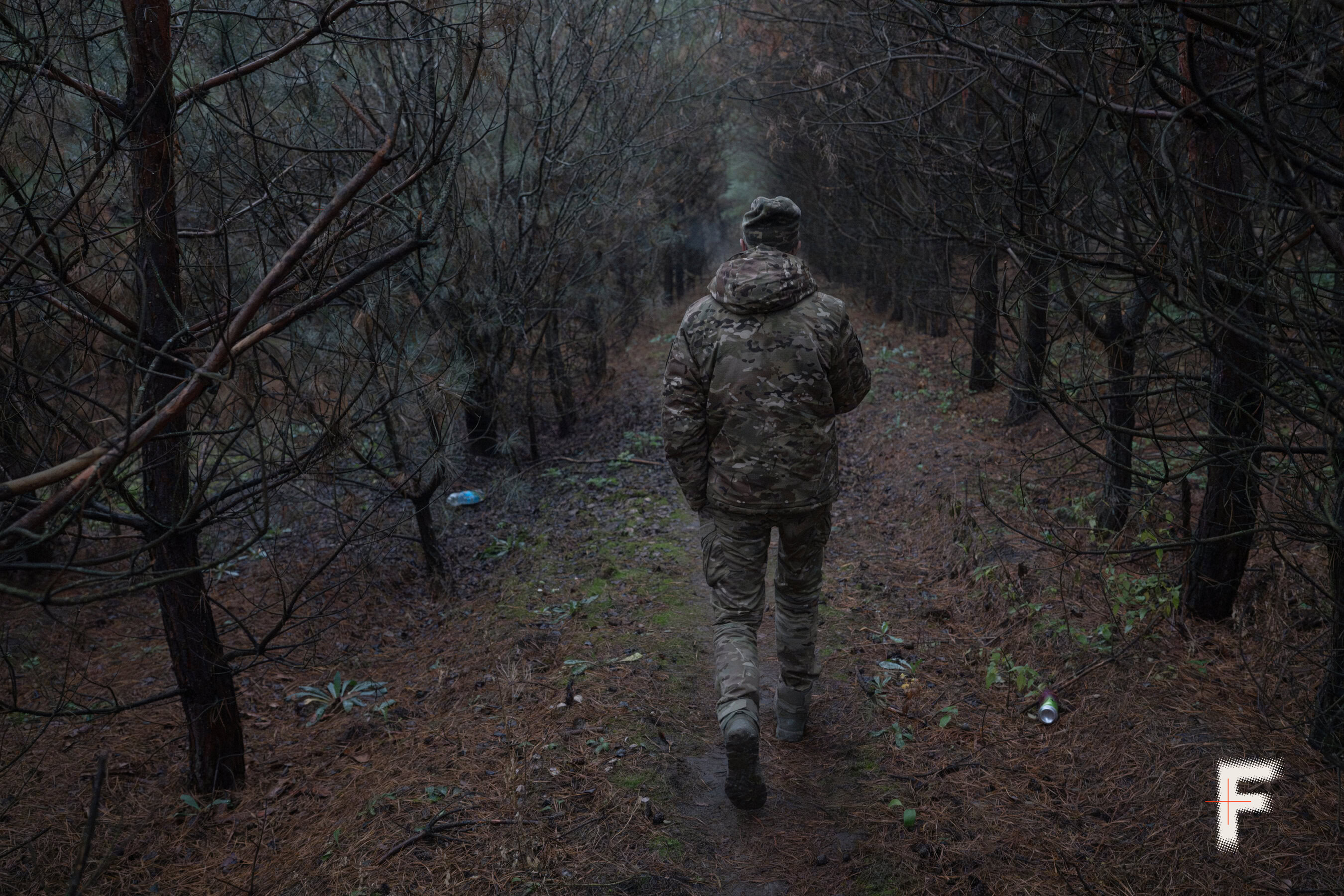
Mykhailo, whose call sign is “Totia,” has been serving on the Vovchansk front for six months. During that time, seven soldiers from his platoon have “disappeared.” Four of them had been fighting since 2014 and for years formed the backbone of the battalion. Mykhailo himself went absent without leave for a week. He returned before a criminal case could be opened against him.
Our major went absent without leave,
“He’d been serving since 2015. He went through Ilovaisk, fought in Soledar, held the line in Bakhmut. He was blown up when he was delivering ammo to the guys and hit a mine. The blast almost took his legs, he was badly burned, but he came back to duty. They reassigned him to headquarters even though he didn’t want that, he wanted to keep fighting. As if he somehow knew that’s where they would push him to go AWOL, and not in a trench,” Totia says, lighting another cigarette.
He has been in the military since February 2022, when he voluntarily joined the army. He went on to help liberate the Kyiv region and later fought in the Kharkiv and Zaporizhzhia regions. He went AWOL from a base in central Ukraine, where he had been sent to recover. He said he took a leave without permission after his commander told him he would not get any leave in 2025.
“If the service were normal, everyone would go on combat missions, even with that insane mileage. We buy supplies with our own money, even though it eats up 10–15 thousand a month. But leave? I can only dream about it! Before, my wife would ask when I’d come home to fix the house. I’d give her a month and an approximate day, go to the commander, and he’d approve it. But now, I haven’t had leave for a year and a half. Unauthorized absence doesn’t count, they pushed me too far. I just couldn’t take it anymore,” Mykhailo explains, flicking the ash from his cigarette.
Extortion: one of the reasons why soldiers go AWOL
His comrade, Ihor, known by the call sign “Yuvelir,” transferred to this brigade in the spring. He had previously served as a mortarman in the 109th Territorial Defense Brigade, though in reality he was an infantryman digging foxholes. In his former brigade, he was granted 30 days of leave each year. But he says, there was a price to pay: in 2023, it cost 500 hryvnias per day.
“It’s wrong, but what can you do? It’s the same everywhere. Our commanders paid bribes up the chain, and everyone knew about it,” says “Yuvelir”.
The soldier hasn’t had leave since January 2025, but for now, the situation isn’t critical for him.
“For now, we’re holding out. We don’t have enough guys, no one to replace them. If I ask for leave now and they grant it, there’ll be a gap, and no one to cover it. Even though there are plenty of people in the rear! That’s why I don’t want to ask the commander. I’m afraid I won’t hold back, and I’ll end up in trouble with the Military Police,” the soldier explains in frustration.
Higher pay in a neighboring position
Meanwhile, servicemembers on the Zaporizhzhia and Kharkiv fronts say they are often underpaid. Many don’t even realize they could be earning more, and their commanders make no effort to increase their pay.
It’s not about the front,
it’s about how soldiers are treated.
Anatolii Volodchenko is a soldier attached to a combat brigade on the Chernihiv front. He previously served in a Territorial Defense brigade that defended Kharkiv and Zaporizhzhia regions in 2024.
He went AWOL after learning that soldiers in neighboring positions had earned 50,000 hryvnias more for the same period. When he raised the issue with his platoon commander, the commander refused to explain. It turned out that the brigade’s finance unit had overlooked completing some paperwork and combat orders were getting lost. As a result, Anatolii was officially listed as serving on the positions for only 15 days, even though he had actually been there for 50. When the finance officers declined to recalculate his pay or launch an investigation, he refused to go on combat missions and eventually left his post without authorization.
“Zaporizhzhia, Kherson, Chernihiv — it’s not about the front, it’s about how soldiers are treated. It’s obvious who they neglect if you look at where and how frequently soldiers go AWOL. I’ve been at war since 2015, and I’ve never seen fuckery like this. Back then, commanders knew where we were, made sure we got what we needed. There were leave days and rest days. Now you have to fight for your pay, even though we sit in the mud for weeks, sometimes months,” the servicemember explains.
Even after going AWOL and threatening a transfer to another brigade, the problem remained. In his previous unit (Territorial Defense), he was owed over 300,000 hryvnias for combat deployments. Appeals to pro bono lawyers produced no results, as all the documentation had been lost. In his new brigade, he is already owed more than 50,000 hryvnias for combat duty. Payments are promised, but sometime in the future. The problem of unpaid wages persists.
“Right now, on neighboring positions, guys from another brigade are getting 150,000 hryvnias or more, just because it’s a different brigade, even though they’re also in the Armed Forces. The last payment I got was only 80,000,” Anatolii Volodchenko says.
The army’s fall in public esteem
Of the 20 soldiers surveyed, four say they went AWOL because of how civilians treat the military. Five cite frustration with having to beg for leave and the unreasonable decisions of their commanders. Three point to cases where familiar artillerymen and mortar crews were sent to “fill gaps” at the front. For another eight, family pressure was the reason they left service.
My wife was screaming at me that I hadn’t
been around for three years,
“That I’d only come home twice on leave and barely spent any time with her. She even threatened to divorce me. I sat and thought it over, then went to her. Now she’s happy,” Myroslav Karpenko reflects on his time going AWOL.
Previously, he had considered returning to the military, since he had spent the past two years operating FPV drones. Now, however, he has changed his mind, as it is only possible to return as part of an assault unit.
“They’re treating us like cannon fodder again. That’s not what I was fighting for back then, and I’m not going to fight for it now. If the service terms were normal and I knew I’d be home in a year, I’d probably go back,” Myroslav explains.
Awards and mementos no longer boost morale
Leonid, a soldier in the 127th Territorial Defense Brigade with the callsign “Vedmedyk,” says there is little motivation to return to the military after going AWOL. In the past, morale could be boosted with certificates and brigade badges. Now, even money doesn’t make much of a difference, especially when it comes to infantrymen.
“For the extreme conditions infantrymen serve under, the state should pay them extra every month for life. Soldiers spend 60–90 days on positions, and on the Pokrovske front, up to six months. No ‘suit’ understands these terms when they come up with certificates. In short, our system of incentives is lousy, miserly, and Soviet. Just like in the USSR, when they gave peasants a paper for a hand blown off, we keep doing the same,” the soldier explains.
Editor’s note: Many Soviet veterans, particularly those with disabilities, faced significant social and economic hardships, and in some cases mistreatment despite state propaganda emphasizing their honor and valor.
I met a soldier who spent six months on the position, completely surrounded.
He suffered a severe wound that healed while he was in the dugout.
It took him 21 days to get out of the position, facing five enemy encounters
along the way and being bombed from the air. I thought he’d be
nominated for the Hero of Ukraine, but the guy was handed
a brigade medal ‘For Wounds’ instead,
Leonid says that U.S. Marines receive medals and awards simply for being on the roster for an operation. If they survive, they become national heroes. In Ukraine, by contrast, the highest form of recognition is often a commander’s thanks in front of the unit.
“The stick” will only work until spring
Military psychologist Andrii Kozinchuk believes that, at present, going AWOL is often the only way to escape a commander with whom a soldier has a bad relationship, especially when the commander refuses to approve a transfer request.
The soldier has become even more subjugated.
The army can’t be democratic, but it shouldn’t
impose slavery-like conditions.
“Right now, infantrymen going AWOL are threatened with prison or reassignment to assault units. Yet for a soldier that may have already been on the frontline for who knows how long, prison might seem preferable, since at least the term is known,” says Andrii Kozinchuk.
In December 2025, the Ministry of Defense decided that soldiers going AWOL could return to the army only in the brigade they deserted from or in an assault unit. Kozinchuk predicts this decision will negatively affect the Defense Forces. Fewer soldiers will be willing to fight, and people will continue to flee the army. Those who go AWOL are now more likely to choose prison than become disenfranchised assault troops. Meanwhile, contracts the military began offering in 2026 are unlikely to motivate volunteers to stay.
“We, volunteers from 2014 and 2022, were simply told: ‘You’re a volunteer, you came on your own? Then fight quietly without any term limits, or serve an extra year, two, or even five,’” says the military psychologist, Andrii Kozinchuk.
Mykhailo, call sign “Totia,” who has served in the ATO since 2014 agrees with this sentiment. In his view, the worst thing the government could do was to devalue the volunteers.
“This state will destroy itself with an attitude like this. They’ve devalued us so much that the symbols of moral authority are now those shoved into a military van. And those of us who have been fighting since 2014? We’re forgotten. They think we’re all either disabled, discharged, or buried. But we’re still alive. We just won’t fight under this kind of treatment,” the soldier emphasizes.
By the end of 2025, the situation with soldiers going AWOL had steadily worsened. According to the Prosecutor General’s Office, from January 2022 to October 2025, Ukraine opened about 255,000 cases for AWOL and 56,200 for desertion. How many of these soldiers will return to the army under the imposed conditions is unknown.
Author: Alina Evych
Adapted: Irena Zaburanna
Read more — Invisible trauma of war: how Ukrainian surgeons restore hearing to wounded soldiers
