
Through the Carpathians – on the final journey. Volunteers bring fallen soldiers home
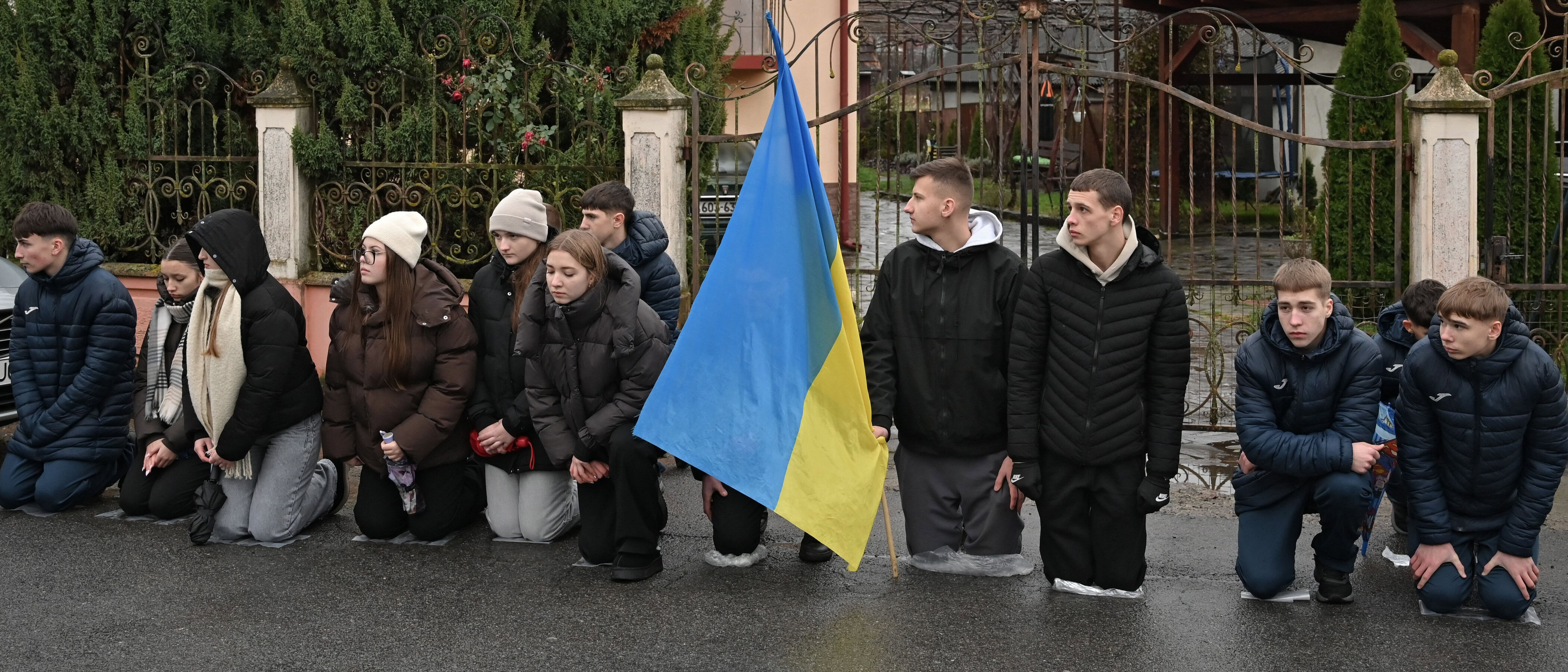
The coffin of a young soldier killed at the front is brought home. He did not live to see his 24th birthday, missing it by three days. The entire village has come out to honor him – in the rain, kneeling, with flowers. On his final journey home, he was carried by Zhuravlyk, a vehicle run by volunteers from the “On the Shield" mission, which returns the bodies of fallen soldiers to their home communities. Valerii and Tetiana Popovych never imagined they would one day be doing this work. Now, their mission is to do everything they can to return the body of a fallen soldier to their family as quickly as possible. Frontliner reporter Anna Semeniuk accompanied the volunteers on the journey to recover the soldier’s body.
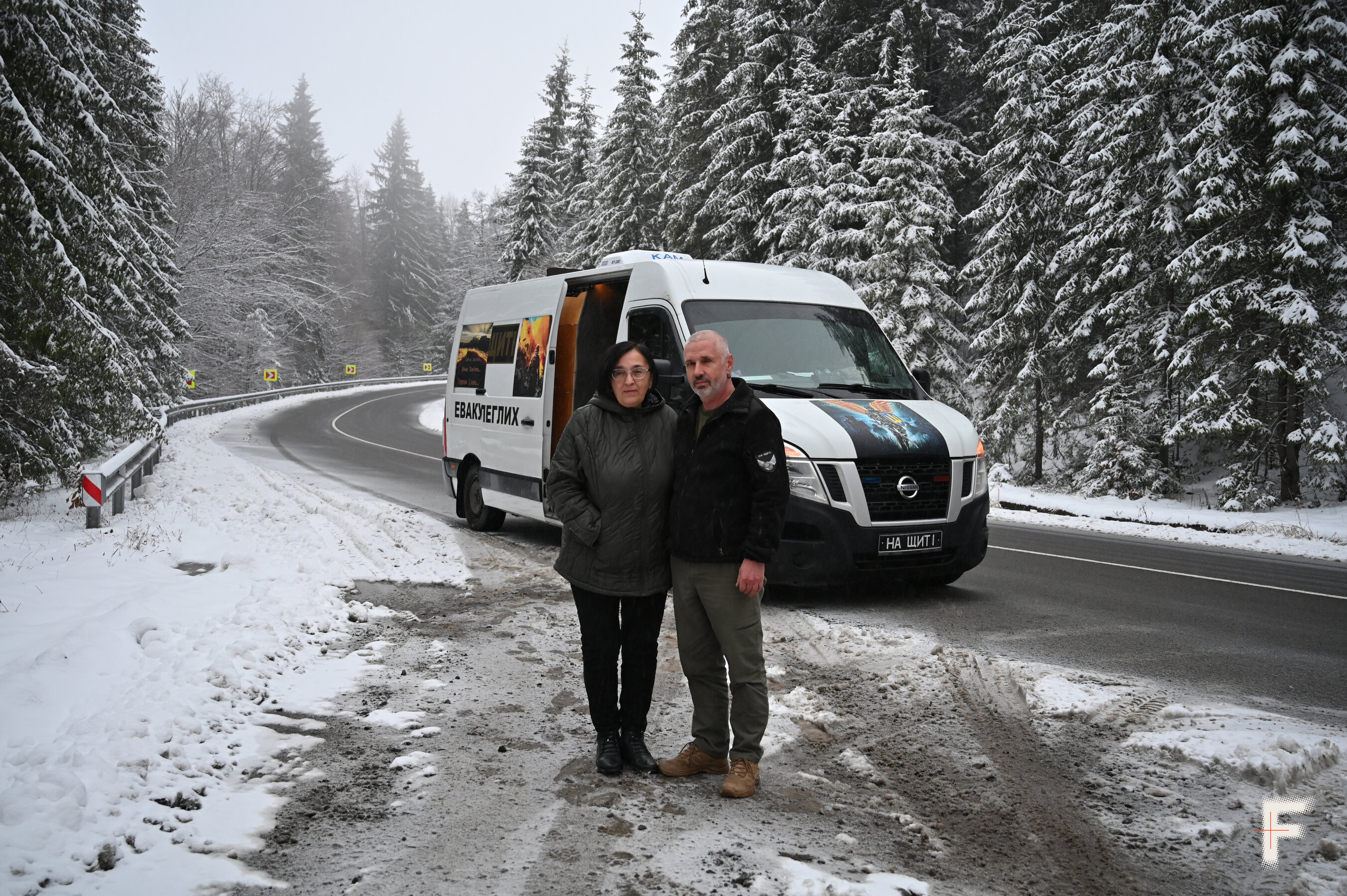
“At the morgue at nine,” – a brief message in the messenger, a terse message in the messenger upends all plans. It’s Sunday morning. A mix of rain and snow falls. A white van marked “Evacuation of the Fallen” pulls up to the morgue in Uzhhorod. Valerii Popovych sits behind the wheel, his wife Tetiana beside him. They set out from home at 7 a.m., on their day off, to carry out a task that is as difficult to speak of as it is impossible to remain silent about.
Valerii and Tetiana Popovych live in the village of Vyshkovo in Zakarpattia. He is a carpenter; she is a teacher. But since the start of the full-scale war, they have been bringing fallen soldiers home. Valerii volunteers with the “On the Shield” mission, and Tetiana often accompanies him on the trips. Together, they organize exhibitions of war artifacts to raise donations for these journeys.
The final journey across the Carpathians
Today, Valerii Popovych’s task is to transport the body of a soldier, a native of Kharkiv, to Ivano-Frankivsk region, where it will be transferred to another vehicle for the journey home to eastern Ukraine. Here in Uzhhorod, a DNA examination was carried out, and now the fallen soldier will make yet another journey of over a thousand kilometers – his final one.
A vehicle carrying the bodies of fallen defenders will drive toward Valerii Popovych’s van, including a soldier from Zakarpattia. He must be picked up and transported to Uzhhorod – closer to the village where his family waits at home.
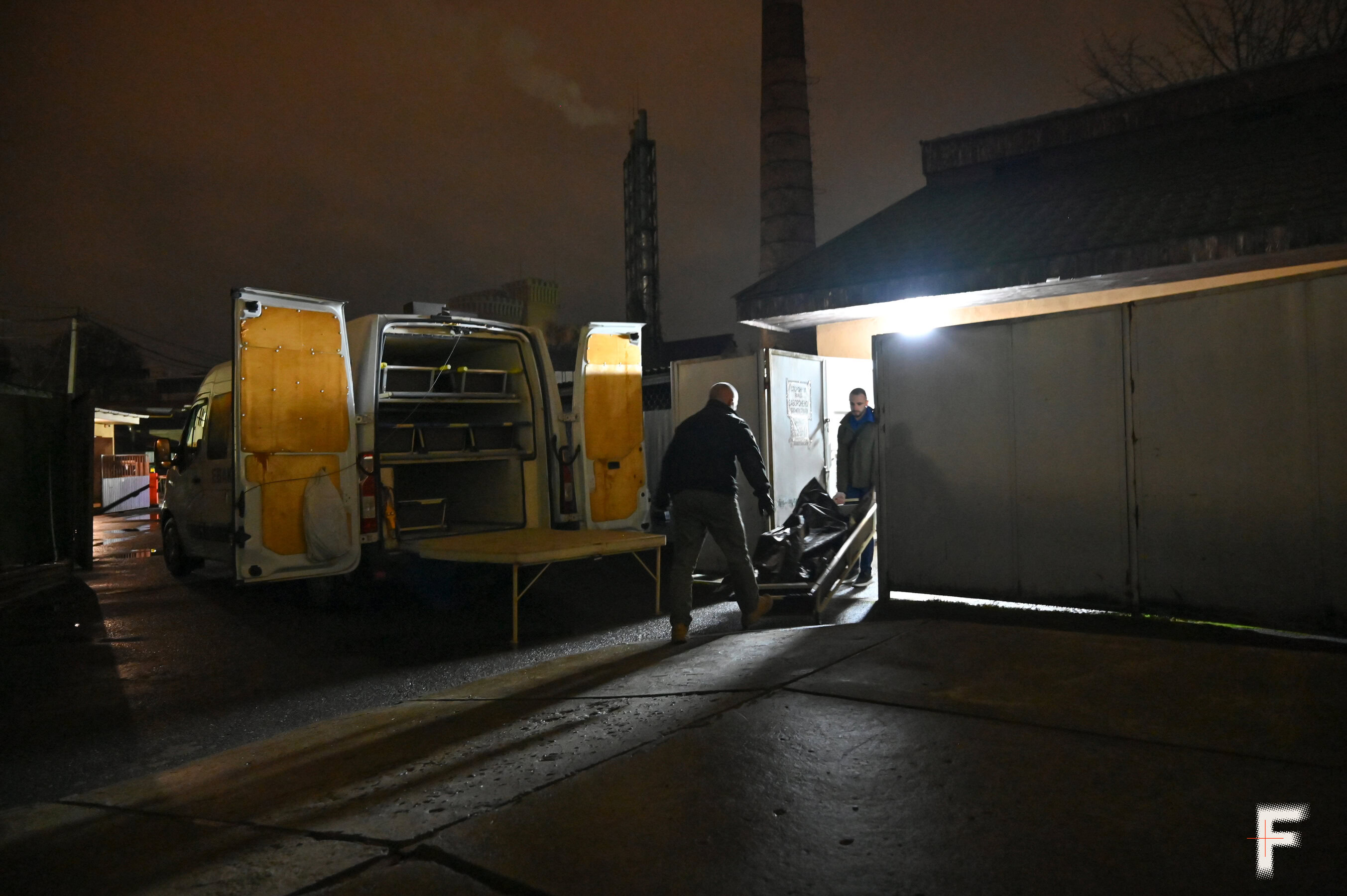
A gray morning hangs over Uzhhorod morgue. Valerii loads the body of a fallen soldier into the van – slowly, carefully, steadily. With a wave of his hand, he signals that it’s time to get in the vehicle – there’s a small sleeping area inside for long trips or unexpected delays at the meeting point. Once on the road, he shares that his family has a tradition of giving their vehicles names. This van is named Zhuravlyk, in Ukrainian – Little Crane.
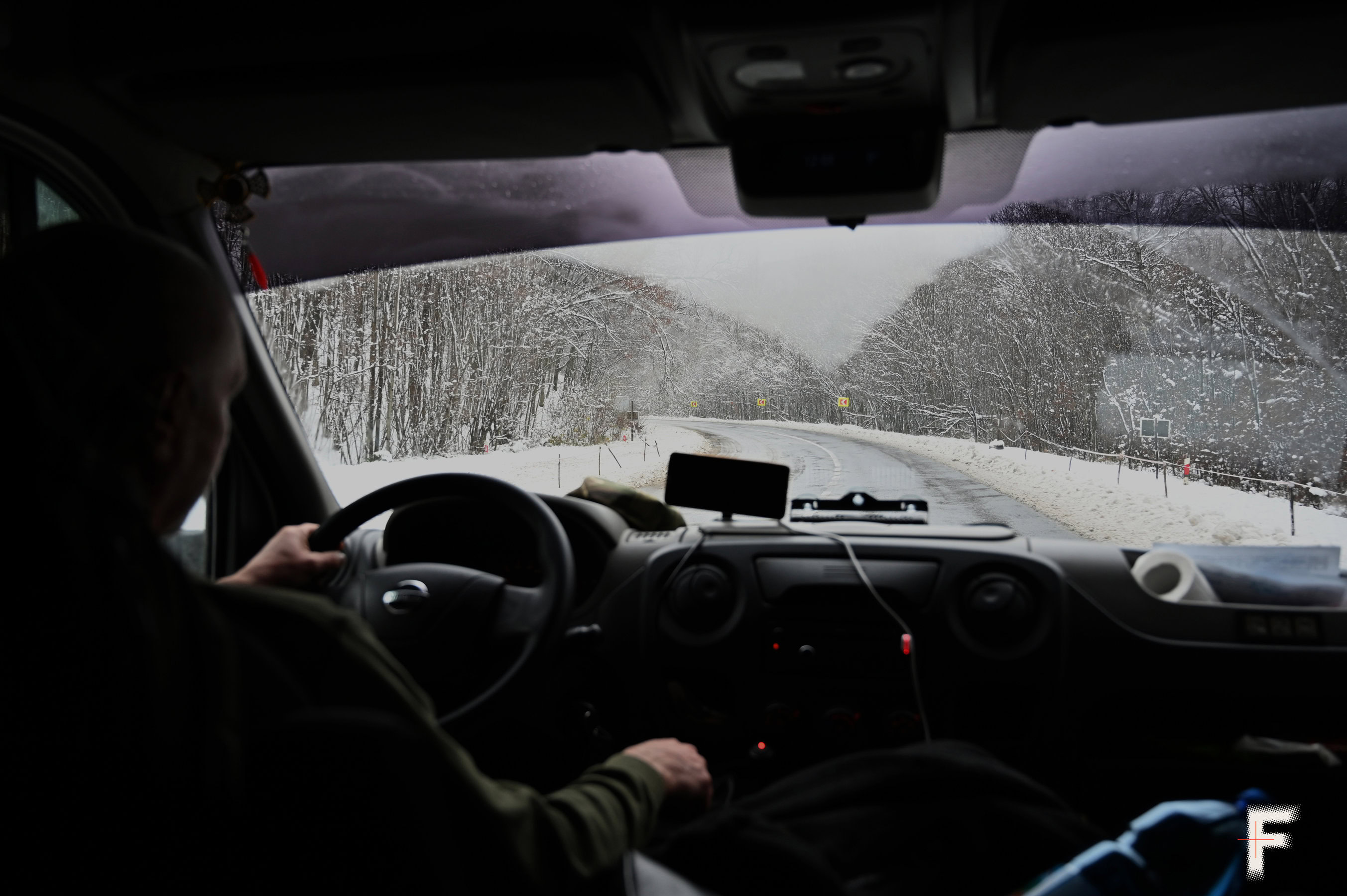
Zhuravlyk sets off for the Carpathians. Along snow-covered roads and through the mountains, it brings grief ever closer to someone’s doorstep.Tetiana works as a teacher of world literature and oversees cultural events at the school in Vyshkovo. Valerii can craft almost anything from wood – from tableware to staircases. They have a 35-year-old son, Dmytro, who serves in the Armed Forces of Ukraine. Since the start of Russia’s full-scale invasion of Ukraine, Valerii has focused more on volunteer work than on woodworking, a craft he once loved so much.
He did not set out to do this work; it began when someone he knew asked him for help to bring the body of a fallen serviceman from Donetsk region to Volovets. At the time, Valerii made the trip in a van not equipped for such transport. What made it possible was that it was winter.
“I went and bought a coffin. That’s how we transported him to Volovets. He was a soldier with the battalion of Carpathian Sich. Ivan Lesiuk,” Valerii says.
Now Valerii and Tetiana are transporting another “heavenly one” – the term they use among themselves for fallen soldiers. The serviceman is from the Kharkiv region. There is little information about him. After the examination, he is being taken home – through small mountain villages, across the snow-covered Carpathians, and through the country he defended.
I can’t do it any other way. I never wanted to be doing this,
Zhuravlyk at work
Valerii and Tetiana pass through yet another picturesque mountain village. On a snow-covered slope, children are sledding, carefree and absorbed in the moment. From the vehicle’s speaker comes the song: “And we will fight again, and we will dance again…” Zhuravlyk speeds on through the mountain passes.
[Translator’s note: The line “And we will fight again, and we will dance again…” comes from the song “Люди‑Титани” (Liudy‑Tytany / Human Titans) by the Ukrainian rock band Kozak System. The song was released in 2024, and became widely known in Ukraine during the Russian invasion, symbolizing resilience and a life‑affirming spirit amid hardship.]
“You see, I can’t leave this work. I can’t do it any other way. I never wanted to be doing this; I was never prepared for it – it unfolded that way,” Valerii says.
He says that his team includes seven other drivers, among them two priests. They take turns making trips to transport the bodies of fallen soldiers.
The volunteer says that government services are functioning fairly well now, but coordination is still lacking. Those who can step in take on parts of the routes themselves, making sure families aren’t left waiting too long for the return of their killed loved ones.
“They don’t always listen to us. Sometimes, the person planning the route seems to have no sense of the map. A vehicle might go from Dnipro to Odesa, then to Kharkiv, then to Kropyvnytskyi, a few more cities, and finally end up in the Carpathians. And for someone from Zakarpattia, it could be a full week before they are finally brought home,” Valerii Popovych explains.
Tetiana accompanies her husband on trips mostly on weekends, when she isn’t teaching at the school. She makes coffee for the journey, offers comfort through conversation, or simply sits quietly beside him. She says she once tried to keep count of the trips and the soldiers brought home, but eventually she stopped – she didn’t have the strength. Both of them say what hurts the most is the indifference of those who have nothing to do with the war, have no family on the front, or consciously choose to shut themselves off from what is happening in the country.
“The most meaningful support comes from the mothers of fallen soldiers. And widows. They give their support consistently – for months, even years. Those who have lost the most give the most,” the woman says.
The first van that Valerii and Tetiana Popovych used when they began their missions to transport the fallen is no longer used for that purpose. It now serves as an exhibition van, filled with artifacts of the war and panels displaying photographs of fallen soldiers. The exhibition travels to towns across Zakarpattia. Tetiana says that most of the donations for transporting bodies come from people who visit it. Visitors respond in different ways: some stop to ask questions and learn more, while others simply walk by.
Sad news meet in Dolyna
After four hours on the road, Zhuravlyk reaches the Ivano-Frankivsk region. The town of Dolyna nestles against the snow-covered Carpathians, wrapped in provincial calm, and today once again becomes a meeting point for members of the “On the Shield” mission.
Valerii Popovych greets a comrade near the local church. They exchange a few words, hand over the necessary papers, and transfer the bodies of the fallen soldiers. The entire process takes only a few minutes. Valerii hands over the body of the soldier he picked up that morning in Uzhhorod – it will now be taken to Kharkiv – and takes another soldier, a man from Zakarpattia. A few practiced movements, and it’s done. The black bag veils reality, shielding from the world a body that only a few days ago was full of life.
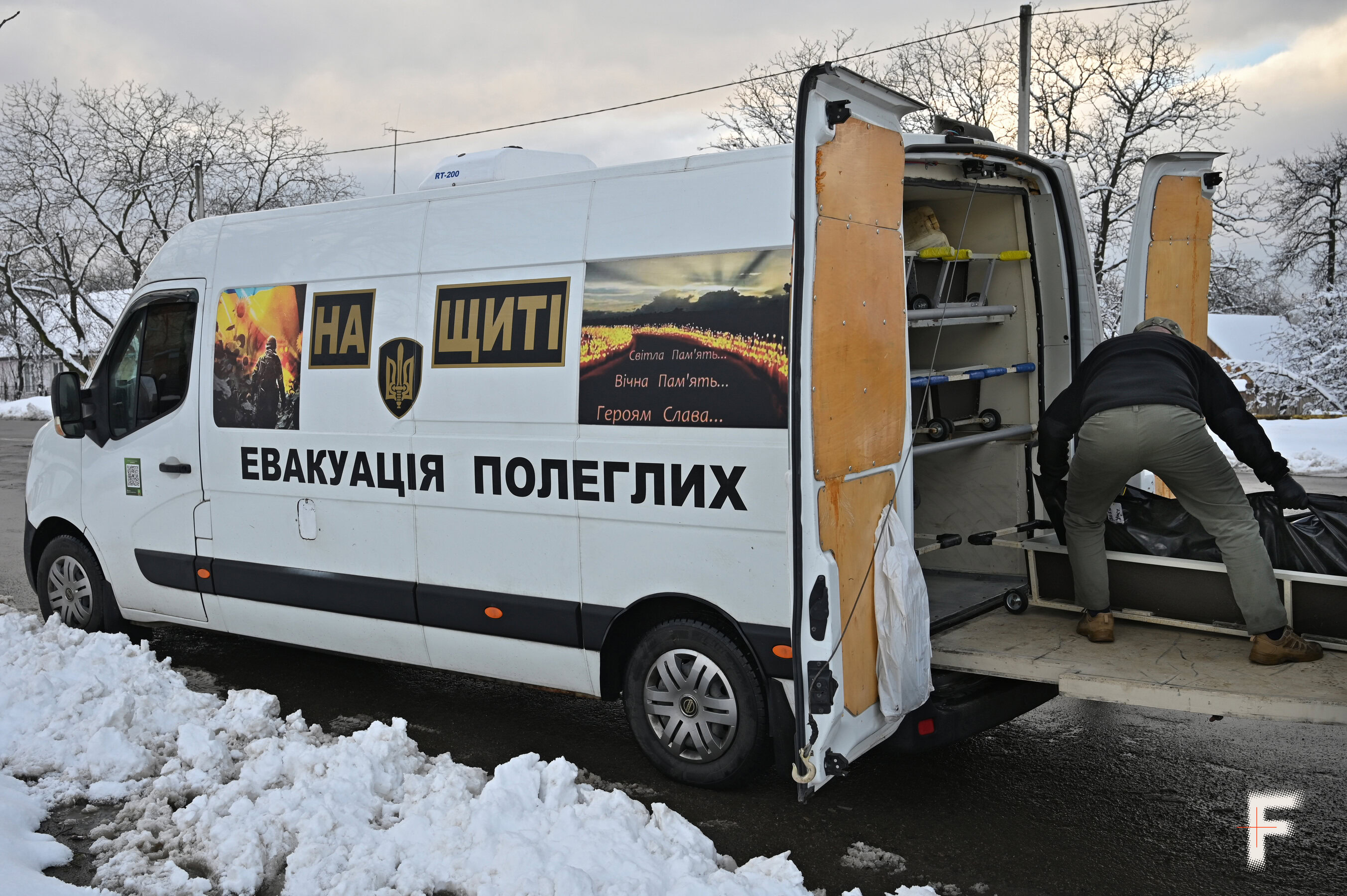
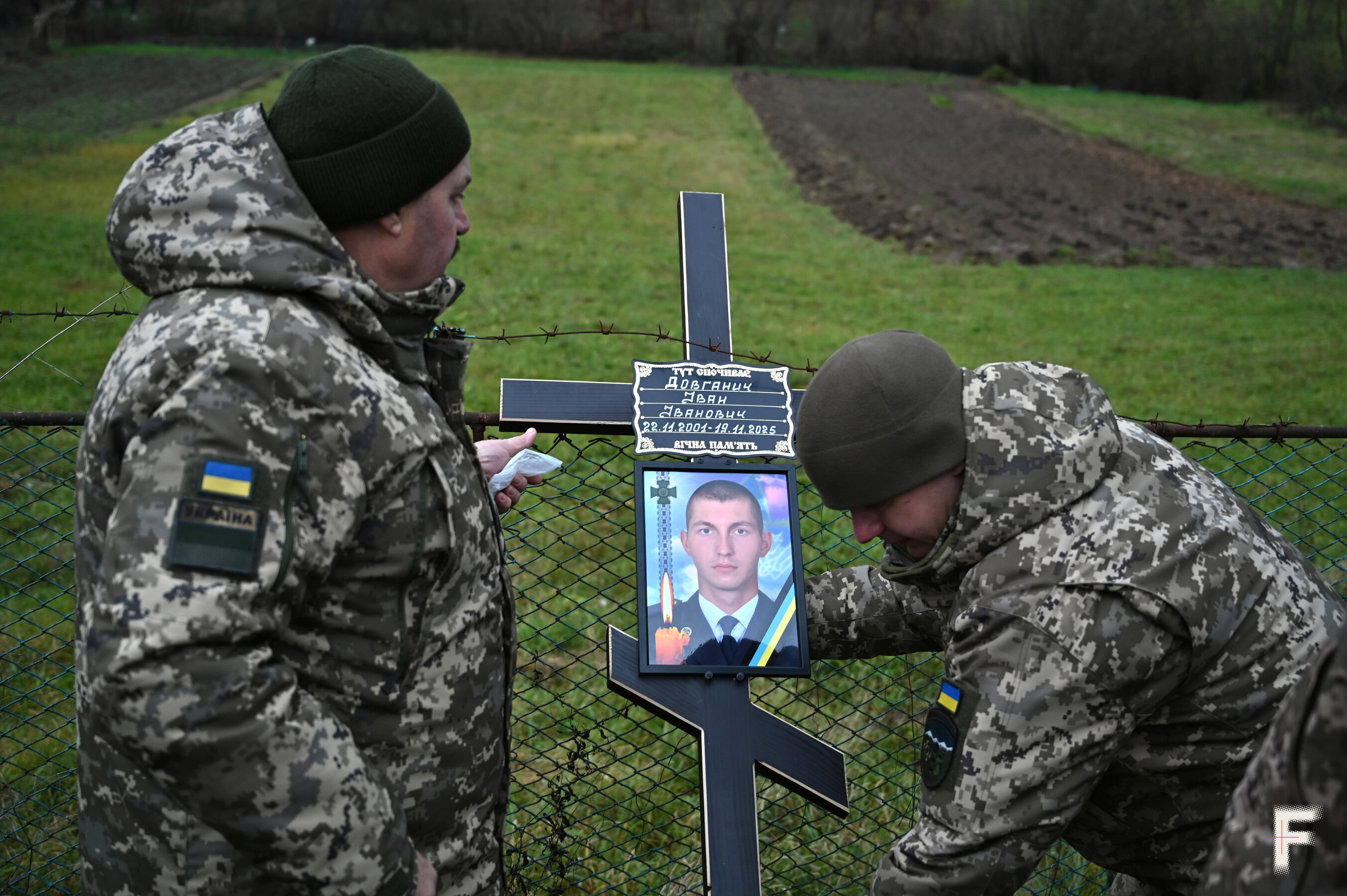
Ivan Dovhanych, 23, a border guard, was killed on November 19, 2025, while carrying out a combat mission near the village of Cherniakiv, close to Vovchansk. Other details will be revealed later. For now, what is clear is that a young man, who fell in the war only three days short of his 24th birthday, is being transported from Dolyna in Ivano-Frankivsk to Zakarpattia in a refrigerated truck.
Valerii drives Zhuravlyk steadily through the mountain passes – the same road again, the same grief again, the same cursed war. Snowflakes hit the van’s windshield, and darkness falls – both outside and in the heart.
Tetiana speaks of the young men – just like Ivan, whose body is now being brought home. She says she cannot hold in her heart the thought that while someone was giving their life for the country, for its people, many simply don’t care.
“Twenty-five, twenty-two, twenty-nine, twenty-four… they’re out having fun. And past them passes a young man just like them – the one who gave everything so they could enjoy themselves without a care. Maybe they don’t know that we carried him past them, but they should understand it, should feel it in their lives. They want to avoid it. They don’t value it – a life that isn’t theirs. They just live and forget.” Tetiana says it hurts deeply.
Silence fills Zhuravlyk. Ahead stretches only dark asphalt and the white lane markings, racing past, blending with snowflakes and the shadows of the Carpathian firs. Valerii looks tired. His strong, calloused hands grip the wheel tightly, his jaw seems slightly clenched. Tetiana asks him gently, “Do you want some water?”
The road to empathy
Zhuravlyk speeds through the darkness. Tetiana and Valerii share stories from their lives and their volunteer work. They say the work demands enormous fortitude, energy, and emotional resilience. Bearing this process is psychologically difficult. But they admit that the most exhausting part is the indifference that still surrounds them – or, perhaps, the fear of facing reality. At that moment, Valerii signals with his lights and siren, asking drivers to give way, but there is no reaction.
“We’re not in a hurry – he won’t be late anywhere now – but this disrespect is infuriating. They’re supposed to let us through,” Valerii says.
Zhuravlyk is already past Khust. If the Popovychs were heading home, they would have turned off the main road toward their village of Vyshkove sipping tea in their cozy kitchen. The sad music playing in the background is interrupted by a loud video call. Their son, a soldier, is on the line:
“Hi! Are you on the road again?”
“Yes, son. We’re transporting a heavenly one. We’ll call you from home, okay?”
The Popovychs continue on their journey.
“Good evening! I’m bringing the young man. I’ll be there in about an hour and a half,” Valerii calls Uzhhorod to update the morgue staff on his arrival time.
There’s very little left now. It’s sad how little is known about the young man – he fell just three days short of his birthday. His mother is waiting for him. Zhuravlyk carries the soldier, and in the van, the music plays:
“Mom, Mom!” – he shouted with the cry of a crane…
“Mom, Mom! And soared as an angel into the heavens!
Do you hear, Dad? I defended my country,
And you, live on, live here, as you once did…”
Ivan Dovhanych’s journey across the country, through his native Carpathians, is drawing to an end. Valerii prepares to unload the soldier’s body. He tenses, gathers himself for a few seconds in the van, then steps out – and gets to work. He says:
I never would have dreamed, even in a terrible nightmare,
that this would be my ‘pastime’ at 60.
The ‘heavenly one’ on Voznesenska Street
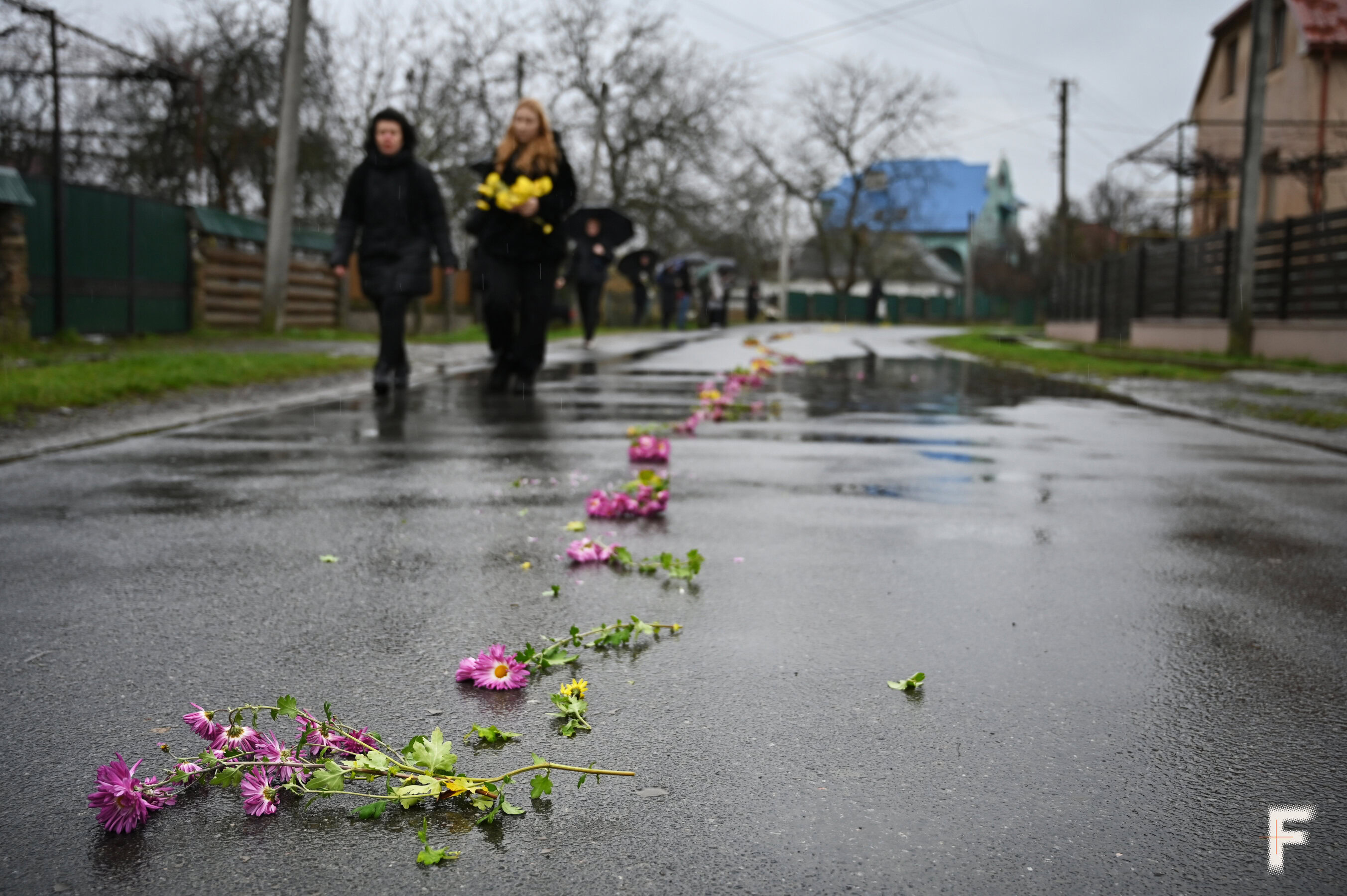
Velyki Lazy. A village near Uzhhorod. The final days of autumn 2025. Cold rain falls on the gray road. Bright autumn flowers are scattered along the road – both to greet and to bid farewell to Ivan Dovhanych, a warrior who was killed just three days short of his 24th birthday. Relatives, friends, classmates, neighbors, and fellow villagers gathered near the soldier’s home. In the yard, flowers and banners are laid out. A tall grapevine is covered with a tarp – the relentless rain just keeps pouring. One of the men has to use a stick to drain the water that has collected on the tarp, which at any moment could spill over everyone gathered. It is the only motion in the yard. Everyone else stands still, their breaths measured, careful not to shatter the weight of this aching silence.
-
Teenagers kneel along the road to honor the funeral cortege of fallen soldier Ivan Dovhanych, Velyki Lazy, November 26, 2025. Anna Semeniuk / Frontliner

-
The funeral of 23-year-old soldier Ivan Dovhanych in Velyki Lazy, Uzhhorod region. November 26, 2025. Anna Semeniuk / Frontliner
-
Friends and neighbours of fallen soldier Ivan Dovhanych lay flowers along the road before greeting the funeral cortege, Velyki Lazy, November 26, 2025. Anna Semeniuk / Frontliner
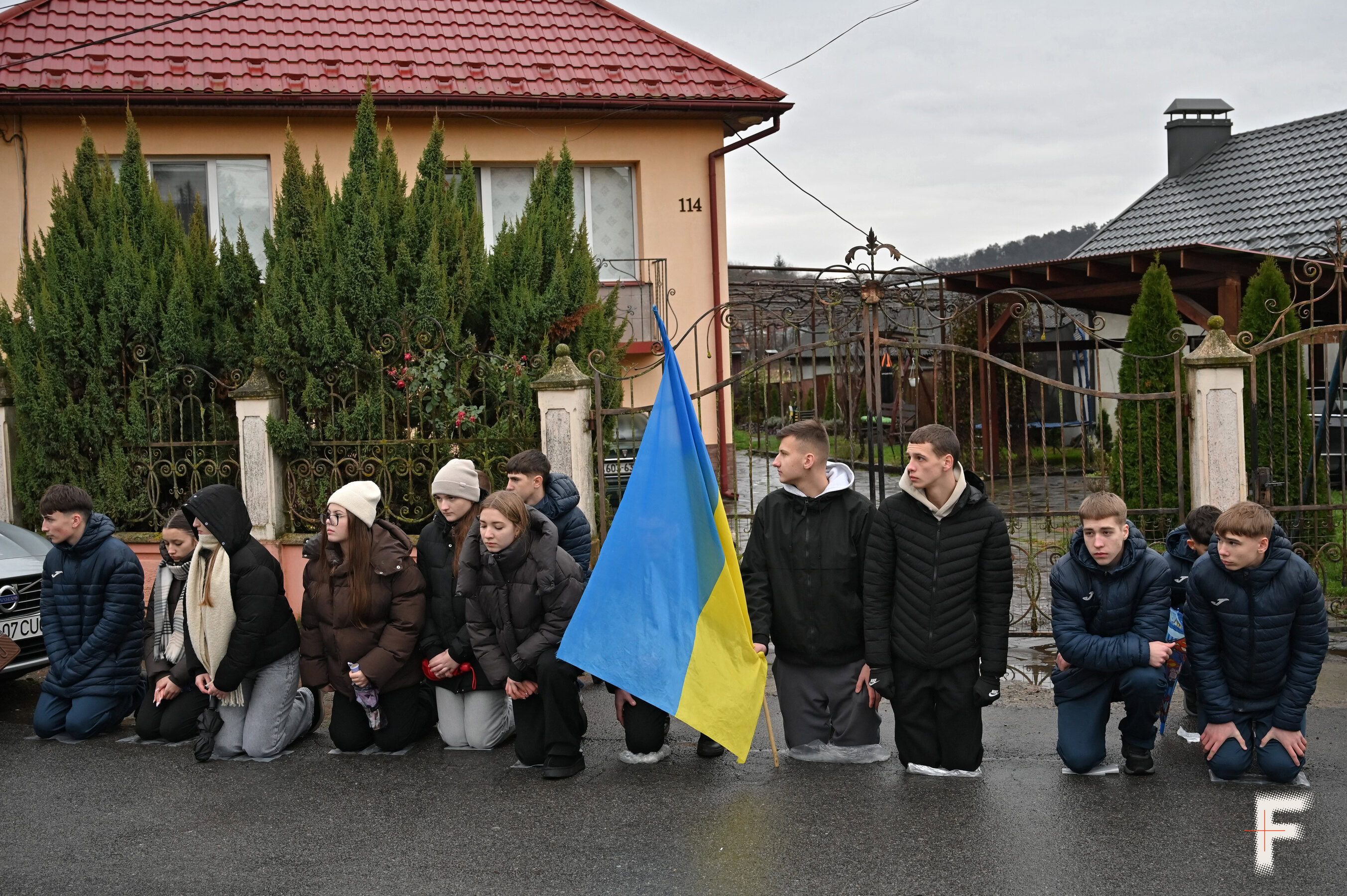
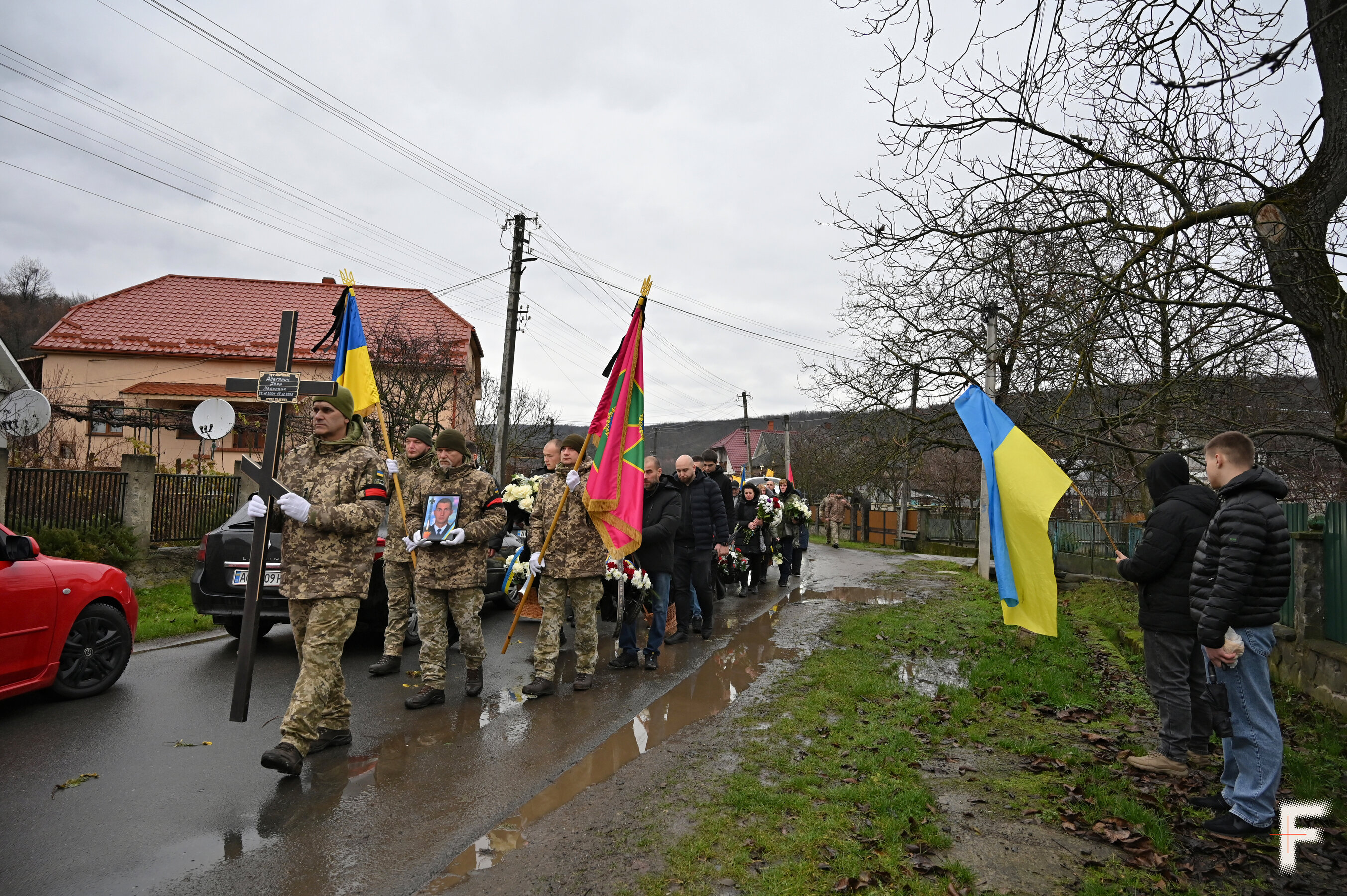
From afar, the strains of Myroslav Skoryk’s Melody can be heard: grief has already reached the village of Velyki Lazy, drawing close to the house on Voznesenska Street. Soon it will fill this space for years, stretching the pain of loss across a lifetime. Villagers fall to their knees; some lay mats and plastic bags on the ground to stay dry, while teenagers hold flags, hiding their tears behind flowers and under umbrellas. The funeral cortege arrives at the house, and the coffin is carried into the yard to the sound of a military band. The priests begin the rites. Ivan Dovhanych’s home village sees him for the last time.
[Translator’s note: Myroslav Skoryk (1938–2020) was a renowned Ukrainian composer. Melody in A Minor has become iconic in Ukraine, often performed at memorials and funerals.]
“Bidding farewell to his mother, bidding farewell to his sister, bidding farewell to his brother…” – over the young still body in the coffin, his family bows in boundless grief. Nearby, baskets of flowers bear messages: “To dear Vania, from classmate Khrystia.” In just a moment, this young man – a son, brother, beloved, friend, comrade, neighbor from the street across – will be buried in the ground he gave his life to defend.
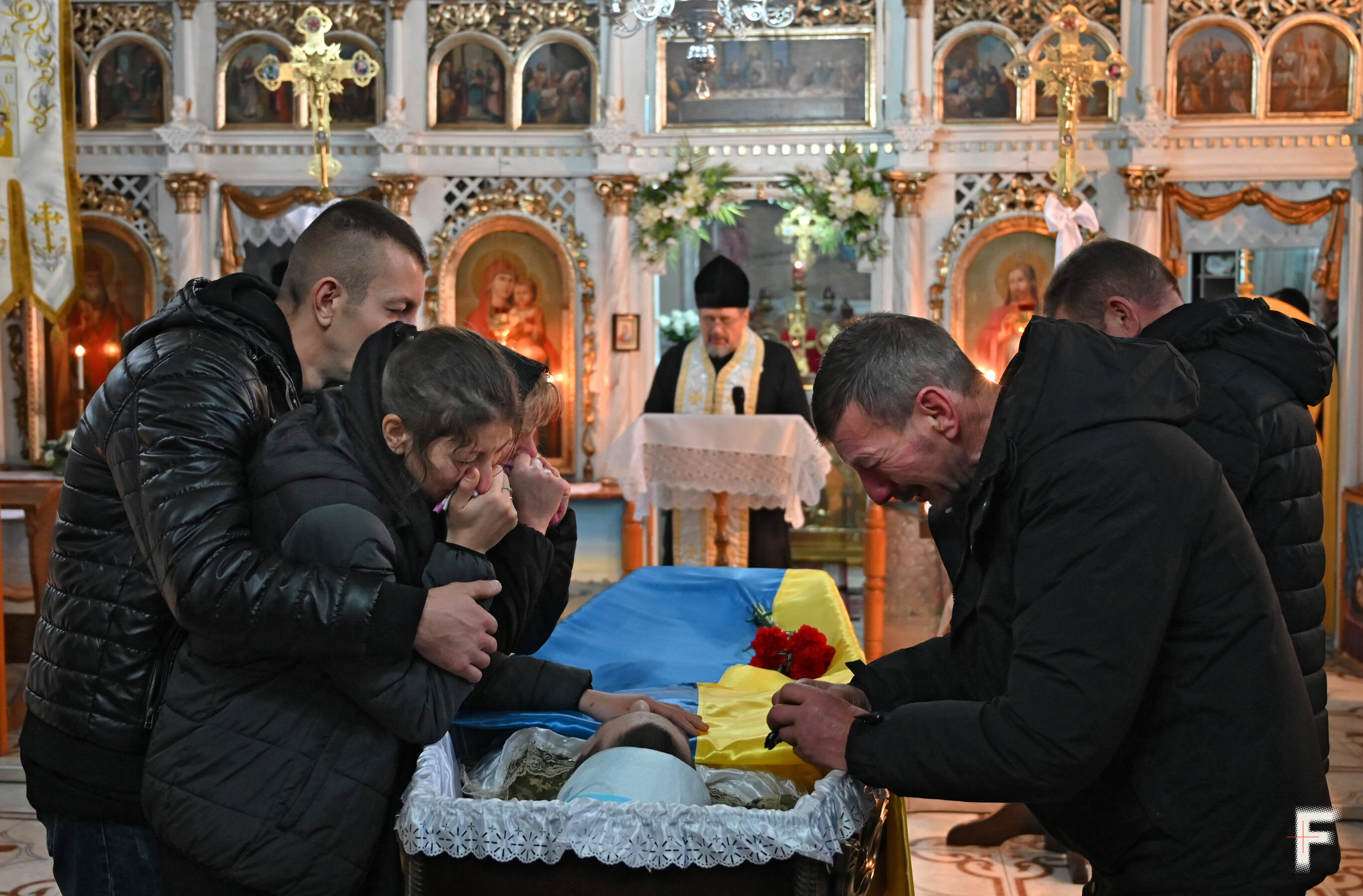
The road in Velyki Lazy remains strewn with flowers. Now, however, they lie mixed with puddles, crushed and forlorn. A gray chill seeps to the bone. I remember the road Ivan took for the last time home – across the country, through his native mountains, with Zhuravlyk and those who tenderly called him “the heavenly one.” I want to believe that the relentless rain falls not because Ivan was unlucky, but because nature itself mourns him. I want to believe that the warrior has risen to the heavens. If such a place exists.
Author: Anna Semeniuk
Adapted: Irena Zaburanna
Read more — Suspended youth: the story of a young man who witnessed hell in Krynky and survived
