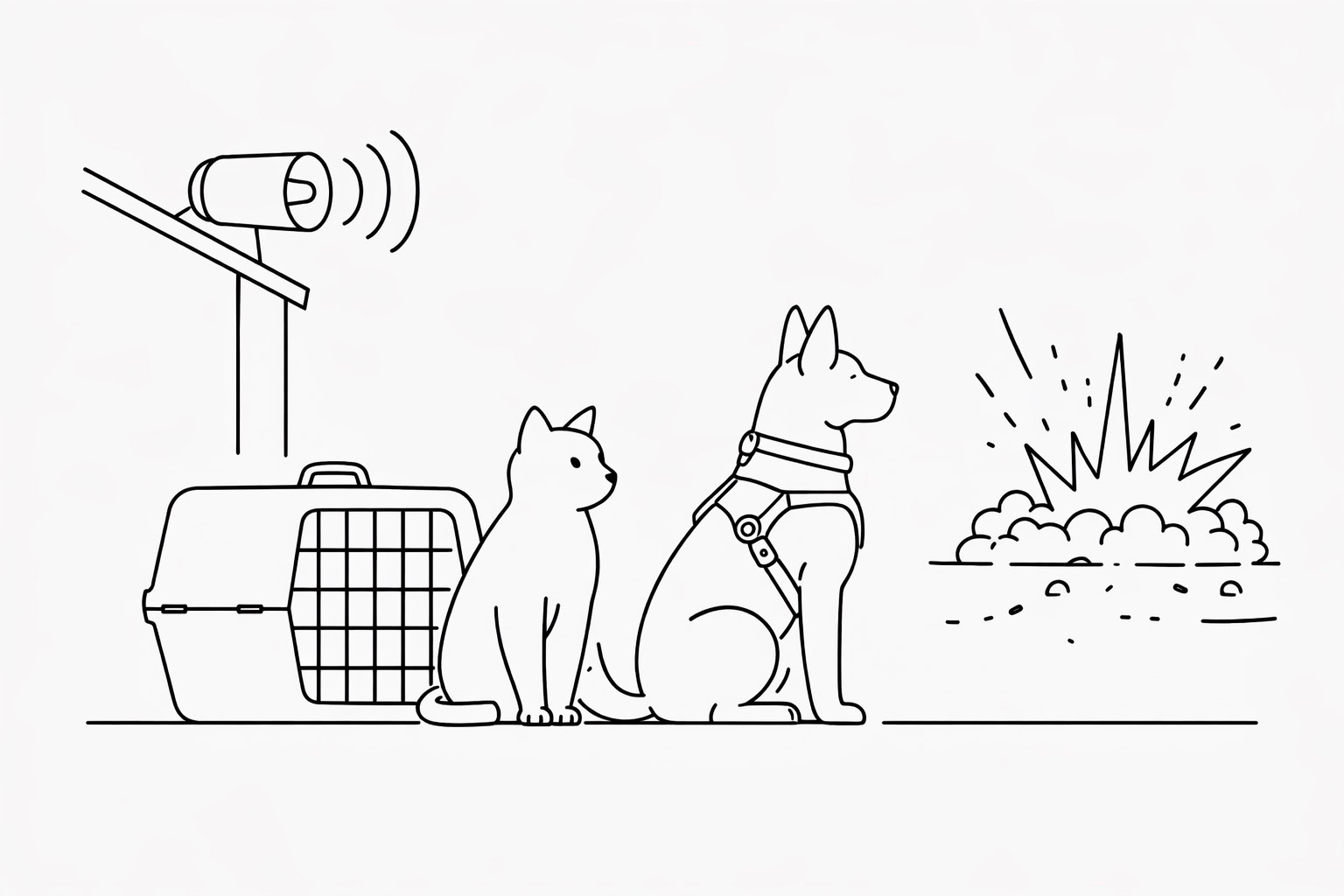
Tails in wartime: how to protect your pet under shelling
After explosions, danger for people often subsides faster than for animals. Pets struggle to orient themselves in chaos, react sharply to loud sounds and may break free from a leash or bolt through a door. In frontline areas, these risks are compounded by land mines, limited veterinary care and disrupted evacuation routes. Problems most often arise in the first minutes after an air raid siren, when owners become anxious and rush. Frontliner spoke with experts about how to prepare and what to do in practice.
Preparation should start with basics: pets must remain under control whenever the risk of shelling increases. Do not leave them alone. Ensure you have reliable restraint equipment and a minimal set of supplies in case evacuation becomes necessary.
The second principle is simplicity. During an air raid, there is no time to coax a cat into a carrier or search for a harness. Everything needed for a quick descent to shelter or departure should be stored in one place and ready for use.
During shelling: control and a safe point
The shelter logic for people applies to animals as well: go to the nearest accessible shelter or move to a windowless room and follow the “two-wall rule,” meaning two solid barriers between you and the outside.
Pets need an anchor: a carrier for a cat or small dog, or a short leash and harness for a larger dog. Under stress, an animal can slip even from a collar. Do not hold a pet in your arms near stairwells or entrances without secure restraint. One sharp sound can lead to loss of control.
An emergency kit for your pet
In frontline cities, evacuation often means spending several hours or days with friends, relatives, in a basement or on the road rather than leaving permanently. The kit should therefore be compact: water, one to two days’ worth of food, a bowl, waste bags, litter and basic medication, bedding, plus documents and the owner’s contact information attached to the collar or carrier.
An ID tag with a phone number is better. A microchip is even more reliable, significantly increasing the chances of recovering a lost animal. In wartime conditions, this is a realistic scenario: explosions and crowds create classic circumstances for pets to run away.
Frontline areas: walks and veterinary risks
In frontline communities, even a routine walk carries risk. After shelling, do not let pets run off leash. Avoid craters, debris and areas you cannot fully assess. If a neighborhood may be contaminated with explosive remnants, stick to one verified route.
At the same time, ordinary veterinary threats persist and may intensify during war, including rabies. Prevention means regular vaccination. In frontline regions, this is particularly important, as contact with stray animals and accidental bites becomes more frequent.
Risk-reducing tips
- Keep the harness, leash and carrier visible and accessible; train your pet to enter the carrier during calm periods.
- During an alert, secure the animal: cat in a carrier, dog in a harness with a short leash in hand.
- Choose a windowless safe spot; do not leave pets alone in rooms where glass fragments are possible.
- Prepare an emergency kit: water, food, bowl, waste bags, litter, basic medications and veterinary passport; attach the owner’s phone number to the collar or carrier.
- Ensure identification: an ID tag with a number, an up-to-date photo and, if possible, a microchip.
- In frontline areas, do not allow pets to roam after shelling and keep them away from impact sites and debris.
- Keep vaccinations current, including against rabies; have contact information for the nearest veterinary clinic readily available.
- If evacuation of animals from dangerous areas is needed, verify current assistance channels, including applications through UAnimals.
When a plan is ready, risks are lower
Protecting a pet during war requires a predictable sequence of actions: control, secure restraint, a simple route to a safe place and a minimal set of supplies. It does not guarantee complete safety, but it reduces the most common causes of escape, injury and panic.
In frontline communities, if a pet is part of the family, it needs its own emergency plan, just like people do. The best time to prepare is before the next siren, not after.
Adapted: Kateryna Saienko
***
Frontliner wishes to acknowledge the financial assistance of the European Union though its Frontline and Investigative Reporting project (FAIR Media Ukraine), implemented by Internews International in partnership with the Media Development Foundation (MDF). Frontliner retains full editorial independence and the information provided here does not necessarily reflect the views of the European Union, Internews International or MDF.