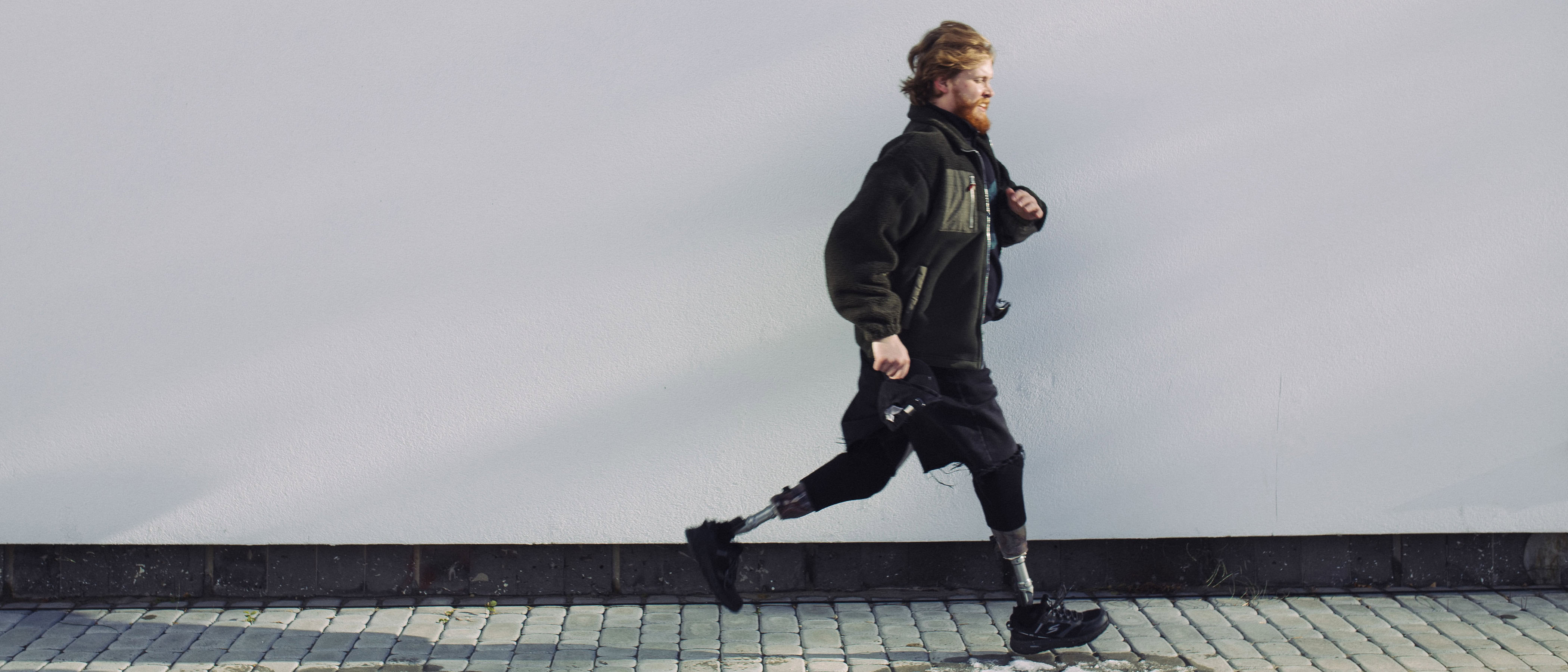
Breaking through the wall: how far can you run on prosthetic legs?
After losing both legs, Serhii Telehera decided to train for a 42-kilometer marathon. It’s his way of challenging fate and proving that life didn’t end in a hospital bed. He may never complete the full distance, but every training session brings him closer to his goal. A Frontliner reporter learned how the marathon became a lifeline for the veteran.
Just minutes after being thrown through the windshield, Serhii Telehera pulls himself up onto his elbows. Everything around him looks gray, as if he’s seeing the world through a veil of ash. His vision spirals inward, and he feels nauseous. Regaining his bearings, he crawls a few meters, opens the car door, reaches for his Kalashnikov, and fires a full magazine into the air to warn the enemy that he will fight back. Fortunately, his brothers in arms reach him before the Russian drones do.
On June 20, 2023, Telehera could have kept his legs. That day, his partner was meant to be on duty, but asked Serhii to take his place and drive a drone operator to a position near Kupiansk. Serhii’s legs might have been spared if he had been driving a left-hand-drive vehicle instead of a right-hand-drive Mitsubishi Delica; or if he had turned left rather than right when mines began falling in front of the vehicle and one of them detonated beneath the wheel.
After being evacuated to Kupiansk, both of his legs were amputated. Over the following year, the veteran underwent 17 more surgeries. Lying in a hospital ward in Vynnyky, Serhii realized that unless he found a new sense of purpose and a new goal, he – like many veterans – risked isolation, withdrawal, and depression. Training for a marathon became that goal.
From the restaurant to the bunker
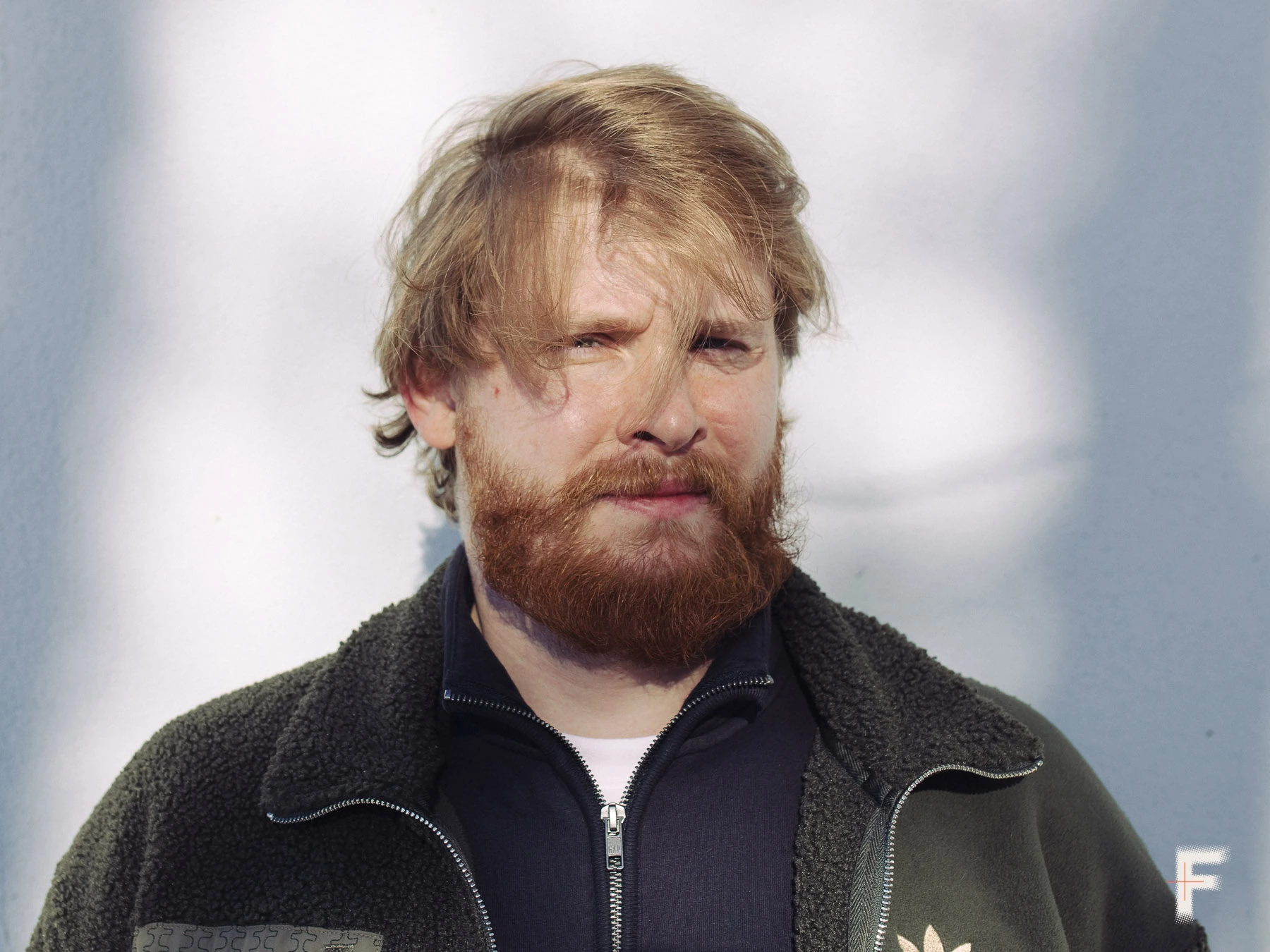
Serhii Telehera is 29 years old. With a red beard and a Beatles-style haircut, he gives the impression of someone who could power up a battery just by being near it. The first thing you notice is how he moves – it’s almost as if he isn’t aware that he no longer has his legs. He swiftly and energetically adjusts his prosthetics, even though the sockets, after recent surgeries, press painfully on his residual limbs. It’s not just an attempt to maintain composure in public, it’s a principle: movement is more important than pain.
Telehera doesn’t see himself as a high achiever; he’s more of a steady, slightly mischievous but ordinary guy who has always managed to succeed. Before the full-scale invasion, he worked at Lucky, a restaurant in Kyiv considered one of the best in the city. Telehera’s role as a junior sommelier was, in some ways, reminiscent of military drill: four times a month he would be tested by a supervisor on his knowledge of wines, memorize service rules, and even bring work home, reading books about luxury beverages.
Working as a sommelier is one of the most demanding jobs in the restaurant business, especially for those aiming for the world’s top establishments. More people have been to space than have been awarded the Master Sommelier diploma – fewer than 300 in total. Stanislav Borysov, Telehera’s supervisor, says the profession has an extremely high bar for entry: the work doesn’t stop at the restaurant; it continues at home with reading specialized literature. Without motivation, you won’t last long – just as in a marathon.
In the spring of 2022, Telehera swapped the restaurant for a bunker. He quickly showed his comrades that he wasn’t just a city slicker with a high-paying job. He first guarded rear command posts in the Mykolaiv region and later served as an artilleryman during the Kharkiv counteroffensive. Before his injury, he interviewed with the Third Assault Brigade and planned to join the infantry, feeling that artillery duels no longer gave him the same rush of adrenaline.
Telehera says he tried to apply the skills he had developed in the army and in the restaurant to his marathon training: attention to detail, focus, endurance, and curiosity. He set a deadline for himself: one year to recover from surgeries, find a coach, prepare, and finally run a marathon – 42 kilometers across rugged terrain.
A step into the unknown
Training for a marathon has little in common with sprinting. A long-distance runner doesn’t always stick to roads or tracks; they climb mountain ridges, navigate forests, and wade through waist-deep rivers. Lightning can strike, and bears can attack. Every marathoner is a runner, but not every runner is a marathoner.
The conditions of some races verge on extreme: a peak along one section of the Mount Marathon Race in Alaska is nicknamed the ‘Widowmaker’ because so many runners slip from its cliffs. Long distances also play tricks on the mind: marathoners say they sometimes mistake other runners’ headlamps for the headlights of an oncoming train.
-
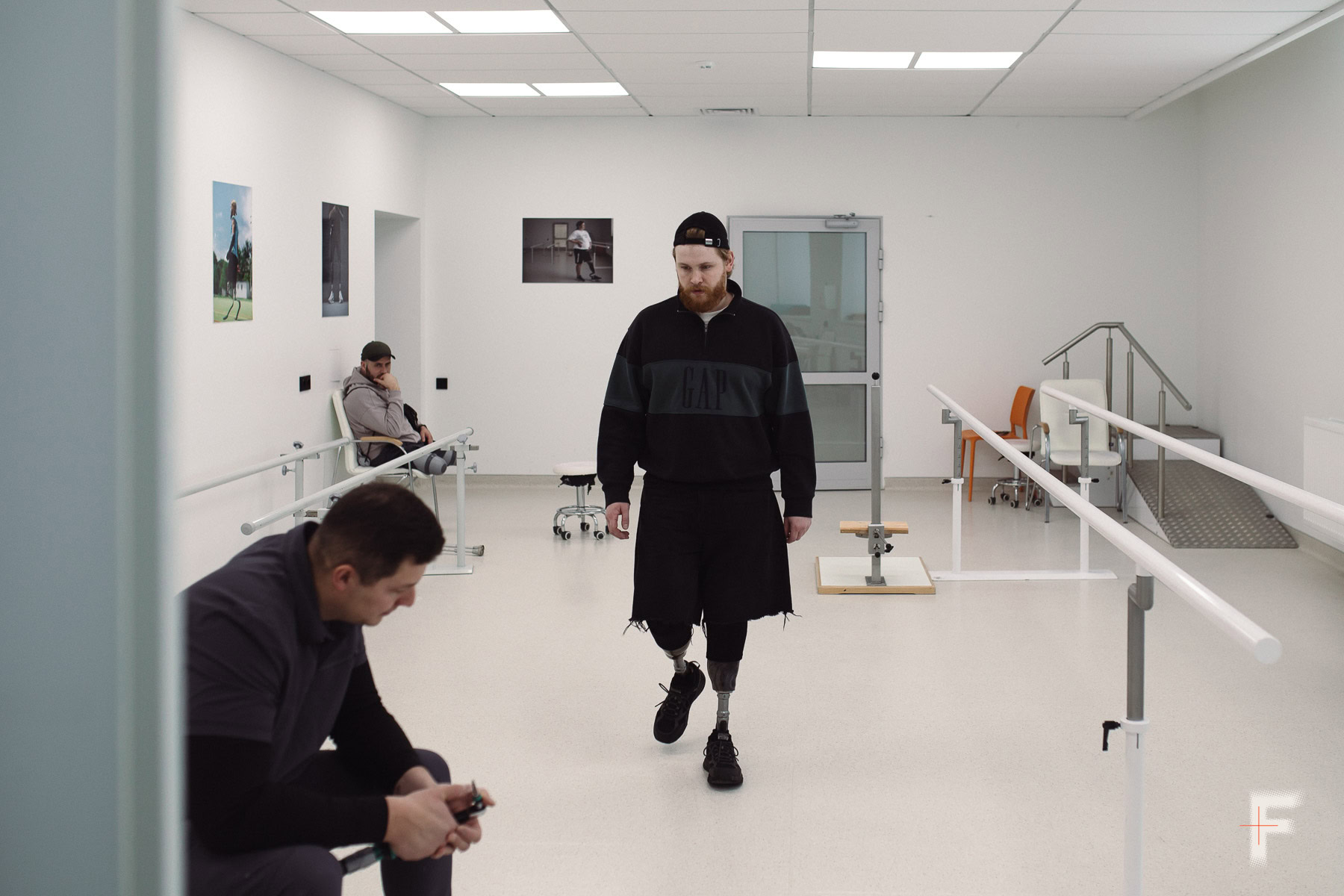
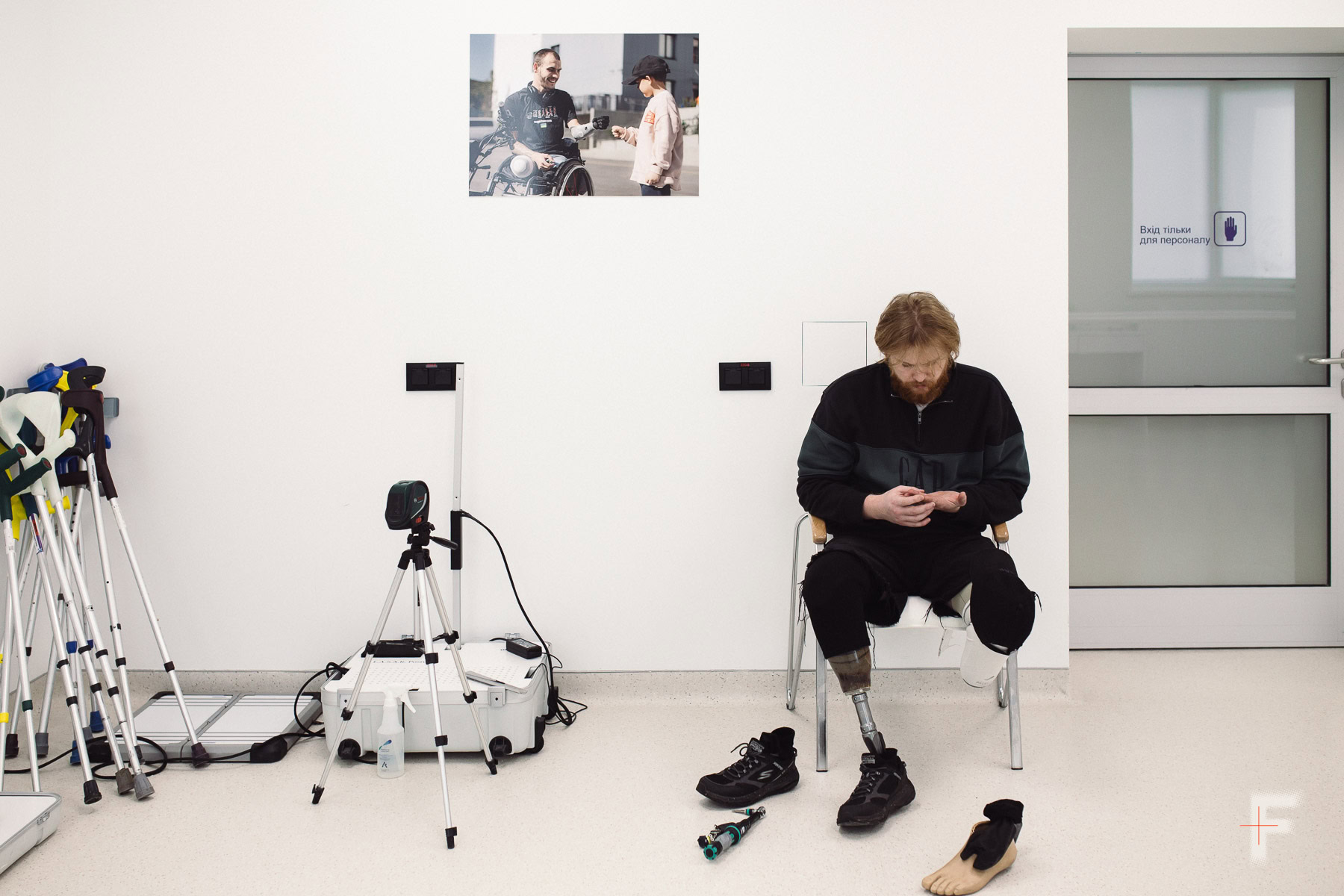
Orthopedic prosthetist Dmytro Kononchuk adjusts the prostheses of Serhii Telehera, Vynnyky, Ukraine, November 24, 2025. Anna Zubenko / Frontliner

-
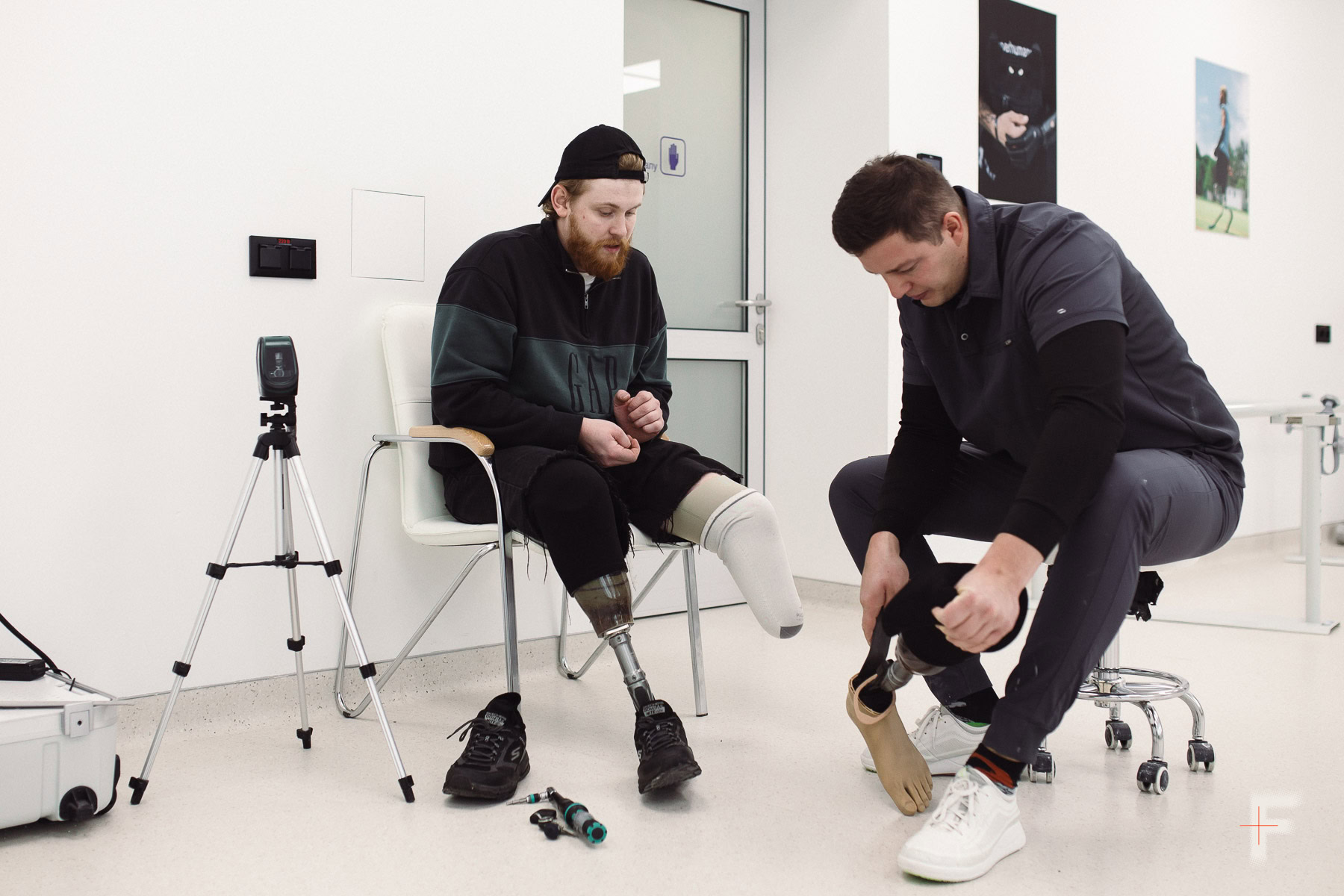
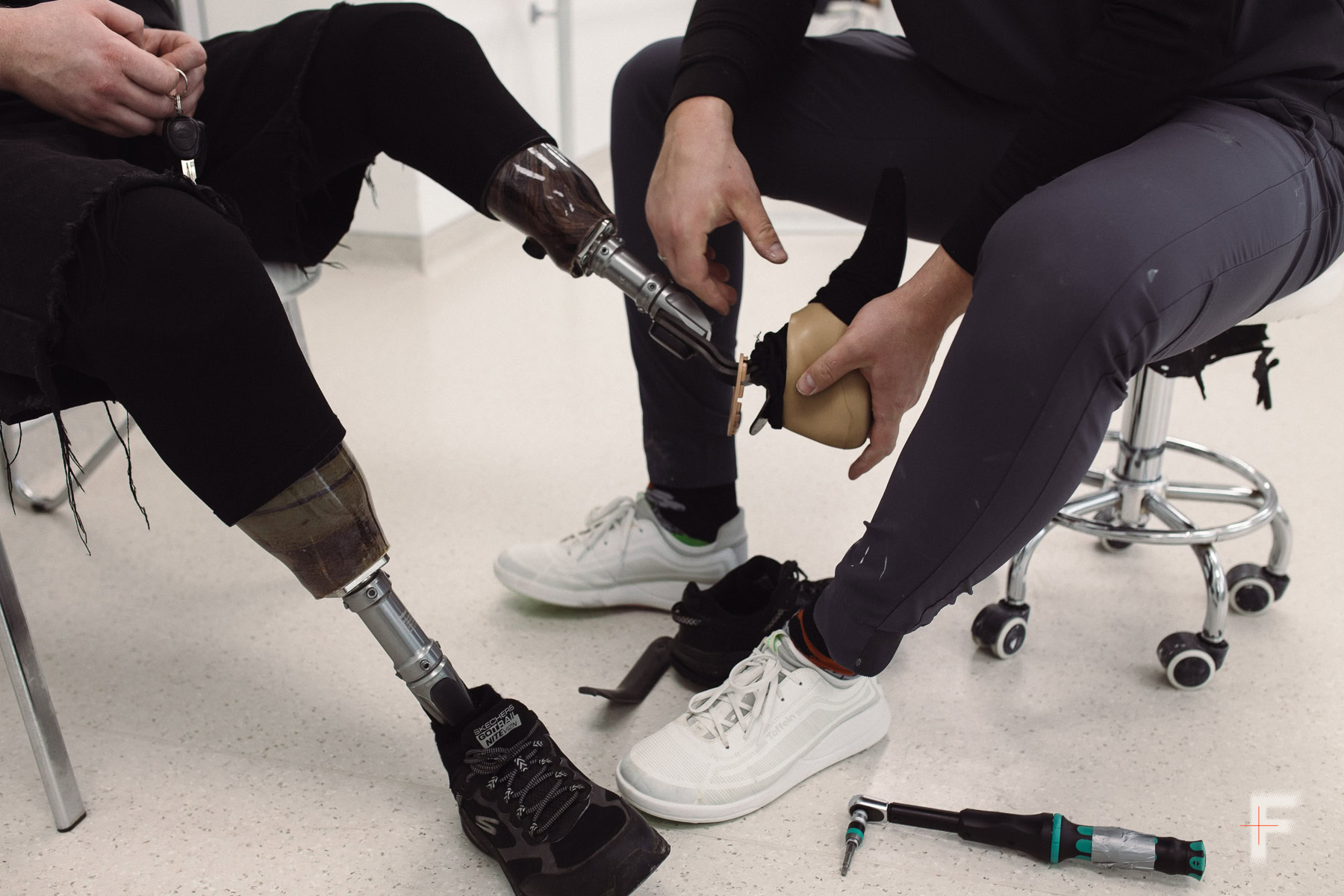
In November 2023, five months after his amputation surgery, Telehera took his first step toward preparing for a marathon. Seated in a rehabilitation room at Superhumans, he watches as his doctor, Dmytro Kononchuk, removes from a box something that vaguely resembles a pirate’s hook or a sickleC – shaped running blades, prostheses designed for athletic use. Wearing his walking prostheses and braced by crutches under his arms, Telehera puts on the new blades and begins to run.
[Translator’s note: Superhumans is a Ukrainian nonprofit medical center providing advanced prosthetics, rehabilitation, and long-term care to civilians and soldiers injured in the war.]
Superhumans treat around 800 patients each year, and a large proportion of them pass through Kononchuk’s office. He says that not a single patient has ever managed to run even a few meters on the blades during their first attempt. It is far harder than it looks: stepping onto thin running prostheses for the first time feels like running on tiptoe across a floating inflatable mattress.
Telehera’s story reads like a sports drama, with a hero who overcomes one challenge after another despite the pain. It seems he has all the needed traits. He is naturally restless and, for someone without legs, possesses an extraordinary sense of balance:
“Patients are often afraid to take their first step on prostheses, but Serhii was not,” recalls rehabilitation specialist Kononchuk.
Wherever Serhii is, whatever conditions he finds himself in,
he always spreads and thrives,
He also has a strong will and a love of challenges:
“He insisted I shouldn’t meet him, saying he’d make his way up to the 11th floor on his own if the power went out and the elevators stopped,” says coach Natalia Shevchenko.
He also possesses an ability to adapt quickly to his surroundings:
“I would compare him to ivy: wherever Serhii is, whatever conditions he finds himself in, he always spreads and thrives,” says his former mentor Stanislav Borysov.
Stories about athletes with amputations are often not just about overcoming personal challenges and injuries, but also about breaking records.
Telehera lost 16% of his body, yet he has an advantage. Without legs, the springiness of his prostheses literally propels him forward, allowing athletes with amputations to surpass fully able-bodied competitors.
To break through a wall
It wasn’t so simple. After rehabilitation, Telehera did conquer the summit of a mountain, even if it’s a mountain in name only. Six months after his amputation, he climbed Lviv’s Lion Mountain. The ascent covered only 389 meters, but it took him an hour to reach the top.
Three times a week, Telehera trains with his coach. In the imagination, it looks like a marathon-ready workout: kilometers through forests and trails, steep climbs, and river crossings.The reality is different. He warms up on a treadmill for about 10 minutes, then does no more than 15 squats while holding onto a rope, grabs suspended straps, and lifts his knees toward his chest. The training session lasts an hour, and by the end, large beads of sweat cover Telehera’s face, as if he had truly run a marathon.
“It’s not always about success,” says Telehera. “Often, it’s about falling and setbacks.“
The deadline set by Telehera has passed, but he did not run the marathon. He couldn’t even cover one-eighth of the distance. Preparing for long-distance running became, perhaps, the first challenge in his life that proved truly difficult.
There are months after surgery when I can’t train, and those are the ones that hit motivation the hardest. It’s difficult to stay upbeat, especially when you find yourself on the operating table 18 times in a single year,
Telehera’s current record stands at five kilometers. He cannot say with certainty that in a week it will be six, or then seven. Nor can he predict exactly when he will lace up his running shoes and, at the sound of the starting pistol, begin his first marathon. He had hoped to run it in 2024, but feels he has recovered only about 30%.
“He has a strong will,” says coach Natalia Shevchenko. “But his body can’t keep up with it.“
Telehera had assumed that with each training session he would add another 300–500 meters to his personal record. And then even more. But, at least for now, his body simply isn’t capable of that. His approach, then, is to change his way of thinking: it doesn’t matter whether he adds a few hundred meters to his run – what matters is that he ran at all.
But it seems his purpose runs deeper. Running a full marathon of 42 kilometers is impossible without setting smaller goals: cover five kilometers, then another five, run 40 kilometers in the city streets, 40 kilometers over rugged terrain. Telehera understood that to keep himself from falling into a dark place, he has to occupy himself so completely that there’s no time left for dwelling.

Sports halls of fame have long celebrated record-breakers – athletes who ran the hundred meters or long-distance races faster than anyone else.
Yet, the determination to keep trying, again and again, despite setbacks, is itself a record. English swimmer Jabez Wolfe attempted to cross the English Channel 22 times, once stopping just 400 meters from the finish. Australian runner John Landy tried six times to break the mile record and run it faster than 4:02.
Two seconds may not sound much, but to me it’s like
trying to break through a brick wall,
Breaking through a brick wall is what Serhii Telehera does every day. He may never fully get through it. Some days, he might even turn and walk away. No one knows if Telehera will ever run a full marathon. But he keeps trying – and that is what saves his life.

Text:Danyl Lekhovitser
Photos: Anna Zubenko
Adapted: Irena Zaburanna