Kropyvnytskyi: the city holding the home front
Kropyvnytskyi is a city that is not known for its tourist attractions or large-scale events. Low-rise buildings, shop signs familiar since childhood, and unhurried passersby define the city. Today, explosions and the sound of air defense systems are rarely heard in Kropyvnytskyi – the war lives on in conversations and headlines. Since the start of the full-scale invasion, its residents have fully lived up to the city’s new status – a city of volunteers. Frontliner reporter Ruslana Sushko tells the story of Kropyvnytskyi as a place where volunteer headquarters, fundraising drives, and constant aid efforts have become part of daily life.
Kropyvnytskyi has never been a top destination for tour operators. To me, the city has always had a relaxed pace, with an excess of city buses for its 115 square kilometers, and a community where people know each other by name. I can’t recall a day when I didn’t run into someone I knew while walking the streets. Tourists do appear here too, but mostly in one spot: Teatralna Street.
Teatralna Street is lined with historic buildings, alongside restaurants, cafés, and bars where young people often gather. It’s no wonder that as early as 2011, after winning the TV show “Maidans”, Kropyvnytskyi earned the nickname “the dance capital of Ukraine.” The street would often echo with loud music, and every hundred meters or so, you could see groups of amateur dancers showing off their moves.
[Translator’s note: Maidans was a Ukrainian dance competition TV show featuring teams from various cities performing choreographed routines.]
The street was always busy. I worked with street photographers, taking pictures of visitors and offering to print them for a small souvenir newspaper. The pay wasn’t much, but the job gave me a chance to get to know the city and its people better. They had their own character – unhurried, calm, and a little dreamy. Most of them spoke in the Surzhyk I knew so well.
[Translator’s note: Surzhyk is a mixed Ukrainian-Russian sociolect.]
Kropyvnytskyi gave me a love of tulips. Like many children in the city, I was often taken to the Dendropark. The rides and attractions held little interest for me – I was far more fascinated by the vast swaths of yellow, pink, purple, and orange flowers covering most of the grounds. The park came alive with the sound of children’s laughter.
The rumble of planes on February 24
The first days of the full-scale invasion changed the rhythm of the city. For quiet Kropyvnytskyi, the rumble of planes on the morning of February 24, 2022, felt completely surreal. Instead of chatting at bus stops, people stared silently at their phones. The news reported that a Russian column was moving along dirt roads just four kilometers from the city. Of course, no one could believe that this was happening. At the same time, everyone was preparing whatever spaces could serve as shelters. From that time, what stays with me most is the damp smell in the basement of my building. Water trickled down the walls – like most basements in the city, it wasn’t meant for people to spend time in.
The region began taking in displaced people, mostly in schools. By the morning of February 25, more than three thousand people had arrived. Warm blankets, mattresses, pillows, clothing, dishes, and food were all urgently needed. People came together to help – preparing meals, collecting supplies and medicine, and weaving camouflage nets.
From February 26, 2022, leaflets appeared in Kropyvnytskyi urging people to turn off lights at night and to remove any markings that could be used by the Russian army. After dark, the city was patrolled by police, the Security Service of Ukraine, and the military.
On February 27, the sale of alcohol was banned. Billboards with “messages” for the Russians appeared across the city, people began making Molotov cocktails – later nicknamed “Bandera smoothies” – and checkpoints were set up at the entrances to towns and villages.
A city of volunteers
Kozatskyi Island – a green patch near the Inhul River – became a hub for humanitarian aid for both displaced people and the military.
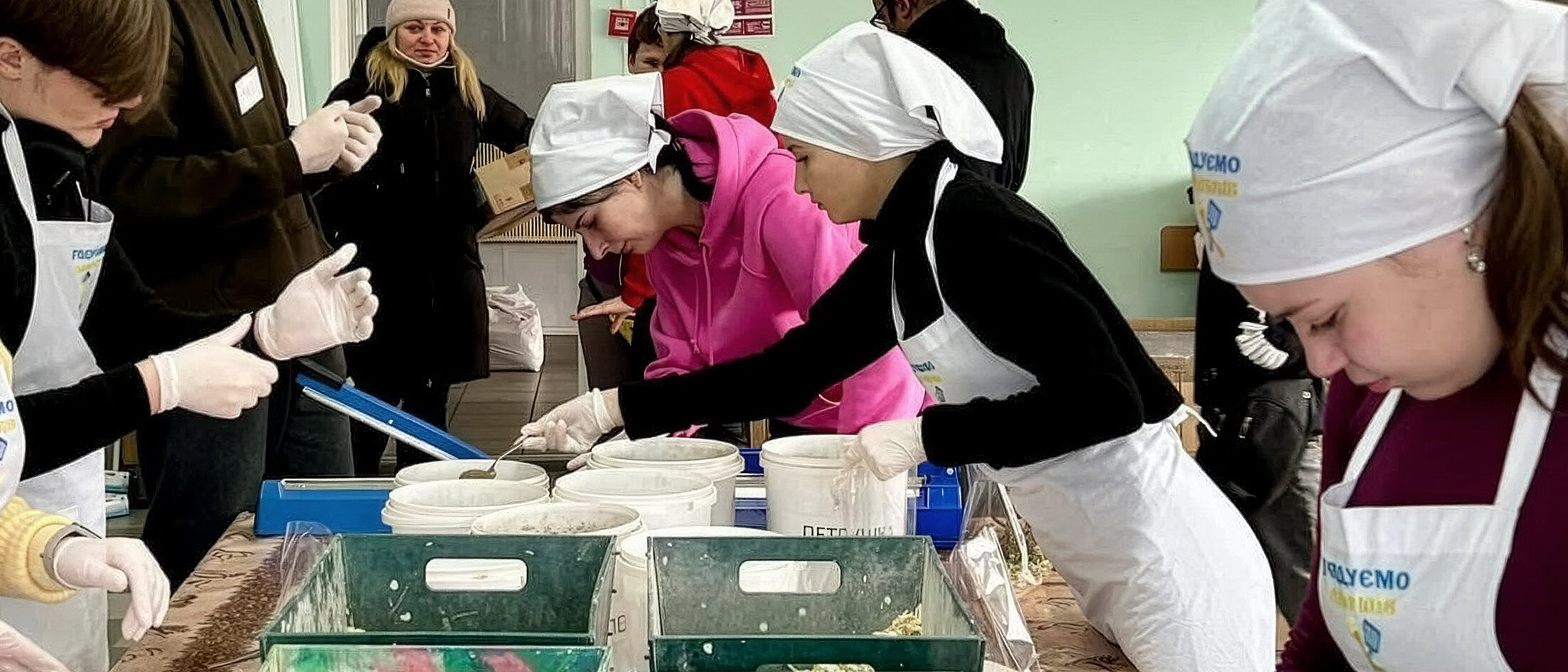
In the second week after the full-scale invasion, I went to help the local volunteers. I donned a white headscarf, an apron, and gloves, and set to work drying vegetables and herbs for soups and borsch. The food was sent to soldiers and to people in regions where, because of the fighting, cooking over open fires was the only option. More than 300 of us took part. In 2023, the staff of a training and rehabilitation center prepared 12 tons of varenyky and over 11,500 buns for the military. While the fighters had plenty to eat, for the people of Kropyvnytskyi it became a way to come together and take their minds off the news for a while.
Volunteers worked every day. It had long stopped being the effort of a few individuals – it had become the rhythm of the city, its new habit. Cafés, shops, and university classrooms were turned into aid stations. A city that once seemed unremarkable had become engaged and essential.
Kropyvnytskyi has taken in a large number of displaced people, and today there are over 85,000 in the city and its region – mostly from Donetsk, Luhansk, and Kherson regions. Humanitarian aid centers provide them with housing, clothing, and essential supplies.
The streets are filled with people again. They’ve been made accessible – both for locals and for those who were forced to leave their homes. Teatralna Street has had its old cobblestones removed, making it easier to get around in wheelchairs. It no longer feels like a place for late-night hangouts – music is heard less and less. Returning to Kropyvnytskyi, I find it harder and harder to recognize faces in the crowd. The streets I once knew so well no longer feel completely familiar. I may not know the city by heart anymore – but it knows me.
The Dendropark blooms every year, but now the laughter of children mixes with parents’ conversations about friends on the front lines. Billboards increasingly display portraits of fallen soldiers. Along Heroes of Maidan Square – once a place for celebrations, rallies, and concerts – fallen soldiers are now honored in processions bearing the words “On the Shield.” Their stories are broadcast on the electronic screen outside city hall.
The city hasn’t changed much on the outside, but it has grown denser inside: more people, more needs, more responsibility for one another. Sirens are heard here rarely, but almost everyone has someone “over there” – a relative, friend, or acquaintance they wait to hear news about. And it’s precisely because of this that the city lives every day – welcoming, helping, and providing support.