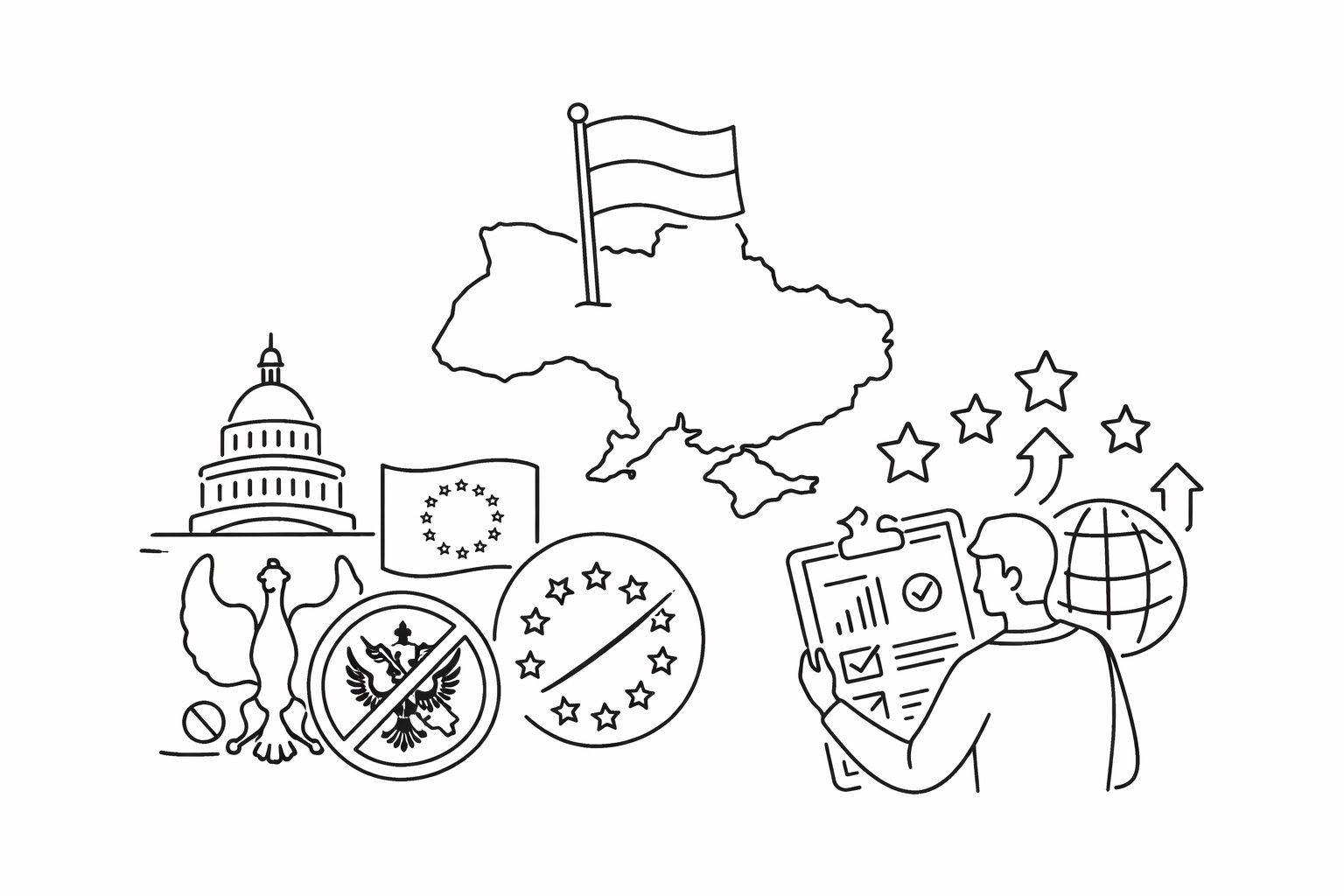
How Ukraine’s global image has changed after nearly four years of full-scale war
Russia’s all-out war has made Ukraine one of the most visible countries in global news, transforming it from “a country somewhere in Eastern Europe” into a symbol of resistance and a test of principle for its partners. Along with respect, however, new frames of perception have emerged: the war has become a familiar backdrop, risk has turned into a default assumption, and aid is increasingly filtered through domestic political debates in allied countries. Frontliner explains how Ukraine’s image has taken shape as of early 2026.
Since 2022, Ukraine’s global visibility has surged. The country is widely associated with defense, resilience, battlefield innovation, volunteerism and civic endurance. This has shaped an image of a state that did not collapse under attack and can organize faster than bureaucracy. At the same time, global attention rises and falls in waves: major events bring Ukraine back to the center of focus, while prolonged positional fighting pushes it into the background.
Solidarity in the EU holds
Across the European Union, public support for Ukraine remains high. Eurobarometer surveys show that a majority of respondents back financial and humanitarian assistance to Ukrainians, as well as sanctions against Russia.
Support, however, is uneven across EU member states. In some societies, skepticism is growing over the cost and duration of aid, influencing political campaigns and government rhetoric.
Sympathy for Ukraine becomes politicized
Public opinion in the United States remains divided, with support for Ukraine increasingly filtered through partisan lenses. Pew Research surveys in 2025 show sharp differences over whether the United States is doing too much or too little to support Ukraine, with views shifting alongside domestic political dynamics.
Gallup polling in 2025 indicates a growing share of Americans who believe the United States is doing too little, but the issue remains one of debate rather than consensus.
Tools instead of sympathy
After nearly four years of full-scale war, Ukraine is more clearly seen as a country that is holding its ground, asking not for sympathy but for tools, and demanding accountability from the aggressor. This image has two sides: rising respect and solidarity are accompanied by fatigue, politicization of aid and a risk marker that affects investment, migration decisions and overall attention.
Ukraine’s task for 2026 is to avoid losing its agency in other countries’ domestic debates and to continue explaining a simple point to the world: this is not a “long war story,” but a story about security rules for Europe and the broader West.
Adapted: Kateryna Saienko
***
Frontliner wishes to acknowledge the financial assistance of the European Union though its Frontline and Investigative Reporting project (FAIR Media Ukraine), implemented by Internews International in partnership with the Media Development Foundation (MDF). Frontliner retains full editorial independence and the information provided here does not necessarily reflect the views of the European Union, Internews International or MDF.