
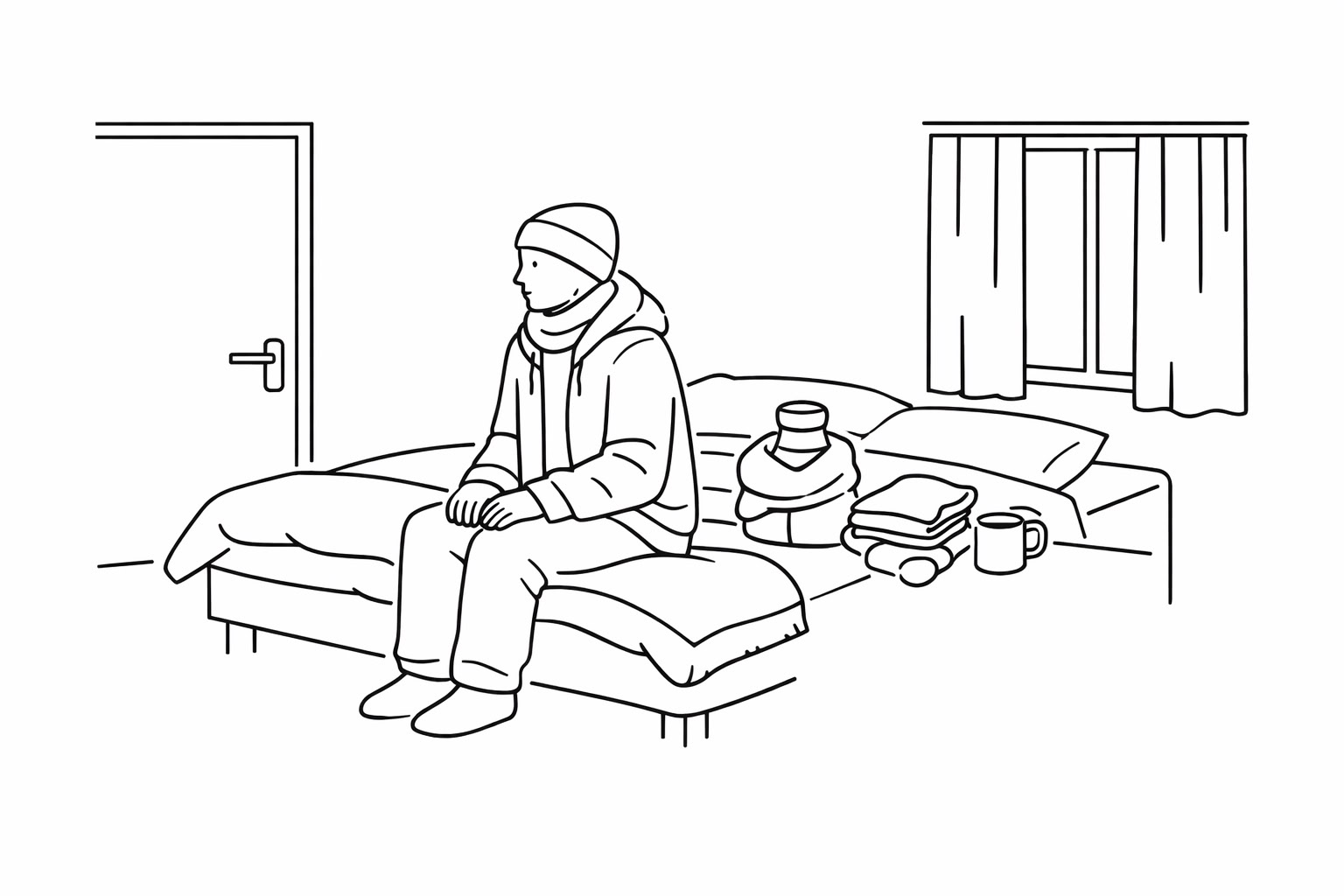
Warmth without central heating: how to stay warm in an apartment during outages
Ukrainians have already endured the coldest spells of this winter. Yet many apartments remain without heating and receive electricity only intermittently. In such conditions, it is a mistake to try to warm the entire home. Instead, it is better to organize space and alternative heating routines correctly. This helps maintain control in a situation that is no longer about comfort, but about survival. Frontliner offers several tips to help get through it.
Choose one warm room
Do not try to heat the whole apartment. Select one room, preferably the smallest one with the fewest exterior walls, and turn it into a “thermal base.” Keep doors tightly closed and minimize drafts. This approach underpins the recommendations of Ukrainian emergency services.
Seal drafts, without going overboard
Close curtains, lower roller blinds and block gaps around windows and doors with improvised materials such as fabric, draft stoppers or tape. Heat often escapes through seemingly insignificant cracks. A tightly sealed window frame can preserve more warmth than an extra sweater.
Clothing and movement
When it comes to clothing, layering is key. Thickness matters less than air pockets: thermal underwear or a dry base layer, an insulating layer, and an outer layer that traps air. Movement should come in short cycles. Exhausting workouts are unnecessary. Three to five minutes of activity every hour or two is enough to stimulate circulation, after which you should return to the warm zone. Avoid sweating – damp clothing in a cold apartment quickly works against you.
Concentrate heat in one place
When electricity comes on briefly, use it not to heat the air, but to prepare heat that can be retained: warm water for hot-water bottles, make a hot drink, preheat bedding. The most effective strategy is not circulating warm air around the room, but warming the body and the sleeping area. Your bed is your radiator. Use a blanket plus a throw, add an extra layer underneath (another blanket or dense fabric), wear socks for sleeping, and a hat or hood if the room is very cold. A hot-water bottle or a bottle of hot water wrapped in a towel provides noticeable warmth exactly where it is needed — in bed.
Practical tips that work
- Gather in one room and keep the door closed: a smaller volume retains heat more easily.
- Close curtains and move the bed at least 20–30 centimeters away from exterior walls and windows.
- Dress in layers and keep a separate dry set of clothes for sleeping.
- Drink warm beverages and eat hot food whenever possible to support internal warmth.
- Do short bouts of movement to stimulate circulation, but avoid sweating.
- If possible, place a blanket underneath you: cold floors silently drain body heat.
- Ventilate briefly and deliberately — two to three minutes is better than constant micro-drafts.
Dangerous heating methods
In a cold apartment, the biggest mistake is trying to heat with anything that poses a risk of fire or poisoning. Ukraine’s State Emergency Service regularly warns that gas stoves, ovens or burners must not be used as heaters — this is a direct path to carbon monoxide poisoning and tragedy, especially in spaces with poor ventilation.
The same applies to candles, burners and any open flame. In apartments where people are tired, lighting is limited and attention is scattered, flames can easily turn into fires. If a candle is used as a light source, it must stand on a non-flammable surface, far from fabrics, and under constant supervision.
Another dangerous option is running engines or generators indoors or on enclosed balconies. Carbon monoxide can quickly accumulate to life-threatening levels. The rule is simple: anything that runs on fuel and produces exhaust does not belong in living spaces.
Pay attention to how you feel
If a person becomes drowsy, lethargic, confused in speech, experiences shivering that suddenly stops, or if cold extremities lose mobility, this is no longer just discomfort — it is likely a hypothermia. Warming should be gradual: change into dry clothes, wrap the person up, give warm drinks, and focus on warming the torso rather than aggressively heating hands and feet.
This January taught a simple lesson: warmth in an apartment is not one device or one trick. It is a routine built from small elements — a limited warm zone, dry clothing, sensible pauses, and the absence of risky experiments. That kind of discipline can often prevent exhaustion and life-threatening danger, even when radiators are cold and electricity is fleeting.
Adapted: Kateryna Saienko
***
Frontliner wishes to acknowledge the financial assistance of the European Union though its Frontline and Investigative Reporting project (FAIR Media Ukraine), implemented by Internews International in partnership with the Media Development Foundation (MDF). Frontliner retains full editorial independence and the information provided here does not necessarily reflect the views of the European Union, Internews International or MDF.


