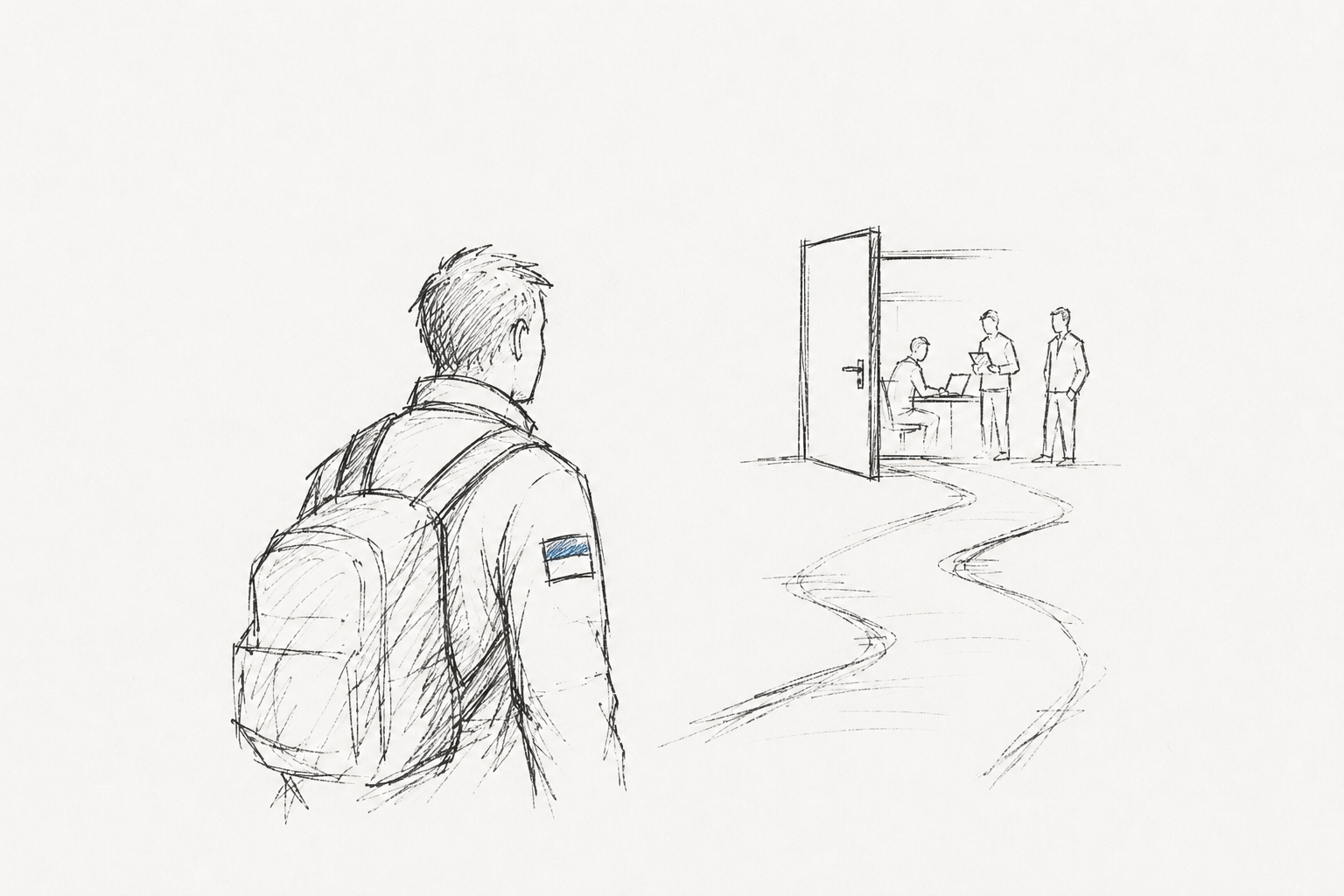
A soldier at the doorstep of the future: Why veterans struggle to find a job after leaving service?
More Ukrainian service members are returning to civilian life after years of full-scale war, facing the challenge of finding jobs, rebuilding careers and redefining their place in society. As of 2026, Ukraine has nearly 1.8 million veterans, and the number continues to rise. But frontline experience does not guarantee an easy return to civilian employment. In some cases, it creates additional obstacles. Many veterans face physical exhaustion, psychological strain, employer bias or a sense that their wartime skills do not fit civilian workplaces. Frontliner examines why veteran employment has become one of Ukraine’s growing social and economic challenges in 2026.
Returning to work after military service is often far more difficult than veterans and their families expect. People who spent years living through combat rotations, constant danger and military routines must suddenly adapt to office culture, job interviews, deadlines and ordinary workplace tensions.
Many employers still do not know how to work with veterans. Some fear psychological instability or workplace conflict. Others worry about long medical leave or emotional burnout. As a result, even experienced professionals can spend months searching for work after demobilization.
The frontline reshapes professional skills
Wartime experience does not always translate into employment
Many veterans return to a country where their prewar profession no longer feels relevant, or where they no longer want to return to their former careers. This is especially true for people who spent years in combat units.
At the same time, military service often develops skills that are difficult to present in a resume: leadership under pressure, crisis management, rapid decision-making and technical problem-solving. The challenge is that Ukraine’s civilian labor market still struggles to recognize and evaluate those abilities.
Exhaustion also affects work performance
Some veterans return with chronic fatigue, sleep disorders, health problems or psychological exhaustion. Even without severe injuries, adapting to civilian employment can take months.

For many, ordinary office routines or constant communication with coworkers become an additional source of stress, especially after prolonged time in combat zones.
The job market is changing
Employers are slowly adapting
Over the course of the war, some companies have launched veteran hiring programs, trained HR specialists and revised hiring practices for former service members. Such efforts are most common among large businesses and international companies.
Still, many fears and stereotypes remain. Some employers hesitate to hire veterans because of assumptions tied to PTSD, concerns about workplace conflict or fears that adaptation to civilian teams may be difficult.
Retraining is becoming more common
In 2026, more veterans are pursuing retraining and education after military service. The shift extends beyond IT and technical professions. Some former soldiers are moving into security, logistics, manufacturing, drone operations or launching their own businesses.
What can help veterans:
- avoiding an immediate return to prewar work intensity;
- pursuing education or retraining, even with previous experience;
- explaining post-service strengths and skills to employers;
- using veteran employment and support programs;
- seeking psychological support during adaptation;
- relying on veteran communities and professional networks during the job search.
Returning to civilian life
Adaptation takes time
Society often expects former service members to quickly “return to normal” after demobilization. But after years of war, such a rapid transition rarely exists.
For many veterans, work becomes more than a source of income. It is also a way to regain control over life, build a new identity and reconnect with civilian society.
Ukraine is still learning how to support veterans
Since 2022, Ukraine has gained extensive experience supporting its military, but systems for helping veterans return to civilian life are still developing. That includes employment, rehabilitation and mental health support.
According to Prime Minister of Ukraine, Yulia Svyrydenko, the number of veterans in Ukraine has already reached about 1.8 million people and continues to grow. As that number increases, the country’s ability to integrate former service members into civilian life is becoming a major long-term challenge.
In 2026, finding work after military service has become, for many veterans, a continuation of the adaptation process that began after leaving the front line. How effectively Ukraine responds to that challenge will shape not only the well-being of veterans, but also the country’s long-term social and economic stability after years of war. full-scale war.