Four years of full-scale war: how to end it on Ukraine’s terms
Four years after the start of the invasion on February 24, 2022, Russia has failed to achieve its primary objective — breaking Ukrainian statehood. Yet Ukraine has not reached the ending it hoped for either. About 20% of its territory remains under occupation. Russian forces continue to kill Ukrainian civilians. Millions remain displaced and unable to return home. The cost of reconstruction is measured in the hundreds of billions of dollars and continues to rise.
Alongside the fighting, discussions of a possible “ceasefire” persist. But four years of full-scale war have brought Ukraine neither triumph nor catastrophe. Instead, they have produced an exhausting and complex reality in which the central task is to endure without losing national identity, as Frontliner concludes.
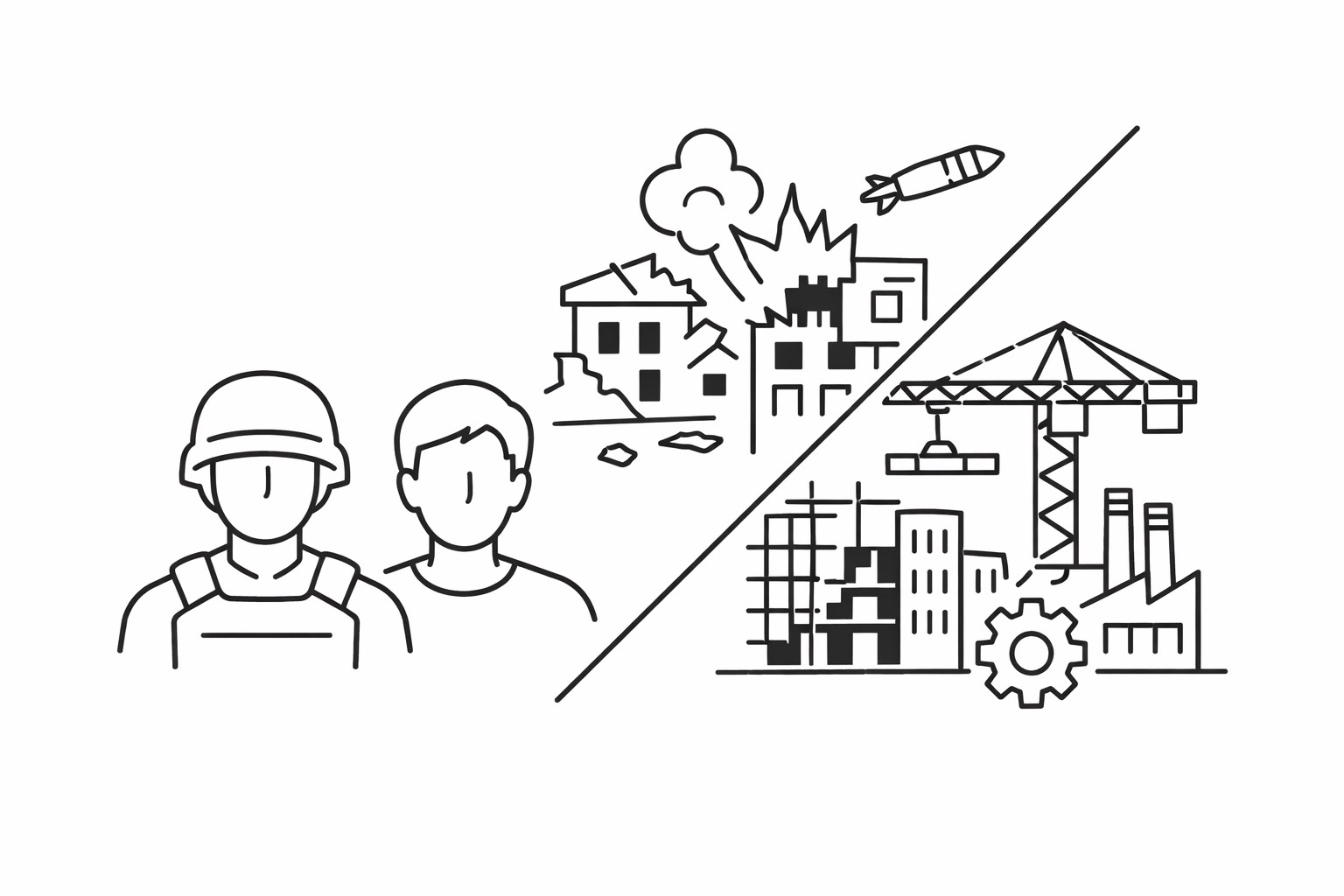
Ukraine enters its fifth year of full-scale war with two contradictory outcomes. On one hand, the country has learned to function under constant threat, such as strengthening its defenses, expanding domestic production and rebuilding infrastructure after attacks. On the other, normalization of wartime conditions has limits. Resources are finite, manpower is not endless and fatigue accumulates.
According to the United Nations Human Rights Monitoring Mission in Ukraine, more than 15,000 civilians have been killed and over 41,000 injured since the start of the full-scale war.
Russia has also paid a high price for its aggression, but that does not make it less dangerous. On the contrary, its reliance on mass strikes against civilian infrastructure and sustained pressure along the front line suggests the Kremlin is not seeking an exit, but searching for vulnerabilities.
Territory and people
As of February 2026, Russia controls roughly one-fifth of Ukraine’s territory, home to millions of people for whom the war does not end even when explosions are not heard nearby. Reports from occupied regions describe forced imposition of the “Russian world,” coercive passportization, repression for pro-Ukrainian views and mobilization into the Russian army.
At the same time, Ukraine has retained the capacity to evacuate civilians and support those who lost their homes. By the end of 2025, about 3.7 million people remained internally displaced within the country. The number of refugees registered across Europe exceeded 5.3 million in January 2026.
Economy and reconstruction
Ukraine’s economic resilience rests on a combination of domestic tax revenues, external assistance and constant repairs following attacks. The International Monetary Fund projected economic growth below 2% in 2025, while anticipating somewhat stronger performance in 2026 under its baseline scenario.
This means Ukraine is fighting not only with weapons, but with its budget. Any delay in financial assistance or political bargaining among Western partners over support packages directly affects Ukraine’s ability to fund defense, social payments and reconstruction.
A comprehensive assessment conducted in 2024 by the Ukrainian government, the World Bank, the European Union and the United Nations estimated reconstruction costs at $524 billion over the coming decade. Since then, the figure has only grown.
Strikes on energy infrastructure during the winter of 2025–2026 underscored that rebuilding proceeds alongside new destruction. In January 2026, attacks on the energy system were reported almost daily across different regions.
Negotiations: much talk, little peace
Public discussions about “ending the war” are frequent, but realities on the ground tell a different story. Fighting continues. Strikes on civilian infrastructure persist. Fundamental disagreements remain unresolved.
Promises of a swift peace often resemble political messaging suited to podium speeches and television studios, rather than the daily realities facing Ukrainians.
External support remains critical, but is increasingly shaped by domestic politics within partner countries. The European Union has declared readiness to move toward Ukraine’s membership and formally advances the negotiation process. Yet this path is measured not in months — and possibly not even in clearly defined years.
Financial decisions also become subjects of political bargaining. A single veto by one country can delay or block major European support packages for Ukraine.
Four years is not the end
As of February 2026, Ukraine’s position is less optimistic than many would wish. Hostilities and shelling of cities and villages continue. Losses and destruction remain extensive. The prospect of rapidly regaining all territories is far from guaranteed.
But for Russia, this is not the victory portrayed by Kremlin propaganda. Ukraine did not disappear, did not capitulate and did not return to an imperial framework.
That is the central fact of four years of the all-out war: the country endured when the Kremlin’s plan was to destroy the Ukrainian state.
Relying on negotiation rhetoric alone would be dangerous. Ukraine must rely on its own strength. A strong defense, a resilient economy, realistic diplomacy and the protection of Ukrainian identity must form the foundation of a strategy to end the war on Ukraine’s terms.
***
Frontliner wishes to acknowledge the financial assistance of the European Union though its Frontline and Investigative Reporting project (FAIR Media Ukraine), implemented by Internews International in partnership with the Media Development Foundation (MDF). Frontliner retains full editorial independence and the information provided here does not necessarily reflect the views of the European Union, Internews International or MDF.