‘I cannot leave my neighbor’: Druzhkivka is being torn apart by drones. Evacuation has become nearly impossible
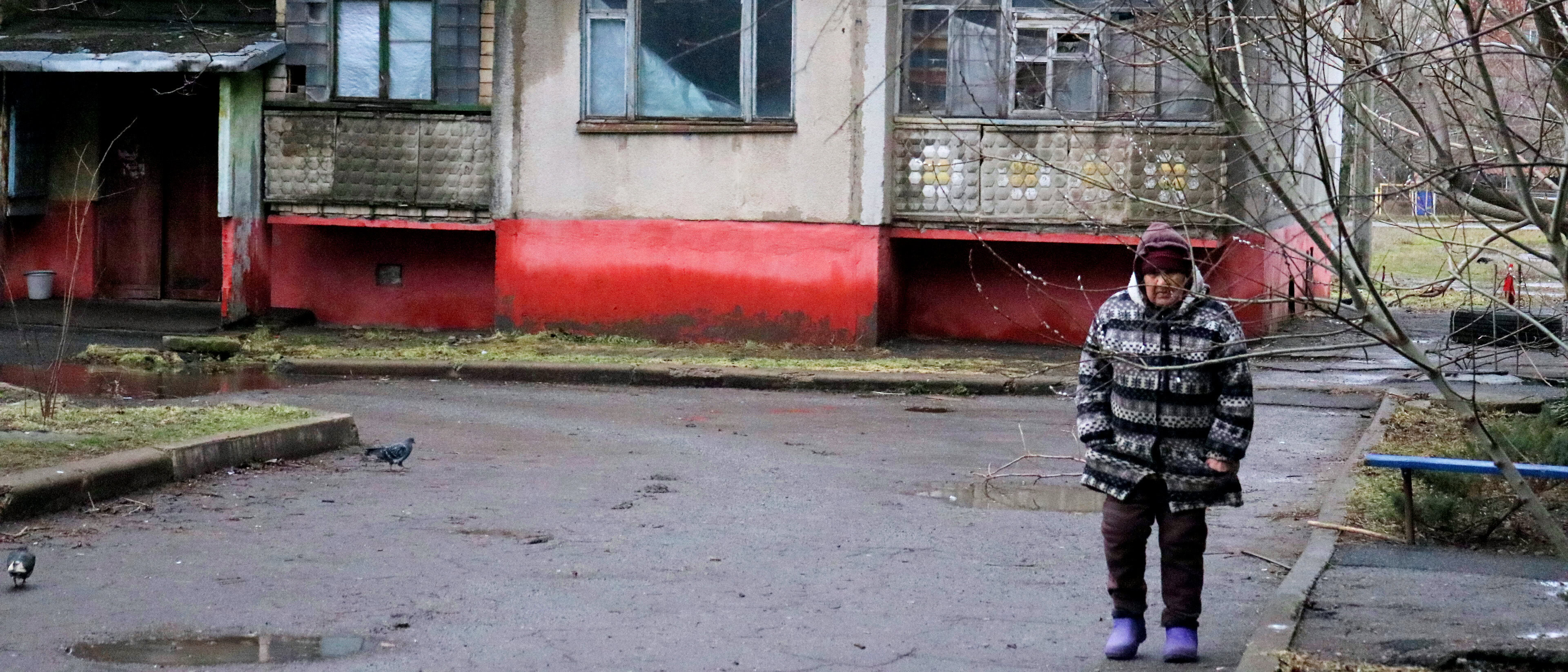
In Kostiantynivka, Russians are conducting a safari on civilians, with drones hovering over houses and basements for days, waiting for someone to step outside. The city streets are littered with puddles of blood and corpses that no one is left to bury. To survive, residents of Kostiantynivka must travel 21 kilometers on foot to Druzhkivka while under constant UAV raids. The route is covered with the burned-out remains of vehicles that failed to escape Russian “liberation”. Even in Druzhkivka, going outside is a death sentence as drones hunt for people and missiles explode in every neighborhood. Despite this, residents continue to cling to the ruins of their homes. This Frontliner report explores why they remain in such a lethal zone.
46-year-old Druzhkivka resident Iryna Karpenko leaves her home for only two reasons: to collect water or to pick up groceries delivered by her husband by car. At all other times, she and her husband avoid the streets, fearing that something horrific might happen to them. They refuse to evacuate the area despite constant bombardment because they recently purchased an apartment and completed renovations in the spring of 2023. They spent their life savings and found it impossible to sell the property in 2024.
We bought everything new for the apartment, including the furniture and dishes.
We just wanted to live in a place of our own.
Now, look at us: no water, no electricity, and no heating,
The couple gave up on finding buyers a long time ago. No one was willing to pay the $17,000 they had invested in the property, and they even failed to sell it for $10,000. So now, they stay in the apartment to avoid the cost of renting in another region. While only two shops remain in Druzhkivka, they visit them rarely, as prices there are 1.5 times higher than in Kramatorsk or Sloviansk.
“We do not want to leave. The moment you step over the threshold, consider the house abandoned. People will move in and create such a mess that the apartment will never be clean again. Some men approached me and asked if we were moving out, offering to rent the place just for the cost of utilities.
Yet, none of them are offering to let us stay in their apartments
somewhere in Lviv or Kyiv. So, we will stay here until we have no other choice.
If no one comes to evacuate us, we will find a basement or leave on foot,
Iryna Karpenko dismisses the volunteers’ warning that apartments in Druzhkivka will soon have neither windows nor walls, remarking that one must first live to see that day.
The couple does not want to stay in free shelters or abandoned rural houses. There are options; however, those places need to be fixed up to be comfortable.
“We did not sink all that money into this apartment just to live like beggars,” the woman snaps aggressively before walking away.
The humanitarian aid she had come to collect from the volunteers was unavailable. While this disappointed her, it was not enough to persuade her to evacuate.
An elderly woman from Druzhkivka tried to starve herself to death
83-year-old Valentyna walks alone in a courtyard surrounded by high-rises. In recent months, whenever she hears the sound of an engine, she hurries outside as fast as her failing legs allow. This happens rarely — only once every few weeks. To her, that sound means the last of her neighbors are leaving Druzhkivka.
It was as if someone came to me, and a voice said
it was not my time yet, that I still had to live.
“I am not leaving. My wallet is empty. There is some money in my bank account, but I cannot withdraw it. There used to be those machines that gave out cash [Editor’s note: ATMs], but they do not work anymore. Maybe they work further away, but I would not know. I am 83 years old. I thought to myself that I had lived into such a nightmare that it was time to die. So I decided, like our Lord, not to eat. The Bible says He did so. I only lasted for a week! I was so weak after that. On the last night that I did not eat, it was as if someone came to me, and a voice said it was not my time yet, that I still had to live. So now I am cooking on the gas stove, and I just finished some porridge. When I heard you arrive, I came out to see who they were taking away,” the Druzhkivka resident says with a smile.
Since January 2026, the retiree has seen three families evacuate. She cried twice because of the feeling that she was being left all alone. However, things felt a bit better after she befriended a man from a neighboring building. He has no plans to leave anywhere. He is staying behind to guard his apartment.
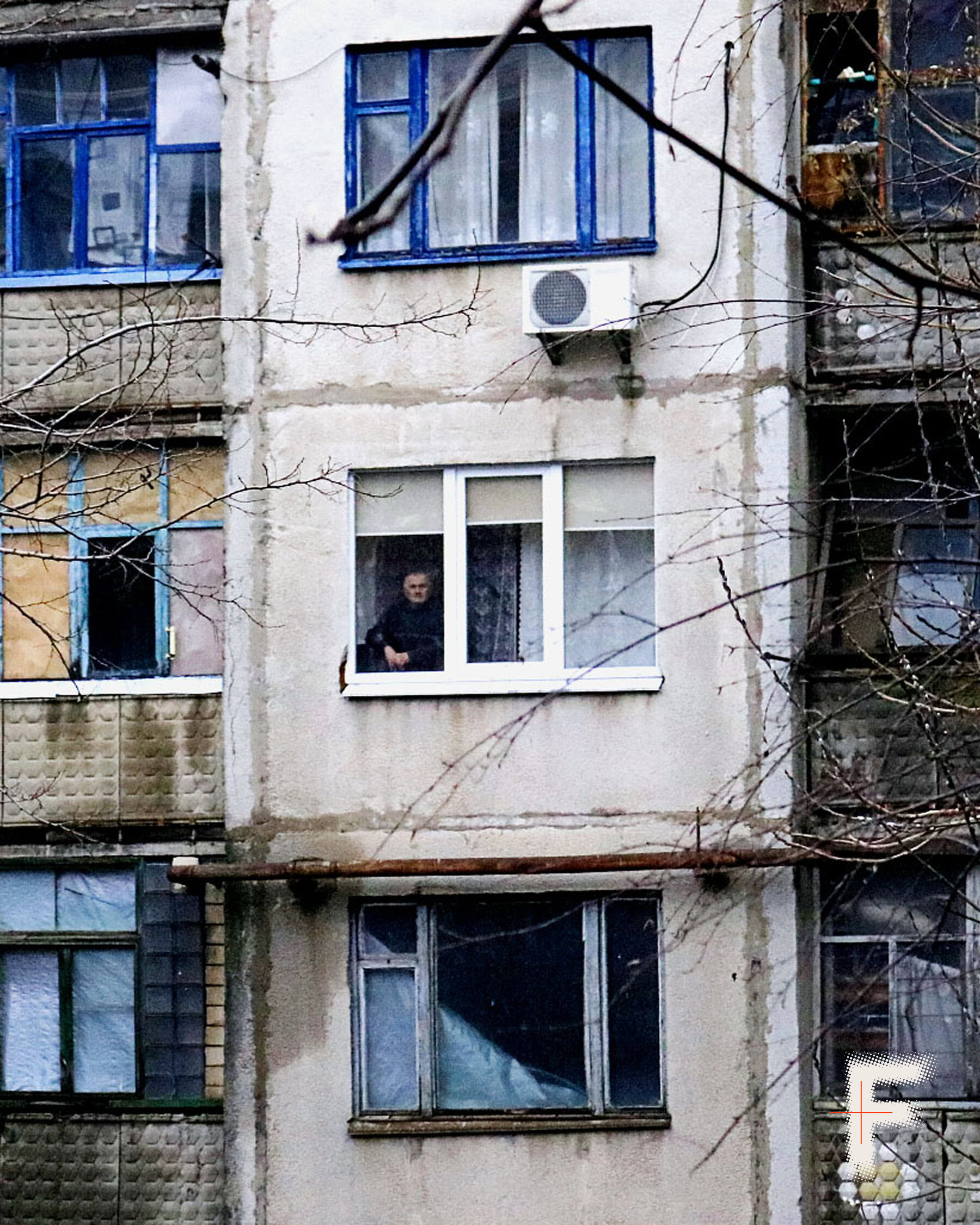
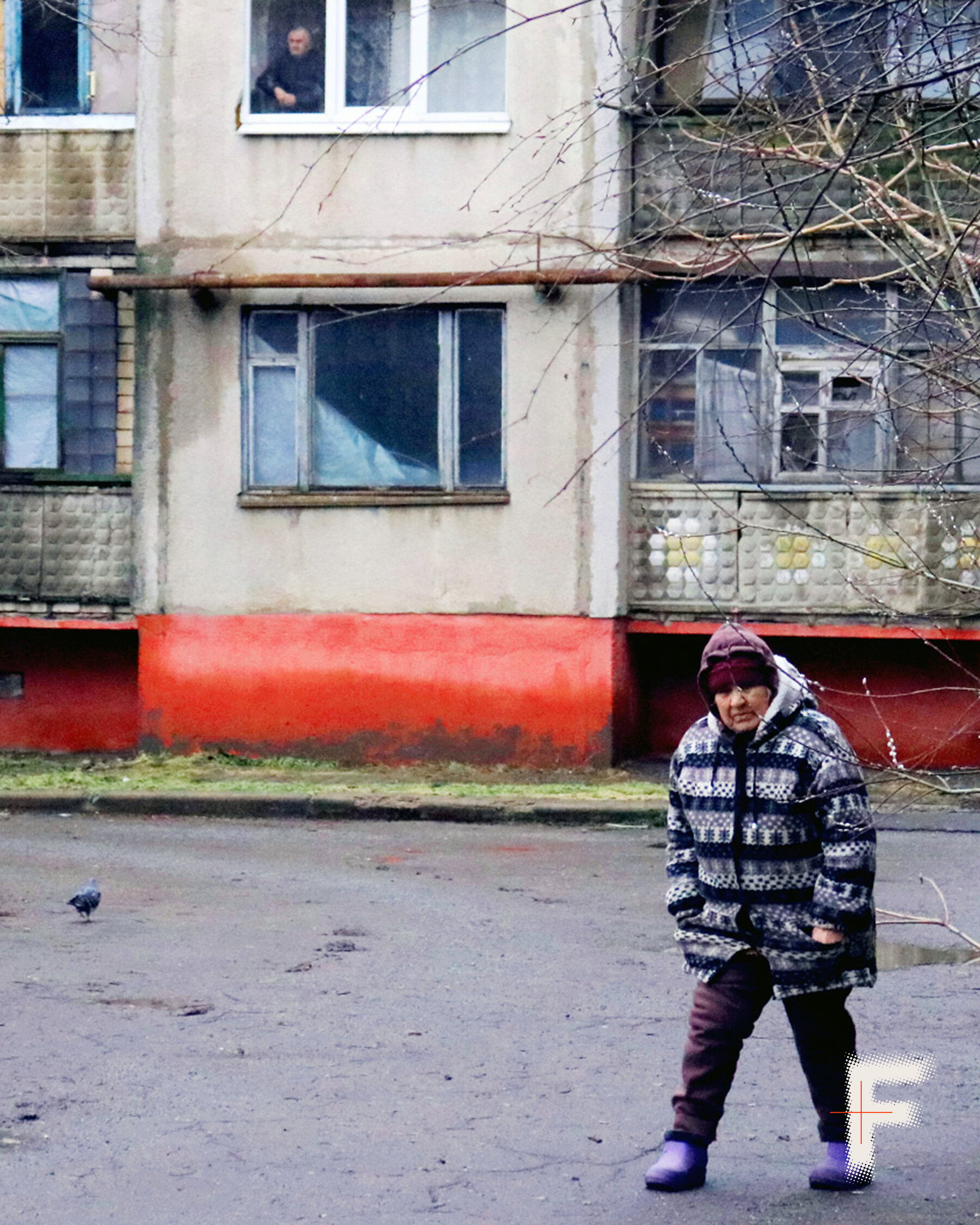
“Yesterday some guys evacuated Tania from my entrance, and she is already begging to come back! They brought her to Lozova, paid 10,800 hryvnias, and put her in a room with four strangers. How can you live with people you do not know? I could not. I am used to being the hostess of my own home, where no one bothers me. I go outside to feed the cats and the dogs. What would they do without me? We both have a roof over our heads, so everything is fine, except the war never ends,” the retiree says.
I could not get back to sleep since
I was scared and cold.
At that moment a UAV flies overhead. It is likely a fiber-optic model because the drone detector fails to pick up any signal. The elderly woman does not even react as she is convinced it is not coming for her.
“I have not slept all night because of a rocket hit. I could not get back to sleep since I was scared and cold even though I dressed in layers with trousers, a sweater, a robe, and a jacket. I sleep under a duvet but last night was so terrifying that I was actually shaking in my bed,” Valentyna says.
They fear they will have to leave most things behind
The woman is worried because she truly wants to see her neighbors off. She still refuses to evacuate herself, especially when she sees volunteers carrying out the belongings of those leaving in checkered bags. The retiree complains that she has no such bags, so the volunteers probably will not take her.
Suddenly, a loud explosion is heard — another drone strikes the neighboring high-rise. Valentyna is startled and asks timidly:
“What if I pack my stuff in a box? Will the boys be angry with me?”
The elderly woman is silent for a few minutes, listening to the war as it gets closer to her home. Finally, unable to bear it, she asks if the invaders will hit the city hard. Volunteer Bohdan Zuiakov simply says “Yes” while showing her a photo of Kostiantynivka. Her eyes well up as she says it hurts to think of her home being reduced to rubble.
“Recently, people from Kostiantynivka and Bakhmut were living among us. I saw them arrive with volunteers, carrying bags, armchairs, and mattresses.”
And now they have to flee again? Poor souls, they had only just settled in,
only to be forced out once again,
During the conversation, another Druzhkivka resident approaches the volunteers. She had already signed up for evacuation but was told her transport would arrive in three days. Seeing the vehicle parked by a neighboring house, she is visibly startled, thinking they have come for her ahead of schedule.
“My husband and I were already debating whether to refuse to evacuate or to rush and pack our stuff,” the woman explains.
Valentyna listens carefully to her neighbor’s conversation with Bohdan. She is visibly curious about where people are being sent, the conditions offered, and the IDP [Internally Displaced Person] payments they might receive.
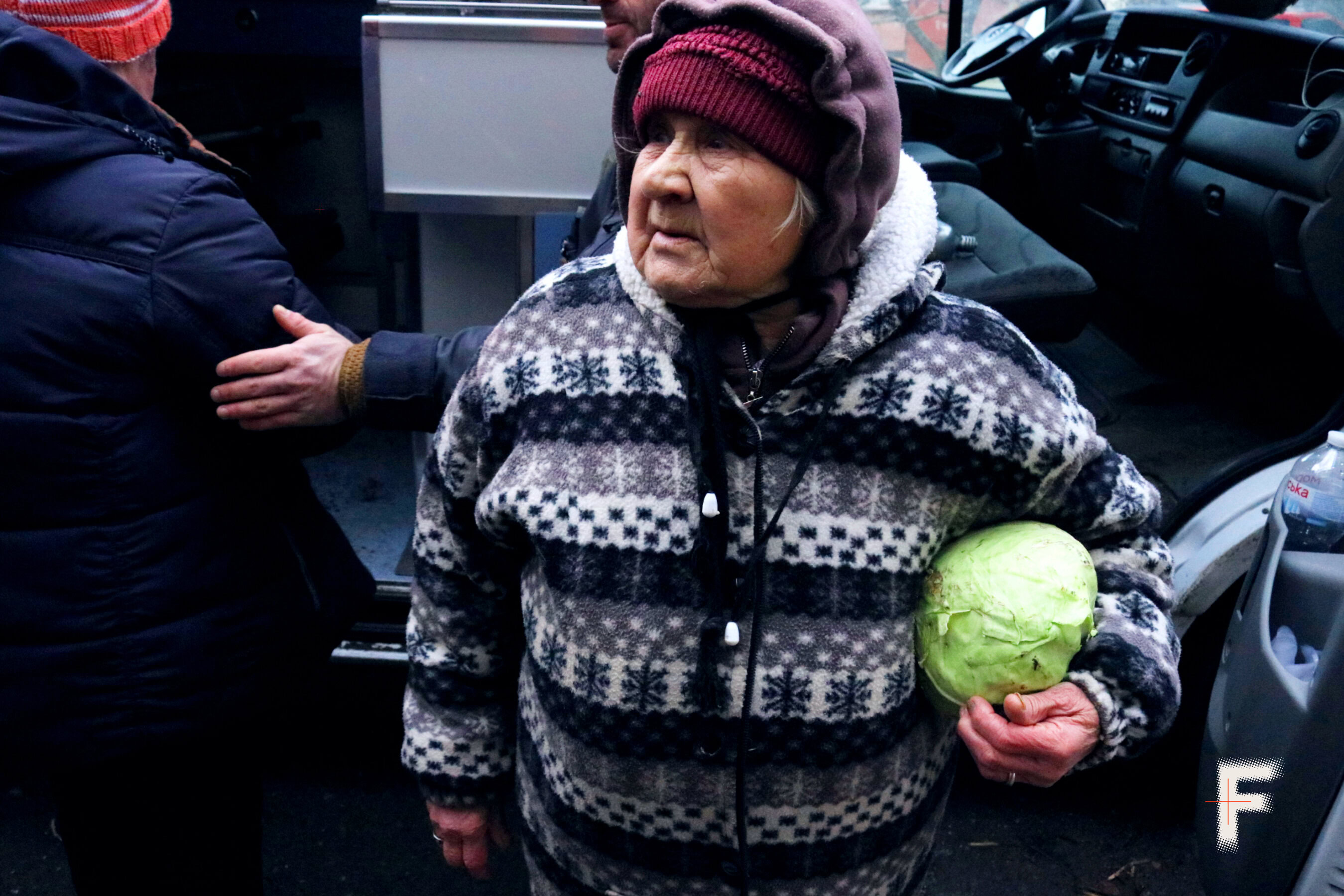
Olena steps outside holding a head of cabbage. It does not fit in any of her bags as there is simply no room left. She hands the vegetable to her neighbor. Valentyna turns it over in her hands and says she will have it for dinner.
People cling to absurd reasons
to delay evacuation.
They used to talk occasionally, stepping outside after the shelling to share their “impressions”. Saying goodbye, the women cling to each other, silently shaking their heads. Valentyna looks at Olena, while Olena gazes at the courtyard she is leaving behind.
Bohdan Zuiakov starts hurrying them because the drone detector has intercepted a signal. A drone is coming for an attack. With the car parked in the middle of the yard, the danger is quite clear. Valentyna does not hold them up, but she finally saves the evacuation hotline number in her black-and-white phone.
“If you can take me with my boxes, then… Oh, I just do not know. I will talk to my neighbor and we will consult each other. If he tells me to go, then I will. He lives on the third floor here. We greet each other on the street or when we see one another through our windows,” the retiree says.
As the vehicle pulls out of the courtyard, Valentyna is still standing by the entrance where no one else lives. She watches the van drive away, waving her hand. In her phone, she has the number of the volunteers who are ready to risk their lives to return to Druzhkivka to evacuate her. But Bohdan Zuiakov is certain: the retiree will not call back.
What is happening in Druzhkivka as Russian forces advance
Volunteer Bohdan Zuiakov is convinced that Druzhkivka has a strange influence on people. The previous city with such an impact was Kostiantynivka, where residents were certain that no drone or shell would ever strike them. Now, half-dead survivors from Kostiantynivka, who managed to escape despite the “drone safari,” are arriving in Druzhkivka. While waiting for volunteers, they share stories of the shelling they endured and of civilian bodies left in the streets, killed by bombs or UAVs.
In Kostiantynivka, Russian forces are killing people fleeing for their lives with extreme brutality. Druzhkivka may now face the same tragic fate.
“People cling to absurd reasons to delay evacuation. Someone spends months trying to rehome a cat. Someone else needs to replant a flower or finish burning through their firewood because they feel it is a pity to let it go to waste. One man in Kostiantynivka refused to leave three times, even though one wall of his house was completely gone. He wanted to wait for warm weather to dig up his parents’ grapevine and take it with him. He thought we would pick him up right about now with the stuff and that vine. But we can no longer enter Kostiantynivka. We cannot reach parts of Druzhkivka either, not even in armored vehicles,” volunteer Bohdan Zuiakov says.
Since autumn, Russian forces have increased the pressure on the Kostiantynivka hub – all settlements within a 15 to 30-kilometer radius of the city. Evacuation from Druzhkivka is also dangerous because drones frequently target volunteer vehicles. Last month, an elderly woman was killed in one of these cars when a UAV dropped an explosive onto the roof. Miraculously, the driver and the other passengers survived.
The fate of those who remain near the grey zone is tragic. Volunteers have witnessed this firsthand through years of evacuations from Kostiantynivka, Bakhmut, Dobropillia, Chasiv Yar, Pokrovsk, and dozens of other settlements. Yet, the residents of Druzhkivka still believe that death from Russian strikes will somehow pass them by.
***
Hi, I am Alina, the author of this article. Thank you for reading to the end.
In Druzhkivka, even half an hour is enough to feel a full dose of war reality. After every strike, new pools of blood appear on the sidewalks, and through shattered windows you can see apartments where the wounded died. Few civilians are saved, yet despite knowing this, the locals stay and continue living under bombardment.
Every day, our journalists work in life-threatening environments and report from the front lines and the surrounding areas to document the reality of the Russo-Ukrainian War. Join the Frontliner community so we can keep telling important stories from the ground.
***