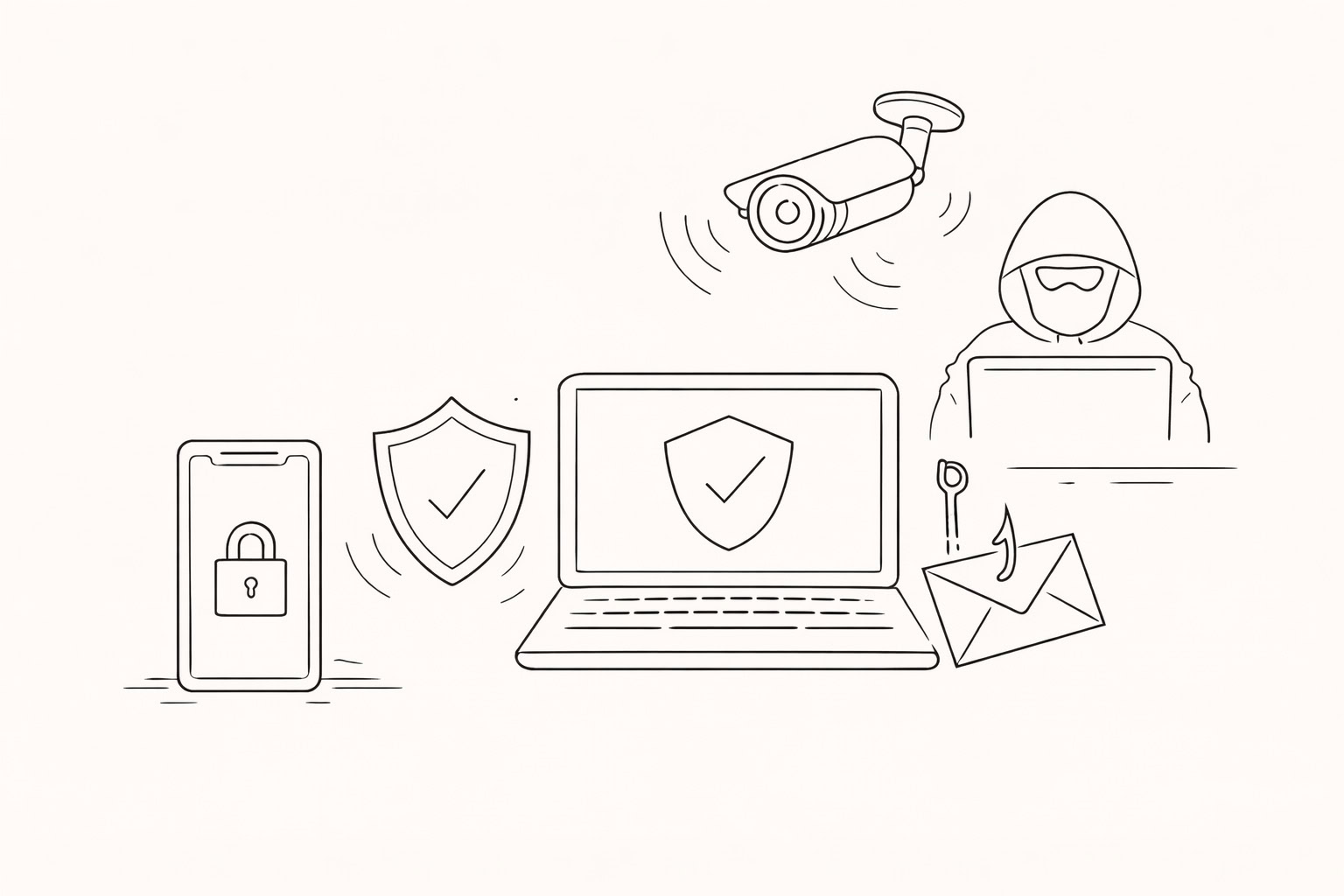
Digital security during war: How to protect your devices and accounts
The full-scale war has created new risks in the digital space. Alongside shelling and combat, the number of scams, account breaches and recruitment attempts online has increased. Smartphones and computers have become entry points to personal data and finances. Frontliner explains how to protect yourself and avoid these schemes.
Today, a smartphone is a wallet, a record of communications and a gateway to government services. Losing control of it can mean losing control over a significant part of one’s personal life. According to Ukraine’s Cyberpolice and the Security Service, the main threats in 2025–2026 are not sophisticated cyberattacks but user deception.
Most attacks rely on simple scenarios. A person receives a message with a link or a job offer. They are then asked to take an action, such as follow a link, install an app or share a code received via SMS. After that, the account or device falls under the control of attackers
Key threats
Digital attacks have become more targeted. Scammers collect information about individuals from open sources and tailor messages to their interests. This increases trust and lowers critical judgment.
There has also been a rise in recruitment attempts by Russian intelligence services. Through messaging apps, they offer easy money for simple tasks: sharing information, taking photos of locations or installing applications. These actions may be used for intelligence gathering or sabotage. In many cases, individuals do not immediately realize they are being drawn into illegal activity.
Risks to devices and accounts
The most vulnerable part of the story is the user. Security tools are effective only when used correctly. Most breaches occur because access is shared voluntarily or through carelessness.
Third-party apps and files present a separate risk. They may collect data, read messages or grant remote access to a device. Such software is often disguised as useful services or games.
Basic security rules
- Enable two-factor authentication for all important accounts.
- Use different passwords and store them in a password manager.
- Do not follow links from suspicious messages.
- Do not install apps outside official stores.
- Regularly update the operating system and applications.
- Limit app access to contacts, camera and location.
- Do not share verification codes, even with acquaintances.
- Verify job or income offers through official sources.
High-risk zone: social media and messaging apps
Social media remains the primary channel for attacks. It is used to distribute phishing links and conduct conversations aimed at deception.
Popular messaging apps, such as Telegram, Viber and WhatsApp, are particularly active environments, as users tend to respond quickly to messages. Private messaging on Facebook Messenger and Instagram is also widely used.
It is important to control what information you publish. Photos, geolocation, work details or movement patterns can be used for analysis and further attacks. This applies to civilians as well as military personnel and volunteers
If your account or device has been compromised
First, change passwords for all connected services. Then check active sessions and log out from unknown devices. If banking apps are involved, notify your bank.
In more serious cases, contact the Cyberpolice of Ukraine or report to the Security Service of Ukraine, especially if there has been contact with suspicious individuals or attempts to involve you in illegal activity.
Threats are becoming simpler in form but more dangerous in consequences. The main tool used by attackers is the exploitation of trust. Basic digital security practices and attentiveness are key to maintaining control over personal devices and data.
***
Frontliner wishes to acknowledge the financial assistance of the European Union though its Frontline and Investigative Reporting project (FAIR Media Ukraine), implemented by Internews International in partnership with the Media Development Foundation (MDF). Frontliner retains full editorial independence and the information provided here does not necessarily reflect the views of the European Union, Internews International or MDF.