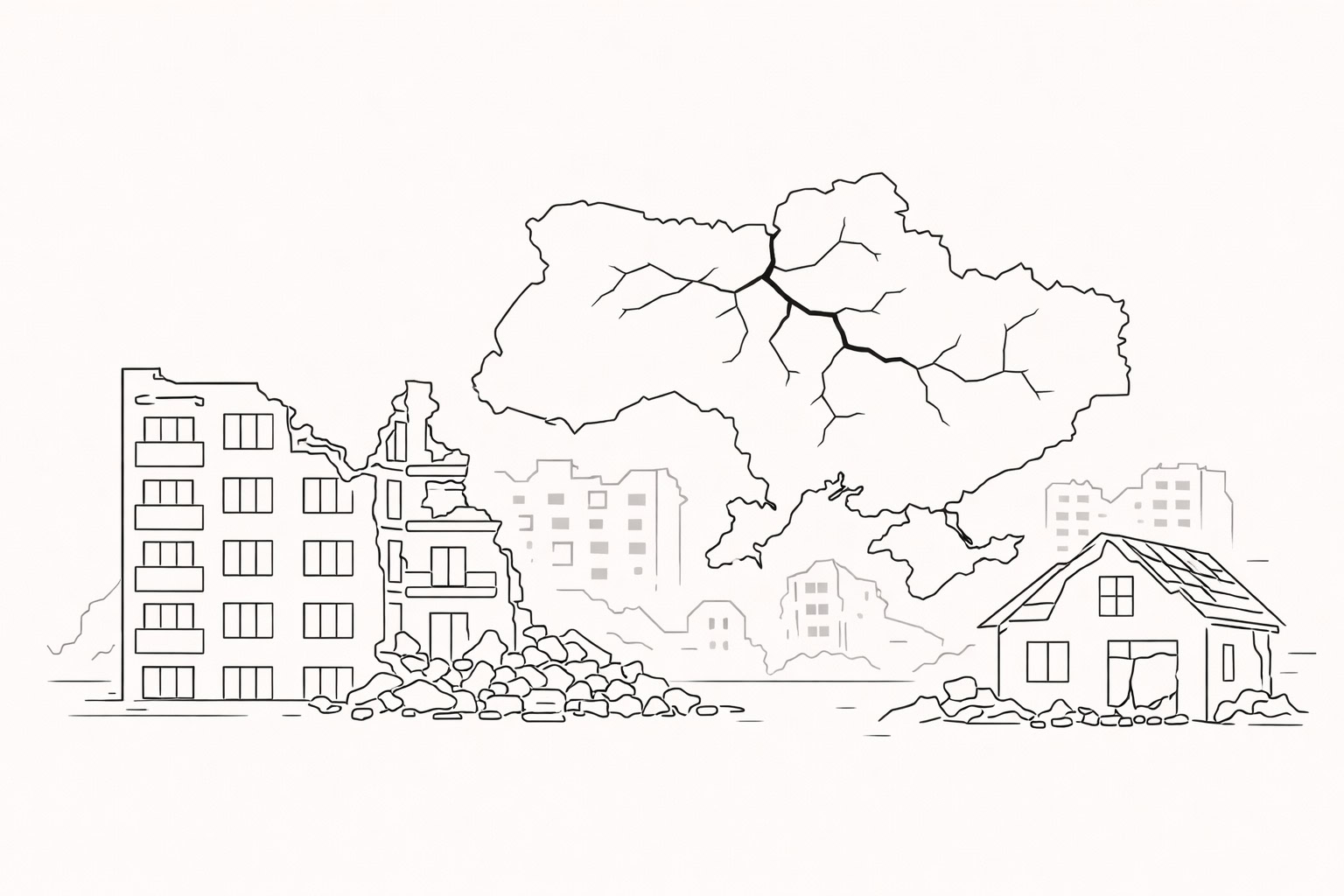
Destroyed housing: What Ukraine has lost and what must be rebuilt
Russia has destroyed 14% of Ukraine’s housing stock, according to estimates by international organizations and the Ukrainian government. Over 3 million households have lost or had their homes damaged. The destruction is concentrated in regions where fighting took place or that were under occupation. The scale of losses is already reshaping the country’s housing balance, and these changes will need to be considered in reconstruction efforts, Frontliner reports.
Since the start of the all-out war, the housing sector has suffered widespread destruction. According to estimates by the World Bank, the Ukrainian government and the United Nations, more than 3 million households or about 14% of total housing, have been damaged or destroyed.
The destruction has been uneven. The heaviest losses have been recorded in regions affected by active fighting or occupation, including the Donetsk, Kharkiv, Luhansk, Zaporizhzhia, Kherson and Kyiv regions. In some localities, individual buildings have been damaged, while in others, entire neighborhoods have been destroyed. Several cities were almost completely razed. Some housing can be repaired, while other properties are beyond recovery. This means part of the housing stock will have to be rebuilt from scratch.
Housing stock in 2026
Ukraine’s housing stock developed over decades. Before Russia’s full-scale war, it was largely made up of buildings constructed during the Soviet period, while new housing construction expanded in major cities during the 2010s and early 2020s.
Overall, housing supply was sufficient, and there was no systemic shortage. Much of the stock was outdated, but people generally had access to owned or rented apartments and houses. The housing market functioned relatively steadily.
By 2026, the housing stock has shrunk due to destruction and the occupation of parts of the country. Some housing has been physically destroyed, while other properties remain inaccessible.
Ukraine’s population has also declined. Millions have left the country or been internally displaced. This has created a new imbalance: some regions now have vacant housing, while cities that received large numbers of displaced people face shortages. The deficit is localized, with the greatest pressure in major cities and relatively safer regions.
According to international estimates, rebuilding the housing sector will require about $90 billion in the coming years. Direct losses to housing exceed $60 billion. Additional costs include debris removal, restoring utilities and constructing new housing. Total reconstruction costs for Ukraine are estimated at around $588 billion, meaning housing accounts for a significant share.
Compensation programs for lost housing
Ukraine has already introduced state programs to support owners of damaged or destroyed housing. The main initiative is eVidnovlennia.
The program includes two mechanisms. The first provides payments for repairing damaged housing, apartments or houses that can be restored. Funds are issued to a bank card with restricted use and can be spent on construction materials or repair work.
The second mechanism offers compensation for completely destroyed housing. In such cases, individuals receive a housing certificate that can be used to purchase a new apartment or house or to invest in construction.
Applications can be submitted via the Diia app or portal, as well as through administrative service centers or local authorities.
After submission, an inspection is carried out to assess the level of damage. A commission documents the findings and determines the amount of compensation or eligibility for a certificate.
The program is gradually expanding, drawing on state budget funds and international assistance. Priority is given to those who lost their only home and to internally displaced persons.
After the war ends, Ukraine will face an unprecedented scale of reconstruction. At the same time, it will have an opportunity to introduce a new approach to urban development and improve the quality of life in its cities.
***
Frontliner wishes to acknowledge the financial assistance of the European Union though its Frontline and Investigative Reporting project (FAIR Media Ukraine), implemented by Internews International in partnership with the Media Development Foundation (MDF). Frontliner retains full editorial independence and the information provided here does not necessarily reflect the views of the European Union, Internews International or MDF.