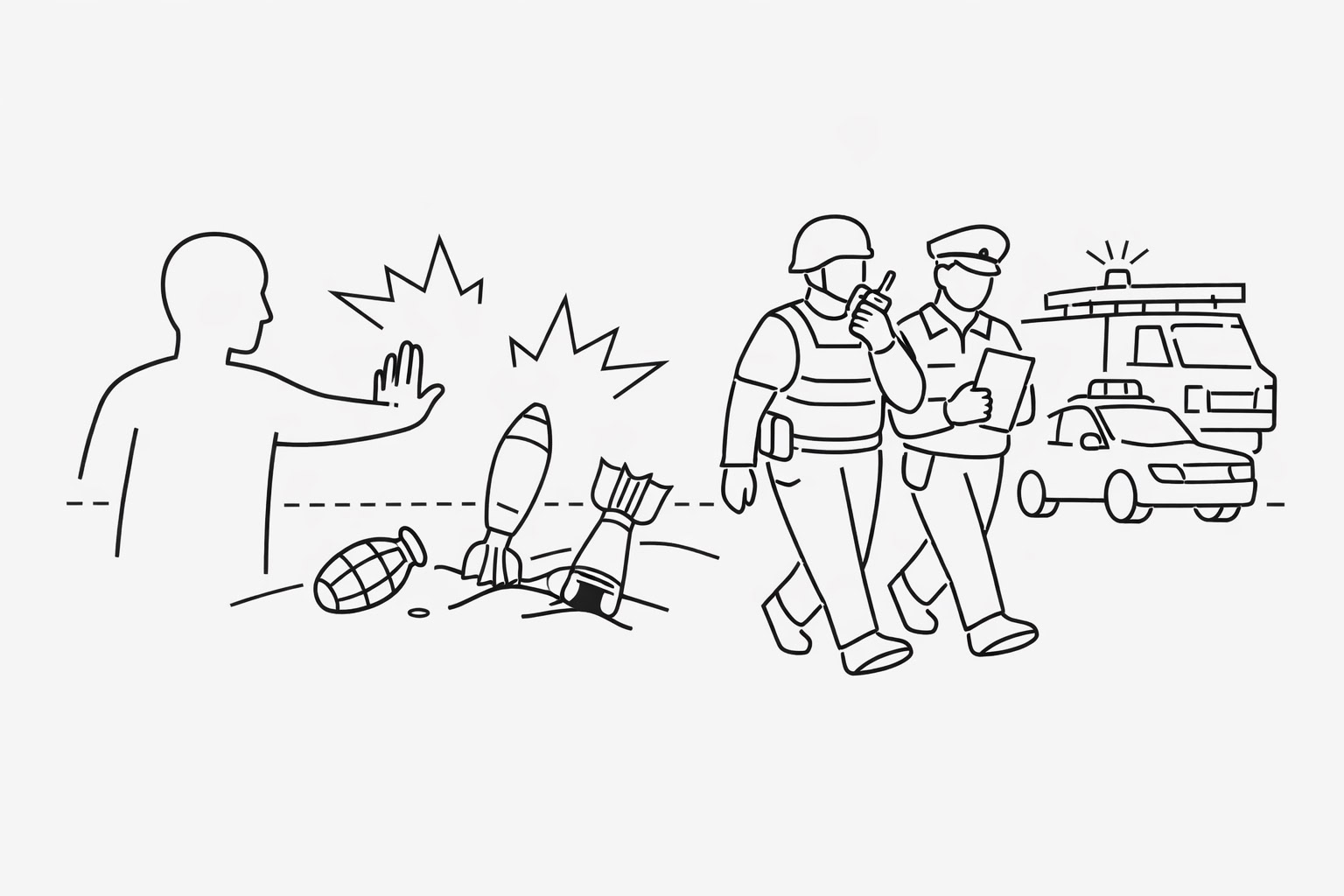
All debris after shelling is dangerous: how to avoid injury
After an impact, danger does not disappear when the blast wave subsides. Metal fragments, casing parts, electronics and, most critically, unexploded ordnance can remain on the ground, capable of detonating from touch or movement. A fragment may appear inert, but its explosive component or fuse can still be active, effectively turning the strike site into a minefield. Frontliner reviewed guidance on how to stay safe around hazardous debris.
The first rule after an explosion is to resist the impulse to approach the site — to take a closer look, photograph it or move fragments from a road or yard. Such actions most often lead to injury. For a dangerous object, a single удар, jolt, flip or heat source can be enough to trigger detonation.
Ukrainian civil protection services strictly prohibit approaching, handling or attempting to neutralize suspicious objects independently and advise immediately contacting emergency responders and police.
A second risk involves non-combat injuries. Debris often has sharp edges, may be extremely hot and can be covered in soot, fuel or other technical fluids. Even without detonation, contact can cause cuts, burns or infections, especially if a person is in shock and lacks gloves or first-aid supplies.
What dangerous remnants can look like
Hazardous items are not limited to intact “shells.” Explosive remnants of war include a wide range of objects.
In practice, this can mean anything: a tail stabilizer, a fragment with exposed wires, part of an engine, a battery, a control unit, metal pieces of unknown purpose or small unfamiliar objects near a crater. The key rule is not to try to identify the type of munition on the spot. Safe behavior is the same for any suspicious find.
Cluster munitions: the main trap
Cluster systems are particularly dangerous because they scatter numerous small submunitions over a wide area. Some fail to explode immediately and can function like land mines for years, detonating upon contact or movement.
These small unexploded elements pose a long-term threat to civilians. A common mistake is to assume a small object is a harmless fragment. Cluster submunitions can be tiny and hard to notice in grass, on roadsides or among shattered glass. If, after shelling, you see many small fragments or several identical or similar suspicious objects, this is an additional warning not to approach and not to allow children or animals near them.
Guided missiles, drones and aerial bombs
Guided weapons often leave behind technological debris, such as circuit boards, batteries, navigation modules, wing fragments. But the primary risk may not lie in the electronics. If the warhead has not detonated, the object remains explosive regardless of how “advanced” the weapon was.
Missiles and other munitions that fail to function as intended can still kill upon contact.
There is also a combined hazard: debris mixed with fuel, composites and batteries. Some components may burn, smoke or emit strong odors, and metal parts may remain hot. Picking up an object to “clear it away” or move it aside is a dangerous idea, even if it appears to be just a casing fragment.
Where to report and what not to do
The basic algorithm promoted by Ukrainian authorities is simple: do not approach, do not touch, report.
Ukraine’s State Emergency Service and the Ministry of Internal Affairs advise calling 101 (emergency responders) and 102 (police), even if you are unsure whether the object is truly dangerous.
After reporting, it is important to reduce risk for others: warn people nearby and, if possible, organize a detour at a safe distance. The Interior Ministry has cited approximately 500 meters as a general reference distance, though in practice it depends on terrain, buildings and the type of object. The safest option is to move as far away as possible and wait for instructions.
Guidance from the State Emergency Service also includes a key point: do not use mobile phones or other radio devices near a suspicious object. Make the call only after moving to a safe distance.
Tips to reduce injury risk
- Move away from the object and guide others out of the area; do not create a crowd around “interesting” debris.
- Do not touch, turn over, move aside or test the object by hitting or heating.
- Avoid craters and areas where many small elements are visible; unexploded parts are more common there.
- Mark the location mentally using a visible landmark from afar. Do not place markers close to the object or walk around it.
- Call 101 and 102, clearly stating the location and nearby landmarks.
- Do not use phones or radios near the find; move away first.
- Explain the rules to children: do not approach, do not touch.
- If you have already been injured by debris, treat the wound and seek medical assistance without returning to the site.
Safety is Routine
The best way to prevent injuries after shelling is not to try to be a hero. An unknown metal object is not worth a close-up photo — and certainly not worth bringing home.
In a country where explosive remnants of war can be found almost anywhere, the logic is simple: do not touch, note the location from a distance and inform the competent authorities.
***
Frontliner wishes to acknowledge the financial assistance of the European Union though its Frontline and Investigative Reporting project (FAIR Media Ukraine), implemented by Internews International in partnership with the Media Development Foundation (MDF). Frontliner retains full editorial independence and the information provided here does not necessarily reflect the views of the European Union, Internews International or MDF.