A stranger in his own home: Why leave can be mentally challenging for soldiers?
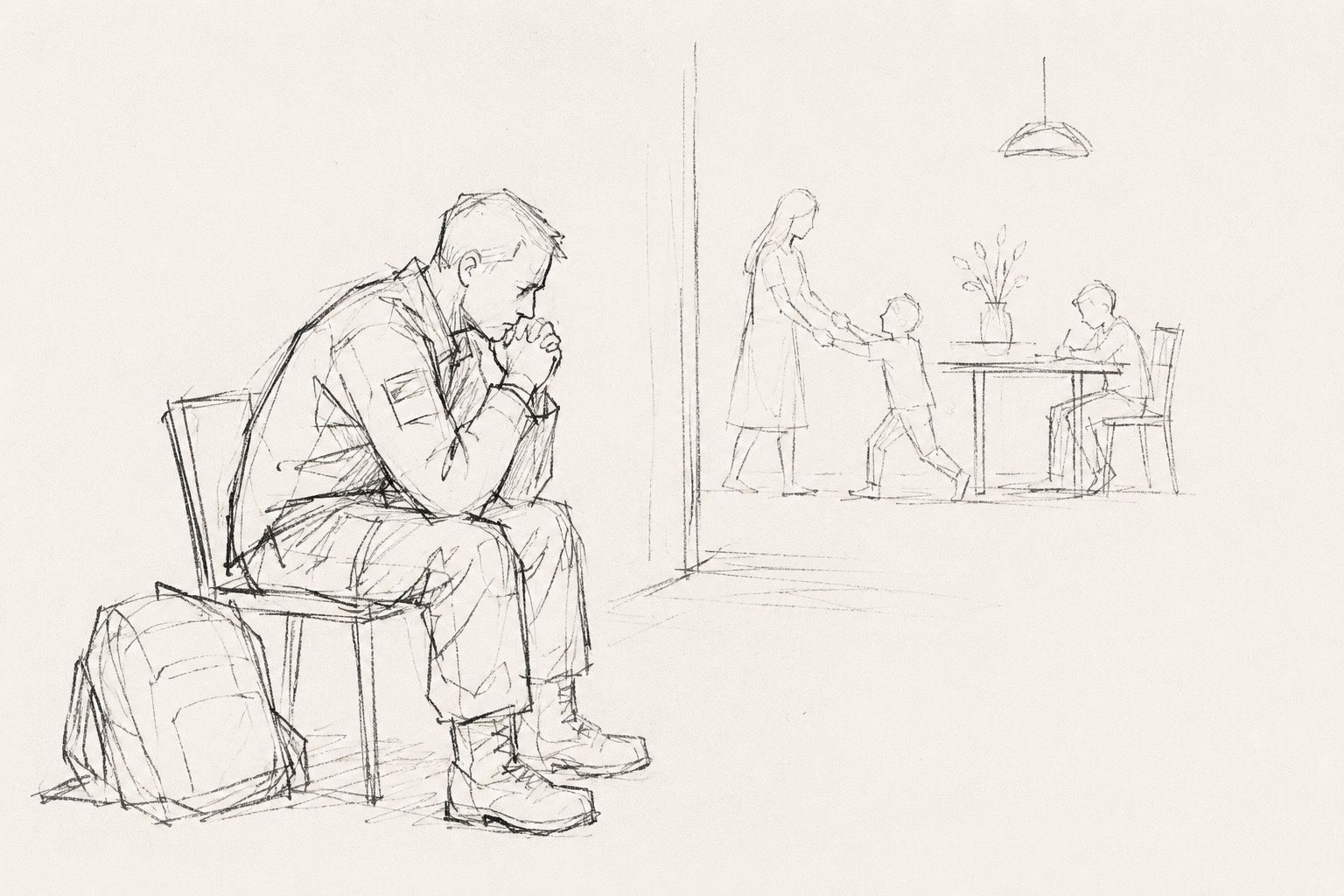
He's finally home. He lies down on the couch, turns to face the wall, and barely speaks. He waited months for these few days off, and now he can't explain what's happening to him, not to his wife, kids or even himself. Millions of Ukrainian families share this scene. Frontliner explains why leave can sometimes feel harder than the frontline itself.
International military research shows that a soldier can typically remain combat-effective for 3 to 6 months without rotation. But those studies were based on soldiers in Iraq and Afghanistan, where combat was far less intense than in Ukraine. As Frontliner has reported before, this means Ukrainian soldiers are fighting under conditions that no existing research on endurance was designed for.
For Ukrainian soldiers in 2026, leave is a scarce resource. They’re entitled to just 30 calendar days of leave per year, and unused days roll over, but that doesn’t guarantee real rest. A commander can deny leave without detailed justification, solely on the basis of the combat situation. So when leave does happen, it carries an enormous weight of expectation: healing, reunion, a full reset. But the mind doesn’t work that way.
Living between two realities
The logic of the front vs. the reality of home. On the front line, each day follows a clear structure: a mission, a defined area of responsibility, fellow soldiers, and constant readiness to react to danger. Many decisions become automatic, since reaction speed can be the difference between life and death.
When soldiers return to civilian life, they can feel disoriented, disconnected from what’s going on around them. Life at home runs on different rules. People rush to work, plan vacations, argue over small things, wait in line for coffee, or talk about things that lost all meaning on the front line long ago. Soldiers have to adjust to a world where they no longer need to watch every direction at all times. But a body and mind wired for survival don’t simply switch off on command. For someone who had been carrying out combat missions just a day earlier, this sudden change in environment becomes a source of stress in itself.
Soldiers come home carrying a heavy emotional load they can’t always share. The behaviors that helped them survive at the front can look like coldness or aggression at home. But hyper-vigilance, flinching at sudden noises, or refusing to sit in a café with their back to the door aren’t personality quirks but physiological responses. The gap between front-line experience and home-front life isn’t a matter of attitude; it’s rooted in neurobiology. Someone who has watched people die beside them can’t simply switch into a conversation about home repairs or school grades. Their nervous system is still in survival mode. Loved ones want their soldier back the way he was. But part of him is still there, even once his body is home.
Families meet a different person, too
Both soldiers and their families count down the days to a short leave, but they often expect very different things from it. Families want to make up for months apart, spend more time together, talk through everything that’s built up, or simply feel, even briefly, like life is back to normal.
Soldiers, on the other hand, often need something else entirely. They need sleep, peace, and a break from answering questions or explaining their feelings. That doesn’t mean they don’t care about their families. It’s actually the opposite: it’s how the mind gradually shifts from one way of living to another. That’s why psychologists advise against reading this quietness as a sign of distance. Ukraine’s Ministry of Defense has said it wants to make psychological support a constant, not something that only kicks in “while soldiers are at the front, but also once they come home.”
The hardest part comes just before going back
Right after getting used to home, it’s time to head back
One of the toughest emotional contradictions of a short leave is that it often ends right when a soldier starts to feel at home again. After a few days of slowly adjusting, he has to pack up, say goodbye to his family, and return to his unit.
There’s another layer to this, too. Even at home, many soldiers stay mentally connected to their unit, checking in with fellow soldiers, following news from their part of the front, and worrying about the people who stayed behind. Families may see this as a kind of betrayal, just as leaving home to return to the front can feel like betraying his fellow soldiers.
The soldier ends up caught between two pulls, unable to fully belong to either one. Therefore, leave rarely becomes real psychological rest.
The whole family goes through it
War doesn’t just change the soldier, but his whole family. They live between looking forward to the reunion and bracing for the next goodbye. Each leave briefly restores a sense of shared life, but it’s also a reminder that soon, they’ll have to adjust to separation all over again.
This is why international research on reintegrating Ukrainian soldiers and veterans increasingly points to one thing: psychological support for service members and for their families. Loved ones are often the ones helping soldiers get through a long war, but in doing so, they build up their own exhaustion, anxiety, and emotional strain
What not to expect from a soldier during a short leave
- An instant return to their normal routine.
- Willingness to talk right away about what they went through at the front.
- A desire to be around people constantly or take part in every family event.
- Quick solutions to problems that piled up at home.
- Full emotional openness after a long stretch in combat.
- Complete psychological recovery after just a few days at home.
Home shouldn’t expect someone to go back to who they were
A short leave doesn’t bring a soldier back to civilian life. It only briefly connects two realities that keep drifting further apart the longer the war goes on. That’s why psychologists increasingly stress the need to support soldiers throughout their entire service.
War changes both the people who fight it and the people waiting for them. That’s why the best support doesn’t start with trying to bring someone back to who they used to be. It starts with being willing to accept their new experience, their new habits, and even their new silence. Sometimes, a few days at home without having to explain anything or pretend to be someone they’re not means more to a soldier than any words ever could.