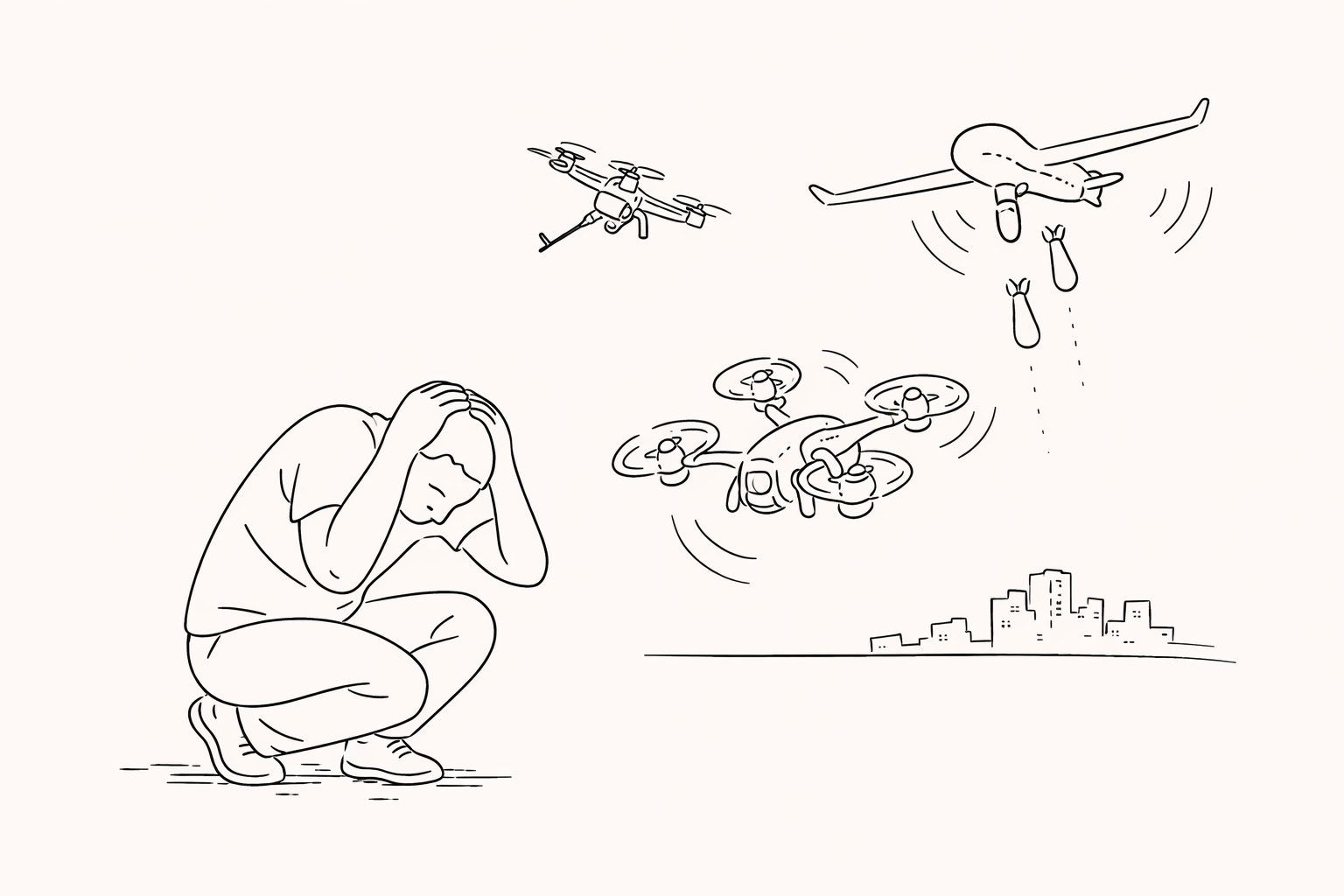
A drone overhead: How civilians should respond and what saves lives
Unmanned aerial vehicles have become a routine threat not only along the front line but also deep in the rear. FPV drones, strike UAVs and modified “Shahed” drones are reaching cities where they had not previously appeared. Some are equipped with cameras, improved guidance systems and the capability to drop munitions. Frontliner explains how civilians should respond when a drone is already overhead.
Air defense systems cannot fully shield the sky from enemy drones. The threat is increasing as drones become more maneuverable and are more often operated in real time. Some “Shahed” drones have also been adapted to carry and release explosive payloads.
Drones have recognizable characteristics. FPV drones typically produce a sharp electric motor sound and fly low and fast. Shahed-type drones emit a loud, steady buzzing noise and usually operate at medium altitude.
If a drone can be heard, reaction time is limited. In urban areas, drones may appear suddenly, using buildings for cover.
When a drone is overhead
- Immediately move into a building or shelter.
- If no shelter is available, lie on the ground and cover your head.
- Stay away from open areas and roads.
- Avoid proximity to vehicles and equipment.
- Do not approach windows or go onto balconies.
- Do not film the drone or attempt to observe it.
- Do not go outside immediately after it passes; follow-on strikes are possible.
Even if a drone does not strike directly, debris and blast effects remain dangerous. Low flight altitude means the impact may be localized but severe.
After an explosion
Do not rush to leave shelter after a blast.
Drones are often used in sequence: one may serve as a decoy while another carries out the strike.
Do not touch debris. It may be explosive.
Avoid impact sites, where secondary detonations or fires may occur.
What may improve survival
In frontline areas, portable drone detectors are increasingly used. They can signal the approach of a drone and provide additional time to take cover.
Portable interception tools, including net launchers, are also emerging. These can disable small drones at close range. While not widely used in urban settings, such systems are being deployed in certain areas.
Drones are becoming a cheaper warfare tool and more widely available, suggesting their use will continue to grow. For civilians, this creates a new reality in which rapid response and basic safety awareness are critical.
In most cases, simple actions determine whether injury can be avoided. Taking cover, maintaining distance and avoiding unnecessary risks remain the most effective protective measures.
***
Frontliner wishes to acknowledge the financial assistance of the European Union though its Frontline and Investigative Reporting project (FAIR Media Ukraine), implemented by Internews International in partnership with the Media Development Foundation (MDF). Frontliner retains full editorial independence and the information provided here does not necessarily reflect the views of the European Union, Internews International or MDF.